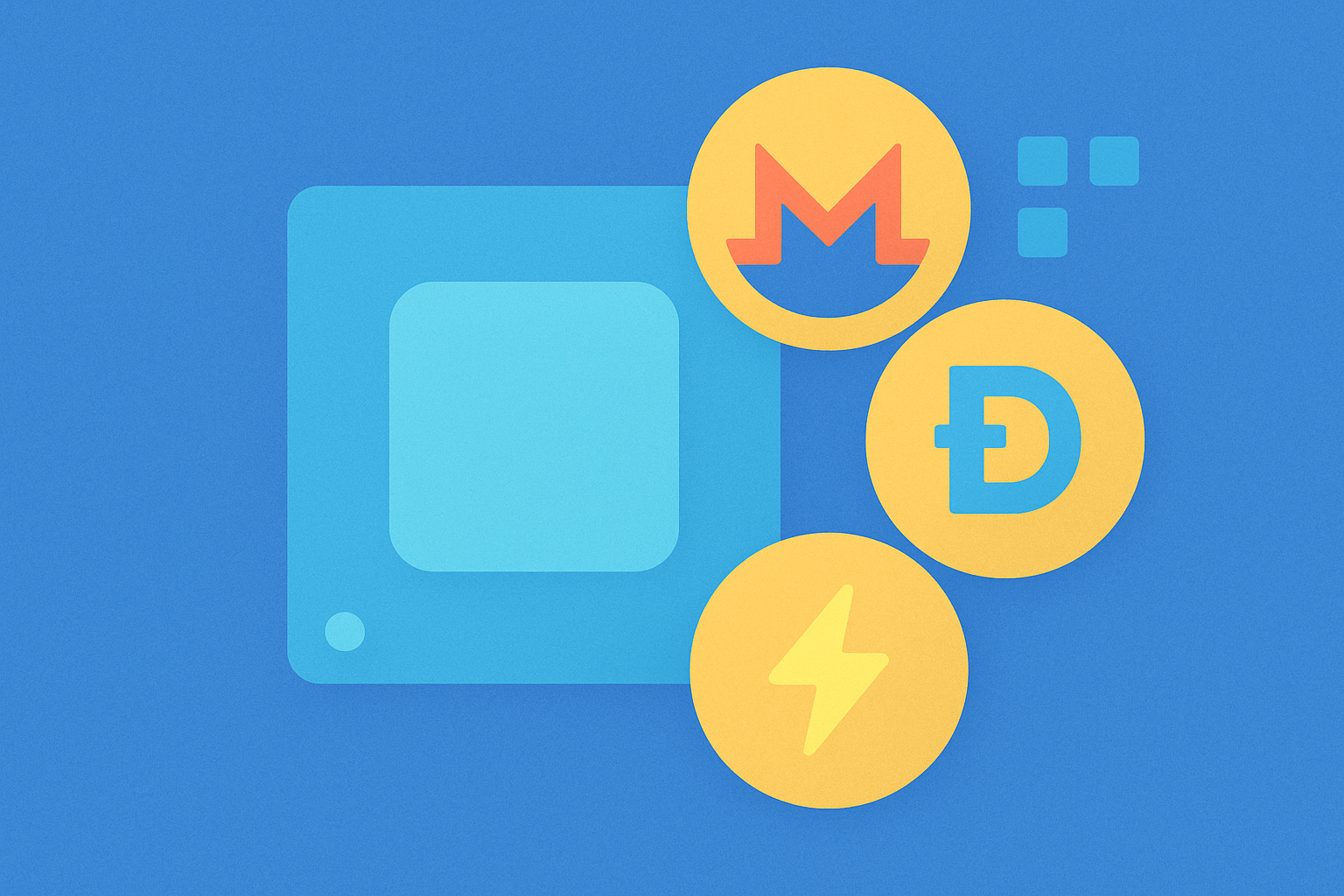
Comprehensive guide to efficient Bitcoin mining using a CPU for beginners. Explore which CPUs are suitable, realistic profit expectations, coins that support CPU mining, and strategies to optimize costs.
What Is CPU Mining for Bitcoin?
Bitcoin mining involves using your computer’s processing power to solve complex cryptographic algorithms. This process allows miners to validate and record new transactions on the blockchain ledger. When a miner successfully verifies a transaction block, they receive a corresponding cryptocurrency reward.
Most mining today relies on the processing power of GPUs (graphics cards), but you can also mine cryptocurrency using a CPU (central processing unit). However, CPUs are only effective for mining certain cryptocurrencies—typically those with lower mining difficulty or that are specifically optimized for CPU mining.
CPU mining for Bitcoin was common in Bitcoin’s early days. But as technology has advanced and mining difficulty has increased, this method has become much less effective compared to dedicated solutions such as GPUs and ASICs.
CPU Mining for Bitcoin Is Not Always Efficient
While CPU mining is possible and offers some distinct advantages, it is not effective for networks with high mining difficulty. Using a CPU will require significantly more time to mine a block, which translates to higher electricity costs.
As blockchain networks mature, the number of Bitcoins available per block becomes more scarce, and mining difficulty rises exponentially. For example, when Bitcoin first launched, CPU mining was feasible and could be profitable. Recently, however, the difficulty has increased to the point where you need specialized GPU or even ASIC hardware to mine Bitcoin efficiently and profitably.
Therefore, before investing in CPU-based Bitcoin mining, you should carefully consider electricity costs, mining efficiency, and actual profitability.
Do You Need a High-Performance CPU to Mine?
Yes, you definitely need a powerful CPU. If you’re considering CPU mining for Bitcoin, it’s essential to invest in a high-performance processor. A low-end CPU will not only slow down the mining process but could also result in electricity costs that exceed the value of your mined cryptocurrency.
The CPU you select directly determines your achievable hash rate, which affects your competitiveness and potential profitability. Don’t cut corners here if you’re serious about crypto mining.
What Is the Best CPU for Mining?
Number of Cores
The number of processor cores is a primary factor in mining performance. More cores provide greater parallel processing capability, enabling faster resolution of complex algorithms. More cores let your CPU multitask efficiently, handling multiple computation tasks simultaneously without loss of performance.
For mining, it’s generally recommended to use a CPU with at least 8 cores. If budget allows, consider higher-end CPUs with 12, 16, or even 32 cores to maximize mining output.
Number of Threads
Depending on your CPU brand (AMD or Intel), you can leverage multi-threading technology. This feature splits physical cores into multiple virtual threads, increasing processing capacity and optimizing overall efficiency.
Modern CPUs typically offer twice as many threads as physical cores. For example, a 4-core CPU may support 8 threads, while an 8-core CPU can manage 16 threads. The general rule: the more threads, the better the mining efficiency, as each thread can independently process a portion of the workload.
Clock Speed
CPU clock speed, measured in GHz (gigahertz), determines how quickly each core processes information. Mining requires a high hash rate, so you’ll need a CPU with a competitive clock speed.
Higher clock speeds deliver greater hash rates and faster algorithm solving. However, faster speeds also mean higher power consumption and more heat, so ensure your system is properly cooled.
Keep in mind: a low-performance processor may cost you money. While it can mine cryptocurrencies, the electricity costs may outweigh your mining gains. Investing in a high-quality CPU up front is essential.
Important: Never use a laptop for CPU mining Bitcoin. Even high-end laptop processors are not built for the sustained heat and power demands of mining. Instead, use a desktop with stable power, robust cooling, and the optimal CPU characteristics described above.
Is CPU Mining for Bitcoin Profitable?
CPU mining for Bitcoin can be profitable, but your returns depend heavily on the specific cryptocurrency you choose and the mining software and tools you use. In reality, CPU mining cannot match the profitability of GPU or ASIC mining.
If you combine a powerful CPU with a high-performance GPU, you may achieve better returns—especially when focusing on coins with lower mining difficulty and those optimized for CPU mining.
Generally, pure CPU mining for Bitcoin yields only modest profits. Electricity costs, increasing mining difficulty, and competition from specialized hardware all limit its profitability. Be sure to evaluate and calculate your investment carefully.
How to Mine Bitcoin with a CPU
Solo Mining Bitcoin
You can mine cryptocurrency solo, but this approach is not recommended—especially for beginners. Solo miners compete directly with thousands of others around the world to be the first to solve a block algorithm. Only the first to finish receives the full block reward.
The biggest challenge is competing with miners who operate professional setups, including large-scale farms with hundreds of GPUs and ASICs. The odds of a single CPU succeeding in this environment are extremely low.
Don’t attempt solo mining unless you have advanced technical knowledge, powerful hardware, and a thorough understanding of the financial risks involved.
Joining a Mining Pool
Joining a mining pool is a far more common and recommended option for CPU miners. Here, you work with hundreds or even thousands of other miners to solve blocks collectively.
Pooling your computing power with other members greatly increases your chances of being the first to solve a block. When the pool is successful, rewards are distributed fairly among all members based on their computational contributions.
Reputable mining pools include Nanopool, which supports a variety of digital assets, and MineXMR, which specializes in Monero. Pools generally charge a service fee—typically 1–3% of your earnings—which is reasonable given the increased stability and income potential.
Cryptocurrencies That Support CPU Mining
Monero (XMR)
Monero is one of the most popular privacy-focused cryptocurrencies and is an excellent choice for CPU mining. Monero is designed to resist ASIC mining from the outset.
This means you avoid the intense competition from ASIC farms found in Bitcoin or Ethereum mining. The RandomX algorithm is optimized for CPUs, making Monero mining fairer for individuals. Monero is also highly liquid and widely accepted, facilitating easy conversion to fiat currency.
Dogecoin (DOGE)
Dogecoin started as a meme coin but has grown into a cryptocurrency with real value. Strong community backing and high-profile supporters have fueled its growth, making it a potential mining target.
However, mining Dogecoin is not as easy as mining coins specifically designed for CPUs. While its difficulty is lower than Bitcoin or Ethereum, you still compete with many GPU and ASIC miners. For optimal results, join large mining pools and use a high-performance CPU.
Electroneum (ETN)
Electroneum is a long-running project with a vision for blockchain-based mobile payments. Its ASIC-resistant mining algorithm makes it appealing to CPU miners.
ASIC resistance means less competition, giving CPUs a better chance to compete. Electroneum is also building a blockchain-based freelance platform, renewing community interest and potentially driving price growth.
Conclusion
After reading this article, you should have a strong foundation and the confidence to begin your CPU mining for Bitcoin journey. This method is a viable and worthwhile option, especially for desktop miners with limited budgets.
CPU mining tools and software for Bitcoin generally require much lower initial investment compared to GPU or ASIC setups, making them an ideal entry point for newcomers. However, remember that only certain cryptocurrencies are designed for or allow efficient CPU mining.
Before investing, research the coin you want to mine, calculate electricity costs, assess your CPU’s capability, and consider joining reputable mining pools to maximize profitability. With proper preparation and patience, CPU mining can become an engaging and rewarding secondary income stream.
FAQ
What is CPU mining? How does CPU mining differ from GPU mining?
CPU mining uses the central processor to verify blockchain transactions. GPU mining uses graphics cards, which deliver higher performance. CPU mining is less efficient; GPU mining is better suited for intensive computational tasks.
Can you earn money mining Bitcoin with a CPU? What kind of income can you expect?
CPU mining for Bitcoin is no longer profitable. Earnings are very low and usually don’t cover electricity costs. By 2026, CPU mining profits are negligible.
What should beginners prepare to mine Bitcoin with a CPU? What hardware and software are needed?
CPU mining for Bitcoin isn’t practical because Bitcoin requires specialized ASIC hardware. However, you can mine other coins like Monero with an Intel Core i5 or AMD Ryzen 5 CPU. Install mining software such as CGMiner or BFGMiner and connect to a mining pool.
How do you choose Bitcoin mining software? What CPU mining tools are recommended?
NiceHash QuickMiner is a recommended tool for CPU mining. It’s user-friendly, offers automatic algorithm switching, and is suitable for beginners and first-time users.
How does CPU mining affect your computer? Is it safe for long-term operation?
CPU mining degrades computer performance, increases heat, and accelerates hardware wear. Running continuously may cause component failures. Long-term mining on a personal computer is not recommended.
Is CPU mining for Bitcoin still viable in 2024? What’s the outlook?
In 2024, CPU mining for Bitcoin is virtually unprofitable because of high difficulty and electricity costs. The outlook is poor and not worth the investment.
* The information is not intended to be and does not constitute financial advice or any other recommendation of any sort offered or endorsed by Gate.