A beginner-friendly guide to interpreting and using depth charts. You’ll learn how to read order books, analyze buying and selling pressure, and evaluate market liquidity. Depth chart analysis on Gate helps you avoid slippage and build effective trading strategies for cryptocurrency trading.
A depth chart visually displays the order book in cryptocurrency markets. This tool enables traders to quickly understand the distribution of buy and sell orders in the market at a glance.
Exchanges that provide order book data commonly use depth charts, which reflect both trading intent and capital flow among market participants. Specifically, the chart shows the volume of orders stacked at each price level, making market depth (liquidity thickness) visible. When market depth is robust, traders can execute large orders with minimal impact on price, which makes depth charts a key decision-making tool.
Depth charts also reflect active user behavior and trading volume on exchanges, serving as an indicator for overall market health. In highly liquid markets, the depth chart’s order book is thick, resulting in smoother trade execution.
Key Components of a Depth Chart
Understanding the elements of a depth chart is essential for accurate interpretation. The following explains the chart’s main components in detail.
The X-axis (horizontal axis) represents order prices, increasing from left to right. This axis allows users to see where orders are concentrated across price levels.
The Y-axis (vertical axis) displays order quantities, representing the cumulative volume of buy or sell orders at each price point. Greater Y-axis values indicate higher order volumes at those levels.
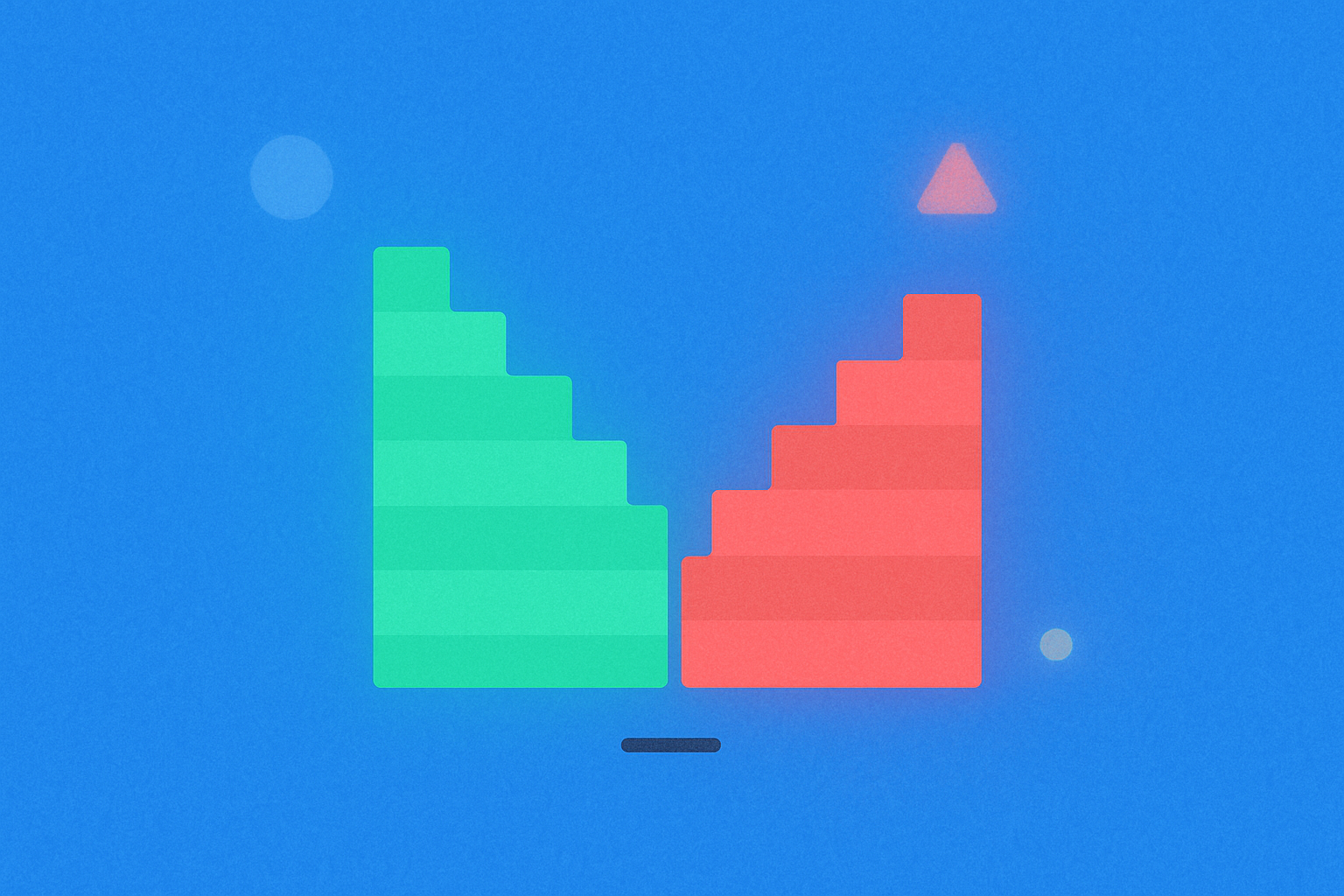
The green area shows buy orders (bids). A wider and thicker green area signals strong buying pressure in the market. Substantial buy-side accumulation suggests support for prices against decline.
The red area shows sell orders (asks). A wider and thicker red area signals strong selling pressure. Heavy sell-side presence may suppress price increases.
The intersection point is where buying and selling pressure balance, indicating the current market price. Movement of this point offers clues about future price trends.
The price range displays the range of traded prices and helps identify the spread (the difference between bid and ask prices). A narrower spread signals higher market liquidity.
How to Read a Depth Chart
To use a depth chart effectively, traders must accurately assess market depth and the balance between buying and selling pressure.
For evaluating market depth, a thick order book and tight spread mean buy and sell orders are densely layered across price levels, reflecting strong market depth. In this environment, large trades have limited price impact, enabling stable execution. Conversely, a thin order book and wide spread indicate shallow depth, increasing the risk of slippage—the gap between expected and actual execution price.
For assessing the balance of buying and selling pressure, a large green area means buying pressure dominates and may suggest an uptrend, as buyers support higher prices. A dominant red area indicates strong selling pressure and a potential downtrend, with price increases likely constrained. When red and green areas are roughly equal, buyers and sellers are balanced, and the market is often consolidating. In this scenario, prices tend to move sideways as traders await the next trend shift.
Key Benefits of Understanding Depth Charts
Accurately interpreting a depth chart offers traders several distinct advantages.
In reducing trading costs, strong market depth allows trades to execute near the current market price, minimizing costs. High-liquidity markets have narrow spreads and rapid order fills, reducing unnecessary expenses. For large trades especially, confirming market depth helps avoid poor executions.
In avoiding slippage, depth chart analysis lets traders anticipate liquidity and avoid executing trades in conditions with high slippage risk. By steering clear of thin periods or price bands, traders can minimize unexpected losses. When sharp price moves are likely, the depth chart helps with precise timing decisions.
In developing trading strategies, combining depth chart readings with assessments of buying and selling pressure enables more precise strategies. For instance, strong buying pressure may favor a buy-the-dip approach, while strong selling pressure may suit sell-the-rally tactics. Using the depth chart gives traders an objective view of market sentiment for rational, emotion-free decision-making.
Summary
Mastering depth chart analysis allows traders to better gauge market depth and order flow dynamics, empowering them to build more accurate strategies, reduce costs, and trade efficiently.
The depth chart is more than a visual aid; it’s a critical analysis tool reflecting liquidity and market sentiment. By evaluating order book thickness, spread, and the balance of buy and sell pressure, traders can make better-timed decisions.
Effectively using depth charts also helps avoid slippage and poor execution, minimizing trading costs. In volatile crypto markets, depth chart analysis is a key factor for trading success.
However, cryptocurrency trading carries significant risks, including price volatility, liquidity risk, and system risk. The depth chart is only one input and should be used alongside other technical and fundamental analysis. Investors must fully understand these risks and make decisions with caution.
FAQ
What Is a Depth Chart (Market Depth Chart)? How Is It Used in Cryptocurrency Trading?
A depth chart visually displays market buy and sell orders. In crypto trading, it shows trading volume and order depth at each price point, helping traders gauge liquidity and anticipate price movement. It’s essential for reading market sentiment.
How Do You Read an Order Book? What Do Bid and Ask Mean?
To read an order book, review the bid and ask prices. The bid is the price buyers offer, and the ask is the price sellers demand. The spread between them indicates market liquidity.
How Can You Assess Market Liquidity from a Depth Chart?
A depth chart displays the quantity of buy and sell orders at each price. Higher volumes mean stronger liquidity and more stable prices. Areas with concentrated orders mark support and resistance levels, helping assess market strength or weakness.
Why Do Depth Charts Differ Across Exchanges?
Each exchange has different liquidity levels and order book structures. Variations in trade volume and participant counts lead to differences in market depth and price precision.
Can a Depth Chart Be Used to Identify Support and Resistance Levels?
Yes. Because depth charts make bid and ask “walls” visible, they’re highly effective for identifying support and resistance. Traders can pinpoint price zones with concentrated orders and accurately identify key levels.
How Are Large Orders (“Whale Orders”) Displayed on a Depth Chart?
Large orders show up as prominent peaks in the depth chart. Buy orders are shown in red, sell orders in green, and these “whale” orders are especially visible as tall spikes on either side.
What Trading Strategies Use Depth Chart Analysis?
Depth chart analysis strategies include judging market direction by comparing buy and sell pressure, identifying support and resistance, and spotting large orders to anticipate price shifts. These methods help traders precisely time entries and exits.
* The information is not intended to be and does not constitute financial advice or any other recommendation of any sort offered or endorsed by Gate.