The article delves into the investment comparison between Cosmos (ATOM) and Optimism (OP), two prominent cryptocurrencies with distinct market roles. It examines historical price trends, supply mechanisms, institutional adoption, technical development, and investment strategy for potential investors. The analysis aims to determine which asset holds better current buying prospects. Targeted at investors seeking insight into ATOM's interoperability potential and OP's Ethereum scaling solutions, the article provides strategies, risk assessments, and long-term price predictions based on current data. Visit Gate for real-time pricing updates.
Introduction: ATOM vs OP Investment Comparison
In the cryptocurrency market, the comparison between ATOM and OP has always been a topic that investors can't avoid. The two not only show significant differences in market cap ranking, application scenarios, and price performance, but also represent different positions in crypto assets.
Cosmos (ATOM): Since its launch in 2019, it has gained market recognition for its vision of creating an "Internet of Blockchains".
Optimism (OP): Introduced in 2021, it has been hailed as a leading Ethereum Layer 2 scaling solution, aiming to reduce transaction costs and increase throughput on the Ethereum network.
This article will comprehensively analyze the investment value comparison between ATOM and OP, focusing on historical price trends, supply mechanisms, institutional adoption, technical ecosystems, and future predictions, attempting to answer the question that concerns investors the most:
"Which is the better buy right now?"
I. Price History Comparison and Current Market Status
ATOM and OP Historical Price Trends
- 2022: ATOM reached its all-time high of $44.45 on January 17, 2022.
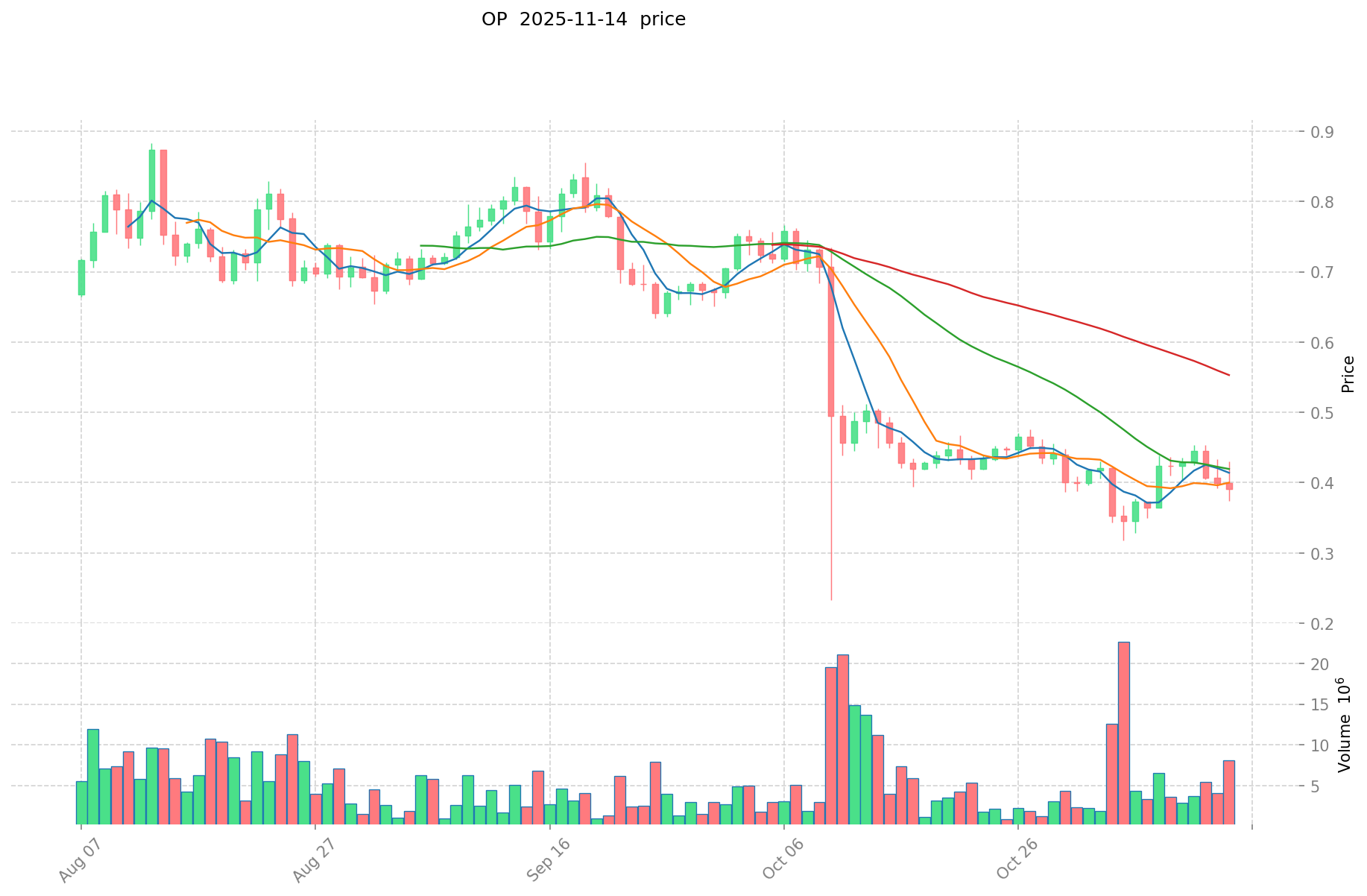
- 2025: OP hit its all-time high of $4.84 on March 6, 2024, but later dropped to its all-time low of $0.322746 on November 5, 2025.
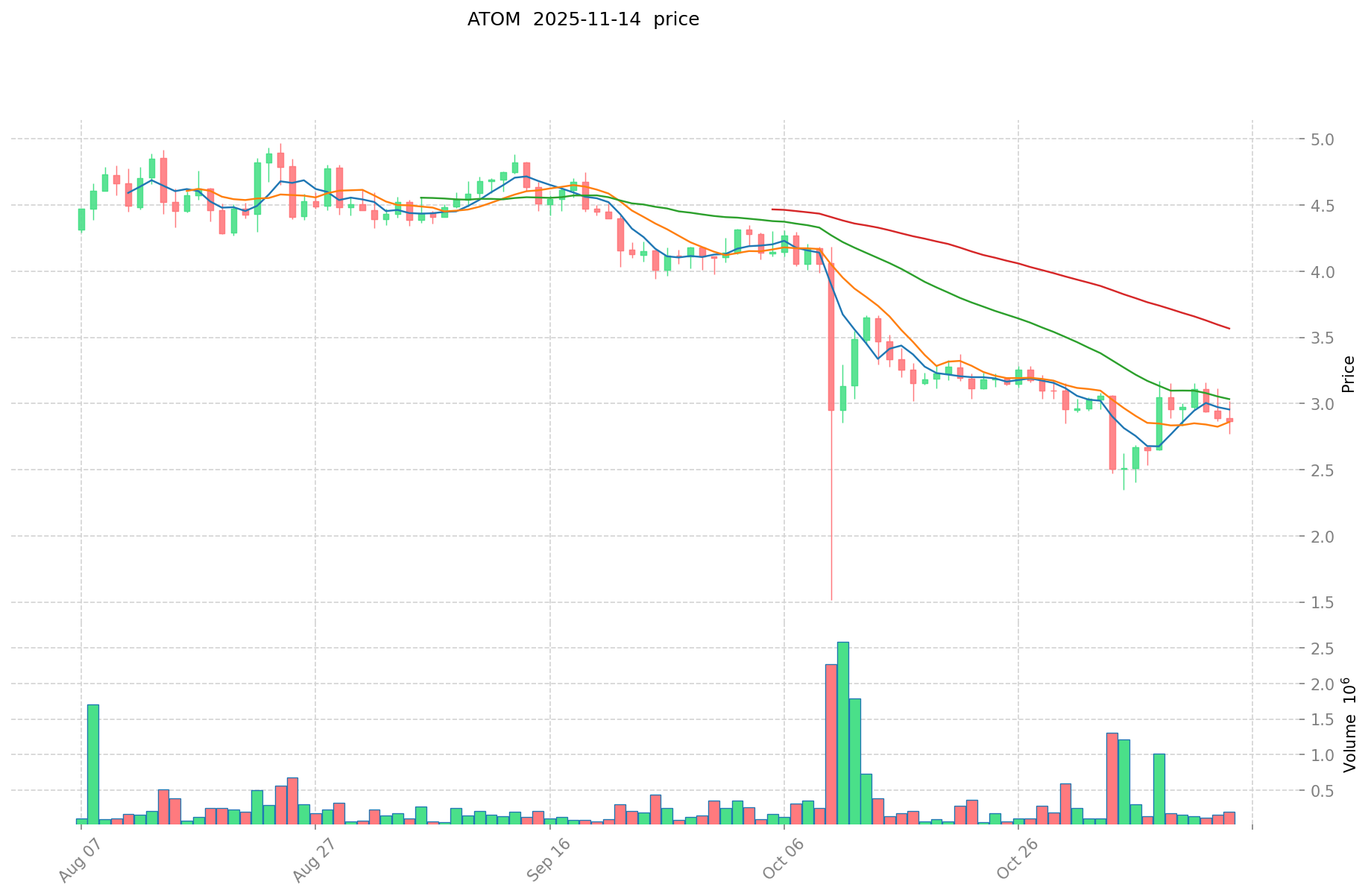
- Comparative analysis: In recent market cycles, ATOM has fallen from its peak of $44.45 to a current price of $2.873, while OP has dropped from its high of $4.84 to $0.3861.
Current Market Situation (2025-11-15)
- ATOM current price: $2.873
- OP current price: $0.3861
- 24-hour trading volume: ATOM $891,671.99699 vs OP $3,490,487.429518
- Market Sentiment Index (Fear & Greed Index): 16 (Extreme Fear)
Click to view real-time prices:
II. Core Factors Affecting Investment Value of ATOM vs OP
Supply Mechanisms (Tokenomics)
- ATOM: Inflationary model with annual inflation rate ranging from 7% to 20%, adjusted based on staking participation rate. Higher staking rates result in lower inflation.
- OP: Fixed supply of 4.29 billion tokens with gradual distribution over time through ecosystem funding, retroactive funding, and governance.
- 📌 Historical pattern: ATOM's inflation model creates continuous selling pressure, while OP's fixed supply with gradual distribution tends to create scarcity as ecosystem adoption grows.
Institutional Adoption and Market Applications
- Institutional holdings: OP has attracted more significant institutional support, with major backing from a16z and other prominent venture capital firms.
- Enterprise adoption: ATOM focuses on cross-chain interoperability services for various blockchains, while OP targets enterprise-level scaling solutions for Ethereum applications.
- Regulatory attitudes: Both projects face similar regulatory considerations, though OP may benefit from Ethereum's relatively clearer regulatory status in some jurisdictions.
Technical Development and Ecosystem Building
- ATOM technical upgrades: Cosmos Hub 2.0, introduction of Interchain Security, and ATOM 2.0 economic restructuring to enhance the token's utility across the broader Cosmos ecosystem.
- OP technical development: Continuous improvements to the Optimistic Rollup technology, OP Stack development for custom L2 solutions, and Superchain vision to unify L2 networks.
- Ecosystem comparison: OP has stronger DeFi and NFT applications leveraging Ethereum's liquidity and security, while ATOM offers broader interoperability across independent blockchains through IBC protocol.
Macroeconomic Factors and Market Cycles
- Performance during inflation: OP may demonstrate stronger anti-inflationary properties due to its fixed supply mechanism, whereas ATOM's variable inflation rate could be a disadvantage during inflationary periods.
- Monetary policy impacts: Both tokens show sensitivity to interest rate changes and dollar strength, with risk-off environments typically favoring more established networks.
- Geopolitical factors: ATOM's cross-chain infrastructure may benefit from increased demand for decentralized interoperability in fragmented regulatory environments.
III. 2025-2030 Price Prediction: ATOM vs OP
Short-term Prediction (2025)
- ATOM: Conservative $1.62-$2.89 | Optimistic $2.89-$4.17
- OP: Conservative $0.33-$0.39 | Optimistic $0.39-$0.49
Mid-term Prediction (2027)
- ATOM may enter a growth phase, with an estimated price range of $2.76-$5.25
- OP may enter a consolidation phase, with an estimated price range of $0.46-$0.63
- Key drivers: Institutional capital inflow, ETFs, ecosystem development
Long-term Prediction (2030)
- ATOM: Base scenario $5.80-$8.12 | Optimistic scenario $8.12+
- OP: Base scenario $0.66-$0.76 | Optimistic scenario $0.76+
View detailed price predictions for ATOM and OP
Disclaimer
ATOM:
| 年份 |
预测最高价 |
预测平均价格 |
预测最低价 |
涨跌幅 |
| 2025 |
4.16736 |
2.894 |
1.62064 |
0 |
| 2026 |
4.0249752 |
3.53068 |
3.354146 |
22 |
| 2027 |
5.251180364 |
3.7778276 |
2.757814148 |
31 |
| 2028 |
5.14653453948 |
4.514503982 |
3.43102302632 |
57 |
| 2029 |
6.762726965036 |
4.83051926074 |
3.139837519481 |
68 |
| 2030 |
8.1152723580432 |
5.796623112888 |
5.04306210821256 |
101 |
OP:
| 年份 |
预测最高价 |
预测平均价格 |
预测最低价 |
涨跌幅 |
| 2025 |
0.485375 |
0.3883 |
0.330055 |
0 |
| 2026 |
0.6465195 |
0.4368375 |
0.419364 |
13 |
| 2027 |
0.633763845 |
0.5416785 |
0.45500994 |
40 |
| 2028 |
0.62298444285 |
0.5877211725 |
0.511317420075 |
52 |
| 2029 |
0.70826278497975 |
0.605352807675 |
0.338997572298 |
56 |
| 2030 |
0.761897043739755 |
0.656807796327375 |
0.584558938731363 |
70 |
IV. Investment Strategy Comparison: ATOM vs OP
Long-term vs Short-term Investment Strategies
- ATOM: Suitable for investors focused on cross-chain interoperability and ecosystem potential
- OP: Suitable for investors interested in Ethereum scaling solutions and Layer 2 growth
Risk Management and Asset Allocation
- Conservative investors: ATOM: 30% vs OP: 70%
- Aggressive investors: ATOM: 60% vs OP: 40%
- Hedging tools: Stablecoin allocation, options, cross-currency combinations
V. Potential Risk Comparison
Market Risk
- ATOM: Higher volatility due to inflationary tokenomics
- OP: Dependency on Ethereum's market performance and adoption
Technical Risk
- ATOM: Scalability, network stability across multiple chains
- OP: Reliance on Ethereum's base layer, potential vulnerabilities in rollup technology
Regulatory Risk
- Global regulatory policies may impact both differently, with OP potentially benefiting from Ethereum's regulatory clarity
VI. Conclusion: Which Is the Better Buy?
📌 Investment Value Summary:
- ATOM advantages: Cross-chain interoperability, established ecosystem, potential for growth in multi-chain future
- OP advantages: Ethereum scaling solution, institutional backing, fixed supply tokenomics
✅ Investment Advice:
- New investors: Consider a balanced approach with higher allocation to OP due to its connection with Ethereum
- Experienced investors: Explore opportunities in both, with ATOM for ecosystem diversity and OP for Ethereum scaling exposure
- Institutional investors: Evaluate OP for its institutional backing and potential in the Ethereum ecosystem
⚠️ Risk Warning: The cryptocurrency market is highly volatile. This article does not constitute investment advice.
None
VII. FAQ
Q1: What are the main differences between ATOM and OP?
A: ATOM is focused on cross-chain interoperability and creating an "Internet of Blockchains", while OP is an Ethereum Layer 2 scaling solution. ATOM has an inflationary tokenomics model, whereas OP has a fixed supply. ATOM's ecosystem is more diverse across independent blockchains, while OP leverages Ethereum's existing DeFi and NFT applications.
Q2: Which token has performed better historically?
A: Historically, ATOM reached a higher all-time high of $44.45 in January 2022, compared to OP's all-time high of $4.84 in March 2024. However, both have experienced significant drops from their peaks, with ATOM currently trading at $2.873 and OP at $0.3861 as of November 15, 2025.
Q3: How do the supply mechanisms of ATOM and OP differ?
A: ATOM has an inflationary model with an annual inflation rate ranging from 7% to 20%, adjusted based on staking participation. OP, on the other hand, has a fixed supply of 4.29 billion tokens, distributed gradually over time through ecosystem funding and governance.
Q4: Which token has attracted more institutional support?
A: OP has attracted more significant institutional support, with major backing from prominent venture capital firms like a16z. ATOM, while having a strong community, has not seen the same level of high-profile institutional investment.
Q5: What are the key technical developments for each project?
A: ATOM has introduced Cosmos Hub 2.0, Interchain Security, and ATOM 2.0 economic restructuring. OP focuses on improving Optimistic Rollup technology, developing the OP Stack for custom L2 solutions, and advancing the Superchain vision to unify L2 networks.
Q6: How do the long-term price predictions for ATOM and OP compare?
A: For 2030, ATOM's base scenario predicts a range of $5.80-$8.12, with an optimistic scenario above $8.12. OP's base scenario for 2030 is $0.66-$0.76, with an optimistic scenario above $0.76. These predictions suggest potentially higher growth for ATOM in percentage terms.
Q7: What are the main risks associated with investing in ATOM and OP?
A: ATOM faces risks related to higher volatility due to its inflationary tokenomics and challenges in maintaining scalability across multiple chains. OP's main risks include dependency on Ethereum's market performance and potential vulnerabilities in rollup technology. Both face regulatory risks, though OP may benefit from Ethereum's regulatory clarity in some jurisdictions.
* The information is not intended to be and does not constitute financial advice or any other recommendation of any sort offered or endorsed by Gate.














