Beginner’s Guide to Candlestick Charts

2026-01-01 10:48:58
Crypto Trading
Crypto Tutorial
K-line
Spot Trading
Trading Bots
Article Rating : 4
52 ratings
Master reading candlestick charts for cryptocurrencies as a beginner. Uncover how to interpret candlestick patterns, apply technical analysis using candlesticks, and develop trading strategies on Gate. This is your complete guide for traders.
Beginner’s Guide to Candlestick Charts

Introduction

For newcomers to trading or investing, chart reading can seem daunting. Many rely on hunches and make investment decisions based on intuition. However, trading and investing are fundamentally about probability and risk management. That's why understanding how to read candlestick charts is essential for nearly any investment approach, no matter your experience level.

What Is a Candlestick Chart?

A candlestick chart is a financial chart that visually displays an asset’s price movement over a defined time interval. Each chart consists of candles, with each candle representing the same duration. Candles can depict any timeframe—ranging from seconds to years—making them versatile tools for different analytical strategies.

Candlestick charts trace back to the 17th century. They are widely credited to a Japanese rice trader named Homma, who used them to analyze rice prices. His concepts likely formed the foundation for today’s modern candlestick charts, which are now a cornerstone of technical analysis.

How Do Candlestick Charts Work?

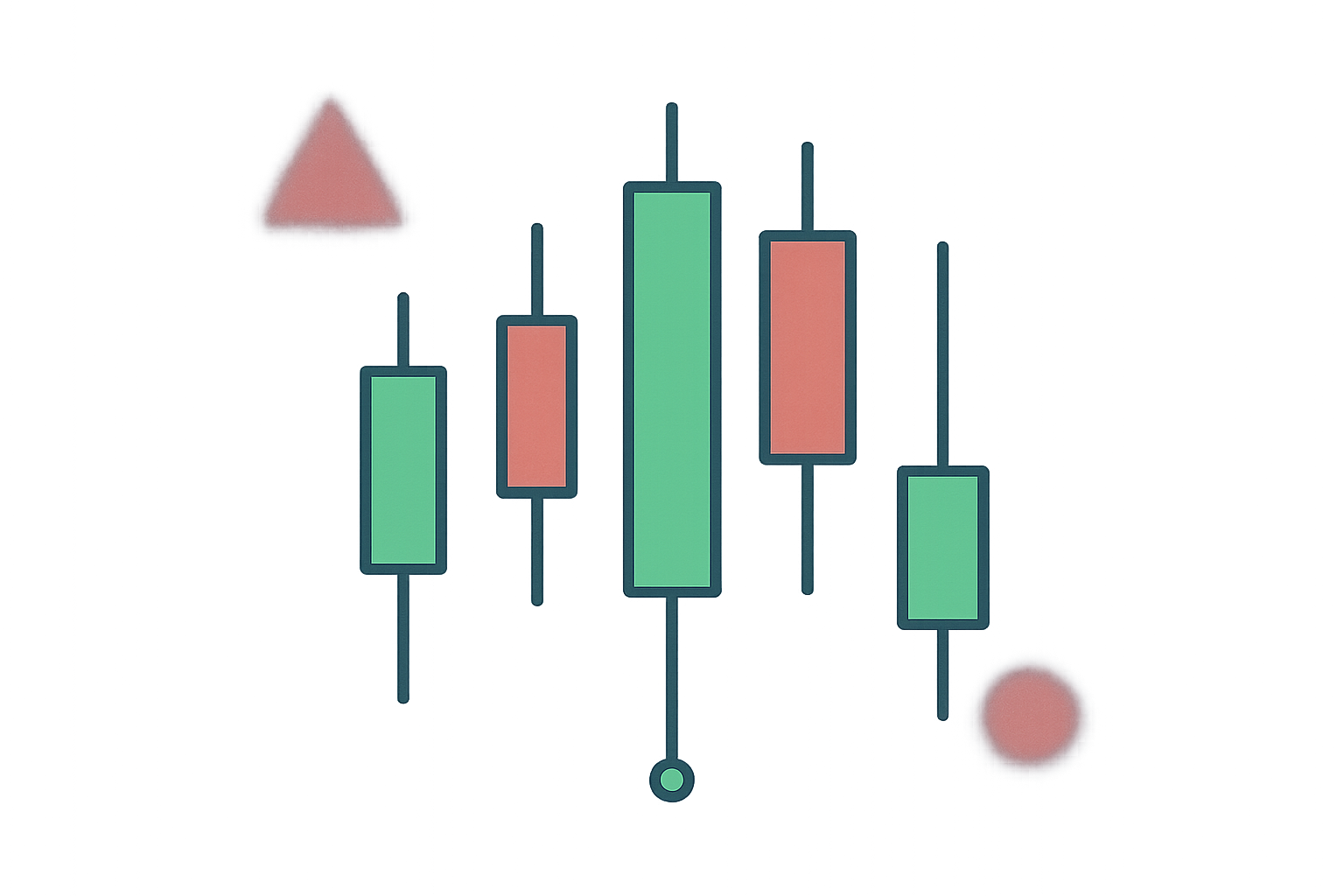
Candlestick charts display four key price points within a specific timeframe. Each candle is constructed using these data points:

  1. Open — The initial trading price of the asset in the timeframe.
  2. High — The highest trading price of the asset recorded in the timeframe.
  3. Low — The lowest trading price of the asset recorded in the timeframe.
  4. Close — The final trading price of the asset in the timeframe.

The distance between the open and close forms the “body,” while the space between these points and the high or low is known as the wick or shadow. This structure enables traders to quickly assess price direction and volatility for the analyzed period.

How to Read Candlestick Charts

Most traders find candlestick charts easier to interpret than traditional bar or line charts. Each candle reflects the struggle between buyers (bulls) and sellers (bears) within a specific period. A longer body signals stronger buying or selling momentum during that timeframe.

The color of the candle is crucial for reading market direction. A green body means the asset closed higher than it opened, indicating upward (bullish) pressure. Conversely, a red body shows the price fell during the period, with the close below the open, signaling downward (bearish) pressure. Wicks also offer insights into price rejection or reversal attempts.

What Candlestick Charts Don’t Reveal

While candlesticks give a useful overview of price action, they don’t offer every detail for thorough analysis. They only show the open and close distance, not the full price action between those points. This means significant price swings within the period may go unrepresented by the candle’s appearance.

Candlestick charts can also introduce substantial market noise, especially on shorter timeframes. This noise can trigger false signals that mislead less experienced traders. As a result, many analysts combine candlestick charts with other technical indicators and analysis tools for a more comprehensive market perspective.

Heikin-Ashi Candles

Heikin-Ashi, which translates to “average bar” in Japanese, refers to a modified candlestick chart that calculates candles using average price data. This approach distinguishes Heikin-Ashi from traditional Japanese candlesticks. Its main purpose is to smooth price movements and filter out market noise, giving a clearer view of underlying trends.

Traders frequently use Heikin-Ashi candles alongside standard candlesticks to avoid false signals and improve market trend detection. Green Heikin-Ashi candles without lower wicks generally signal a strong uptrend, while red candles without upper wicks can indicate a strong downtrend. This combination helps analysts pinpoint trend reversals with greater accuracy.

Conclusion

Candlestick charts are foundational tools for traders and investors aiming to understand market dynamics. They not only provide a clear visual record of an asset’s price action, but also allow flexible analysis across multiple timeframes, supporting a range of trading strategies.

Systematic study of candlestick charts and patterns, paired with analytical thinking and hands-on practice, can give traders a decisive edge. Mastering this core skill is a key step toward building a robust and profitable investment strategy.

FAQ

What is a candlestick chart and how does it work?

A candlestick chart visualizes price quotes using geometric shapes. The body shows the gap between open and close (green for rises, red for declines). Wicks mark the period’s highest and lowest prices, helping you analyze market moves.

What are the main components of a candlestick (open, close, high, low)?

Each candlestick consists of four key elements: open (starting price), close (ending price), high (maximum price), and low (minimum price) within a given period. These elements create the candle’s body and wicks.

What’s the difference between a bullish (green) and a bearish (red) candle?

A bullish (green) candle means the price closed above the open, indicating buyer strength. A bearish (red) candle means the price closed below the open, showing seller control.

A hammer pattern signals a bullish reversal after a drop; an inverted hammer points to a bearish reversal; a doji indicates market indecision when open and close are nearly equal. Always use these in conjunction with other analytical tools.

Which timeframes should beginners use to read candlestick charts?

As a beginner, start with 5- to 15-minute timeframes. These intervals highlight clear trends without overloading your analysis. Once comfortable, progressively move to longer timeframes like hourly or daily charts.

What are the most basic buy and sell signals in candlestick charts?

Basic buy signals include hammers at support levels, while shooting stars at resistance suggest sells. Also, look for small bodies with long wicks and shifts in trading volume to confirm trend changes.

* The information is not intended to be and does not constitute financial advice or any other recommendation of any sort offered or endorsed by Gate.
Related Articles
What is a red hammer Candlestick and how to use it

What is a red hammer Candlestick and how to use it

Understanding how the red hammer Candlestick pattern serves as a powerful bullish reversal signal is crucial for cryptocurrency traders operating in volatile markets. This article helps identify genuine red hammer patterns, emphasizing their formation after downtrends and at key support levels, and validating them with higher trading volume. Learn strategic trading implementation, utilizing technical indicators and risk management to enhance profitability. Gate's advanced tools assist in pattern recognition and real-time alerts. Optimize your trading approach through red hammer analysis to enhance your cryptocurrency investment strategy.
2025-11-03 03:11:16
Decoding the KDJ Indicator: A Comprehensive Guide

Decoding the KDJ Indicator: A Comprehensive Guide

"Decoding the KDJ Indicator" is a comprehensive guide for traders and analysts, focusing on the KDJ as a short-term analysis tool in financial markets. It explains the indicator's components: K-line, D-line, and J-line, and their roles in identifying overbought and oversold conditions. The article highlights key usage rules and signals like Golden and Death Crosses, and divergence detection. It also discusses the practical application of KDJ in day trading and crypto markets, guiding readers on decision-making with it and addressing FAQs for deeper understanding. Suitable for traders seeking clearer insights into price movements and market sentiment.
2025-11-26 09:10:48
How to Use the MACD Indicator for Crypto Trading Success

How to Use the MACD Indicator for Crypto Trading Success

The article delves into using the MACD indicator for successful crypto trading by breaking down its components: DIF, DEA, and histogram. It explains how these elements work together to identify market momentum and potential trading opportunities. Key insights include recognizing "golden cross" buy signals, leveraging MACD for analyzing market trends, and generating trading signals for optimal entry and exit points. The content is tailored for traders seeking actionable insights to enhance their trading strategies. This comprehensive guide emphasizes clear, structured analysis to facilitate informed trading decisions.
2025-12-02 09:23:50
How to Interpret MACD and RSI Signals for Cryptocurrency Trading?

How to Interpret MACD and RSI Signals for Cryptocurrency Trading?

This article offers a comprehensive guide to interpreting MACD and RSI signals, essential for optimizing cryptocurrency trading strategies. It explores the fundamentals of these indicators and their application in analyzing trends and momentum. The piece addresses the challenges of false signals by integrating volume analysis, providing a robust trading framework. Targeted at traders, especially those in Gate, the article enhances decision-making by combining technical indicators and market data effectively. Keywords such as MACD, RSI, and volume are emphasized for readability and quick understanding.
2025-12-04 03:56:42
Understanding the KDJ Indicator for Trading Success

Understanding the KDJ Indicator for Trading Success

This article offers a thorough examination of the KDJ indicator, a technical analysis tool for financial market trading. It explains how the interplay of K, D, and J curves can help traders identify overbought and oversold conditions, guiding potential buy and sell decisions. The piece addresses the needs of traders seeking to optimize their strategies by exploring the basic rules, such as golden and death crosses, and areas of divergence. Understanding the KDJ indicator's application enhances traders' market insights. The article emphasizes integrating KDJ with other tools for effective analysis. Key terms like 'overbought', 'oversold', 'trends', and 'KDJ' are highlighted for ease of understanding.
2025-11-19 08:18:47
Understanding the Vela Doji: A Guide to Candlestick Pattern Analysis

Understanding the Vela Doji: A Guide to Candlestick Pattern Analysis

This article explores the Dragonfly Doji candlestick pattern, a crucial tool in technical analysis for traders aiming to identify potential market trend reversals. It provides insights into the formation and application of the pattern in trading strategies, emphasizing the importance of using it alongside other indicators for accurate predictions. Readers will understand how to effectively trade Dragonfly Dojis, recognize their formation, and be aware of their limitations. Ideal for traders seeking a deeper comprehension of trend reversals, this guide is structured for easy navigation and quick grasp of key concepts.
2025-11-06 11:43:20
Recommended for You
Is Crypto Mining Legal in Singapore?

Is Crypto Mining Legal in Singapore?

# Crypto Mining Regulations in Singapore: What You Need to Know This comprehensive guide explores Singapore's legal framework for cryptocurrency mining, addressing compliance requirements, regulatory obligations, and operational best practices for investors, traders, and mining operators. The article examines real-world case studies demonstrating profitable mining operations within MAS regulations, technological advancements in energy-efficient mining, and the sector's economic contributions. Covering taxation implications, licensing requirements, AML/CFT compliance, and penalties for non-compliance, this resource provides essential knowledge for stakeholders navigating Singapore's crypto mining landscape. Whether you're considering mining operations on Gate or expanding existing ventures, understand the regulatory landscape, sustainability standards, and strategic factors required for legal and profitable mining activities in Singapore.
2026-01-01 13:09:54
Blockchain Là Gì?

Blockchain Là Gì?

# Giới Thiệu Về Blockchain: Công Nghệ Và Cách Hoạt Động Bài viết này cung cấp cái nhìn toàn diện về blockchain – công nghệ sổ cái phân tán đang thay đổi cách chúng ta xử lý dữ liệu và giao dịch. Từ cấu trúc khối-chuỗi cơ bản đến các cơ chế nodes và tính chất bất biến, bài viết giải thích cách blockchain đạt được phân quyền, bảo mật và minh bạch. Nội dung hướng đến những ai muốn hiểu rõ công nghệ này, từ nguyên lý hoạt động cho đến ứng dụng thực tiễn ngoài tiền điện tử. Bài viết cân bằng phân tích ưu điểm (an toàn cao, chi phí thấp) và nhược điểm (hạn chế kỹ thuật, thách thức pháp lý) của blockchain. Phần FAQ giải đáp các câu hỏi phổ biến về bảo mật, ứng dụng trên Gate và chi phí giao dịch, giúp bạn nắm vững kiến thức blockchain từ cơ bản đến nâng cao.
2026-01-01 13:08:24
Is Cryptocurrency Mining Legal in Indonesia?

Is Cryptocurrency Mining Legal in Indonesia?

# Article Introduction **Is Bitcoin Mining Permissible in Indonesia?** This comprehensive guide examines Indonesia's legal framework for cryptocurrency mining, clarifying the regulatory requirements and operational compliance necessary for investors and miners. The article addresses critical questions facing prospective market entrants: licensing requirements, tax obligations, legal risks, and electricity cost implications. It provides actionable insights for investors evaluating mining feasibility, operators navigating regulatory compliance, and traders assessing market viability on platforms like Gate. The content combines legal analysis with real-world case studies, renewable energy integration models, and economic impact data showing 150% business growth. Key sections cover regulatory status, business registration requirements, risk mitigation strategies, and Indonesia's positioning as a sustainable mining destination. Essential reading for anyone considering cryptocurrency mining operations in Indonesi

2026-01-01 13:05:57
OM Coin là gì? Tiềm năng và vai trò của MANTRA Chain (OM) trong thị trường DeFi

OM Coin là gì? Tiềm năng và vai trò của MANTRA Chain (OM) trong thị trường DeFi

# Khám Phá Toàn Diện Về Nền Tảng MANTRA và Đồng Coin OM Bài viết này cung cấp hướng dẫn chi tiết về OM Coin và hệ sinh thái MANTRA DAO, giúp nhà đầu tư hiểu rõ cơ chế hoạt động, tiềm năng phát triển và những rủi ro tiềm ẩn. Bạn sẽ khám phá các chức năng chính của OM như staking, quản trị DAO và thanh toán phí, cùng với định hướng phát triển Layer 1 của MANTRA tập trung vào token hóa tài sản thực (RWA). Nội dung phân tích biến động thị trường, so sánh OM với các đối thủ cạnh tranh như Centrifuge và Maple Finance, đồng thời hướng dẫn cách mua OM trên Gate. Bài viết lý tưởng cho những người quan tâm đến DeFi, token hóa tài sản và các giải pháp blockchain compliance, cung cấp nền tảng kiến thức cần thiết trước khi đưa ra quyết định đầu tư.

2026-01-01 13:04:23
Differences Between USDT-M Futures and Coin-M Futures

Differences Between USDT-M Futures and Coin-M Futures

# Article Introduction This comprehensive guide explores USDT-M Futures and Coin-M Futures trading on Gate, two distinct derivative products designed for different investment strategies in Web3. USDT-M Futures offers intuitive profit calculation in stablecoins with hundreds of trading pairs, ideal for traders holding USDT seeking diversified leverage exposure. Coin-M Futures enables cryptocurrency holders to trade using their assets as collateral, maximizing capital efficiency during bull markets while maintaining long-term positions. The article compares key differences including settlement methods, fee structures, and risk profiles, helping traders select the optimal futures product based on their asset holdings, risk tolerance, and investment objectives. Whether you prioritize stable settlement or cryptocurrency-denominated returns, this guide provides actionable insights for navigating Gate's futures markets.
2026-01-01 13:01:42
What is LKI: A Comprehensive Guide to Learning Key Indicators and Their Applications

What is LKI: A Comprehensive Guide to Learning Key Indicators and Their Applications

# Article Introduction: What is LKI - A Comprehensive Guide to Learning Key Indicators and Their Applications **Laika AI (LKI)** is an innovative on-chain data layer platform combining artificial intelligence with blockchain technology to deliver advanced market analysis and enhanced security for digital asset traders. This comprehensive guide examines LKI's technical architecture, tokenomics, market performance, and investment potential for investors navigating the cryptocurrency ecosystem. Explore how LKI operates on Binance Smart Chain, its current market metrics ($207,198 market cap, $0.000753 price as of January 2026), and practical purchasing instructions via Gate. The article addresses critical needs for sophisticated AI-powered analytics and real-time blockchain insights while detailing risks including 97.49% annual depreciation and limited trading liquidity. Ideal for investors, traders, and blockchain developers seeking understanding of emerging AI-blockchain convergence projects and their applicat
2026-01-01 12:43:18