The article "BLOCKST vs SOL: Comparing Two Leading Blockchain Platforms for Smart Contract Development" delves into a comparative analysis of BLOCKST and SOL, two pivotal blockchain platforms. It evaluates historical price trends, investment value, and technological ecosystems, offering insights into each asset's potential for growth and market stability. Readers will gain understanding of supply mechanisms, market applications, investment strategies, and associated risks. Geared towards investors evaluating long-term and short-term positions, the article is structured to guide informed financial decisions, highlighting the strategic benefits of both BLOCKST and SOL. Keywords include BLOCKST, SOL, investment comparison, blockchain platforms, smart contract development.
Introduction: BLOCKST vs SOL Investment Comparison
In the cryptocurrency market, the comparison between BLOCKST vs SOL has always been an unavoidable topic for investors. The two not only have significant differences in market cap ranking, application scenarios, and price performance, but also represent different cryptocurrency positioning.
BLOCKST (BLOCKST): Since its launch in 2025, it has gained market recognition for its role in empowering builders and driving USD1 adoption.
SOL (SOL): Since its inception in 2017, it has been hailed as a high-performance blockchain protocol, becoming one of the cryptocurrencies with the highest global trading volume and market capitalization.
This article will comprehensively analyze the investment value comparison between BLOCKST vs SOL, focusing on historical price trends, supply mechanisms, institutional adoption, technological ecosystems, and future predictions, attempting to answer the question investors care about most:
"Which is the better buy right now?"
I. Price History Comparison and Current Market Status
BLOCKST (Coin A) and SOL (Coin B) Historical Price Trends
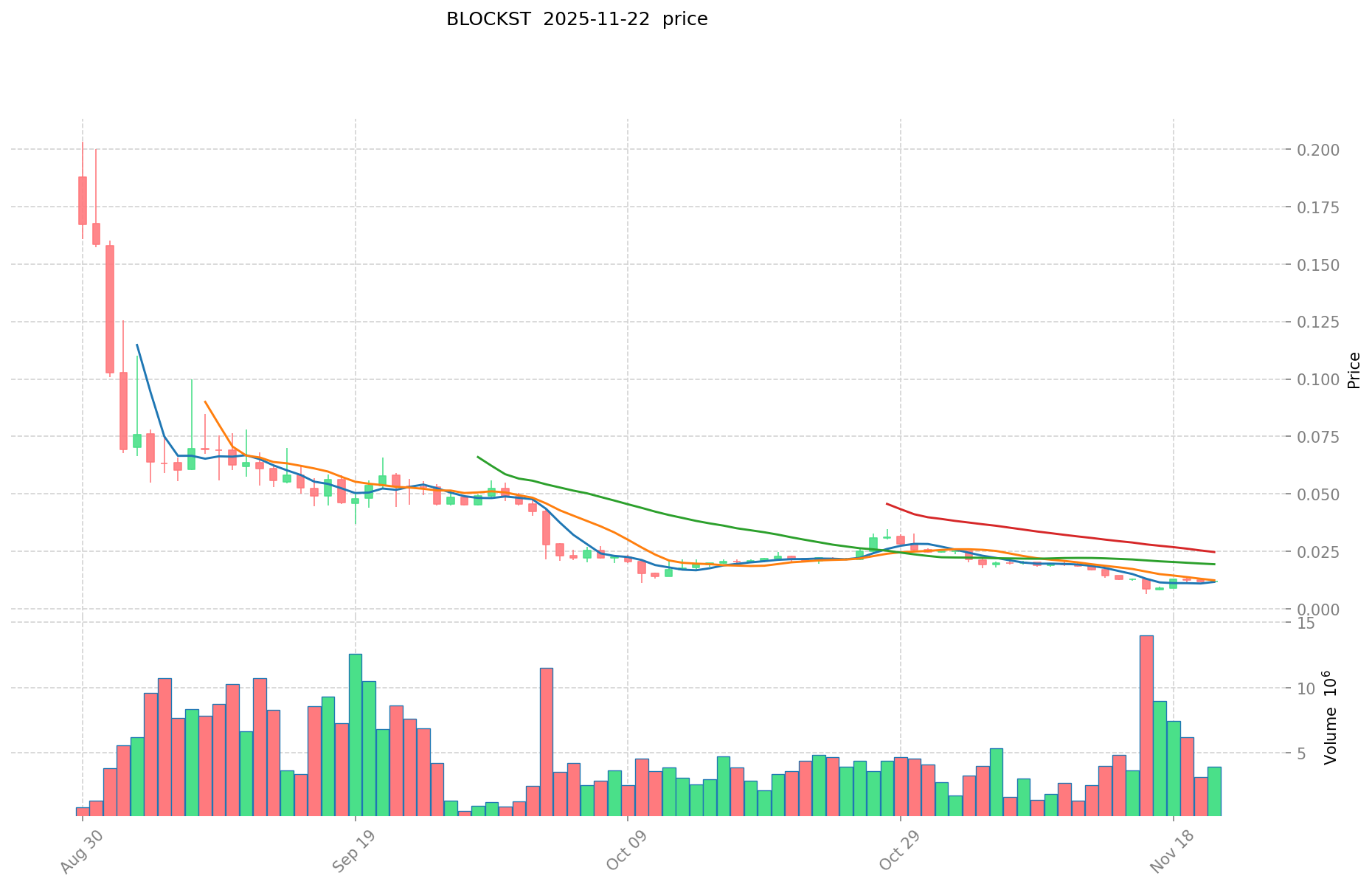
- 2025: BLOCKST reached its all-time high of $0.2032 on August 30, 2025, but subsequently experienced a significant decline.
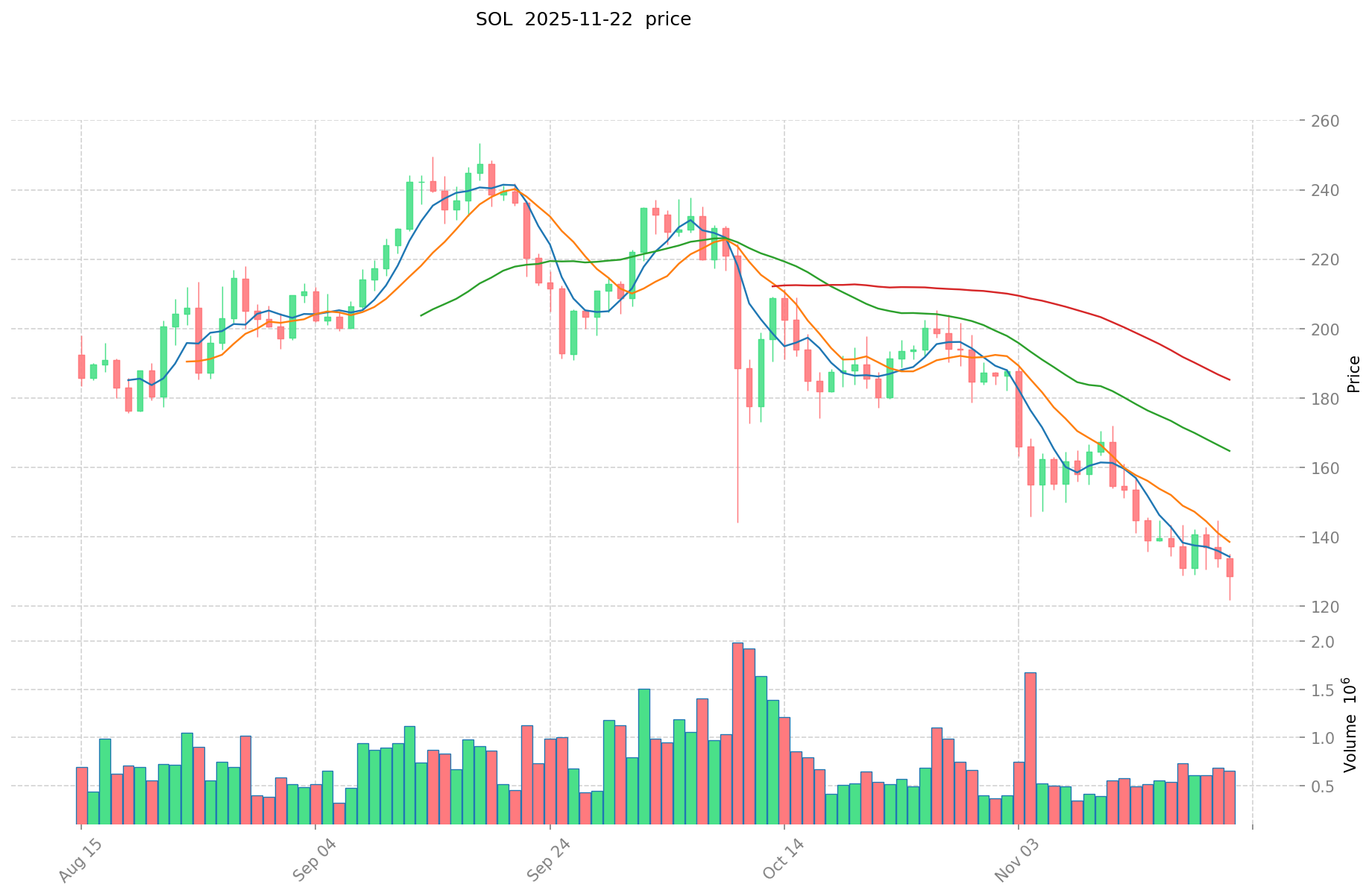
- 2025: SOL faced a downturn, with its price dropping by 50.78% over the past year.
- Comparative analysis: In the recent market cycle, BLOCKST fell from its peak of $0.2032 to a low of $0.00637, while SOL declined from its all-time high of $293.31 to its current price of $126.02.
Current Market Situation (2025-11-22)
- BLOCKST current price: $0.011913
- SOL current price: $126.02
- 24-hour trading volume: BLOCKST $36,478.43 vs SOL $64,944,107.71
- Market Sentiment Index (Fear & Greed Index): 11 (Extreme Fear)
Click to view real-time prices:
- Check BLOCKST current price Market Price
- Check SOL current price Market Price
II. Core Factors Affecting Investment Value of BLOCKST vs SOL
Supply Mechanism Comparison (Tokenomics)
-
BLOCKST: Fixed supply model with a maximum cap of 100 million tokens
-
SOL: Inflationary model with disinflationary characteristics; initial annual inflation rate of 8%, decreasing over time to reach 1.5% eventually
-
📌 Historical Pattern: Fixed supply tokens like BLOCKST typically show greater price sensitivity to demand changes, while SOL's controlled inflation provides sustainable funding for network development while potentially diluting value less over time as inflation decreases.
Institutional Adoption and Market Applications
- Institutional Holdings: SOL has attracted more institutional investors, with major funds and trading firms participating in its ecosystem; BLOCKST's institutional adoption remains in earlier stages
- Enterprise Adoption: SOL demonstrates stronger enterprise integration with partnerships across financial services, NFT marketplaces, and gaming platforms; BLOCKST usage primarily centered on its native ecosystem applications
- Regulatory Attitudes: Both face varying regulatory scrutiny across jurisdictions; SOL has generally established more regulatory clarity in major markets
Technical Development and Ecosystem Building
- BLOCKST Technical Development: Focus on scalability improvements and cross-chain interoperability solutions
- SOL Technical Development: Continuous upgrades to enhance transaction throughput, stability, and reduced network outages; implementation of advanced state compression technologies
- Ecosystem Comparison: SOL leads with a robust ecosystem spanning DeFi (over $10B TVL), NFT marketplaces, gaming, and payment systems; BLOCKST ecosystem still developing with fewer active applications and lower overall liquidity
Macroeconomic Factors and Market Cycles
- Inflation Performance: SOL has shown mixed correlation with inflation metrics, while BLOCKST's fixed supply model potentially offers inflation-resistant properties similar to other scarce digital assets
- Monetary Policy Impact: Both assets demonstrate sensitivity to Federal Reserve policy changes and interest rate adjustments, with risk-off environments typically affecting SOL more severely due to its higher market volatility
- Geopolitical Factors: Cross-border usage of both networks increases during periods of regional currency instability, with SOL's higher transaction capacity potentially offering advantages during usage spikes
III. Price Predictions for 2025-2030: BLOCKST vs SOL
Short-term Prediction (2025)
- BLOCKST: Conservative $0.00655 - $0.01191 | Optimistic $0.01191 - $0.01263
- SOL: Conservative $111.15 - $126.31 | Optimistic $126.31 - $184.41
Mid-term Prediction (2027)
- BLOCKST may enter a growth phase, with estimated prices of $0.00754 - $0.01730
- SOL may enter a consolidation phase, with estimated prices of $105.10 - $175.17
- Key drivers: Institutional capital inflow, ETF, ecosystem development
Long-term Prediction (2030)
- BLOCKST: Base scenario $0.01749 - $0.02606 | Optimistic scenario $0.02606 - $0.03000
- SOL: Base scenario $202.94 - $276.00 | Optimistic scenario $276.00 - $300.00
View detailed price predictions for BLOCKST and SOL
Disclaimer: This analysis is based on historical data and market projections. Cryptocurrency markets are highly volatile and unpredictable. These predictions should not be considered as financial advice. Always conduct your own research before making investment decisions.
BLOCKST:
| 年份 |
预测最高价 |
预测平均价格 |
预测最低价 |
涨跌幅 |
| 2025 |
0.01262778 |
0.011913 |
0.00655215 |
0 |
| 2026 |
0.0137428368 |
0.01227039 |
0.0077303457 |
3 |
| 2027 |
0.017298795822 |
0.0130066134 |
0.007543835772 |
9 |
| 2028 |
0.01636492097988 |
0.015152704611 |
0.01075842027381 |
27 |
| 2029 |
0.019225751610436 |
0.01575881279544 |
0.015286048411576 |
32 |
| 2030 |
0.026063500482378 |
0.017492282202938 |
0.013119211652203 |
46 |
SOL:
| 年份 |
预测最高价 |
预测平均价格 |
预测最低价 |
涨跌幅 |
| 2025 |
184.4126 |
126.31 |
111.1528 |
0 |
| 2026 |
163.129365 |
155.3613 |
85.448715 |
23 |
| 2027 |
175.16986575 |
159.2453325 |
105.10191945 |
26 |
| 2028 |
215.69780287125 |
167.207599125 |
128.74985132625 |
32 |
| 2029 |
214.4270251179 |
191.452700998125 |
126.3587826587625 |
52 |
| 2030 |
275.998213758897 |
202.9398630580125 |
113.646323312487 |
61 |
IV. Investment Strategy Comparison: BLOCKST vs SOL
Long-term vs Short-term Investment Strategies
- BLOCKST: Suitable for investors focused on ecosystem potential and fixed supply dynamics
- SOL: Suitable for investors seeking high-performance blockchain exposure and established ecosystem
Risk Management and Asset Allocation
- Conservative investors: BLOCKST: 20% vs SOL: 80%
- Aggressive investors: BLOCKST: 40% vs SOL: 60%
- Hedging tools: Stablecoin allocation, options, cross-currency portfolio
V. Potential Risk Comparison
Market Risks
- BLOCKST: Higher volatility due to lower liquidity and market cap
- SOL: Susceptibility to broader crypto market trends and sentiment shifts
Technical Risks
- BLOCKST: Scalability challenges, network stability
- SOL: Centralization concerns, potential security vulnerabilities
Regulatory Risks
- Global regulatory policies may impact both assets differently, with SOL potentially facing more scrutiny due to its larger market presence
VI. Conclusion: Which Is the Better Buy?
📌 Investment Value Summary:
- BLOCKST advantages: Fixed supply model, potential for ecosystem growth
- SOL advantages: Established ecosystem, high performance, institutional adoption
✅ Investment Advice:
- New investors: Consider allocating a smaller portion to BLOCKST for potential growth, with a larger allocation to SOL for stability
- Experienced investors: Balance portfolio between BLOCKST and SOL based on risk tolerance and market outlook
- Institutional investors: Focus on SOL for liquidity and ecosystem maturity, while monitoring BLOCKST for emerging opportunities
⚠️ Risk Warning: Cryptocurrency markets are highly volatile. This article does not constitute investment advice.
None
VII. FAQ
Q1: What are the main differences between BLOCKST and SOL in terms of supply mechanism?
A: BLOCKST has a fixed supply model with a maximum cap of 100 million tokens, while SOL has an inflationary model with disinflationary characteristics. SOL's initial annual inflation rate is 8%, decreasing over time to eventually reach 1.5%.
Q2: How do BLOCKST and SOL compare in terms of institutional adoption?
A: SOL has attracted more institutional investors, with major funds and trading firms participating in its ecosystem. BLOCKST's institutional adoption remains in earlier stages.
Q3: What are the key technical developments for BLOCKST and SOL?
A: BLOCKST focuses on scalability improvements and cross-chain interoperability solutions. SOL is continuously upgrading to enhance transaction throughput, stability, and reduce network outages, while implementing advanced state compression technologies.
Q4: How do the ecosystems of BLOCKST and SOL compare?
A: SOL leads with a robust ecosystem spanning DeFi (over $10B TVL), NFT marketplaces, gaming, and payment systems. BLOCKST's ecosystem is still developing with fewer active applications and lower overall liquidity.
Q5: What are the short-term price predictions for BLOCKST and SOL in 2025?
A: For BLOCKST, the conservative estimate is $0.00655 - $0.01191, and the optimistic estimate is $0.01191 - $0.01263. For SOL, the conservative estimate is $111.15 - $126.31, and the optimistic estimate is $126.31 - $184.41.
Q6: How do BLOCKST and SOL differ in terms of investment strategies?
A: BLOCKST is suitable for investors focused on ecosystem potential and fixed supply dynamics, while SOL is suitable for those seeking high-performance blockchain exposure and an established ecosystem.
Q7: What are the potential risks associated with investing in BLOCKST and SOL?
A: BLOCKST faces higher volatility due to lower liquidity and market cap, as well as scalability challenges. SOL is susceptible to broader crypto market trends and sentiment shifts, with potential centralization concerns and security vulnerabilities.
Q8: What is the recommended asset allocation for conservative and aggressive investors?
A: For conservative investors, a suggested allocation is 20% BLOCKST and 80% SOL. For aggressive investors, a suggested allocation is 40% BLOCKST and 60% SOL.
* The information is not intended to be and does not constitute financial advice or any other recommendation of any sort offered or endorsed by Gate.













