"BMB vs XLM: A Comprehensive Comparison of Two Leading Blockchain Tokens" provides a deep dive into the investment prospects of Beamable Network (BMB) and Stellar (XLM). The article examines historical price trends, market status, investment factors, and risk management strategies. It caters to both novice and experienced investors by comparing long-term and short-term investment strategies, while also addressing potential risks. With insights into future price predictions and investment recommendations, readers gain clarity on which token might be the better buy. Key insights and real-time updates are accessible through Gate.
Introduction: BMB vs XLM Investment Comparison
In the cryptocurrency market, the comparison between Beamable Network (BMB) and Stellar (XLM) is a topic investors cannot overlook. The two assets differ significantly in market capitalization rankings, application scenarios, and price performance, representing distinct positioning within the crypto asset landscape.
Beamable Network (BMB): Since its launch, it has gained market recognition by offering decentralized compute resources and positioning itself as a tokenized on-chain system that transforms computing power into a tradable asset class, achieving cost reductions exceeding 40% compared to traditional centralized services.
Stellar (XLM): Since its inception in 2014, XLM has been recognized as a blockchain project focused on enabling rapid, stable, and extremely low-cost digital asset transfers across banks, payment institutions, and individuals through a decentralized gateway architecture.
This article will conduct a comprehensive analysis of the investment value comparison between BMB and XLM across historical price movements, supply mechanisms, institutional adoption, and technical ecosystems, while attempting to answer the question investors care most about:
"Which is the better buy right now?"
I. Price History Comparison and Current Market Status
Beamable Network (BMB) and Stellar (XLM) Historical Price Trends
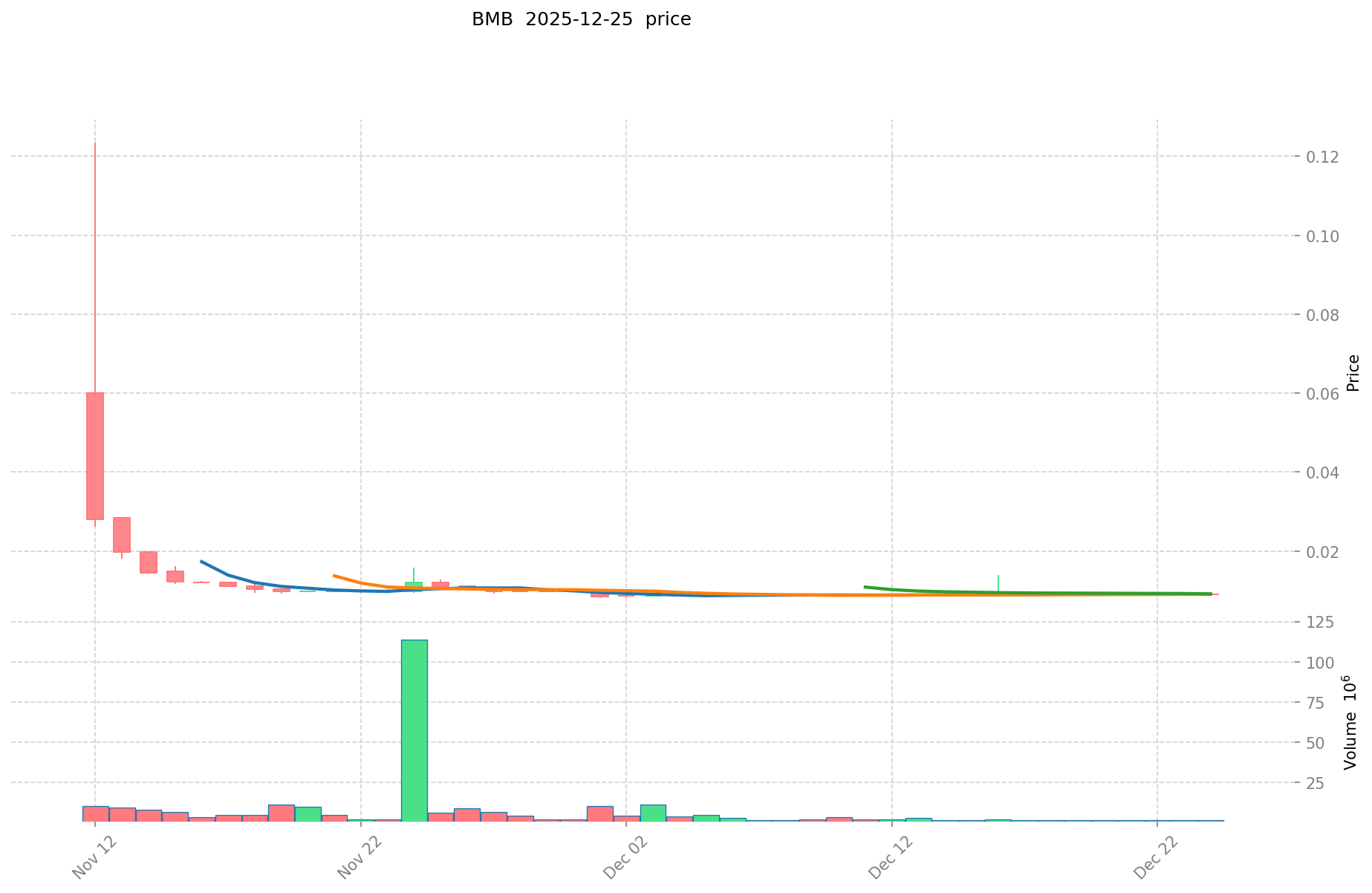
- November 2025: BMB reached its all-time high of $0.12349 on November 12, 2025, driven by early network adoption and ecosystem development.
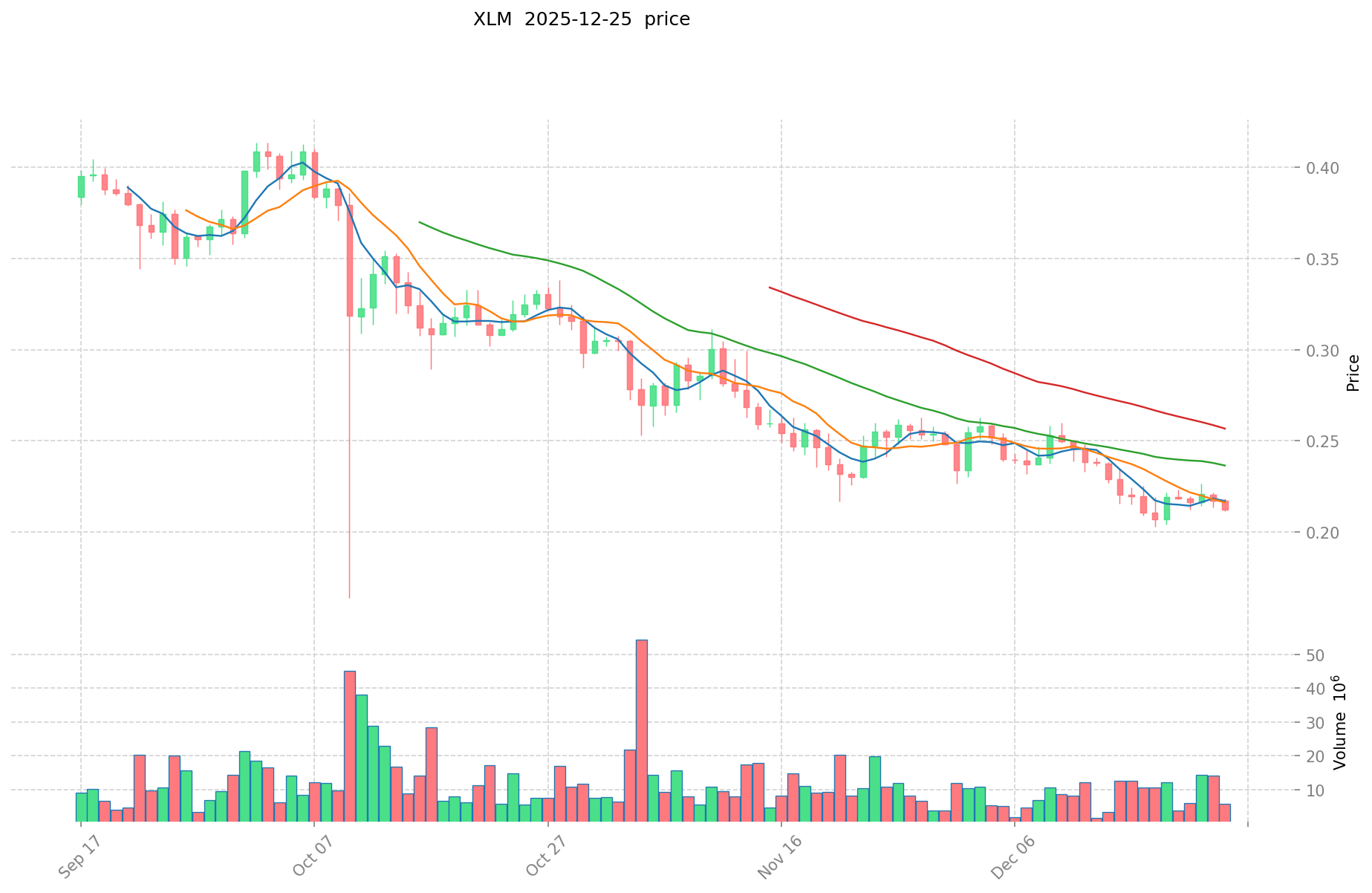
- January 2018: XLM achieved its historical peak of $0.875563 on January 3, 2018, during the broader cryptocurrency market boom.
- Price Comparison: BMB has declined from its November 2025 high of $0.12349 to its current level, representing a significant pullback, while XLM has fallen from its January 2018 peak of $0.875563 by approximately 75.7% to current trading levels.
Current Market Status (December 25, 2025)
- BMB current price: $0.009076
- XLM current price: $0.21284
- 24-hour trading volume: BMB $14,913.19 vs XLM $1,070,960.12
- Market Sentiment Index (Fear & Greed Index): 23 (Extreme Fear)
Click to view real-time prices:
Core Factors Influencing BMB vs XLM Investment Value
II. Core Factors Influencing BMB vs XLM Investment Value
Supply Mechanism Comparison (Tokenomics)
Based on the available reference materials, specific supply mechanism details for BMB and XLM are not provided in the sources. This section cannot be completed without additional information on fixed supply, deflationary models, or halving mechanisms for these tokens.
Institutional Adoption and Market Application
Market Sentiment: Investor confidence and sentiment directly influence BMB/USD price movements.
Regulatory Environment: Government policies and regulations on cryptocurrencies directly impact market acceptance, which in turn determines their value relative to fiat currencies such as USD.
Economic Factors: Broader economic conditions influence cryptocurrency valuation.
Technology Development and Ecosystem Building
The reference materials do not contain specific information regarding technology upgrades, ecosystem development, DeFi integration, NFT applications, or smart contract implementations for BMB and XLM. Detailed comparisons of technical developments and ecosystem ecosystems cannot be provided without relevant source data.
Macroeconomic Environment and Market Cycles
Rational Investment and Emotional Control: Investment requires rationality rather than following market trends. Self-emotional control is a key factor in investment success.
The reference materials do not provide sufficient information regarding inflationary resistance, the impact of monetary policy changes, interest rate effects, US dollar index correlations, or geopolitical factors on BMB and XLM price movements.
III. 2025-2030 Price Predictions: BMB vs XLM
Short-term Prediction (2025)
- BMB: Conservative $0.00626244-$0.009076 | Optimistic $0.009076-$0.01188956
- XLM: Conservative $0.1360576-$0.21259 | Optimistic $0.21259-$0.2848706
Mid-term Prediction (2026-2028)
- BMB may enter a recovery phase, with estimated price range $0.0076524294-$0.01759695009534
- XLM may enter a bullish phase, with estimated price range $0.172090835955675-$0.363929800627575
- Key drivers: institutional capital inflow, ETF adoption, ecosystem development
Long-term Prediction (2029-2030)
- BMB: Base case $0.013645071654914-$0.017393717713957 | Optimistic case $0.019133089485352-$0.019792851191744
- XLM: Base case $0.242267221929403-$0.323022962572537 | Optimistic case $0.361785718081242-$0.437760718878302
View detailed price predictions for BMB and XLM
BMB:
| 年份 |
预测最高价 |
预测平均价格 |
预测最低价 |
涨跌幅 |
| 2025 |
0.01188956 |
0.009076 |
0.00626244 |
0 |
| 2026 |
0.0118455414 |
0.01048278 |
0.0076524294 |
15 |
| 2027 |
0.013620276054 |
0.0111641607 |
0.009824461416 |
23 |
| 2028 |
0.01759695009534 |
0.012392218377 |
0.00842670849636 |
36 |
| 2029 |
0.019792851191744 |
0.01499458423617 |
0.013645071654914 |
65 |
| 2030 |
0.019133089485352 |
0.017393717713957 |
0.016350094651119 |
91 |
XLM:
| 年份 |
预测最高价 |
预测平均价格 |
预测最低价 |
涨跌幅 |
| 2025 |
0.2848706 |
0.21259 |
0.1360576 |
0 |
| 2026 |
0.281065239 |
0.2487303 |
0.181573119 |
16 |
| 2027 |
0.299334479535 |
0.2648977695 |
0.182779460955 |
24 |
| 2028 |
0.363929800627575 |
0.2821161245175 |
0.172090835955675 |
32 |
| 2029 |
0.400548473589946 |
0.323022962572537 |
0.242267221929403 |
51 |
| 2030 |
0.437760718878302 |
0.361785718081242 |
0.242396431114432 |
69 |
IV. Investment Strategy Comparison: BMB vs XLM
Long-term vs Short-term Investment Strategies
- BMB: Suitable for investors focused on emerging computing infrastructure opportunities and early-stage ecosystem participation, with higher risk tolerance for volatile assets
- XLM: Suitable for investors seeking established payment rail adoption, institutional partnerships, and relatively stable cross-border transfer solutions
Risk Management and Asset Allocation
- Conservative investors: BMB 5% vs XLM 20%
- Aggressive investors: BMB 25% vs XLM 15%
- Hedging tools: Stablecoin allocation, options strategies, cross-asset diversification
V. Potential Risk Comparison
Market Risk
- BMB: Limited trading volume ($14,913.19 in 24-hour volume) creates higher liquidity risk and price volatility; early-stage asset with concentration risk among limited holders
- XLM: Larger established market with higher trading volume ($1,070,960.12); exposed to broader market sentiment and macroeconomic cycles
Technology Risk
- BMB: Scalability challenges in decentralized compute resource distribution; network stability during high-demand periods; protocol upgrade execution risks
- XLM: Consensus mechanism robustness; validator node centralization concerns; cross-chain interoperability security
Regulatory Risk
- Global regulatory policies affect both assets; payment-focused tokens face stricter compliance scrutiny; compute infrastructure tokens encounter data privacy and jurisdiction concerns
VI. Conclusion: Which Is the Better Buy?
📌 Investment Value Summary:
- BMB Advantages: Emerging decentralized compute infrastructure positioning; 40% cost reduction potential compared to centralized services; early adoption opportunities; long-term price appreciation potential (estimated 91% gain by 2030)
- XLM Advantages: Established payment network with institutional adoption since 2014; higher liquidity and trading volume; stable cross-border transfer use case; mature ecosystem development; moderate 69% growth forecast by 2030
✅ Investment Recommendations:
- Beginner investors: Prioritize XLM for established market presence, lower complexity, and institutional validation; allocate small position in BMB only if risk tolerance permits
- Experienced investors: Consider balanced approach with core XLM position (60-70%) and tactical BMB allocation (10-15%) based on infrastructure adoption trends
- Institutional investors: XLM aligns with regulatory clarity and payment settlement frameworks; BMB represents emerging infrastructure allocation with higher due diligence requirements
⚠️ Risk Disclaimer: Cryptocurrency markets exhibit extreme volatility. Current market sentiment (Fear & Greed Index: 23 - Extreme Fear) indicates heightened risk conditions. This analysis does not constitute investment advice and should not be used as sole basis for investment decisions.
FAQ
XLM是什么货币?
XLM是Stellar网络的原生加密货币,用于跨境金融转账。它是一个去中心化的、开源的协议,旨在提高金融系统的开放性和效率。
BMB是什么,有什么用途?
BMB币是基于区块链技术的数字资产,以篮球传奇科比·布莱恩特命名。主要用于去中心化支付、加密交易和投资,为全球用户提供安全便捷的资产流转方式。
BMB和XLM在技术架构上有什么区别?
BMB采用模块化设计架构,强调微服务方式处理;XLM基于分布式账本技术,专注支付协议。BMB主要用于数据库管理,XLM用于区块链交易结算。两者技术路线和应用场景差异较大。
BMB和XLM哪个更适合投资?
BMB主要面向传统高端资产管理,XLM是加密货币资产。若追求数字资产增长,XLM更具区块链潜力;若偏好传统投资,BMB更稳健。两者投资方向不同,需根据个人资产配置选择。
BMB和XLM的流动性和交易对比如何?
XLM流动性较强,交易额更大,市场活跃度高。BMB交易对相对较少,流动性低于XLM。XLM更适合大额交易,BMB流动性相对受限。
BMB和XLM分别在哪些交易所上线?
BMB和XLM作为主流加密资产,已在众多全球顶级交易平台上线,包括币安、Kraken、Coinbase等主流交易所,提供充足的流动性和交易深度,用户可便捷获取这两种资产。
* The information is not intended to be and does not constitute financial advice or any other recommendation of any sort offered or endorsed by Gate.