This article provides a detailed comparative analysis of two emerging blockchain platforms, BNSX and FLOW, focusing on their investment value, historical price trends, supply mechanisms, institutional adoption, and technical ecosystems. It aims to assist investors in determining which token is a better buy, addressing questions about performance, supply models, and institutional interest. The analysis covers price history, core influencing factors, and future price predictions. Suitable for both novice and experienced investors, the article advises on allocation strategies and highlights potential market, technical, and regulatory risks. Key terms: blockchain platforms, investment comparison, BNSX, FLOW, price trends, institutional adoption.
Introduction: Investment Comparison between BNSX and FLOW
In the cryptocurrency market, the comparison between BNSX vs FLOW has always been a topic that investors cannot avoid. The two not only show significant differences in market cap ranking, application scenarios, and price performance, but also represent different positioning in the crypto asset space.
BNSX (BNSX): Since its launch, it has gained market recognition for addressing the growing need for decentralized identity solutions and short domain services within the Web3 and Bitcoin ecosystems.
FLOW (FLOW): Introduced in 2020, it has been hailed as a platform for next-generation games, applications, and digital assets, becoming one of the cryptocurrencies with significant global trading volume and market capitalization.
This article will comprehensively analyze the investment value comparison between BNSX vs FLOW, focusing on historical price trends, supply mechanisms, institutional adoption, technological ecosystems, and future predictions, attempting to answer the question that investors are most concerned about:
"Which is the better buy right now?"
I. Price History Comparison and Current Market Status
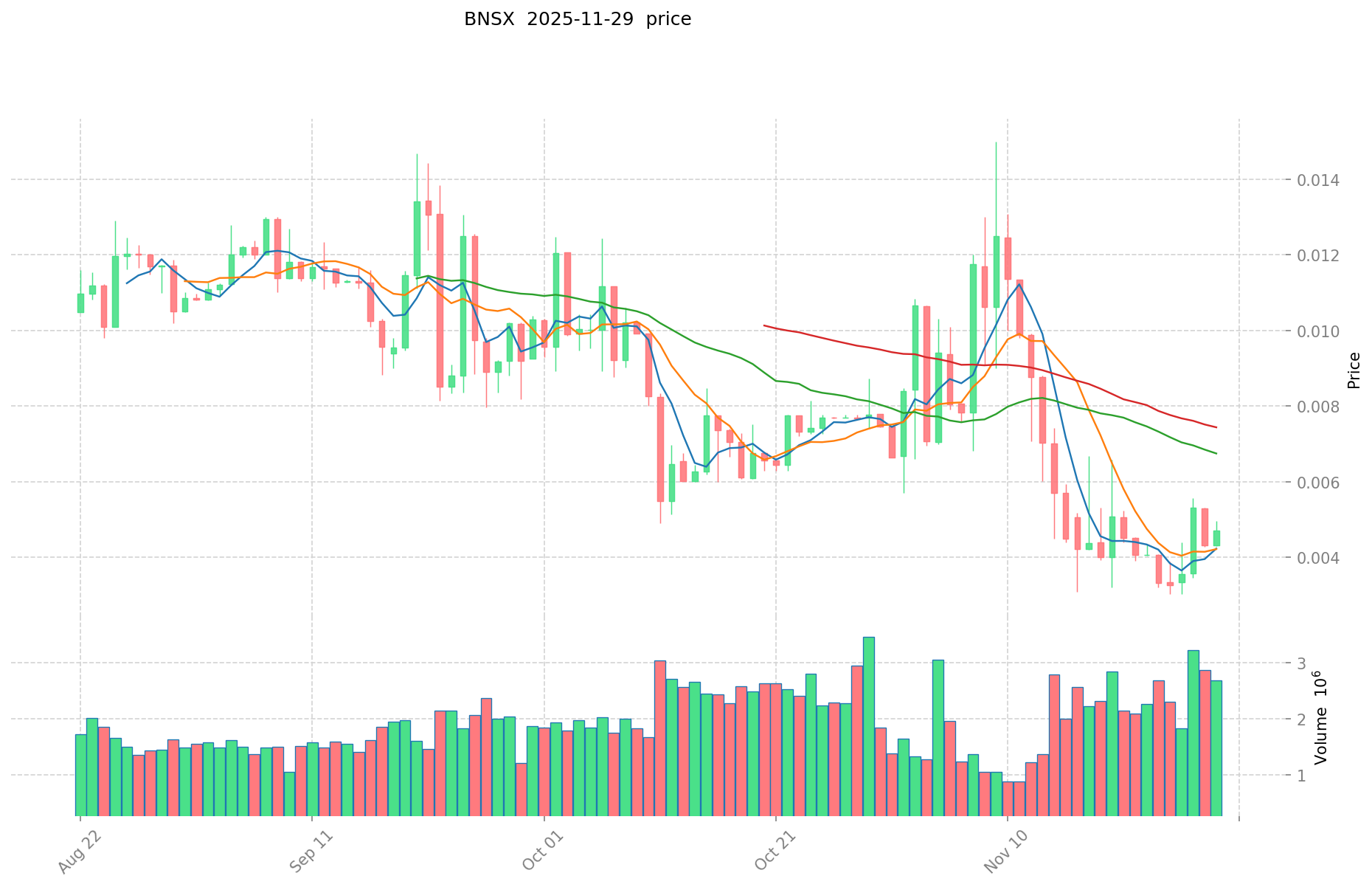
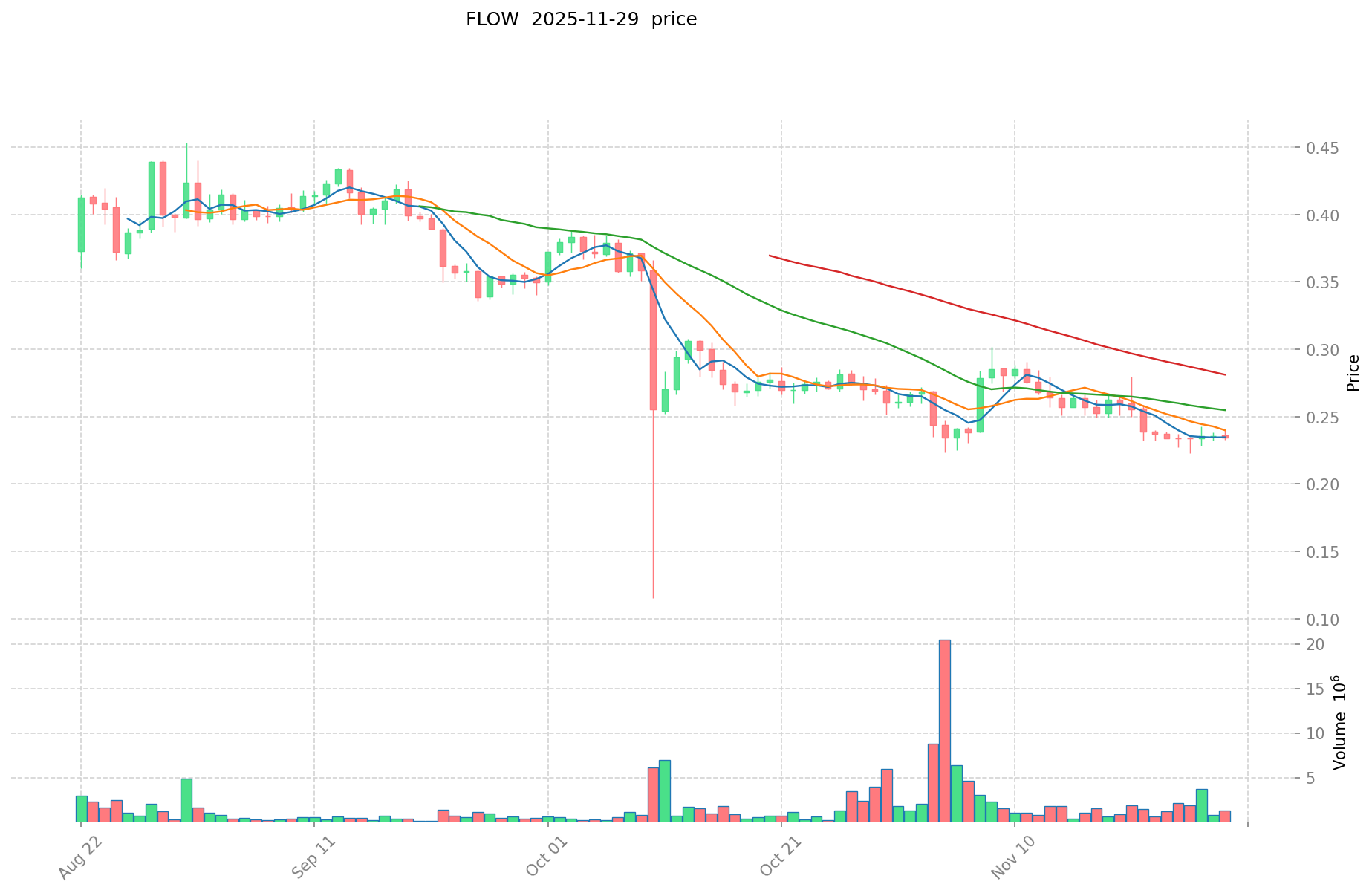
BNSX (Coin A) and FLOW (Coin B) Historical Price Trends
- 2023: BNSX reached its all-time high of $2.4798 on December 19, 2023.
- 2025: BNSX hit its all-time low of $0.003025 on November 24, 2025.
- 2021: FLOW reached its all-time high of $42.4 on April 5, 2021.
- 2025: FLOW hit its all-time low of $0.156967 on October 11, 2025.
Comparative Analysis: In the recent market cycle, BNSX has fallen from its high of $2.4798 to a current price of $0.004952, while FLOW has declined from its peak of $42.4 to a current price of $0.2343.
Current Market Situation (2025-11-29)
- BNSX current price: $0.004952
- FLOW current price: $0.2343
- 24-hour trading volume: BNSX $12,058.94 vs FLOW $222,390.43
- Market Sentiment Index (Fear & Greed Index): 28 (Fear)
Click to view real-time prices:
- View BNSX current price Market Price
- View FLOW current price Market Price
II. Core Factors Affecting the Investment Value of BNSX vs FLOW
Supply Mechanism Comparison (Tokenomics)
- FLOW: FLOW employs an inflationary model with a target annual inflation rate of 3-5%. The network has no maximum supply cap but implements a controlled, predictable issuance schedule to support network operations.
- BNSX: BNSX follows a fixed supply model with a maximum cap of 100,000,000 tokens. This creates scarcity in the token economy.
- 📌 Historical pattern: Fixed supply models like BNSX's typically create stronger price pressure during bull markets, while FLOW's controlled inflation provides sustainability for long-term ecosystem growth.
Institutional Adoption and Market Applications
- Institutional holdings: FLOW has attracted greater institutional interest, with Dapper Labs securing significant backing from major VCs and sports organizations, including the NBA.
- Enterprise adoption: FLOW has demonstrated stronger enterprise adoption through partnerships with major sports leagues (NBA, NFL, UFC) and entertainment companies, while BNSX's adoption remains more limited to its specific ecosystem.
- National policies: Both tokens face varying regulatory approaches across jurisdictions, with FLOW benefiting from clearer regulatory positioning due to its focus on NFTs and digital collectibles.
Technical Development and Ecosystem Building
- FLOW technical upgrades: FLOW has implemented multi-node architecture for improved scalability and resource-oriented programming with Cadence language, specifically designed for digital assets and NFT functionality.
- BNSX technical development: BNSX focuses on cross-chain functionality and interoperability features to enhance its ecosystem connectivity.
- Ecosystem comparison: FLOW has a more developed NFT ecosystem with proven applications (NBA Top Shot, NFL All Day), while BNSX's ecosystem is still developing its DeFi and cross-chain applications.
Macroeconomic Factors and Market Cycles
- Performance during inflation: FLOW's utility-focused model may provide better resistance to inflation through continuous platform use and development.
- Macroeconomic monetary policy: Interest rate increases typically affect both tokens negatively, though FLOW's established use cases may provide some insulation against broader market downturns.
- Geopolitical factors: FLOW's focus on entertainment and sports provides some insulation from geopolitical tensions, while cross-border transaction demand affects both tokens' adoption potential.
III. 2025-2030 Price Prediction: BNSX vs FLOW
Short-term Prediction (2025)
- BNSX: Conservative $0.00273 - $0.00495 | Optimistic $0.00495 - $0.00713
- FLOW: Conservative $0.21069 - $0.2341 | Optimistic $0.2341 - $0.33945
Mid-term Prediction (2027)
- BNSX may enter a growth phase, expected price range $0.00640 - $0.00950
- FLOW may enter a stable phase, expected price range $0.2893 - $0.3102
- Key drivers: Institutional inflows, ETF developments, ecosystem growth
Long-term Prediction (2030)
- BNSX: Base scenario $0.00619 - $0.00998 | Optimistic scenario $0.00998 - $0.01317
- FLOW: Base scenario $0.24005 - $0.32884 | Optimistic scenario $0.32884 - $0.38803
View detailed price predictions for BNSX and FLOW
Disclaimer
BNSX:
| 年份 |
预测最高价 |
预测平均价格 |
预测最低价 |
涨跌幅 |
| 2025 |
0.00713088 |
0.004952 |
0.0027236 |
0 |
| 2026 |
0.0074309712 |
0.00604144 |
0.0052560528 |
21 |
| 2027 |
0.009498049896 |
0.0067362056 |
0.00639939532 |
35 |
| 2028 |
0.00844181285792 |
0.008117127748 |
0.00600667453352 |
63 |
| 2029 |
0.011674053127173 |
0.00827947030296 |
0.005878423915101 |
66 |
| 2030 |
0.013169325463888 |
0.009976761715066 |
0.006185592263341 |
100 |
FLOW:
| 年份 |
预测最高价 |
预测平均价格 |
预测最低价 |
涨跌幅 |
| 2025 |
0.339445 |
0.2341 |
0.21069 |
0 |
| 2026 |
0.3097143 |
0.2867725 |
0.272433875 |
22 |
| 2027 |
0.310173136 |
0.2982434 |
0.289296098 |
27 |
| 2028 |
0.31333451604 |
0.304208268 |
0.27987160656 |
29 |
| 2029 |
0.3489116729826 |
0.30877139202 |
0.200701404813 |
31 |
| 2030 |
0.388033008351534 |
0.3288415325013 |
0.240054318725949 |
40 |
IV. Investment Strategy Comparison: BNSX vs FLOW
Long-term vs Short-term Investment Strategy
- BNSX: Suitable for investors focused on decentralized identity solutions and Web3 ecosystem potential
- FLOW: Suitable for investors interested in NFTs, gaming, and digital collectibles markets
Risk Management and Asset Allocation
- Conservative investors: BNSX: 30% vs FLOW: 70%
- Aggressive investors: BNSX: 60% vs FLOW: 40%
- Hedging tools: Stablecoin allocation, options, cross-currency portfolio
V. Potential Risk Comparison
Market Risk
- BNSX: Higher volatility due to smaller market cap and nascent ecosystem
- FLOW: Dependency on NFT market trends and adoption of blockchain-based gaming
Technical Risk
- BNSX: Scalability, network stability
- FLOW: Smart contract vulnerabilities, potential centralization issues
Regulatory Risk
- Global regulatory policies may impact both tokens differently, with FLOW potentially facing less scrutiny due to its focus on digital collectibles
VI. Conclusion: Which Is the Better Buy?
📌 Investment Value Summary:
- BNSX advantages: Fixed supply model, potential for growth in decentralized identity solutions
- FLOW advantages: Established partnerships, proven use cases in NFTs and digital collectibles
✅ Investment Advice:
- Novice investors: Consider a smaller allocation to FLOW due to its more established ecosystem
- Experienced investors: Balanced approach with exposure to both tokens, emphasizing FLOW for near-term stability and BNSX for long-term growth potential
- Institutional investors: Focus on FLOW for its institutional backing and clearer regulatory positioning
⚠️ Risk Warning: The cryptocurrency market is highly volatile. This article does not constitute investment advice.
None
VII. FAQ
Q1: What are the main differences between BNSX and FLOW?
A: BNSX focuses on decentralized identity solutions and short domain services within the Web3 and Bitcoin ecosystems, with a fixed supply model. FLOW is designed for next-generation games, applications, and digital assets, particularly NFTs, with an inflationary model and established partnerships in sports and entertainment.
Q2: Which token has performed better historically?
A: FLOW has shown better historical performance, reaching an all-time high of $42.4 in April 2021, compared to BNSX's all-time high of $2.4798 in December 2023. However, both have experienced significant declines from their peaks.
Q3: How do the supply mechanisms of BNSX and FLOW differ?
A: BNSX has a fixed supply model with a maximum cap of 100,000,000 tokens, creating scarcity. FLOW employs an inflationary model with a target annual inflation rate of 3-5% and no maximum supply cap, supporting long-term ecosystem growth.
Q4: Which token has better institutional adoption?
A: FLOW has attracted greater institutional interest, with significant backing from major VCs and sports organizations, including partnerships with NBA, NFL, and UFC. BNSX's adoption remains more limited to its specific ecosystem.
Q5: What are the key factors affecting the future price of these tokens?
A: Key factors include institutional inflows, ETF developments, ecosystem growth, regulatory changes, technological advancements, and overall market conditions. FLOW's price may be more influenced by trends in the NFT and digital collectibles markets, while BNSX's price could be affected by developments in decentralized identity solutions.
Q6: How should investors allocate their portfolio between BNSX and FLOW?
A: Conservative investors might consider allocating 30% to BNSX and 70% to FLOW, while aggressive investors might opt for 60% BNSX and 40% FLOW. The specific allocation should depend on individual risk tolerance and investment goals.
Q7: What are the main risks associated with investing in BNSX and FLOW?
A: Both tokens face market risks due to cryptocurrency volatility. BNSX has higher volatility due to its smaller market cap and nascent ecosystem. FLOW faces risks related to NFT market trends and blockchain gaming adoption. Both also face potential regulatory risks, though FLOW may have a slight advantage due to its focus on digital collectibles.
* The information is not intended to be and does not constitute financial advice or any other recommendation of any sort offered or endorsed by Gate.













