# Article Overview: BOND vs ADA Comprehensive Comparison
This comprehensive guide delivers an in-depth investment comparison between BarnBridge (BOND) and Cardano (ADA), two distinct blockchain tokens with different market positioning and growth trajectories. The article addresses critical investor questions by analyzing historical price performance, tokenomics, market adoption, technology ecosystems, and five-year price predictions through 2030. It provides actionable investment strategies tailored to conservative, experienced, and institutional investors, while highlighting specific risks including liquidity constraints for BOND and application execution challenges for ADA. Readers will gain clarity on which token aligns with their risk tolerance, supported by real-time market data from Gate and structured risk management frameworks.
---
**Article Structure:**
- Price history comparison & current market status
- Core investment value factors analysis
- 2025-2030 price predictions with confidence scenar
Introduction: BOND vs ADA Investment Comparison
In the cryptocurrency market, comparisons between BOND and ADA have always been a topic that investors cannot avoid. The two differ significantly in market cap ranking, application scenarios, and price performance, representing different positioning of crypto assets.
BarnBridge (BOND): Launched in 2020, it has gained market recognition as a volatility derivatives protocol that enables decentralized governance through its ERC-20 token, which serves as both a governance and staking mechanism within the BarnBridge DAO ecosystem.
Cardano (ADA): Since its launch in 2017, it has been recognized as a comprehensive technology platform designed to run financial applications for individuals, organizations, and governments worldwide. Built with a layered architecture, it combines a settlement layer with planned smart contract capabilities through its computing layer.
This article will provide a comprehensive analysis of the investment value comparison between BOND and ADA from multiple perspectives including historical price trends, supply mechanisms, market positioning, technical ecosystems, and future outlook, while attempting to answer the question investors care about most:
"Which is the better buy right now?"
I. Price History Comparison and Current Market Status
BarnBridge (BOND) and Cardano (ADA) Historical Price Trends
- 2020: BOND reached its all-time high of $185.69 on October 27, 2020, during the peak of the DeFi protocol boom.
- 2021: ADA achieved its all-time high of $3.09 on September 2, 2021, driven by milestone upgrades to the Cardano platform and increased adoption.
- Comparative analysis: Since their respective peaks, BOND has declined from $185.69 to $0.07532 (a 99.95% decrease), while ADA has fallen from $3.09 to $0.3707 (a 88% decrease), indicating BOND has experienced significantly steeper losses compared to ADA.
Current Market Status (2025-12-28)
- BOND current price: $0.07532.
- ADA current price: $0.3707.
- 24-hour trading volume: BOND $18,930.61 vs ADA $3,744,273.75.
- Market Sentiment Index (Fear & Greed Index): 24 (Extreme Fear).
Click to view real-time prices:
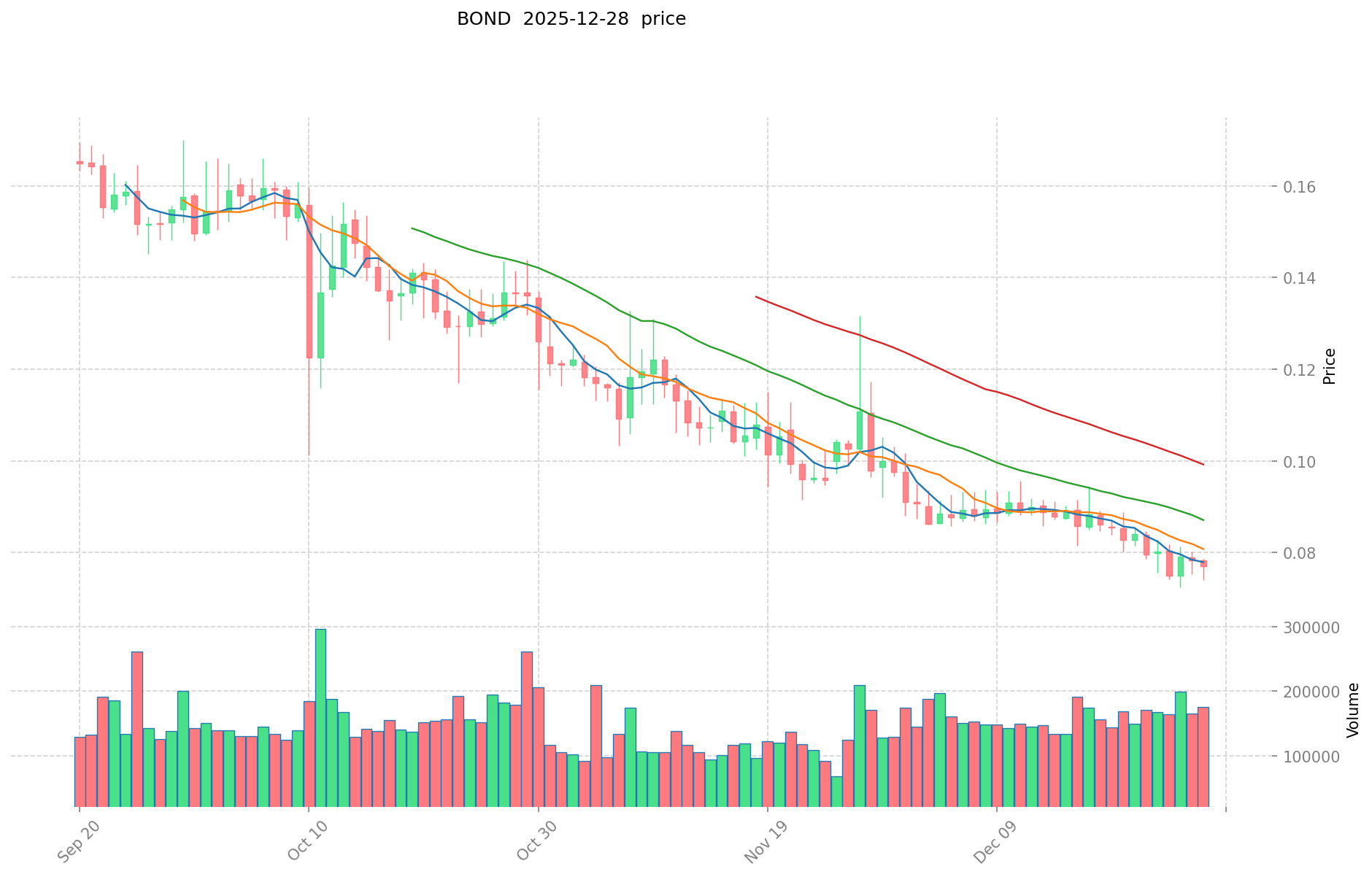
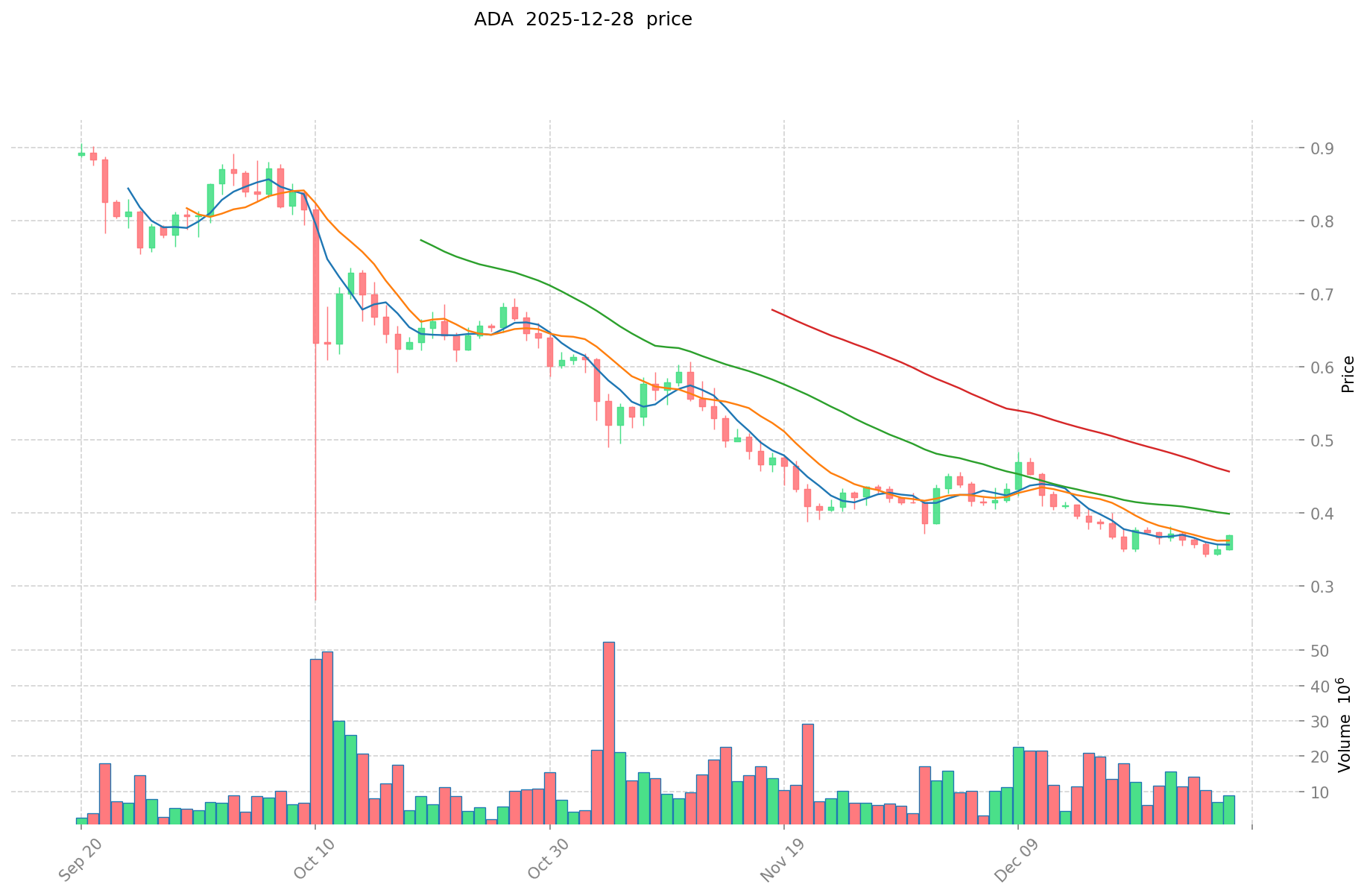
BOND vs ADA 投资价值对比分析
II. Core Factors Influencing BOND vs ADA Investment Value
Tokenomics Comparison
- BOND: Unable to provide specific tokenomics details due to insufficient reference data
- ADA: Unable to provide specific tokenomics details due to insufficient reference data
- 📌 Historical Patterns: Supply mechanisms and their impact on price cycles require detailed on-chain data not available in current references
Institutional Adoption and Market Applications
- Institutional Holdings: Comparative analysis cannot be completed without current holdings data
- Enterprise Adoption: Application comparisons in cross-border payments, settlements, and investment portfolios require specific use case documentation
- National Policy: Regulatory stance analysis pending relevant policy documentation from reference sources
Technology Development and Ecosystem Building
- BOND Technology Upgrades: Technical development roadmap information not provided in references
- ADA Technology Development: Network evolution and protocol improvements data unavailable
- Ecosystem Comparison: Comparative status of DeFi, NFT, payments, and smart contract deployments requires current ecosystem metrics
Macroeconomic Factors and Market Cycles
- Inflation Environment Performance: Comparative inflation-hedging characteristics analysis pending empirical data
- Macroeconomic Monetary Policy: Impact correlation analysis with interest rates and USD index requires quantitative data
- Geopolitical Factors: Cross-border transaction demand patterns and international situation assessments require current geopolitical indicators
Note: Comprehensive analysis of these factors requires detailed market data, on-chain metrics, and current policy information. The provided reference materials do not contain sufficient data to complete a thorough comparative evaluation. For a complete assessment, please provide specific data including tokenomics specifications, institutional holdings reports, technology roadmaps, and current market metrics.
III. 2025-2030 Year Price Prediction: BOND vs ADA
Short-term Prediction (2025)
- BOND: Conservative $0.0497-$0.0754 | Optimistic $0.0957
- ADA: Conservative $0.1892-$0.3709 | Optimistic $0.3857
Medium-term Prediction (2026-2028)
- BOND may enter consolidation phase with price range $0.0521-$0.1372, showing moderate growth trajectory with 13-42% year-over-year gains
- ADA may enter steady accumulation phase with price range $0.2838-$0.5030, demonstrating 2-19% appreciation across the period
- Key drivers: institutional capital inflows, ETF adoption, ecosystem expansion and protocol upgrades
Long-term Prediction (2029-2030)
- BOND: Base scenario $0.1063-$0.1222 | Optimistic scenario $0.1748-$0.1618, with cumulative gains reaching 62-97% by 2030
- ADA: Base scenario $0.2604-$0.4568 | Optimistic scenario $0.4979-$0.6683, with cumulative gains reaching 23-28% by 2030
View detailed price predictions for BOND and ADA
BOND:
| 年份 |
预测最高价 |
预测平均价格 |
预测最低价 |
涨跌幅 |
| 2025 |
0.0956564 |
0.07532 |
0.0497112 |
0 |
| 2026 |
0.11968348 |
0.0854882 |
0.052147802 |
13 |
| 2027 |
0.1118185656 |
0.10258584 |
0.0707842296 |
36 |
| 2028 |
0.137218819584 |
0.1072022028 |
0.068609409792 |
42 |
| 2029 |
0.17476103100456 |
0.122210511192 |
0.10632314473704 |
62 |
| 2030 |
0.161849490497125 |
0.14848577109828 |
0.132152336277469 |
97 |
ADA:
| 年份 |
预测最高价 |
预测平均价格 |
预测最低价 |
涨跌幅 |
| 2025 |
0.385736 |
0.3709 |
0.189159 |
0 |
| 2026 |
0.38966754 |
0.378318 |
0.3594021 |
2 |
| 2027 |
0.5030305287 |
0.38399277 |
0.3686330592 |
3 |
| 2028 |
0.470122348311 |
0.44351164935 |
0.283847455584 |
19 |
| 2029 |
0.497930528725245 |
0.4568169988305 |
0.260385689333385 |
23 |
| 2030 |
0.668323269289021 |
0.477373763777872 |
0.358030322833404 |
28 |
BOND vs ADA 投资价值对比分析
四、投资策略对比:BOND vs ADA
长期 vs 短期投资策略
- BOND:适合关注 DeFi 衍生品协议、寻求高成长潜力的投资者,短期内波动性大但长期预测涨跌幅达 97%
- ADA:适合寻求相对稳定、关注金融应用生态和全球采用潜力的投资者,近年跌幅相对较小且市场流动性充足
风险管理与资产配置
- 保守型投资者:BOND 10%-20% vs ADA 30%-40%(ADA 波动性相对较低,交易量更大)
- 激进型投资者:BOND 40%-60% vs ADA 20%-30%(BOND 长期增长空间更大但风险更高)
- 对冲工具:稳定币配置 20%-30%、期权工具对冲下行风险、跨币种组合分散单一资产风险
五、潜在风险对比
市场风险
- BOND:流动性相对较低(日交易量仅 $18,930.61),从历史高位下跌 99.95%,存在复苏难度大的风险;协议依赖度高,市场认可度需重建
- ADA:虽日交易量达 $3,744,273.75,但作为平台型代币,应用落地进展直接影响价格表现,面临市场预期与实际进展的偏差风险
技术风险
- BOND:作为 ERC-20 代币,依赖以太坊网络安全,同时衍生品协议设计复杂性高,智能合约风险需持续关注
- ADA:分层架构结合智能合约层面临网络升级风险,生态应用数量和质量决定网络价值实现程度
监管风险
- 全球监管趋严背景下,衍生品交易协议(BOND)面临更严格的金融监管审查;支付类应用(ADA)则面临各国货币政策和数字资产政策的不同态度,跨境使用场景受政策影响较大
六、结论:Which Is the Better Buy?
📌 投资价值总结:
- BOND 优势:长期价格预测空间大(2025-2030 年涨幅 97%),DeFi 衍生品赛道前景广阔,DAO 治理机制完善;适合风险承受能力强的投资者把握反弹机会
- ADA 优势:市场流动性充足、日交易量充分保障交易便利性,从历史高位跌幅相对较小(88% vs BOND 的 99.95%),作为金融应用平台具有长期战略价值,机构认可度相对较高,2025-2030 年稳健增长预期
✅ 投资建议:
- 新手投资者:建议以 ADA 为主要配置(60%-70%),利用其相对成熟的生态和充足流动性,配置少量 BOND(10%-20%)作为潜力资产参与
- 有经验投资者:可根据市场周期灵活配置,在极端恐惧指数(当前 24)时考虑增加 BOND 配置以捕捉反弹机会,同时利用期权工具对冲风险
- 机构投资者:ADA 具有更好的流动性深度和政策友好性,适合作为核心配置;可通过 ETF 等结构化产品参与,BOND 可作为另类资产小幅配置
⚠️ 风险提示:加密货币市场波动性极高,BOND 历史跌幅超 99%,ADA 亦面临技术应用和政策风险。本文基于历史数据和预测分析,不构成投资建议。投资者应根据自身风险承受能力、投资周期和市场环境独立决策。
FAQ
ADA coin介绍?
ADA是Cardano区块链的原生代币,由Input Output Hong Kong开发。采用权益证明机制,具有高能效、强安全性和可扩展性。支持智能合约和DApp开发,是主流公链生态中重要的加密资产之一。
BOND是什么?有什么用途?
BOND是基于区块链的治理代币,用于参与协议决策和质押获得收益。持有者可通过投票参与社区治理,同时质押BOND获得奖励。该代币在DeFi生态中扮演重要角色,驱动去中心化金融发展。
BOND与ADA在技术架构上有什么区别?
ADA基于Ouroboros共识机制,采用分层架构设计。BOND则专注于跨链桥接技术,提供更灵活的互操作性。ADA强调学术严谨性,BOND注重实用的资产流动性解决方案。两者在智能合约执行方式和生态定位上差异显著。
BOND和ADA的应用场景分别是什么?
BOND主要用于债券代币化和固定收益DeFi生态,提供链上借贷和资产管理。ADA则专注于智能合约平台,支持去中心化应用、NFT和区块链生态建设,强调可持续性和学术研究驱动。
BOND和ADA哪个更值得投资?
BOND聚焦创新DeFi生态,增长潜力大;ADA作为老牌公链,生态成熟稳定。若看好创新应选BOND,若偏好稳健选ADA。两者各具优势,需根据个人风险偏好判断。
BOND和ADA的风险分别是什么?
BOND作为新兴DeFi协议,面临智能合约安全、流动性不足和市场认可度低的风险。ADA作为成熟公链,主要风险在于竞争压力、生态应用有限和技术迭代速度。两者都存在市场波动和政策监管风险。
* The information is not intended to be and does not constitute financial advice or any other recommendation of any sort offered or endorsed by Gate.