A Guide to Hard Forks and Soft Forks

2026-01-01 20:38:26
Bitcoin
Blockchain
Crypto Tutorial
DAO
Ethereum
Article Rating : 3
169 ratings
Explore the fundamental distinctions between Hard Forks and Soft Forks in blockchain. Learn how protocol upgrades operate, how they affect the Bitcoin network and other cryptocurrencies, and why forks play a vital role in the decentralized evolution of blockchain networks.
A Guide to Hard Forks and Soft Forks

Introduction

When you get a notification to update your digital banking app, you probably don't hesitate to accept it. But with open-source cryptocurrencies, it's a different story. There’s no central authority or bank to push updates or make changes at will. That means adding new features to blockchain networks can be a major challenge.

This article explores how cryptocurrency networks can be upgraded even without a central authority. Two key mechanisms enable this: Hard Forks and Soft Forks. Understanding these concepts is crucial for anyone looking to grasp how blockchains evolve and adapt to community needs.

Who Makes Decisions in a Blockchain Network?

To understand how forks work, you first need to know who participates in blockchain network governance and decision-making.

Developers

Developers create and update the network’s source code. For most cryptocurrencies, anyone can contribute. The code is open for public review, enabling the community to suggest and implement improvements. Developers collaborate to introduce new features and security enhancements.

Miners

Miners secure the blockchain and validate transactions. They run the cryptocurrency’s code and dedicate significant computing power to add new blocks. Block rewards and transaction fees incentivize miners economically to maintain network security.

Full Node Users

Full nodes form the backbone of a cryptocurrency network. They validate, send, and receive blocks and transactions to ensure data integrity. Full nodes also store a complete copy of the blockchain, safeguarding the network’s historical record.

Many believe real control of the network lies with full nodes. Since participation is voluntary—users choose which software to run—the community ultimately holds decision-making power.

What Is a Fork?

A fork occurs when software is copied and substantially modified. The original project continues, but the new project moves in a different direction. This concept is fundamental to understanding blockchain evolution.

Forked projects share a common origin and development history. Like a road that splits, the projects permanently diverge. This split can be either temporary or permanent, depending on the type of fork.

Hard Forks vs. Soft Forks

What Is a Hard Fork?

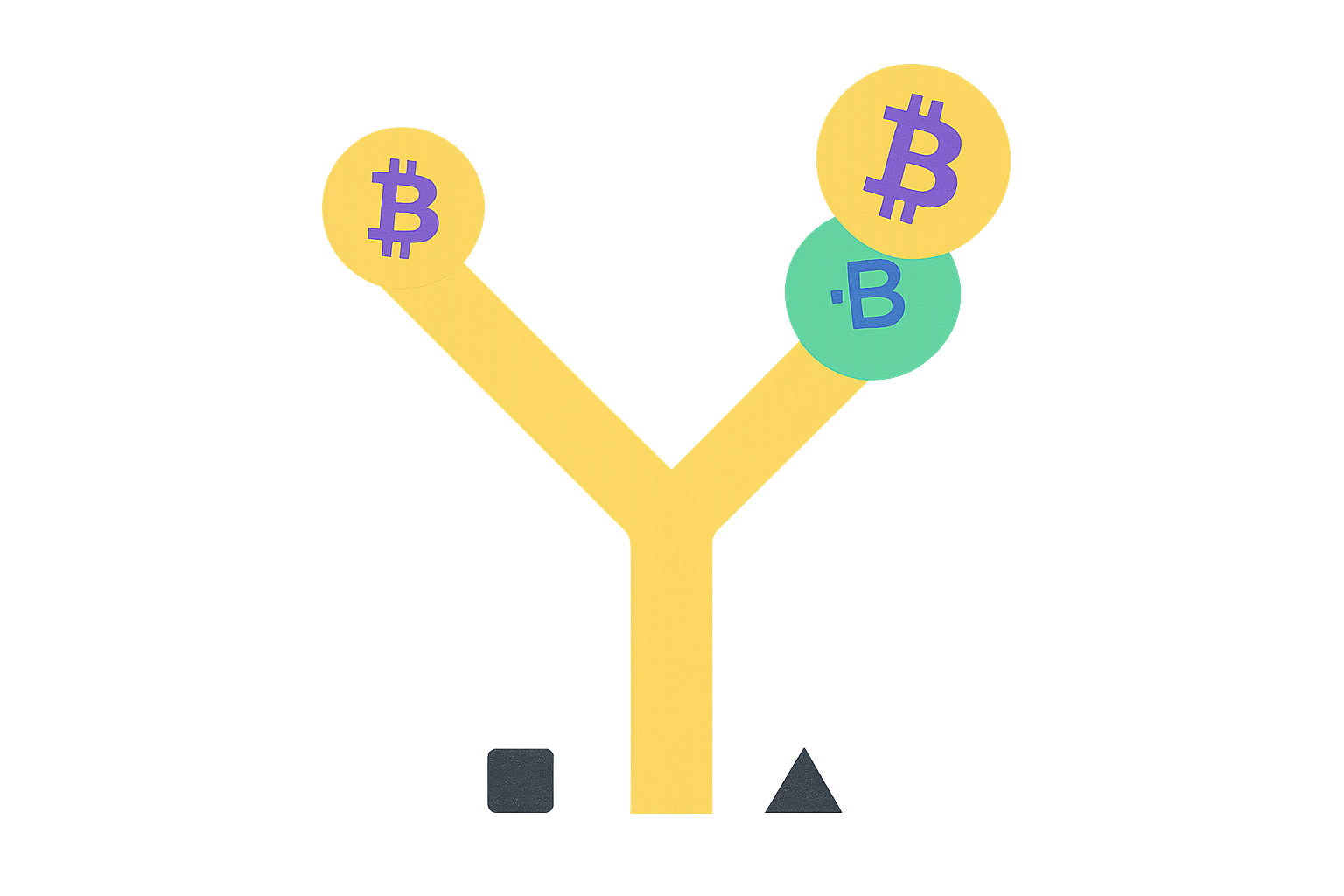
A Hard Fork is a software update that isn’t compatible with previous versions. This typically happens when nodes adopt new rules that conflict with older ones. New nodes can only communicate with others running the same new version. The result is a blockchain split, creating two separate networks: one with the old rules and one with the new.

Because both networks share the same history, if you held coins before the fork, you’ll have coins on both chains. This means you receive equivalent tokens on the new chain as well.

A major real-world Hard Fork occurred in 2017, splitting the Bitcoin blockchain into Bitcoin (BTC) and Bitcoin Cash (BCH). The fork followed intense technical and community debate about how best to solve Bitcoin’s scalability challenges.

What Is a Soft Fork?

A Soft Fork is a backward-compatible update. Nodes that have upgraded can still communicate with those running the old version. Soft forks introduce new rules that don’t conflict with existing ones. This backwards compatibility is what sets soft forks apart.

A prime example is Segregated Witness (SegWit). Older nodes could still validate blocks and transactions, but didn’t interpret them fully. SegWit changed how signature data is stored, increasing transaction capacity while preserving compatibility with older nodes.

Hard Forks vs. Soft Forks – Which Is Better?

Each type of fork serves distinct purposes as blockchains evolve. Highly contentious Hard Forks can fracture a community and the network itself. But well-planned, widely supported forks allow for major upgrades when consensus is reached.

Soft Forks are less disruptive and generally safer. Their scope is more limited, though, since updates can’t conflict with existing rules. If an upgrade can be made compatible with older versions, there’s no risk of splitting the network or community.

Deciding between a Hard Fork and a Soft Fork depends on the scope of the proposed changes and the level of community agreement. Minor, compatible updates are better suited for Soft Forks, while fundamental changes may require a Hard Fork.

Final Thoughts

Hard Forks and Soft Forks are essential for the long-term growth of blockchain networks. They allow decentralized systems to evolve and upgrade—even in the absence of a central authority. These mechanisms ensure blockchains remain flexible and responsive to the community’s needs.

Forks let blockchains and cryptocurrencies add new features over time, boosting security, scalability, and usability. Without these upgrade paths, blockchains would require centralized, top-down control—contradicting the very principles of decentralized crypto. Understanding these processes is key to grasping how blockchain networks work and evolve.

FAQ

What’s the difference between a Hard Fork and a Soft Fork?

A Hard Fork changes the blockchain protocol so older nodes become incompatible, while a Soft Fork retains compatibility with previous versions. A Hard Fork is a permanent split; a Soft Fork enables gradual expansion.

Why do blockchain projects use hard forks or soft forks?

Projects use hard forks or soft forks to update protocols and improve network performance and security. Hard forks enable structural changes, while soft forks refine existing rules. Both approaches support innovation built on community consensus.

What happens to my crypto assets during a hard fork?

During a hard fork, everyone holding tokens on the original chain receives an equal amount of tokens on the new chain. Your assets are duplicated, giving you access to both versions.

What are the major hard fork events in blockchain history?

Key hard forks include Ethereum’s 2016 split after the DAO incident, which created Ethereum Classic (ETC). Other major examples are the 2017 launch of Bitcoin Cash, driven by disagreements over block size, and the Ethereum Merge in 2022, which shifted consensus from PoW to PoS.

Are soft forks backward compatible? How do they affect the network?

Yes, soft forks retain backward compatibility. They add new rules while maintaining compatibility with the existing protocol, so non-upgraded nodes can continue operating as usual.

How should a typical user prepare for an upcoming hard fork or soft fork?

Update your client or wallet to a version that supports the new protocol. Make sure your exchange or service provider supports the upgrade. Keep your private keys secure and follow official updates.

Does a hard fork create a new coin? How do I get the new coin from the fork?

Yes, a hard fork produces a new coin. If you hold the original coin, you’ll automatically receive the new coin in the same wallet—no extra steps needed. The amount of new coins matches your balance at the time of the fork.

* The information is not intended to be and does not constitute financial advice or any other recommendation of any sort offered or endorsed by Gate.
Related Articles
Understanding Different Types of Blockchain Forks and Their Potential Outcomes

Understanding Different Types of Blockchain Forks and Their Potential Outcomes

The article delves into the dynamics of blockchain forks, emphasizing hard forks, their causes, and impacts. It addresses the challenges of community divides and how innovative strategies can mitigate disruptions. The piece distinguishes between hard and soft forks, highlighting their technological and community implications. Suitable for developers, traders, and blockchain enthusiasts, it offers insights into the complex processes behind blockchain evolution, emphasizing the importance of communication, governance, and testing in maintaining network integrity. The article is a valuable resource for understanding the essentials and consequences of blockchain forks.
2025-12-20 16:52:11
Explained: In a Block in a Blockchain, What Represents a Block's Unique Identifier Like a Fingerprint?

Explained: In a Block in a Blockchain, What Represents a Block's Unique Identifier Like a Fingerprint?

This article delves into the crucial role of block hashes as unique identifiers in blockchain technology, akin to digital fingerprints. It explains how block hashes maintain data authenticity, ensure security, and link blocks together. The article explores variations in block identification across major blockchains such as Ethereum, Ripple, and Cardano, emphasizing their unique features and hashing algorithms. It also highlights practical applications in Web3 development, including transaction confirmation and state management. This content is essential for developers and blockchain enthusiasts seeking to understand the intricacies of blockchain security and functionality.
2025-09-12 17:28:14
How Many Quarters Make a Dollar?

How Many Quarters Make a Dollar?

This article explores the fundamental concept that four quarters make a dollar and delves into its significance in American currency history, financial literacy, and cryptocurrency understanding. It connects the quarter's historical and material evolution to broader financial systems, offering readers a conceptual bridge between traditional and digital currencies. The article addresses practical financial applications, enhancing monetary comprehension for both cash and crypto transactions. Aimed at educators and cryptocurrency beginners, it uses the quarter-dollar relationship to simplify complex concepts in fractional systems, while highlighting Gate's role in facilitating this educational transition. Keywords: quarters, dollar, fractional currency, cryptocurrency, financial literacy, Gate.
2025-11-07 04:13:28
Understanding Blockchain Network Infrastructure: The Role of Nodes

Understanding Blockchain Network Infrastructure: The Role of Nodes

Understanding Blockchain Network Infrastructure: The Role of Nodes explores the essential functions and types of blockchain nodes, emphasizing their significance in decentralization, security, and transaction validation. The guide addresses practical challenges in node operation, from storage and bandwidth requirements to technical expertise, catering to those interested in operating nodes or understanding blockchain systems. It provides insight into operating full, light, and masternodes, as well as validating consensus mechanisms. The article is structured to offer a comprehensive overview followed by implementation guidance, optimizing keyword density to enhance readability and facilitate quick scanning.
2025-12-04 14:23:20
Understanding Cold Wallets: Top 3 Options for Secure Crypto Storage

Understanding Cold Wallets: Top 3 Options for Secure Crypto Storage

This article provides an in-depth look at cold wallets, offering a comprehensive guide to their function and importance in securing cryptocurrency assets. It examines the mechanics of cold wallets—including offline key management—and reviews top options like Ledger, Trezor, and SafePal, catering to users prioritizing asset security. The article addresses the safety benefits, operational complexities, and strategic advantages of cold wallets for serious cryptocurrency investors. With a focus on asset protection and best practices for transfer, it underscores cold wallets as essential tools for preserving digital wealth.
2025-12-22 23:41:41
Understanding Cryptographic Hash Functions in Digital Security

Understanding Cryptographic Hash Functions in Digital Security

The article "Understanding Cryptographic Hash Functions in Digital Security" explores the vital role crypto hashing plays in digital security and cryptocurrency networks. It discusses how these functions work, their purpose, differences from key encryption, and their application in cryptocurrency. The content is structured around defining cryptographic hash functions, explaining their mechanisms, and detailing their importance for data integrity and security. This article caters to anyone seeking to understand blockchain technology, cybersecurity, and data protection methods. Keywords such as cryptographic hash functions, SHA-256, data integrity, and blockchain enhance readability for quick comprehension.
2025-12-02 11:08:03
Recommended for You
How does Hyperliquid (HYPE) community engagement drive ecosystem growth compared to other crypto projects?

How does Hyperliquid (HYPE) community engagement drive ecosystem growth compared to other crypto projects?

# Article Overview: Hyperliquid (HYPE) Community Engagement & Ecosystem Growth Hyperliquid demonstrates market leadership through strategic community engagement across social media, trading activity, and developer participation. This article examines how @HyperliquidX's Twitter and Telegram dominance secured 34 exchange listings on Gate and beyond, while $35.9M daily trading volume reflects sustained user participation. The ecosystem attracts 50+ DApps through HyperEVM integration and hosts $65.35B TVL with $41.65B in perpetual positions, positioning Hyperliquid as a derivatives-focused powerhouse outpacing competitors like Arbitrum and Polygon in growth trajectory. **Key topics:** Social media strategy driving institutional adoption, active user engagement metrics, GitHub developer ecosystem expansion, DApp TVL concentration, and community governance mechanisms through HYPE token distribution and rewards.
2026-01-02 02:05:08
What is Floki (FLOKI) Fundamentals: Whitepaper Logic, Use Cases, and Ecosystem Roadmap Analysis?

What is Floki (FLOKI) Fundamentals: Whitepaper Logic, Use Cases, and Ecosystem Roadmap Analysis?

# Article Introduction This comprehensive guide examines **Floki (FLOKI)** fundamentals, detailing its transformation from meme coin to utility-driven ecosystem. The article explores FLOKI's community-governed governance structure, four core utility products—Valhalla gaming metaverse, FlokiFi DeFi suite, Floki University education platform, and FlokiPlaces marketplace—alongside multi-chain infrastructure and deflationary tokenomics. Designed for crypto investors and ecosystem participants seeking to understand FLOKI's technical architecture and real-world value proposition, this analysis covers successful roadmap execution, ecosystem integration mechanisms, and critical investment risk factors. Discover how FLOKI's play-to-earn mechanics, cross-chain compatibility via Gate, and token burn mechanisms create sustainable value beyond speculation.
2026-01-02 02:03:05
What is FLOKI on-chain data analysis: active addresses, whale movements, and transaction trends in 2026?

What is FLOKI on-chain data analysis: active addresses, whale movements, and transaction trends in 2026?

# FLOKI On-Chain Data Analysis: Active Addresses, Whale Movements, and Transaction Trends in 2026 This comprehensive guide analyzes FLOKI's on-chain metrics, tracking whale accumulation of 76.5 ETH, active address participation exceeding 540,000 holders, and transaction volume dynamics throughout 2026. Designed for investors, traders, and market analysts, this article reveals smart money movements, holder distribution patterns, and network health indicators essential for understanding FLOKI's ecosystem. Discover how whale concentration at 46.96% among top holders impacts price stability, examine transaction trends on Gate and other platforms, and learn to interpret on-chain signals for informed decision-making. From fee dynamics to long-term holder sentiment, this analysis equips you with critical intelligence for navigating FLOKI's market landscape during volatile periods.
2026-01-02 02:00:59
What are the key derivative market signals in crypto trading: futures open interest, funding rates, and liquidation data in 2025?

What are the key derivative market signals in crypto trading: futures open interest, funding rates, and liquidation data in 2025?

# Article Introduction **Crypto Derivatives Market Signals Guide: Master Futures Open Interest, Funding Rates & Liquidation Data in 2025** This comprehensive guide decodes three critical derivative market signals that drive crypto trading decisions: record-breaking futures open interest exceeding $900 billion in Q3 2025, funding rate mechanics that signal market reversals, and liquidation cascades revealing systemic vulnerabilities. Designed for traders on Gate and institutional participants, this article equips you with actionable intelligence to interpret long-short ratios, anticipate price volatility, and identify market extremes before they occur. Learn how to synthesize open interest, funding rates, and liquidation data simultaneously for superior risk management and positioning strategies in increasingly volatile cryptocurrency derivatives markets. --- **Key Topics Covered:** Futures open interest signals | Negative funding rates | Liquidation cascades | Long-short ratio analysis | Options open inte
2026-01-02 01:58:29
What Is On-Chain Data Analysis: Active Addresses, Whale Movement, and Transaction Trends Explained

What Is On-Chain Data Analysis: Active Addresses, Whale Movement, and Transaction Trends Explained

# On-Chain Data Analysis: Active Addresses, Whale Movement, and Transaction Trends Explained On-chain data analysis reveals authentic cryptocurrency market dynamics beyond price speculation by examining blockchain transaction records and user behavior patterns. This comprehensive guide decodes three critical metrics—active addresses indicating genuine network participation, transaction volume and value reflecting market intensity, and whale movements signaling strategic positioning—that collectively predict market trends and price movements. Readers learn to distinguish real adoption from artificial activity, monitor large holder behavior as leading indicators, and optimize trading decisions using free tools and Gate platforms. Whether you're tracking network health, identifying market sentiment shifts, or analyzing institutional activity, this article equips investors with actionable insights into blockchain ecosystem fundamentals and on-chain indicators that enhance decision-making accuracy in volatile cry
2026-01-02 01:56:27
What is AltLayer (ALT) crypto market overview: price, market cap, and 24h trading volume in 2026?

What is AltLayer (ALT) crypto market overview: price, market cap, and 24h trading volume in 2026?

# AltLayer (ALT) Crypto Market Overview: Price, Market Cap, and 24h Trading Volume in 2026 ## Article Introduction This comprehensive guide examines AltLayer (ALT) cryptocurrency's market dynamics, currently trading at $0.013 with a $65.4 million market cap and moderate liquidity of $13.48 million in 24-hour trading volume. Explore ALT's tokenomics—5.2 billion circulating tokens against 10 billion total supply—and understand how supply distribution influences long-term valuation. Designed for investors and traders evaluating Layer 2 solutions, this article analyzes price trajectories, exchange availability on platforms like Gate, competitive advantages, and investment risks. Discover AltLayer's 2026 roadmap priorities including infrastructure development and ecosystem expansion that shape ALT's market positioning within the competitive rollup protocol landscape.
2026-01-02 01:53:52