# INTR vs GMX: A Comprehensive Comparison of Two Leading Decentralized Trading Protocols
## Article Overview
This comprehensive guide compares Interlay (INTR) and GMX, two prominent decentralized protocols with distinct market positioning. The analysis examines historical price performance, tokenomics, institutional adoption, technical development, and ecosystem maturity to address the critical investment question: "Which token offers better value?" Through detailed market data, risk assessments, and 2026-2031 price predictions on Gate, this article equips investors with actionable insights. Designed for both beginner and experienced traders, it provides tailored investment strategies, fee comparison analysis, and regulatory risk evaluation. Whether seeking cross-chain infrastructure exposure or derivatives trading leverage, readers gain clarity on protocol strengths, weaknesses, and optimal portfolio allocation strategies for navigating volatile cryptocurrency markets.
Introduction: INTR vs GMX Investment Comparison
In the cryptocurrency market, the comparison between Interlay (INTR) and GMX has become an important consideration for investors. The two tokens differ significantly in market capitalization ranking, application scenarios, and price performance, representing distinct positioning within the crypto asset landscape.
Interlay (INTR): A decentralized network dedicated to connecting cryptocurrencies such as Bitcoin with DeFi platforms including Polkadot and Ethereum. The INTR token serves governance, staking, and transaction fee payment functions within the Interlay ecosystem.
GMX (GMX): A decentralized perpetual exchange platform where the GMX token functions as both a utility and governance token, accruing 30% of platform-generated fees to token holders.
This article will provide a comprehensive analysis of the investment value comparison between INTR and GMX across historical price trends, supply mechanisms, market positioning, and ecosystem development, addressing the key question investors frequently ask:
"Which is the better buy right now?"
I. Price History Comparison and Market Status
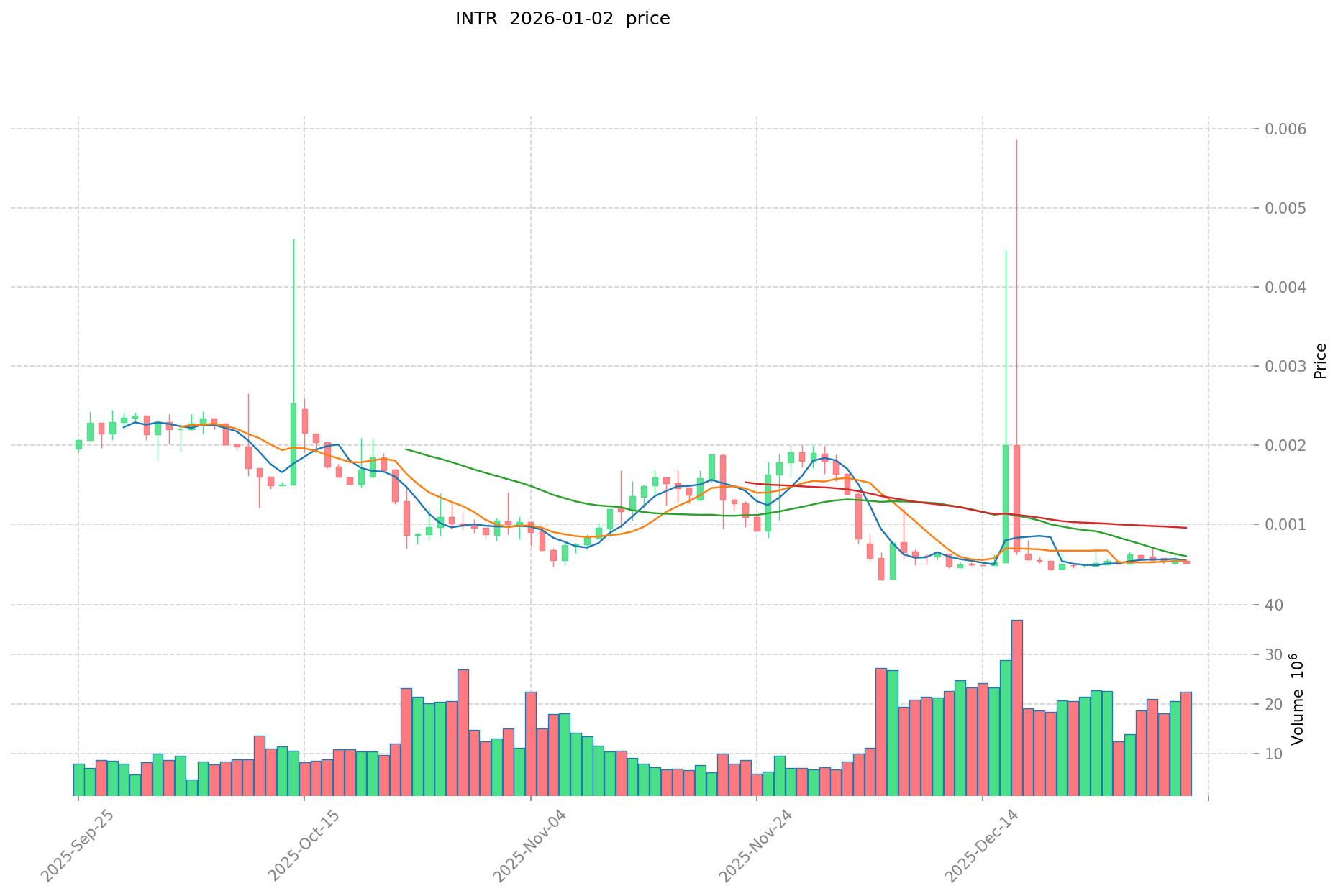
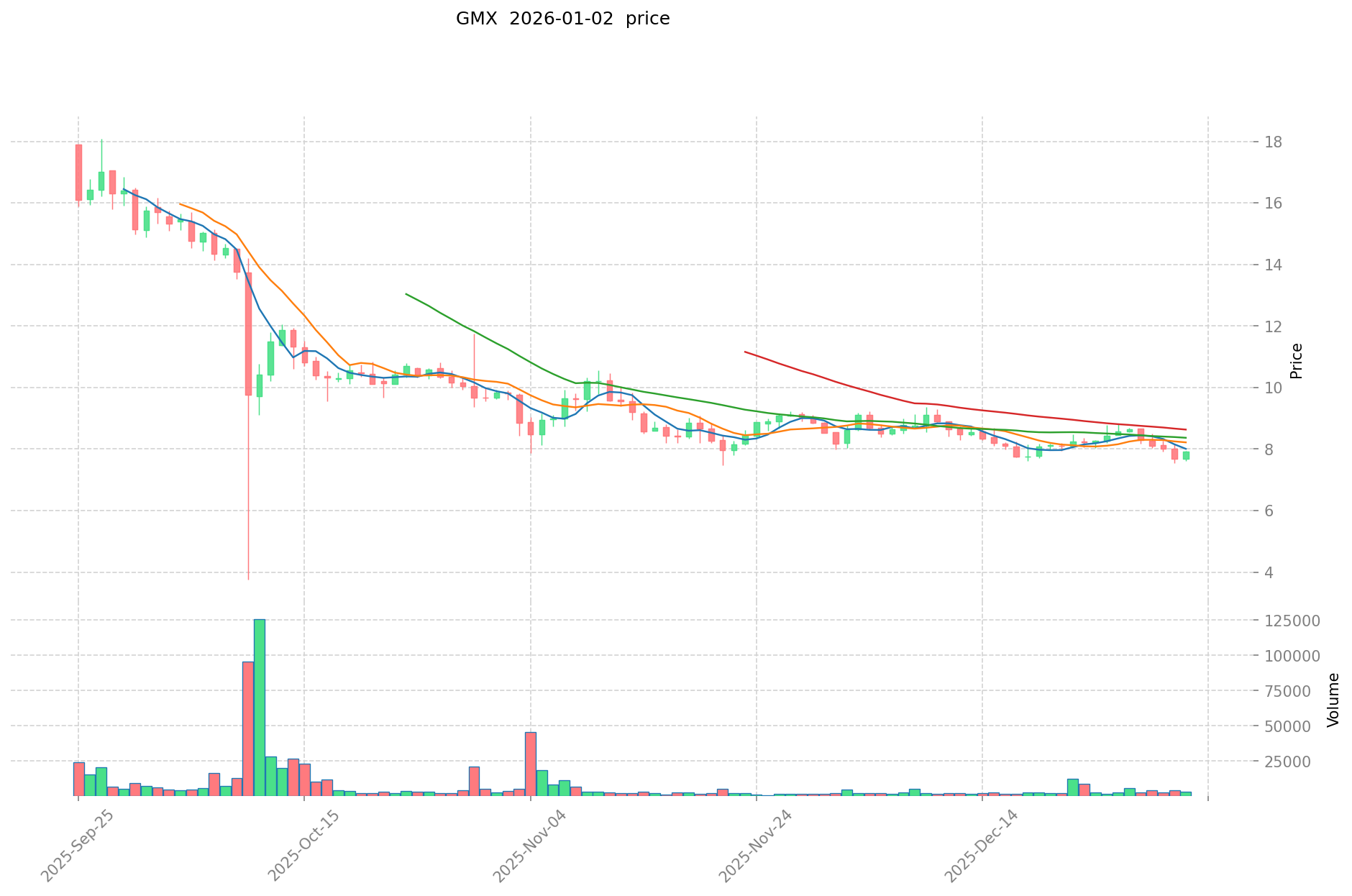
{INTR (Interlay)} and {GMX} Historical Price Trends
- 2022: INTR reached its all-time high of $0.200574 on July 19, 2022, driven by the expansion of cross-chain bridge infrastructure and increased adoption of Polkadot ecosystem solutions.
- 2023: GMX achieved its all-time high of $91.07 on April 18, 2023, reflecting strong market sentiment for decentralized derivatives trading platforms.
- Comparative Analysis: In the 2022-2026 market cycle, INTR declined from its peak of $0.200574 to $0.0005311 (a 99.73% decrease), while GMX experienced a contraction from $91.07 to $7.925 (a 91.30% decrease), demonstrating greater relative resilience in the derivatives exchange sector compared to bridge infrastructure tokens.
Current Market Status (January 3, 2026)
- INTR current price: $0.0005311
- GMX current price: $7.925
- 24-hour trading volume: INTR $11,690.11 vs GMX $31,866.29
- Cryptocurrency Fear & Greed Index: 28 (Fear)
Click to view real-time prices:
INTR vs GMX Investment Value: Core Influencing Factors
I. Tokenomics Comparison
Supply Mechanism
- GMX: The $GMX token operates within the GMX protocol ecosystem, where token value is directly tied to protocol revenue. The protocol generates fees from trading activities, and these revenues support token value dynamics.
- INTR: Insufficient information available in reference materials regarding specific tokenomics or supply mechanisms.
Historical Patterns
Protocol revenue directly influences token price movements. As demonstrated by GMX, when protocol revenue increases, corresponding upward pressure on token valuation typically follows, establishing a revenue-price correlation pattern.
II. Institutional Adoption and Market Applications
Institutional Holdings
- GMX: Institutional investors play a significant role in market dynamics. However, recent data indicates continuous outflows from cryptocurrency ETFs, suggesting institutional capital reallocation during this period.
- INTR: No institutional holdings data available in reference materials.
Protocol Revenue and Application
- GMX: Functions as a decentralized exchange protocol with primary revenue generation through trading fees. The protocol's success directly correlates with user trading volume and market adoption.
- INTR: Insufficient application data in available materials.
Regulatory Environment
- General market context: DeFi protocols face increasing regulatory scrutiny, with provisions focusing on operational resilience and security standards creating indirect pressure on protocol operations.
III. Technical Development and Ecosystem Building
Security and Risk Factors
Recent market analysis indicates that DEX attacks in 2025 resulted in $3.1 billion in losses across major incidents. This emphasizes the critical importance of security track records in capital allocation decisions toward DeFi protocols.
Ecosystem Maturity
Capital flows increasingly favor protocols with strong security records. The DeFi ecosystem is transitioning toward transparency in trust assumptions rather than purely "trustless" architecture, allowing users to make informed risk assessments.
IV. Macroeconomic Environment and Market Cycles
Institutional Sentiment and Capital Flows
ETF continuous outflows clearly demonstrate institutional capital repositioning in the cryptocurrency market, representing a core external factor influencing both INTR and GMX investment values.
Market Dynamics
Institutional investor sentiment, protocol revenue performance, and broader market trends constitute the fundamental drivers of investment value for both tokens. The relationship between protocol performance metrics and token valuation remains central to investment analysis.
III. 2026-2031 Year Price Prediction: INTR vs GMX
Short-term Prediction (2026)
- INTR: Conservative $0.00048551-$0.0005165 | Optimistic $0.000531995
- GMX: Conservative $5.47929-$7.941 | Optimistic $10.08507
Medium-term Prediction (2028-2029)
- INTR may enter consolidation phase with recovery potential, estimated price range $0.000360341519125-$0.000981167204193
- GMX may enter growth phase with expansion potential, estimated price range $7.25233861275-$11.1130315963425
- Key drivers: institutional capital inflow, ETF launches, ecosystem development
Long-term Prediction (2030-2031)
- INTR: Base scenario $0.000853978862909-$0.001272428505735 | Optimistic scenario $0.001275844421186
- GMX: Base scenario $10.43065246323375-$11.890943808086475 | Optimistic scenario $13.727781706861938
View detailed price predictions for INTR and GMX
INTR:
| 年份 |
预测最高价 |
预测平均价格 |
预测最低价 |
涨跌幅 |
| 2026 |
0.000531995 |
0.0005165 |
0.00048551 |
-2 |
| 2027 |
0.000697249175 |
0.0005242475 |
0.00030406355 |
-1 |
| 2028 |
0.00084283270575 |
0.0006107483375 |
0.000360341519125 |
14 |
| 2029 |
0.000981167204193 |
0.000726790521625 |
0.000421538502542 |
36 |
| 2030 |
0.001272428505735 |
0.000853978862909 |
0.000461148585971 |
60 |
| 2031 |
0.001275844421186 |
0.001063203684322 |
0.000946251279046 |
100 |
GMX:
| 年份 |
预测最高价 |
预测平均价格 |
预测最低价 |
涨跌幅 |
| 2026 |
10.08507 |
7.941 |
5.47929 |
0 |
| 2027 |
9.82420815 |
9.013035 |
8.38212255 |
13 |
| 2028 |
10.07792508525 |
9.418621575 |
7.25233861275 |
18 |
| 2029 |
11.1130315963425 |
9.748273330125 |
9.1633769303175 |
23 |
| 2030 |
11.890943808086475 |
10.43065246323375 |
7.09284367499895 |
31 |
| 2031 |
13.727781706861938 |
11.160798135660112 |
5.915223011899859 |
40 |
IV. Investment Strategy Comparison: INTR vs GMX
Long-term vs Short-term Investment Strategy
- INTR: Suitable for investors focused on cross-chain bridge infrastructure potential and ecosystem expansion within Polkadot and multi-chain DeFi scenarios. Best suited as a long-term speculative position given the 99.73% decline from peak and potential recovery in 2028-2031
- GMX: Suitable for investors seeking exposure to decentralized derivatives trading with more established protocol revenue models. The 91.30% decline from peak demonstrates greater resilience, making it more appropriate for both medium-term and long-term positions
Risk Management and Asset Allocation
- Conservative investors: INTR 10% vs GMX 90% (preferring established DeFi revenue models)
- Aggressive investors: INTR 50% vs GMX 50% (balancing infrastructure potential with trading platform exposure)
- Hedging tools: Stablecoin reserve (10-20% of portfolio), options for downside protection, cross-protocol diversification
V. Potential Risk Comparison
Market Risk
- INTR: Extreme volatility with 99.73% historical drawdown; limited 24-hour trading volume ($11,690.11) indicates low liquidity and price manipulation susceptibility
- GMX: Persistent institutional capital outflows from cryptocurrency ETFs signal market sentiment weakness; current Fear & Greed Index of 28 reflects broader market pessimism affecting derivatives platforms
Technical Risk
- INTR: Bridge protocol vulnerability to exploits; cross-chain security dependencies on multiple blockchain networks create concentrated failure points
- GMX: DEX attack landscape demonstrates elevated ecosystem risks; 2025 DEX incidents resulted in $3.1 billion losses, establishing precedent for smart contract vulnerabilities in decentralized exchanges
Regulatory Risk
- Global regulatory focus on DeFi operational resilience and security standards creates indirect operational pressure on both protocols
- Bridge protocols like INTR face heightened scrutiny on cross-chain asset custody and anti-money laundering compliance
- Derivatives platforms like GMX encounter increasing regulatory pressure on leverage mechanisms and market manipulation prevention
VI. Conclusion: Which Is the Better Buy?
📌 Investment Value Summary:
- INTR Advantages: Addresses critical cross-chain interoperability gap in multi-chain DeFi ecosystem; potential recovery leverage from extreme drawdown; early-stage infrastructure positioning
- GMX Advantages: Established protocol revenue generation model with direct fee accrual to token holders; demonstrated market-proven derivatives trading demand; greater historical price resilience; stronger institutional adoption potential
✅ Investment Recommendations:
- Beginner investors: GMX recommended; established business model with 30% fee distribution provides clearer value proposition compared to INTR infrastructure complexity
- Experienced investors: Diversified approach with GMX as core holding (70%) and INTR as speculative satellite position (30%) aligns with risk-adjusted return profile across 2026-2031 prediction cycles
- Institutional investors: GMX preferred for capital allocation; institutional ETF flows currently negative across cryptocurrency sector; wait for capital inflow reversal signals before INTR infrastructure plays
⚠️ Risk Disclaimer: Cryptocurrency markets exhibit extreme volatility. Both INTR (99.73% peak drawdown) and GMX (91.30% peak drawdown) demonstrate severe historical losses. Current Fear & Greed Index of 28 reflects depressed market conditions. This analysis does not constitute investment advice; investors must conduct independent research and assess risk tolerance before capital allocation.
FAQ
INTR和GMX分别是什么?各自的核心功能和定位是什么?
INTR是推理型AI技术,核心功能为高效推理和决策支持。GMX是图神经网络机器学习技术,定位于复杂数据关系分析和建模。两者都在加密领域应用前景广阔。
INTR和GMX在交易机制上有什么区别?
GMX采用AMM自动做市商机制,提供杠杆交易和永续合约。INTR的交易机制设计更侧重于现货交易和流动性挖矿,两者在风险管理和交易深度上存在差异。
INTR和GMX的代币经济学模型有什么差异?
INTR总量固定强调稀缺性,GMX采用通缩模型,通过手续费激励持有者,代币供应随时间递减,两者机制差异明显。
使用INTR和GMX进行交易时的费用和收益对比如何?
GMX采用做市商模式,交易费用较低。INTR费用可能相对较高,但两者都支持持币获得交易费用分红和奖励,具体收益差异取决于交易额和持币数量。
INTR和GMX在安全性和风险方面有什么不同?
INTR采用分散化架构,风险主要来自智能合约漏洞和流动性风险。GMX基于衍生品交易,面临清算风险和价格波动风险。INTR相对更注重协议安全,GMX风险更集中在交易执行环节。
INTR和GMX分别适合什么样的用户和交易场景?
INTR适合中小交易者和初级用户,门槛低、操作简单。GMX适合专业交易者和高频交易者,支持更高杠杆和大额交易额,流动性深。
INTR和GMX的生态和社区发展现状如何对比?
INTR更注重透明度和社区治理参与,GMX则专注技术创新与生态协同。GMX交易额领先,社区更活跃;INTR社区增长势头良好,生态建设稳步推进,两者发展方向各具特色。
投资INTR和GMX代币哪个更具潜力?
GMX代币提供治理权并分享平台盈利,而INTR缺乏这些优势。GMX治理代币更值得持有,具有更强的潜力。
* The information is not intended to be and does not constitute financial advice or any other recommendation of any sort offered or endorsed by Gate.