# INTR vs LTC: A Comprehensive Comparison of Two Distinct Cryptocurrencies and Their Market Performance
This article provides an in-depth investment comparison between Interlay (INTR), a cross-chain DeFi bridge infrastructure project, and Litecoin (LTC), an established peer-to-peer digital currency. The analysis covers historical price trends, tokenomics, technological ecosystems, and market performance metrics to help investors evaluate these two asset categories. Readers will discover detailed price forecasts through 2031, risk assessments, and tailored investment strategies on Gate. Whether you're a beginner seeking stable assets or an experienced investor exploring asymmetric upside potential, this guide addresses critical questions about portfolio allocation, liquidity comparison, and long-term value positioning in the cryptocurrency market.
Introduction: INTR vs LTC Investment Comparison
In the cryptocurrency market, the comparison between Interlay (INTR) and Litecoin (LTC) represents two distinct approaches within the digital asset ecosystem. The two projects differ significantly in market capitalization ranking, application scenarios, and price performance, embodying different positioning strategies within the crypto landscape.
Interlay (INTR): A decentralized network dedicated to connecting cryptocurrencies such as Bitcoin with DeFi platforms like Polkadot and Ethereum, serving as a bridge infrastructure for cross-chain interoperability.
Litecoin (LTC): Since its launch, it has been recognized as a peer-to-peer digital currency system with faster transaction confirmation times compared to Bitcoin, offering efficient network transaction capacity with a maximum supply capped at 84 million coins.
This article will provide a comprehensive analysis of the investment value comparison between INTR and LTC across historical price trends, supply mechanisms, liquidity metrics, and technological ecosystems, addressing key questions for investors evaluating these two different asset categories.
"Which is the better buy right now?"
I. Price History Comparison and Current Market Status
INTR (Interlay) and LTC (Litecoin) Historical Price Trends
- 2022: INTR reached its all-time high of $0.200574 on July 19, 2022, reflecting early market enthusiasm for the Polkadot ecosystem bridge project.
- 2021: LTC reached its all-time high of $410.26 on May 10, 2021, during the broader cryptocurrency bull market cycle.
- Comparative Analysis: From its peak in 2022 to December 2025, INTR declined from $0.200574 to approximately $0.0005309, representing a 99.74% decrease. In contrast, LTC declined from its 2021 peak of $410.26 to $81.3 as of January 3, 2026, representing an 80.19% decrease over a longer timeframe.
Current Market Status (January 3, 2026)
- INTR current price: $0.0005309
- LTC current price: $81.3
- 24-hour trading volume: INTR $11,524.98 vs LTC $3,114,575.53
- Market sentiment index (Fear & Greed Index): 28 (Fear)
Click to view real-time prices:
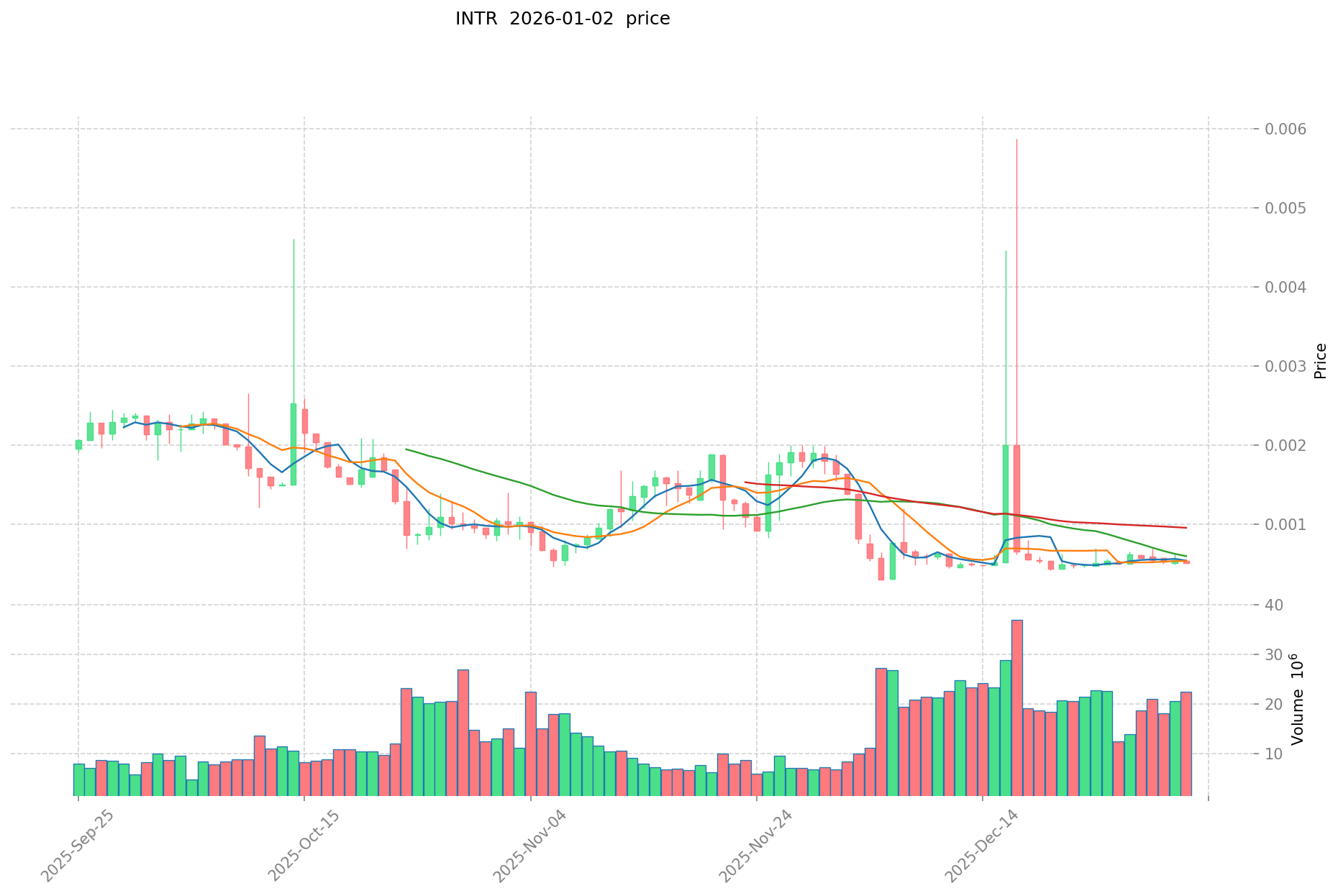
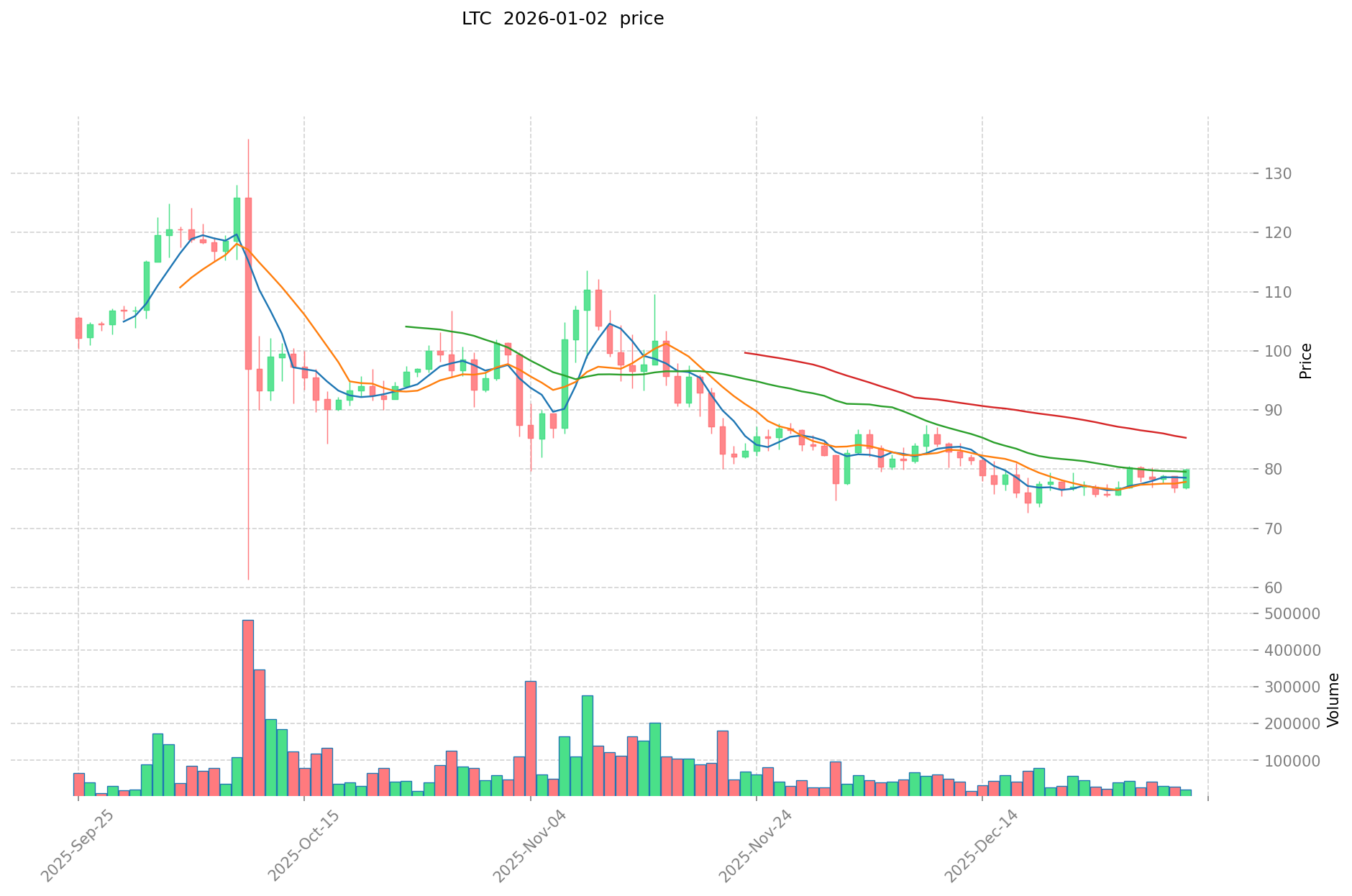
二、影响 INTR vs LTC 投资价值的核心因素
供应机制对比(Tokenomics)
- LTC:Total supply of 84 million coins, four times that of Bitcoin's 21 million. Larger supply distribution enhances market liquidity and accessibility. Uses Scrypt algorithm requiring high memory resources, making mining more accessible to ordinary miners and reducing ASIC monopoly.
- 📌 Historical Pattern:LTC's abundant supply and distributed mining characteristics support broad market participation, though this differs fundamentally from Bitcoin's scarcity model.
技术发展与生态建设
- LTC 技术升级:Pioneered SegWit adoption, supports Lightning Network for payment channels, and introduced MWEB extension block solution. These updates enhance network efficiency, increase privacy features, and improve usability. Technical improvements typically drive short-term price appreciation through enhanced investor confidence.
- 区块生成速度优势:Average block generation time of 2.5 minutes, four times faster than Bitcoin's 10 minutes. This enables shorter transaction confirmation times, making LTC more suitable for daily consumption and high-frequency payments.
- 交易费用:Transaction fees typically remain below $0.01 USD, maintaining low costs even during network congestion periods.
宏观经济与市场周期
- Bitcoin 市场关联性:LTC exhibits high correlation with Bitcoin (BTC). When Bitcoin experiences significant price movements, Litecoin typically follows the same direction. As the market leader, Bitcoin's performance strongly influences overall market sentiment.
- 舆论与社群影响:Media reports, KOL social media activity, and community engagement can drive significant short-term price volatility. LTC remains susceptible to sentiment-driven movements.
- 经济环境因素:Inflation, interest rate changes, and US Dollar index movements affect capital inflows into cryptocurrency markets. During economic uncertainty, some investors view LTC as a hedge tool.
III. 2026-2031 Price Forecast: INTR vs LTC
Short-term Forecast (2026)
- INTR: Conservative $0.000340 - $0.000531 | Bullish $0.000531 - $0.000568
- LTC: Conservative $52.07 - $81.36 | Bullish $81.36 - $107.40
Mid-term Forecast (2027-2029)
- INTR may enter accumulation phase, estimated price range $0.000423 - $0.001129
- LTC may enter growth phase, estimated price range $66.06 - $170.88
- Key drivers: Institutional capital inflows, ETF adoption, ecosystem development
Long-term Forecast (2030-2031)
- INTR: Base case $0.000825 - $0.000976 | Bullish case $0.001005 - $0.001123
- LTC: Base case $130.07 - $174.41 | Bullish case $201.01 - $245.92
View detailed price forecasts for INTR and LTC
INTR:
| 年份 |
预测最高价 |
预测平均价格 |
预测最低价 |
涨跌幅 |
| 2026 |
0.000568063 |
0.0005309 |
0.000339776 |
0 |
| 2027 |
0.000719820765 |
0.0005494815 |
0.000423100755 |
3 |
| 2028 |
0.00090120460815 |
0.0006346511325 |
0.000412523236125 |
19 |
| 2029 |
0.001128853969377 |
0.000767927870325 |
0.000468436000898 |
44 |
| 2030 |
0.001005294375042 |
0.000948390919851 |
0.00082510010027 |
78 |
| 2031 |
0.001123369044563 |
0.000976842647446 |
0.000879158382702 |
83 |
LTC:
| 年份 |
预测最高价 |
预测平均价格 |
预测最低价 |
涨跌幅 |
| 2026 |
107.3952 |
81.36 |
52.0704 |
0 |
| 2027 |
128.353536 |
94.3776 |
66.06432 |
16 |
| 2028 |
138.09330432 |
111.365568 |
64.59202944 |
36 |
| 2029 |
170.8793275392 |
124.72943616 |
97.2889602048 |
53 |
| 2030 |
201.013959315456 |
147.8043818496 |
130.067856027648 |
81 |
| 2031 |
245.91693052136448 |
174.409170582528 |
153.48007011262464 |
114 |
IV. Investment Strategy Comparison: INTR vs LTC
Long-term vs Short-term Investment Strategy
- INTR: Suitable for investors focusing on ecosystem development potential and cross-chain infrastructure opportunities, with expectations for gradual accumulation through mid-term phases
- LTC: Suitable for investors seeking established payment functionality, lower volatility relative to smaller-cap assets, and inflation-hedging properties through proven peer-to-peer transaction capabilities
Risk Management and Asset Allocation
- Conservative investors: INTR 5% vs LTC 95%
- Aggressive investors: INTR 25% vs LTC 75%
- Hedging tools: Stablecoin allocation, options strategies, cross-asset diversification combining both positions with Bitcoin correlation exposure
V. Potential Risk Comparison
Market Risk
- INTR: Extreme price volatility with 99.74% decline from historical peak, limited liquidity with 24-hour trading volume of $11,524.98, vulnerability to sentiment shifts in early-stage DeFi infrastructure projects
- LTC: High correlation with Bitcoin creates systematic market risk, substantial past decline of 80.19% from 2021 peak exposes vulnerability to broader cryptocurrency market cycles and macroeconomic conditions
Technology Risk
- INTR: Early-stage bridge infrastructure faces scalability challenges, cross-chain security vulnerabilities, and dependency on connected ecosystem development
- LTC: Potential mining centralization despite Scrypt algorithm design, network security contingent on maintaining adequate hash rate, competition from alternative Layer 2 solutions
Regulatory Risk
- Global regulatory policies affect both assets similarly as cryptocurrency categories, though bridge infrastructure projects like INTR face additional scrutiny regarding cross-chain asset custody and security. LTC's established payment protocol receives relatively clearer regulatory frameworks across jurisdictions
VI. Conclusion: Which Is the Better Buy?
📌 Investment Value Summary:
- INTR Advantages: Early-stage cross-chain infrastructure positioning, potential for significant appreciation from current low valuations, exposure to growing DeFi and interoperability trends
- LTC Advantages: Established market presence with proven transaction utility, lower volatility profile relative to emerging projects, faster block confirmation times supporting payment use cases, stronger liquidity and trading infrastructure
✅ Investment Recommendations:
- Beginner investors: Prioritize LTC for its established track record, lower technical complexity, and relative market stability, with minimal INTR exposure due to higher risk profile
- Experienced investors: Consider balanced allocation favoring LTC core position with strategic INTR allocation for asymmetric upside potential, utilizing dollar-cost averaging for INTR exposure across accumulation phases
- Institutional investors: Focus on LTC for portfolio diversification and payment infrastructure exposure, evaluate INTR participation only following significant ecosystem validation and reduced execution risks
⚠️ Risk Disclaimer: Cryptocurrency markets exhibit extreme volatility. This article does not constitute investment advice. All investment decisions should incorporate individual risk tolerance, investment timeframe, and comprehensive due diligence.
FAQ
INTR和LTC分别是什么?它们各自的主要功能和应用场景是什么?
INTR是智能合约平台,用于去中心化应用开发。LTC(莱特币)是支付币,提供快速低成本交易。INTR主要应用于DeFi生态,LTC用于日常转账支付。
INTR和LTC在技术架构上有什么区别?共识机制、挖矿方式等方面如何对比?
LTC采用PoW共识机制,使用Scrypt算法挖矿,注重去中心化和安全性。INTR作为新兴项目,技术架构和共识机制设计各有侧重。两者都是公链项目,但在性能、扩展性和应用场景上存在差异。
从投资角度看,INTR和LTC哪个更适合长期持有?风险和收益特征有什么不同?
LTC作为老牌币种更稳定,但增长空间有限。INTR作为新兴项目波动性更大,但潜在收益更高。LTC适合保守型投资者,INTR适合风险承受能力强的投资者。长期持有需根据个人风险偏好选择。
INTR和LTC的流动性和交易对支持情况如何对比?
LTC流动性和交易额均高于INTR,在主流交易平台支持广泛。INTR作为新兴代币,流动性相对有限,交易对支持数量较少。LTC具有更成熟的市场基础和交易生态。
INTR作为跨链资产桥接协议,相比LTC这样的传统公链有什么优势和劣势?
INTR优势:跨链互操作性强,交易额低、速度快。劣势:生态成熟度不如LTC,安全历史沉淀较少。LTC作为传统公链,用户基础扎实,但跨链能力有限。
* The information is not intended to be and does not constitute financial advice or any other recommendation of any sort offered or endorsed by Gate.














