# Article Overview: Is Colend (CLND) a Good Investment?
Colend (CLND) is the premier decentralized lending protocol on Core Chain, enabling Bitcoin holders to generate yield through lending and staking within the emerging BTCFi sector. This comprehensive analysis examines CLND's investment potential by evaluating current market performance ($0.01674 as of January 4, 2026), tokenomics with only 3.68% circulating supply, and price projections through 2031. The article addresses critical questions for investors across all experience levels: whether CLND represents viable BTCFi exposure, what risks accompany its -91.32% annual decline, and how the protocol's innovative ve(3,3) governance model positions it within the competitive lending landscape. Structured through price history review, token economics analysis, risk assessment, and multi-scenario price forecasts, this guide helps both conservative and aggressive investors make informed allocation decisions on Gate's trading platform.
Introduction: Colend (CLND) Investment Position and Market Prospects
Colend is an important asset in the cryptocurrency field. As of January 4, 2026, CLND has a market capitalization of $1,674,000 USD with a circulating supply of approximately 3,676,300 tokens. The current price stands at $0.01674 per token. Positioned as the premier decentralized lending protocol on Core Chain, CLND has emerged as a focal point when investors discuss "Is Colend (CLND) a good investment?"
Colend operates on Core Chain, the fastest-growing Bitcoin sidechain, pioneering the BTCFi sector by transforming Bitcoin into a productive asset. This enables holders to generate yield through lending and staking while supporting Bitcoin's long-term security. With the BTCFi market currently representing less than 1% of total cryptocurrency market capitalization, the sector presents substantial growth potential. Colend differentiates itself through its innovative ve(3,3) governance model, which grants users significant influence over reward distribution mechanisms.
This article provides a comprehensive analysis of Colend's investment value, historical price performance, future price predictions, and investment risks to serve as a reference for investors.
Colend (CLND) Comprehensive Research Report
I. Price History Review and Current Investment Value Status
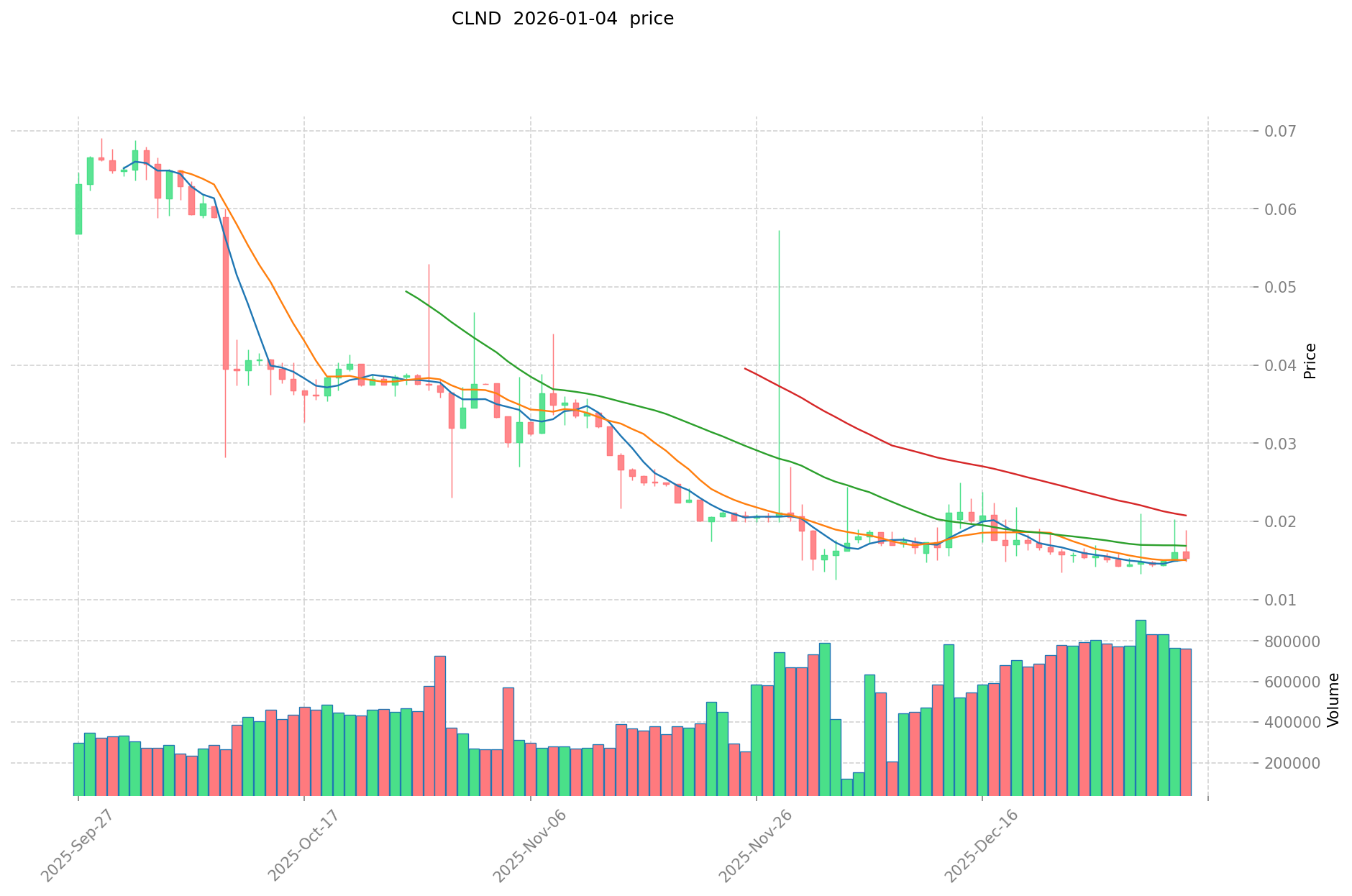
All-Time High (ATH): $0.33999 (November 30, 2024)
All-Time Low (ATL): $0.01254 (December 3, 2025)
Price Decline from ATH: -91.32% (1-Year Performance)
The token experienced a significant contraction from its peak valuation to current levels, reflecting a substantial drawdown of over 91% year-over-year. This represents one of the most severe downturns in the asset's trading history.
Current Market Status (January 4, 2026)
| Metric |
Value |
| Current Price |
$0.01674 |
| 24-Hour Change |
+5.8% |
| 1-Hour Change |
+3.85% |
| 7-Day Change |
+8.26% |
| 30-Day Change |
-4.33% |
| Market Capitalization |
$61,541.26 |
| Fully Diluted Valuation (FDV) |
$1,674,000.00 |
| 24-Hour Trading Volume |
$12,593.22 |
| Market Dominance |
0.000050% |
24-Hour Price Range: $0.01481 - $0.02029
View real-time CLND market price at Gate
II. Project Overview
Protocol Description
Colend is the premier decentralized lending protocol operating on the Core Chain, which functions as the fastest-growing Bitcoin sidechain. The protocol positions itself at the intersection of Bitcoin Finance (BTCFi) and DeFi infrastructure.
Core Value Proposition
Productive Bitcoin Assets: Colend enables Bitcoin holders to transform their holdings into productive assets by participating in lending and staking mechanisms while maintaining long-term network security support.
Market Opportunity: The BTCFi market currently represents less than 1% of total cryptocurrency market capitalization, indicating substantial growth potential relative to the broader digital asset ecosystem.
Governance Innovation
ve(3,3) Model: Colend implements a unique tokenomic governance structure that grants users meaningful influence over reward distribution mechanisms. This design emphasizes community participation in protocol decision-making.
III. Token Economics
Supply Metrics
| Parameter |
Value |
| Total Supply |
100,000,000 CLND |
| Maximum Supply |
100,000,000 CLND |
| Circulating Supply |
3,676,300 CLND |
| Circulation Ratio |
3.6763% |
| Market Cap to FDV Ratio |
3.68% |
Token Distribution Context
The current circulating supply represents only 3.68% of fully diluted valuation, indicating a significant portion of tokens remain in unvested or reserved allocations.
IV. Network Metrics
| Metric |
Value |
| Token Holders |
4,875 |
| Exchange Listings |
1 |
| Market Ranking |
#5,475 |
| Blockchain Network |
Core Chain (CORE) |
| Smart Contract Address |
0x30a540b05468a250fcc17da2d9d4aaa84b358ea7 |
V. Community and Resources
Official Channels:
VI. Market Context
Sector Focus: Bitcoin Finance (BTCFi) Infrastructure
Platform: Core Chain - Fastest-growing Bitcoin sidechain
Protocol Category: Decentralized Lending
The protocol operates within an emerging market segment that remains in early adoption phases relative to broader cryptocurrency market penetration.
Report Generated: January 4, 2026
Disclaimer: This report presents factual data derived from provided sources. It does not constitute investment advice, financial recommendation, or market prediction. Cryptocurrency assets carry inherent risks including but not limited to volatility, liquidity constraints, and technology risks.
Colend (CLND) Investment Analysis Report
Report Date: January 4, 2026
I. Executive Summary
Colend (CLND) is the premier decentralized lending protocol on Core Chain, the fastest-growing Bitcoin sidechain. As of January 4, 2026, CLND is trading at $0.01674 with a 24-hour trading volume of $12,593.22. The token has experienced significant volatility, with an all-time high of $0.33999 (November 30, 2024) and a recent low of $0.01254 (December 3, 2025), representing a -91.32% decline over the past year.
II. Core Factors Influencing CLND as an Investment
I. Supply Mechanism and Scarcity (CLND Investment Scarcity)
Token Supply Structure:
- Total Supply: 100,000,000 CLND
- Circulating Supply: 3,676,300 CLND (3.68% of total)
- Current Holders: 4,875 addresses
- Circulation Ratio: 3.6763%
The low circulating supply ratio indicates substantial token reserves remain unlocked. This creates a potential supply overhang that could impact price dynamics as additional tokens enter circulation. The scarcity mechanism depends heavily on vesting schedules and release mechanisms, which remain critical variables for long-term valuation.
II. Protocol Innovation and Governance (Technology & Ecosystem for CLND Investment)
ve(3,3) Governance Model:
Colend implements a unique ve(3,3) governance framework that provides users with substantial influence over reward distribution mechanisms. This tokenomic design aligns user incentives with protocol success and enables community-driven decision-making regarding liquidity provision and incentive allocation.
Ecosystem Position:
- Operates on Core Chain, described as the fastest-growing Bitcoin sidechain
- Positioned within the BTCFi (Bitcoin Finance) sector
- Enables yield generation through lending and staking mechanisms
III. Market Positioning within BTCFi Sector
Market Context:
The BTCFi market currently represents less than 1% of total cryptocurrency market capitalization, indicating substantial growth potential for protocols operating in this sector. Colend's positioning as a lending protocol addresses a critical need: converting Bitcoin from a non-productive asset into a yield-generating instrument while maintaining Bitcoin's long-term security properties.
Current Market Metrics:
- Market Capitalization: $61,541.26
- Fully Diluted Valuation: $1,674,000
- Market Dominance: 0.00005%
- Market Cap to FDV Ratio: 3.68%
Recent Price Movements
| Time Period |
Change Percentage |
Absolute Change |
| 1 Hour |
+3.85% |
+$0.000621 |
| 24 Hours |
+5.8% |
+$0.000918 |
| 7 Days |
+8.26% |
+$0.001277 |
| 30 Days |
-4.33% |
-$0.000758 |
| 1 Year |
-91.32% |
-$0.176117 |
Price Range (24-Hour):
- High: $0.02029
- Low: $0.01481
- Current: $0.01674
The token demonstrates short-term recovery momentum (positive 1-hour, 24-hour, and 7-day returns) following a sustained year-long decline. However, significant price volatility persists.
IV. Roadmap and Development Initiatives for 2025
Colend's planned developments for 2025 include:
Subscription Model:
Implementation of a monthly subscription mechanism utilizing CLND tokens, enabling users to receive bonus rewards in deposited assets (e.g., USDT rewards for USDT deposits).
Credit Card Integration:
Development of the first crypto credit card associated with the Colend ecosystem, potentially expanding use cases and accessibility.
V. Trading Activity and Liquidity
Exchange Presence:
- Primary Exchange: Gate
- Active Trading Pair: CLND/USDT
- 24-Hour Trading Volume: $12,593.22
The concentrated exchange presence (currently on 1 exchange) represents a liquidity constraint that may limit accessibility and trading flexibility for potential investors.
VI. Community and Resources
Official Channels:
VII. Key Investment Considerations
Positive Factors:
- Operates within emerging BTCFi sector with substantial growth potential
- Innovative ve(3,3) governance structure
- Active development roadmap for 2025
- Short-term price recovery momentum
Risk Factors:
- Extreme year-long price decline (-91.32%)
- Limited exchange availability (single exchange)
- Small holder base (4,875 addresses) indicating concentrated ownership
- Low market capitalization and liquidity
- Significant token supply overhang (96.32% unlocked)
- Overall crypto market volatility and regulatory uncertainty
VIII. Conclusion
Colend presents a specialized investment opportunity within the emerging BTCFi sector. The protocol addresses a legitimate market need by enabling productive use of Bitcoin assets. However, the investment carries substantial risk due to extreme price volatility, limited liquidity infrastructure, and significant token supply dynamics. Investors should conduct thorough due diligence regarding tokenomics, development progress, and market adoption before considering allocation decisions.
III. CLND Future Investment Predictions and Price Outlook (Is Colend(CLND) worth investing in 2026-2031)
Short-term Investment Prediction (2026, short-term CLND investment outlook)
- Conservative Forecast: $0.01255 - $0.01674
- Neutral Forecast: $0.01674 - $0.02039
- Optimistic Forecast: $0.02039 - $0.02394
Mid-term Investment Outlook (2027-2029, mid-term Colend(CLND) investment forecast)
- Market Stage Expectation: Recovery and growth phase with increasing adoption of BTCFi protocols on Core Chain ecosystem
- Investment Return Forecast:
- 2027: $0.01464 - $0.03031 (21% upside potential)
- 2028: $0.01443 - $0.03570 (51% upside potential)
- 2029: $0.02044 - $0.03295 (82% upside potential)
- Key Catalysts: Expansion of BTCFi market penetration, ve(3,3) governance model adoption improvements, Core Chain ecosystem growth acceleration, Bitcoin productive asset utilization trends
Long-term Investment Outlook (Is Colend a good long-term investment?)
- Base Case: $0.02316 - $0.03586 USD (corresponding to steady market expansion and mainstream application development)
- Optimistic Case: $0.03180 - $0.04630 USD (corresponding to large-scale adoption and favorable market conditions)
- Risk Case: $0.01255 - $0.01800 USD (under adverse regulatory environment or protocol competition intensification)
Click to view CLND long-term investment and price predictions: Price Prediction
2026-2031 Long-term Outlook
- Base Case: $0.02316 - $0.03586 USD (corresponding to steady BTCFi market growth and Core Chain mainstream recognition)
- Optimistic Case: $0.03180 - $0.04630 USD (corresponding to widespread adoption of Bitcoin yield protocols and significant BTCFi market share expansion)
- Transformative Case: $0.04630 USD and above (contingent upon breakthrough ecosystem development and mainstream adoption of Bitcoin as productive asset)
- 2031-12-31 Predicted High: $0.04630 USD (based on optimistic development scenario)
Disclaimer
This analysis is based on historical data and publicly available forecasts as of January 4, 2026. It does not constitute investment advice, financial recommendations, or endorsement of any trading strategy. Cryptocurrency markets are highly volatile and subject to regulatory, technological, and market risks. Investors should conduct independent research and consult financial advisors before making investment decisions. Past performance does not guarantee future results.
| 年份 |
预测最高价 |
预测平均价格 |
预测最低价 |
涨跌幅 |
| 2026 |
0.0239382 |
0.01674 |
0.012555 |
0 |
| 2027 |
0.030305259 |
0.0203391 |
0.014644152 |
21 |
| 2028 |
0.035704273095 |
0.0253221795 |
0.014433642315 |
51 |
| 2029 |
0.0329542844013 |
0.0305132262975 |
0.020443861619325 |
82 |
| 2030 |
0.035859143544822 |
0.0317337553494 |
0.023165641405062 |
89 |
| 2031 |
0.046301135742542 |
0.033796449447111 |
0.023319550118506 |
101 |
Colend (CLND) Research Report
Report Date: January 4, 2026
Data Source: Gate Data
Last Updated: 2026-01-04 22:16:29
I. Project Overview
Project Introduction
Colend is the premier decentralized lending protocol on Core Chain, the fastest-growing BTC sidechain. BTCFi is transforming Bitcoin into a productive asset, allowing holders to earn yield through lending and staking while supporting Bitcoin's long-term security. With the BTCFi market representing less than 1% of the total crypto market cap, there is vast potential for growth. Colend innovates through its unique ve(3,3) governance model, giving users substantial influence over reward distribution.
| Metric |
Value |
| Token Name |
Colend |
| Token Symbol |
CLND |
| Network |
Core Chain (CORE) |
| Contract Address |
0x30a540b05468a250fcc17da2d9d4aaa84b358ea7 |
| Market Ranking |
#5475 |
| Launch Date |
November 7, 2024 |
| Official Website |
https://colend.xyz/ |
| Documentation |
https://colend.gitbook.io/home |
II. Token Economics & Market Data
Supply Structure
| Metric |
Value |
| Total Supply |
100,000,000 CLND |
| Maximum Supply |
100,000,000 CLND |
| Circulating Supply |
3,676,300 CLND |
| Circulation Ratio |
3.68% |
| Current Holders |
4,875 |
| Metric |
Value |
| Current Price |
$0.01674 |
| 24H High / Low |
$0.02029 / $0.01481 |
| All-Time High |
$0.33999 (November 30, 2024) |
| All-Time Low |
$0.01254 (December 3, 2025) |
| Launch Price |
$0.15 |
Market Capitalization
| Metric |
Value |
| Market Cap |
$61,541.26 |
| Fully Diluted Valuation (FDV) |
$1,674,000.00 |
| Market Cap / FDV Ratio |
3.68% |
| Market Dominance |
0.000050% |
| 24H Trading Volume |
$12,593.22 |
III. Price Trend Analysis
Price Movement (as of January 4, 2026)
| Time Period |
Change |
Change Amount |
| 1 Hour |
+3.85% |
+$0.000621 |
| 24 Hours |
+5.80% |
+$0.000918 |
| 7 Days |
+8.26% |
+$0.001277 |
| 30 Days |
-4.33% |
-$0.000758 |
| 1 Year |
-91.32% |
-$0.176117 |
Market Sentiment
Current market sentiment indicates cautious interest, though the token has experienced significant volatility since launch.
Key Observations
- Short-term Recovery: CLND has shown positive momentum in the last 24 hours (+5.80%) and over 7 days (+8.26%), suggesting near-term buyer interest.
- Long-term Decline: The token has declined -91.32% over the past year, reflecting significant price pressure from its launch price of $0.15.
- Price Compression: Current price ($0.01674) is substantially below the all-time high ($0.33999), representing an -95% decline from peak valuations.
IV. Investment Strategy and Risk Management
Investment Methodology
Long-Term Holding (HODL Strategy):
- Suitable for investors believing in BTCFi market growth and Colend's protocol positioning
- Requires confidence in the Core Chain ecosystem development
- Appropriate for risk-tolerant investors with multi-year investment horizons
Active Trading:
- Leverage technical analysis opportunities given the token's volatility
- Consider swing trading around identified support/resistance levels
- Monitor macro Bitcoin and broader crypto market conditions
Risk Management
Asset Allocation Considerations:
- Conservative investors: 0-2% portfolio allocation to early-stage DeFi protocols
- Aggressive investors: 2-5% allocation for high-risk BTCFi exposure
- Institutional investors: Weighted allocation based on BTCFi thesis strength and market development
Risk Mitigation:
- Diversify BTCFi exposure across multiple lending protocols
- Maintain positions in larger-cap Bitcoin assets for portfolio stability
- Use stop-loss orders to manage downside risk
Secure Storage:
- Self-custody via non-custodial wallets for significant holdings
- Hardware wallet options for long-term storage
- Multi-signature security for institutional positions
V. Investment Risks and Challenges
Market Risks
- High Volatility: CLND exhibits extreme price swings, with -95% decline from peak and ongoing fluctuations
- Low Liquidity: Limited trading volume ($12,593.24 daily) relative to market cap poses execution challenges
- Market Concentration: Small circulating supply relative to total supply indicates significant dilution risk upon future token releases
Regulatory Risks
- Jurisdictional Uncertainty: DeFi protocols face evolving regulatory frameworks across different regions
- Bitcoin-related Compliance: Regulatory approaches to Bitcoin-native financial services remain uncertain
Technology and Protocol Risks
- Early-stage Protocol: Colend operates as a new lending protocol with limited historical performance data
- Core Chain Adoption Risk: Protocol success depends on Core Chain ecosystem growth and adoption
- Smart Contract Risk: All DeFi protocols carry inherent smart contract vulnerability risks
- Governance Concentration: Early-stage protocols may face governance centralization risks despite ve(3,3) mechanisms
Market Development Risks
- BTCFi Adoption Risk: Success depends on broader adoption of Bitcoin as productive asset
- Competitive Pressure: Multiple lending protocols compete for market share and liquidity
- Funding and Development: Protocol sustainability depends on continued development resources
VI. Conclusion: Is CLND a Good Investment?
Investment Value Assessment
Colend presents a speculative investment opportunity positioned within the emerging BTCFi sector. The protocol operates on the rapidly-growing Core Chain and seeks to capitalize on Bitcoin's transformation into a productive asset through decentralized lending. However, the token has experienced severe price depreciation (-91.32% annually) from its launch price, reflecting significant market challenges and investor caution.
The extremely low circulating supply ratio (3.68%) presents both opportunity and risk, with substantial token supply remaining to be released.
Investor Guidance
✅ Beginner Investors:
- Dollar-cost averaging (DCA) into small CLND positions if allocating to BTCFi exposure
- Prioritize secure self-custody using non-custodial wallets
- Maintain CLND allocation under 2% of total portfolio
✅ Experienced Investors:
- Consider technical analysis-based swing trading around support/resistance levels
- Maintain broader BTCFi portfolio diversification beyond Colend
- Monitor Core Chain ecosystem developments and TVL metrics
✅ Institutional Investors:
- Evaluate Colend positioning within broader BTCFi investment strategy
- Conduct detailed protocol economics and governance analysis
- Consider allocation weightings based on BTCFi market development thesis
Risk Warning
⚠️ Important Disclaimer: Cryptocurrency investments carry substantial risk including potential total loss of capital. CLND exhibits extreme volatility and operates within an early-stage ecosystem. This report is for informational purposes only and does not constitute investment advice. Investors must conduct independent research and consult qualified financial advisors before making investment decisions.
Report Prepared: January 4, 2026
Data Accuracy: Subject to real-time market data availability
Colend (CLND) Frequently Asked Questions
I. What is Colend (CLND) and how does it function?
A: Colend is the premier decentralized lending protocol operating on Core Chain, the fastest-growing Bitcoin sidechain. It enables Bitcoin holders to transform their holdings into productive assets by participating in lending and staking mechanisms while maintaining support for Bitcoin's long-term security. Colend differentiates itself through its innovative ve(3,3) governance model, which grants users substantial influence over reward distribution mechanisms. The protocol positions itself within the BTCFi (Bitcoin Finance) sector, which currently represents less than 1% of total cryptocurrency market capitalization.
A: As of January 4, 2026, CLND is trading at $0.01674 per token with a market capitalization of $61,541.26. The token has shown short-term recovery momentum with gains of +5.80% over 24 hours and +8.26% over 7 days. However, the token has experienced significant long-term decline, declining -91.32% over the past year from its all-time high of $0.33999 (November 30, 2024). Current 24-hour trading volume stands at $12,593.22, indicating limited liquidity.
III. What are the tokenomic characteristics and supply structure of CLND?
A: CLND has a total and maximum supply of 100,000,000 tokens, with only 3,676,300 tokens currently in circulation (3.68% of total supply). The low circulation ratio indicates substantial token reserves remain unlocked through vesting schedules. The market capitalization to fully diluted valuation ratio stands at 3.68%, representing a significant potential supply overhang. Currently, 4,875 token holders maintain positions in CLND, suggesting concentrated ownership distribution.
IV. What are the primary investment risks associated with CLND?
A: CLND carries multiple investment risks including extreme price volatility (down -91.32% annually), limited liquidity with only one exchange listing (Gate), and significant token supply dilution potential (96.32% of supply remains unlocked). Additional risks include early-stage protocol vulnerabilities, dependence on Core Chain ecosystem adoption, uncertain BTCFi market development trajectory, regulatory uncertainty surrounding DeFi protocols, and concentrated holder distribution. The token's substantial decline from launch price ($0.15) to current levels reflects substantial market skepticism.
V. What are the projected price scenarios for CLND through 2031?
A: Price projections vary by scenario through 2031. The conservative short-term forecast (2026) suggests a range of $0.01255 - $0.02394. Mid-term predictions (2027-2029) project potential ranges of $0.01464 - $0.03031 (2027), $0.01443 - $0.03570 (2028), and $0.02044 - $0.03295 (2029), indicating upside potential of 21-82%. Long-term forecasts (2026-2031) suggest base case scenarios of $0.02316 - $0.03586, optimistic scenarios of $0.03180 - $0.04630, and a transformative case scenario exceeding $0.04630, contingent upon breakthrough ecosystem development and mainstream adoption of Bitcoin as a productive asset.
VI. What development roadmap initiatives is Colend planning for 2025?
A: Colend's planned 2025 developments include implementation of a subscription model utilizing CLND tokens to provide users with bonus rewards in deposited assets (e.g., USDT rewards on USDT deposits), and development of the first crypto credit card associated with the Colend ecosystem. These initiatives aim to expand protocol utility and accessibility. However, investors should note that roadmap execution timelines remain subject to development challenges and market conditions.
VII. Is CLND suitable for different investor profiles?
A: CLND suitability depends on individual investor risk tolerance and investment horizons. Conservative investors should limit allocation to 0-2% of portfolio if allocating to early-stage DeFi protocols. Experienced traders may employ dollar-cost averaging strategies or technical analysis-based swing trading approaches given token volatility. Beginner investors should prioritize secure self-custody through non-custodial wallets and maintain small positions. Institutional investors should evaluate CLND positioning within broader BTCFi investment strategies, conduct detailed protocol analysis, and consider allocation weighting based on BTCFi market development theses.
VIII. What distinguishes Colend from other Bitcoin lending protocols?
A: Colend's primary differentiation factor is its innovative ve(3,3) governance model, which grants users meaningful influence over reward distribution mechanisms and enables community-driven decision-making regarding liquidity provision and incentive allocation. Operating on Core Chain, Colend benefits from positioning on the fastest-growing Bitcoin sidechain. The protocol addresses the critical need to convert Bitcoin from a non-productive asset into a yield-generating instrument while maintaining Bitcoin's security properties. However, Colend remains an early-stage protocol competing within an emerging market segment with limited historical performance data relative to established lending protocols.
Disclaimer: This FAQ presents factual information and analysis derived from available data as of January 4, 2026. It does not constitute investment advice, financial recommendations, or endorsement of trading strategies. Cryptocurrency investments carry inherent risks including potential total capital loss. Investors must conduct independent research and consult qualified financial advisors before making investment decisions. Past performance does not guarantee future results.
* The information is not intended to be and does not constitute financial advice or any other recommendation of any sort offered or endorsed by Gate.