# Article Overview: Is JackPool (JFI) a Good Investment?
JackPool Finance (JFI) is a one-click DeFi mining aggregation protocol on the Tron network offering yield optimization with lower fees and faster transactions. This comprehensive analysis examines JFI's investment viability through price history, market metrics, and risk assessment as of January 2026. The article addresses critical investor questions: current valuation ($2.452), historical performance (-60.52% yearly decline), liquidity constraints, and price outlooks through 2031. Structured in five core sections—market status, project overview, investment predictions, risk framework, and FAQs—the guide serves beginner traders, experienced investors, and institutional analysts. Key findings highlight extreme volatility, limited exchange presence (Gate only), and speculative characteristics requiring risk-tolerant positioning. Investors gain actionable frameworks for portfolio allocation, storage strategies, and viability monitoring metrics across dive
Introduction: Investment Position and Market Prospects of JackPool Finance (JFI)
JFI is an important asset in the cryptocurrency field. As a one-click DeFi mining aggregation protocol designed for JustSwap on the Tron network, JFI has gained traction since its launch. As of January 2026, JFI maintains a market capitalization of USD 51,489.55, with a circulating supply of 20,999 tokens and a current price hovering around USD 2.452. Drawing inspiration from YFI's yield maximization design philosophy, JFI positions itself as a tool to help Tron users maximize DeFi mining returns with lower transaction costs and faster transaction speeds compared to other networks. The token has demonstrated recent price momentum, with a 10.3% increase over the past 24 hours and a 26.2% gain over the past week, though it reflects a significant 60.52% decline over the year-to-date period. With 44,598 active holders, JFI has established a presence in the Tron ecosystem. This article will provide a comprehensive analysis of JFI's investment value, historical price trends, future price forecasts, and investment risks to serve as a reference for investors.
JackPool Finance (JFI) Comprehensive Market Report
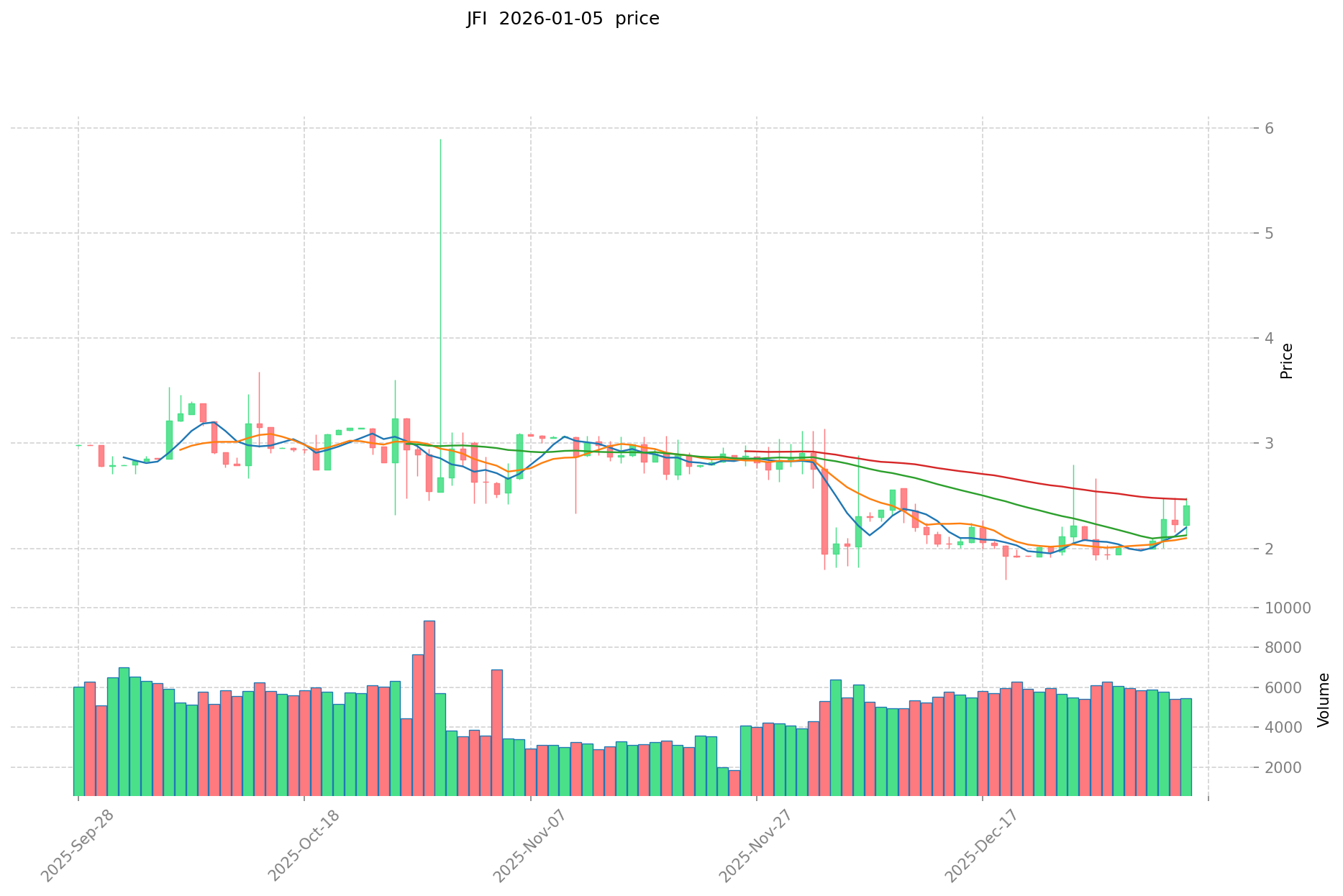
I. JFI Price History Review and Current Investment Status
Based on available data, JFI exhibits significant price volatility across its trading history:
- All-Time High (ATH): USD 1,547.43 (September 5, 2020) - representing the peak valuation during the early DeFi boom period
- All-Time Low (ATL): USD 1.70 (December 19, 2025) - marking the lowest price point in the token's history
- Historical Decline: The token has experienced a substantial 60.52% decline over the one-year period
Current JFI Investment Market Status (January 5, 2026)
- Current Price: USD 2.452
- 24-Hour Price Change: +10.3% (increased by USD 0.229)
- 1-Hour Price Change: +0.25%
- 7-Day Price Change: +26.20%
- 30-Day Price Change: +21.39%
- 1-Year Price Change: -60.52%
Market Metrics
| Metric |
Value |
| 24-Hour Trading Volume |
USD 12,685.07 |
| Total Market Capitalization |
USD 51,489.55 |
| Circulating Supply |
20,999 JFI |
| Maximum Supply |
20,999 JFI |
| Circulation Ratio |
100.0% |
| Market Dominance |
0.0000015% |
| Number of Holders |
44,598 |
- Market Sentiment Indicator: Positive (Value: 1)
- 24-Hour High: USD 2.48
- 24-Hour Low: USD 2.124
Current real-time JFI market prices and data are available at Gate JFI Market
II. Project Overview and Technical Architecture
Project Introduction
JackPool Finance (JFI) is a one-click DeFi mining aggregation protocol developed for the JustSwap ecosystem on the Tron network. The project was designed by a team of programmers and product managers who drew inspiration from Yearn Finance's (YFI) yield optimization design philosophy.
Core Value Proposition:
The protocol enables users to maximize their mining revenue with a single transaction while leveraging Tron's technical advantages, including faster transaction speeds and lower gas fees compared to other blockchain networks.
Blockchain Deployment
- Network: Tron (TRX)
- Contract Address: TN7zQd2oCCguSQykZ437tZzLEaGJ7EGyha
- Target Ecosystem: JustSwap decentralized exchange
Project Resources
III. Distribution and Network Analysis
Token Distribution
- Total Supply: 20,999 JFI tokens
- Circulating Supply: 20,999 JFI tokens
- Distribution Status: Fully distributed (100% circulation ratio)
- Active Holders: 44,598 addresses
Exchange Availability
- Trading Availability: Limited (1 exchange listed)
- Gate Trading: Confirmed active
IV. Market Position and Investment Considerations
Comparative Market Standing
- CoinGecko Ranking: 5,710
- Market Capitalization Rank: Among smaller-cap DeFi protocols
- Market Share: 0.0000015% of total crypto market
Risk and Opportunity Assessment
Historical Context:
The significant decline from the ATH of USD 1,547.43 in September 2020 to current levels reflects the broader market correction experienced by many DeFi tokens following the 2021 bull market cycle. However, recent price action shows recovery momentum with positive returns over 7-day and 30-day periods.
Current Technical Signals:
- Short-term bullish indicators (24-hour: +10.3%, 7-day: +26.20%)
- Long-term bearish trend (1-year: -60.52%)
- Relatively low daily trading volume (USD 12,685.07)
Disclaimer
This report presents factual data and information extracted from available sources as of January 5, 2026. It does not constitute financial advice, investment recommendations, or solicitation to buy or sell any asset. Cryptocurrency markets are highly volatile and speculative. Investors should conduct independent research and consult qualified financial advisors before making investment decisions.
JackPool.finance (JFI) Investment Analysis Report
Report Date: January 5, 2026
I. Project Overview
JackPool.finance (JFI) is a decentralized finance (DeFi) mining aggregation protocol designed for the Tron network. The project was developed by a team of programmers and product managers who drew inspiration from Yearn Finance (YFI)'s yield maximization design philosophy.
Key Project Details:
- Token Name: JFI (JackPool.finance)
- Blockchain: Tron (TRX)
- Current Price: $2.452 (as of January 5, 2026)
- Market Capitalization: $51,489.548
- Circulating Supply: 20,999 JFI
- Total Supply: 20,999 JFI
- Maximum Supply: 20,999 JFI
- Supply Circulation Ratio: 100%
Project Mission
The project aims to provide Tron network users with a one-click DeFi mining aggregation tool that maximizes mining yields. By leveraging Tron's faster transaction speeds and lower gas costs compared to Ethereum, JFI offers users an optimized platform for yield farming on JustSwap.
Official Channels:
II. Core Factors Affecting JFI Investment Viability
Supply Mechanism & Scarcity
JFI operates with a fixed maximum supply of 20,999 tokens, with 100% of the total supply already in circulation. This deflationary supply structure theoretically supports price stability and prevents dilution through new token issuance. However, the small total supply size means the token exists in limited quantity across the market.
Investment Implications:
- Fixed supply eliminates future dilution concerns
- Complete circulation indicates mature token distribution phase
- Scarcity principle applies, though market depth remains limited
Technology & Ecosystem
JFI is built on the Tron blockchain, which provides several technical advantages relevant to investment considerations:
Tron Network Benefits:
- Faster transaction speeds compared to Ethereum
- Lower gas fees for DeFi interactions
- Focus on JustSwap, a Tron-based decentralized exchange
The protocol functions as a one-click mining aggregation tool, allowing users to optimize yield farming strategies without manual intervention.
Market Performance & Price History
Historical Price Data:
- All-Time High: $1,547.43 (September 5, 2020)
- All-Time Low: $1.70 (December 19, 2025)
- Current Price: $2.452 (January 5, 2026)
- 24-Hour Change: +10.3%
- 7-Day Change: +26.2%
- 30-Day Change: +21.39%
- 1-Year Change: -60.52%
Short-Term Momentum:
JFI has demonstrated positive price momentum in recent periods, with gains of 10.3% in 24 hours and 26.2% over seven days. However, the one-year performance shows a significant decline of 60.52%, reflecting extended bearish pressure since early 2025.
Market Liquidity & Adoption
Trading Activity:
- 24-Hour Trading Volume: $12,685.07
- Number of Holders: 44,598
- Number of Exchanges Listed: 1
- Market Ranking: 5,710
The limited trading volume and presence on only one exchange indicate relatively low liquidity and market adoption. This represents a significant constraint for large-scale investors.
Risk Factors
Key Investment Risks:
-
Low Liquidity: With 24-hour volume of only $12,685, the token exhibits poor liquidity, making it difficult to enter or exit large positions without significant price impact.
-
Speculative Nature: Multiple price prediction sources characterize JFI as a speculative investment with unverified supply mechanisms and uncertain long-term viability.
-
Extreme Price Volatility: The token's history shows extreme price swings, from a peak of $1,547 to a low of $1.70, indicating high volatility unsuitable for risk-averse investors.
-
Limited Market Presence: Being listed on only one exchange and having modest trading volumes restricts accessibility and market confidence.
-
Massive Historical Decline: The 99.84% decline from all-time highs suggests previous market enthusiasm has significantly waned.
III. Investment Landscape Assessment
Market Sentiment
Market emotion indicators suggest cautious positioning. The token's recent recovery from December lows (up 26.2% in seven days) may indicate technical bottoming or speculative short-term trading rather than fundamental improvement.
Comparative Analysis with Broader Market
JFI's market dominance stands at 0.0000015%, representing negligible influence in the overall cryptocurrency ecosystem. This ultra-low market share reflects its niche positioning and limited systemic importance.
Liquidity Concerns
The concentration of trading volume on a single exchange creates counterparty risk and potential liquidity crises during market stress events. Investors should consider the implications of limited exit opportunities.
IV. Conclusion
JFI presents a high-risk, speculative investment opportunity characterized by:
- Positive factors: Fixed supply structure, focus on an underserved niche (Tron DeFi), recent short-term price momentum
- Negative factors: Severe liquidity constraints, extreme historical volatility, massive drawdown from historical peaks, limited exchange presence, speculative characterization by market analysts
The project's viability depends on sustained adoption within the Tron ecosystem and the performance of its underlying mining aggregation functionality. Potential investors should conduct thorough due diligence and carefully evaluate their risk tolerance before making investment decisions.
This analysis is provided for informational purposes only and does not constitute investment advice. Cryptocurrency investments carry substantial risk, including potential total loss of principal.
III. JFI Future Investment Prediction and Price Outlook (Is JackPool(JFI) worth investing in 2026-2031)
Short-term Investment Prediction (2026, short-term JFI investment outlook)
- Conservative Forecast: $1.30 - $2.46
- Neutral Forecast: $2.46 - $3.29
- Optimistic Forecast: $3.29 - $3.80
Mid-term Investment Outlook (2027-2029, mid-term JackPool(JFI) investment forecast)
- Market Phase Expectation: Gradual recovery phase with incremental growth in adoption and ecosystem development
- Investment Return Prediction:
- 2027: $2.65 - $3.51 (+8% to +43% from current price)
- 2028: $2.97 - $3.45 (+21% to +41% from current price)
- 2029: $2.32 - $3.49 (-5% to +42% from current price)
- Key Catalysts: Increased DeFi adoption on TRON network, yield farming optimization developments, JustSwap protocol enhancements
Long-term Investment Outlook (Is JackPool(JFI) a good long-term investment?)
- Base Case: $2.28 - $4.87 (Assuming steady ecosystem development and mainstream DeFi adoption on TRON network)
- Optimistic Case: $4.01 - $4.87 (Assuming breakthrough in liquidity mining efficiency and significant user growth)
- Risk Case: $1.30 - $2.97 (Extreme market downturn, protocol abandonment, or competitive displacement)
View JFI long-term investment and price predictions: Price Prediction
2026-01-05 to 2031-12-31 Long-term Outlook
- Base Case: $2.28 - $3.49 USD (Corresponding to steady progress and mainstream DeFi application enhancement)
- Optimistic Case: $3.49 - $4.87 USD (Corresponding to large-scale adoption and favorable market environment)
- Transformative Case: $4.87 USD and above (Such as breakthrough ecosystem progress and mainstream adoption)
- 2031-12-31 Predicted High: $4.55 USD (Based on optimistic development assumptions)
Disclaimer: This analysis is based on historical data and market models without guaranteed accuracy. Cryptocurrency markets carry substantial volatility and risk. Past performance does not guarantee future results. This is not investment advice.
| 年份 |
预测最高价 |
预测平均价格 |
预测最低价 |
涨跌幅 |
| 2026 |
3.29372 |
2.458 |
1.30274 |
0 |
| 2027 |
3.5085492 |
2.87586 |
2.6457912 |
17 |
| 2028 |
3.447580968 |
3.1922046 |
2.968750278 |
30 |
| 2029 |
3.4858874232 |
3.319892784 |
2.3239249488 |
35 |
| 2030 |
4.866132848148 |
3.4028901036 |
2.279936369412 |
38 |
| 2031 |
4.5479626234614 |
4.134511475874 |
4.01047613159778 |
68 |
JackPool Finance (JFI) Research Report
I. Project Overview
Project Introduction
JackPool Finance (JFI) is a one-click DeFi mining aggregation protocol designed for JustSwap, deployed on the Tron network. The project was developed by a team of programmers and product managers who drew inspiration from YFI's design philosophy on DeFi yield maximization. JFI aims to provide Tron users with tools to maximize DeFi revenue mining through a simplified one-click interface, leveraging Tron's faster transaction speeds and lower gas fees compared to other blockchain networks.
Core Features
- One-click DeFi Mining Aggregation: Simplified protocol enabling users to maximize mining revenue with minimal effort
- JustSwap Integration: Specifically designed for the JustSwap decentralized exchange ecosystem
- Tron Network Deployment: Operates on the Tron blockchain, offering cost efficiency and transaction speed advantages
Token Supply Structure
| Metric |
Value |
| Circulating Supply |
20,999 JFI |
| Total Supply |
20,999 JFI |
| Maximum Supply |
20,999 JFI |
| Circulating Ratio |
100.0% |
Current Market Data (as of January 5, 2026)
| Metric |
Value |
| Current Price |
$2.452 USD |
| Market Capitalization |
$51,489.55 USD |
| 24-Hour Trading Volume |
$12,685.07 USD |
| Market Dominance |
0.0000015% |
| Number of Holders |
44,598 |
| Timeframe |
Change |
Price Movement |
| 1 Hour |
+0.25% |
+$0.006 |
| 24 Hours |
+10.3% |
+$0.229 |
| 7 Days |
+26.20% |
+$0.509 |
| 30 Days |
+21.39% |
+$0.432 |
| 1 Year |
-60.52% |
-$3.759 |
Historical Price Extremes
- All-Time High: $1,547.43 (September 5, 2020)
- All-Time Low: $1.70 (December 19, 2025)
- Current Status: Trading significantly below historical highs, with recent short-term upward momentum
III. Investment Strategy & Risk Management
Investment Methodology
Long-Term Holding (HODL JFI)
- Suitable for investors with high risk tolerance and belief in the DeFi aggregation protocol concept
- Appropriate for those seeking exposure to Tron ecosystem growth and JustSwap ecosystem development
Active Trading
- Applicable for traders engaging in technical analysis and swing trading strategies
- Recent price volatility (26.20% gain over 7 days) presents tactical opportunities
Risk Management Framework
Asset Allocation Considerations
- Conservative Portfolio: Limit JFI exposure to less than 1-2% of total holdings due to extreme volatility and micro-cap status
- Aggressive Portfolio: Could allocate 3-5% for high-risk tolerance investors with diversified holdings
- Institutional Investors: Should conduct extensive due diligence before considering positions; typically avoid micro-cap tokens
Risk Mitigation Strategies
- Multi-asset diversification across multiple blockchain ecosystems
- Combination of stable assets (stablecoins) with volatility buffers
- Regular rebalancing to lock in gains from volatile positions
Secure Storage
- Hot wallets: Tron-compatible wallets (TronLink, Ledger Live with Tron support) for active trading
- Cold Storage: Hardware wallets supporting Tron network connectivity (Ledger, Trezor with Tron enabled)
- Non-custodial Solutions: Direct control via Tron address management to mitigate counterparty risk
IV. Investment Risks & Challenges
Market Risk
- Extreme Volatility: 89% decline from all-time high; 26% gain within 7 days indicates severe price swings
- Liquidity Risk: Low 24-hour trading volume ($12,685) relative to market cap suggests potential challenges for large position entry/exit
- Market Manipulation Risk: Micro-cap tokens with limited liquidity are vulnerable to price manipulation
Regulatory Risk
- Jurisdiction Uncertainty: DeFi protocols face evolving regulatory frameworks across jurisdictions
- Tron Network Scrutiny: Regulatory attention to Tron ecosystem could impact project viability
- Compliance Changes: Potential regulatory shifts affecting DeFi aggregation protocol operation
Technology Risk
- Protocol Dependency: Reliance on JustSwap platform stability and security
- Smart Contract Vulnerability: DeFi protocols inherently face security audit and potential exploit risks
- Network Risk: Dependency on Tron network performance and stability
Fundamental Risks
- Project Maturity: Limited information on current development activity and maintenance status
- Market Position: Ranked #5710 globally indicates marginal market presence
- Adoption: Low trading volume and holder count relative to project objectives suggests limited ecosystem adoption
V. Conclusion: Is JFI a Good Investment?
Investment Value Assessment
JFI operates in the DeFi aggregation sector with specific focus on the Tron ecosystem. The project presents extreme volatility characteristics, with 60% annual decline offset by recent short-term gains. The fundamental value proposition centers on providing simplified DeFi yield optimization for Tron users, though market adoption metrics suggest limited current traction.
Investor Recommendations
✅ Beginner Investors: Dollar-cost averaging into small positions combined with secure Tron wallet storage; exposure should remain minimal given volatility
✅ Experienced Traders: Tactical swing trading around technical support/resistance levels; implement strict stop-loss disciplines; allocate only non-critical capital
✅ Institutional Investors: Conduct comprehensive due diligence on development team, protocol security audits, and JustSwap ecosystem integration before consideration; typically avoid micro-cap tokens
Critical Disclaimer
⚠️ Risk Warning: Cryptocurrency investments, particularly in micro-cap DeFi tokens, carry substantial risk of capital loss. JFI exhibits characteristics of highly speculative assets including extreme price volatility, limited liquidity, and unproven market adoption. This report is provided for informational purposes only and does not constitute investment advice, financial recommendations, or solicitation to buy or sell JFI. Investors must conduct independent research and consult with qualified financial advisors before making investment decisions.
Data Updated: January 5, 2026
Project Links:
JackPool Finance (JFI) Frequently Asked Questions
FAQ
Q1: What is JackPool Finance (JFI) and what problem does it solve?
A: JackPool Finance (JFI) is a one-click DeFi mining aggregation protocol designed for the JustSwap ecosystem on the Tron network. Inspired by Yearn Finance's yield optimization design, JFI solves the complexity of manually managing yield farming strategies by allowing users to maximize their DeFi mining returns with a single transaction. It leverages Tron's technical advantages—faster transaction speeds and lower gas fees compared to other blockchain networks—to provide cost-efficient yield farming optimization for Tron users.
Q2: What is the current price and market status of JFI as of January 2026?
A: As of January 5, 2026, JFI is trading at $2.452 USD with a market capitalization of $51,489.55 USD. The token has demonstrated recent positive momentum with a 10.3% gain in the last 24 hours and 26.2% increase over the past 7 days. However, it reflects a significant 60.52% decline over the one-year period from its higher valuations earlier in 2025. With 44,598 active holders and a circulating supply of 20,999 tokens, JFI maintains limited but established market presence in the Tron ecosystem.
Q3: Is JFI a good investment for 2026?
A: JFI presents a high-risk, speculative investment opportunity suitable only for investors with high risk tolerance. The project offers a fixed supply structure (eliminating future dilution) and focuses on an underserved niche within the Tron DeFi ecosystem. However, significant negatives include severe liquidity constraints with only $12,685.07 in daily trading volume, extreme historical volatility (declining 99.84% from its all-time high of $1,547.43), and limited exchange presence (listed on only one exchange). Conservative forecasts suggest JFI may trade between $1.30 and $2.46 in 2026, while optimistic scenarios project $3.29 to $3.80. Investors should limit exposure to 1-2% of total portfolio holdings and conduct thorough due diligence before investing.
Q4: What are the main risks associated with investing in JFI?
A: Key investment risks include: (I) Extreme Price Volatility—the token has experienced swings from $1,547 to $1.70, making it unsuitable for risk-averse investors; (II) Low Liquidity—daily trading volume of $12,685 creates significant challenges for entering or exiting large positions; (III) Limited Market Presence—presence on only one exchange concentrates counterparty risk and restricts accessibility; (IV) Technology Risk—vulnerability to smart contract exploits and dependency on JustSwap platform stability; (V) Regulatory Risk—evolving DeFi regulatory frameworks could impact protocol viability; (VI) Market Adoption Risk—modest trading volume and holder count suggest limited ecosystem adoption relative to project objectives.
Q5: What is the long-term price outlook for JFI through 2031?
A: Based on price prediction models, JFI's long-term outlook through 2031 consists of three scenarios: (I) Base Case—$2.28 to $3.49 USD assuming steady ecosystem development; (II) Optimistic Case—$3.49 to $4.87 USD with breakthrough liquidity mining efficiency and significant user growth; (III) Transformative Case—$4.87 USD and above assuming major ecosystem progress and mainstream adoption. The 2031-12-31 predicted high stands at $4.55 USD under optimistic development assumptions. However, these forecasts carry substantial uncertainty and do not guarantee accuracy given cryptocurrency market volatility.
Q6: How should different investor types approach JFI investment?
A: Investment approaches vary by investor profile: (I) Beginner Investors—implement dollar-cost averaging into small positions, utilize secure Tron wallets (TronLink, Ledger Live), limit total exposure to 1-2% of portfolio; (II) Experienced Traders—employ swing trading strategies around technical support/resistance levels, implement strict stop-loss disciplines, allocate only non-critical capital, capitalize on recent volatility patterns; (III) Conservative Investors—avoid JFI due to extreme volatility and speculative nature; (IV) Institutional Investors—conduct comprehensive due diligence on development team, security audits, and JustSwap integration before consideration; typically avoid micro-cap tokens without established track records.
Q7: What factors should investors monitor to assess JFI's future viability?
A: Critical monitoring factors include: (I) Trading Volume and Liquidity—observe whether daily trading volume expands beyond the current $12,685 baseline, indicating growing market interest; (II) Exchange Listings—monitor announcements of additional exchange listings that would improve accessibility and reduce counterparty concentration risk; (III) Ecosystem Development—track JustSwap protocol enhancements and overall Tron DeFi adoption metrics; (IV) Holder Growth—assess whether the active holder count expands significantly from current 44,598 addresses; (V) Development Activity—review GitHub repository updates and team communication regarding protocol improvements; (VI) Regulatory Developments—monitor regulatory changes affecting Tron network and DeFi aggregation protocols; (VII) Technical Performance—evaluate protocol security audits and comparative yield farming efficiency.
Q8: Where can investors safely store and trade JFI tokens?
A: JFI, deployed on the Tron network (contract address: TN7zQd2oCCguSQykZ437tZzLEaGJ7EGyha), can be managed through multiple wallet types: (I) Trading—currently available on Gate exchange for active trading; (II) Hot Wallets—Tron-compatible wallets including TronLink and Ledger Live with Tron support for active management; (III) Cold Storage—hardware wallets supporting Tron connectivity such as Ledger and Trezor with Tron enabled for secure long-term holdings; (IV) Non-Custodial Solutions—direct Tron address management for complete counterparty risk elimination. Investors should verify wallet compatibility with the Tron network and ensure they control private keys for non-custodial storage options. Official project resources can be found at https://jackpool.finance/ and the verified smart contract address should be used for all transactions.
Disclaimer: This FAQ is provided for informational purposes only and does not constitute investment advice, financial recommendations, or solicitation to buy or sell JFI. Cryptocurrency investments, particularly in micro-cap tokens, carry substantial risk of total capital loss. Past performance does not guarantee future results. Investors must conduct independent research and consult with qualified financial advisors before making investment decisions.
* The information is not intended to be and does not constitute financial advice or any other recommendation of any sort offered or endorsed by Gate.











