# Article Overview: Is Lair Finance (LAIR) a Good Investment?
**Comprehensive Analysis of Tokenomics, Risk Factors, and Market Potential**
This article provides investors with a complete evaluation of Lair Finance (LAIR), a cross-chain liquid restaking gateway trading at $0.001522 as of January 2026. The analysis addresses critical investment questions through examination of token economics, price history, market fundamentals, and future outlook through 2031. Structured across six core sections—market analysis, protocol overview, tokenomics assessment, price performance, investment risks, and strategic recommendations—this guide serves emerging, experienced, and institutional investors seeking data-driven decisions. Whether evaluating LAIR as a short-term trading position or long-term holding strategy, readers gain actionable insights covering supply dilution risks, partnership strength, Berachain expansion prospects, and recommended portfolio allocation frameworks for managing cryptocurrency volatility.
*
Introduction: Lair Finance (LAIR) Investment Position and Market Prospects
Lair Finance (LAIR) is an important asset in the cryptocurrency sector, positioning itself as a cross-chain liquid restaking gateway. As of January 2026, LAIR maintains a market capitalization of $1,522,000 with a circulating supply of approximately 99.8 million tokens, trading at around $0.001522. The protocol has demonstrated significant traction with over 3.6 million users and strategic partnerships with leading Web3 brands including Catizen, Avalon, and Line Next. Following its establishment of 66% total value locked (TVL) on the Kaia network, Lair Finance is actively expanding to Berachain to strengthen its value ecosystem. Given its unique positioning in the liquid restaking space and growing user adoption, LAIR has become a focal point for investors evaluating "Is Lair Finance (LAIR) a good investment?" This article provides a comprehensive analysis of LAIR's investment value, historical price movements, future price projections, and associated investment risks to serve as a reference for investors.
Lair Finance (LAIR) Market Analysis Report
I. LAIR Price History Review and Current Investment Value
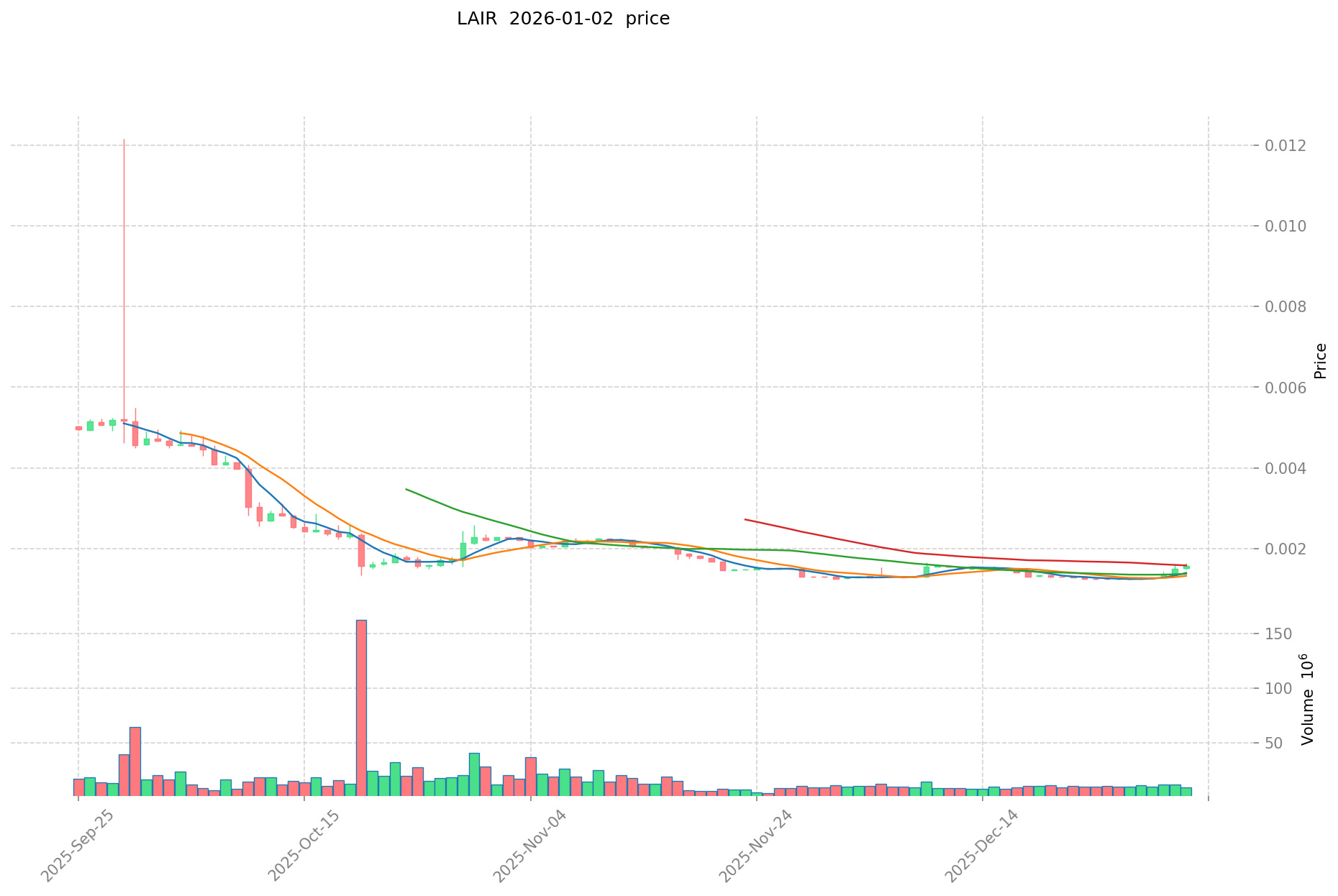
Based on available data, the following price milestones have been recorded:
- All-Time High (ATH): $0.08021 achieved on April 25, 2025
- All-Time Low (ATL): $0.00123 recorded on December 26, 2025
- Price Range Compression: From peak to recent low represents approximately 98.5% decline from ATH
Current LAIR Investment Market Status (January 2, 2026)
| Metric |
Value |
| Current Price |
$0.001522 |
| 24-Hour Change |
-1.74% |
| 7-Day Change |
+21.95% |
| 30-Day Change |
+17.34% |
| Market Capitalization |
$151,895.60 |
| Fully Diluted Valuation (FDV) |
$1,522,000.00 |
| Market Cap Ratio to FDV |
9.98% |
| 24-Hour Trading Volume |
$13,678.87 |
| Circulating Supply |
99,800,000 LAIR |
| Total Supply |
1,000,000,000 LAIR |
| Market Dominance |
0.000047% |
| Number of Holders |
5,115 |
| CoinGecko Ranking |
#4,442 |
Market Sentiment: Positive sentiment indicator recorded
View real-time LAIR market price: https://www.gate.com/price/lair-finance-lair
II. Protocol Overview and Core Functionality
Lair Finance operates as a cross-chain liquid restaking gateway designed to enable users to compound yields while transferring liquidity across Layer 1 blockchains. The protocol's architecture channels staked assets into consumer-facing liquidity pools, facilitating decentralized application (dApp) adoption and network growth acceleration.
Key Operational Metrics
- User Base: Over 3.6 million users
- Kaia TVL Concentration: Secured 66% of Kaia's total value locked
- Primary Blockchain: Deployed on Kaia (contract address: 0xd70c7d511560493c79df607076fb863f5c8a50b0)
Strategic Partnerships
Lair Finance has established partnerships with leading Web3 brands including:
III. Expansion Strategy and Network Growth
Berachain Expansion Initiative
The protocol is currently executing expansion plans to Berachain, designed to enhance its value flywheel across multiple blockchain ecosystems. This multi-chain strategy aims to deliver optimized restaking solutions tailored to each blockchain's unique architectural requirements.
IV. Technical Infrastructure and Access
Blockchain Deployment
- Primary Network: Kaia
- Contract Address: 0xd70c7d511560493c79df607076fb863f5c8a50b0
- Token Standard: ERC-based implementation on Kaia
Official Resources
V. Market Structure and Supply Mechanics
| Parameter |
Amount |
| Circulating Supply |
99,800,000 LAIR (9.98% of total) |
| Total Supply |
1,000,000,000 LAIR |
| Max Supply |
1,000,000,000 LAIR |
| Circulation Rate |
9.98% |
The token's limited circulation relative to maximum supply suggests potential for supply-side dynamics as additional tokens enter circulation.
VI. Short-Term Price Momentum Analysis
| Time Period |
Price Change |
| 1-Hour |
+1.19% |
| 24-Hour |
-1.74% |
| 7-Day |
+21.95% |
| 30-Day |
+17.34% |
Recent price action indicates short-term volatility with notable 7-day and 30-day gains, partially offset by recent 24-hour weakness. The 1-hour positive momentum (+1.19%) suggests potential intraday stabilization attempts.
Report Generated: January 2, 2026
Data Source: Gate Market Data
Disclaimer: This report presents factual market data and protocol information. All statements are based on available documentation and do not constitute investment advice.
Lair Finance (LAIR) Investment Analysis Report
Report Date: January 2, 2026
I. Executive Summary
Lair Finance (LAIR) is a cross-chain liquid restaking protocol that enables users to compound yields while transferring liquidity across Layer 1 blockchains. As of January 2, 2026, LAIR trades at $0.001522 USD with a market capitalization of approximately $151,895.60 and a fully diluted valuation of $1,522,000. The token maintains a 9.98% circulation ratio with 99.8 million tokens circulating out of a 1 billion token total supply.
II. Core Factors Influencing Whether Lair Finance (LAIR) Is a Good Investment
A. Supply Mechanism and Scarcity (LAIR Investment Scarcity)
Token Distribution:
- Total Supply: 1,000,000,000 LAIR tokens
- Circulating Supply: 99,800,000 LAIR tokens (9.98% of total supply)
- Maximum Supply: 1,000,000,000 LAIR tokens
- Current Holders: 5,115 addresses
Investment Implications:
The significant portion of tokens yet to enter circulation (90.02%) represents potential dilution risk for current holders. The concentrated holder base of 5,115 addresses suggests limited distribution, which may impact market liquidity and price stability. Future token unlocks could exert downward pressure on valuations.
B. Ecosystem Development and Strategic Partnerships
Current Deployment Status:
- Lair Finance has secured 66% of Kaia blockchain's Total Value Locked (TVL), establishing itself as a dominant restaking solution on this network
- Protocol expansion to Berachain is underway to enhance its value flywheel across multiple L1 ecosystems
User Base and Partnerships:
- User Base: Over 3.6 million users
- Strategic Partnerships: Established collaborations with leading Web3 brands including Catizen, Avalon, and Line Next
- Application Focus: Tailored restaking solutions designed for each blockchain's unique technical structure
Investment Significance:
The substantial user base and partnerships with recognized Web3 projects provide fundamental utility and adoption metrics. The protocol's presence across multiple Layer 1 blockchains creates exposure to diverse blockchain ecosystems and reduces single-chain dependency risk.
C. Protocol Mechanics and Value Generation
Restaking Mechanism:
Lair Finance channels staked assets into consumer-facing liquidity pools, creating a mechanism to:
- Accelerate decentralized application (dApp) adoption
- Drive network growth through enhanced liquidity provisioning
- Generate compound yields for staked asset holders
Investment Relevance:
The protocol's ability to direct capital flows into productive DeFi activities positions it as an infrastructure layer with potential long-term utility value in the liquid staking and restaking market segment.
Recent Price Action
| Time Period |
Change Percentage |
Price Change Amount |
Current Price |
| 1 Hour |
+1.19% |
+$0.000017898804229667 |
$0.001522 |
| 24 Hours |
-1.74% |
-$0.000026951760635050 |
$0.001522 |
| 7 Days |
+21.95% |
+$0.000273947519475195 |
$0.001522 |
| 30 Days |
+17.34% |
+$0.000224914607124595 |
$0.001522 |
Historical Price Extremes
- All-Time High: $0.08021 (April 25, 2025)
- All-Time Low: $0.00123 (December 26, 2025)
- 24-Hour Range: $0.001472 - $0.001579
- Current Market Emotion: Bearish (Score: 1)
Analysis Note: The substantial decline from all-time high to current price levels represents an approximate 98.1% depreciation over the period. Recent weekly and monthly performance shows modest recovery trends, though short-term sentiment remains negative.
Market Position
- Market Rank: 4,442
- Market Dominance: 0.000047%
- 24-Hour Trading Volume: $13,678.87
- Exchange Availability: 1 exchange
IV. Risk Considerations
Market Concentration Risk: Limited exchange availability and relatively low trading volume may constrain liquidity and increase price volatility.
Price Volatility: Extreme historical price movements from $0.08021 to $0.00123 indicate significant asset class volatility that exceeds typical equity market ranges.
Market Recognition: The extremely small market dominance (0.000047%) suggests limited mainstream institutional adoption relative to established cryptocurrencies.
Supply Dilution Risk: With only 9.98% of tokens currently circulating, future supply releases could impact token economics and holder returns.
V. Data Sources and Disclaimers
Data Currency: All metrics reflect information current as of January 2, 2026, 12:17:56 UTC
Official Resources:
Important Notice: This report presents factual data analysis based on available information. Investment decisions should incorporate comprehensive due diligence, consideration of individual risk tolerance, and consultation with qualified financial advisors. Cryptocurrency markets exhibit high volatility and speculative characteristics that may result in substantial capital loss.
III. LAIR Future Investment Predictions and Price Outlook (Is Lair Finance(LAIR) worth investing in 2026-2031)
Short-term Investment Prediction (2026, short-term LAIR investment outlook)
- Conservative forecast: $0.000919 - $0.001532
- Neutral forecast: $0.001532 - $0.001913
- Optimistic forecast: $0.001913 - $0.002267
Mid-term Investment Outlook (2027-2029, mid-term Lair Finance(LAIR) investment forecast)
- Market stage expectation: Protocol expansion to Berachain and strengthening of value flywheel mechanisms with sustained user growth targeting beyond 3.6 million users
- Investment return predictions:
- 2027: $0.001539 - $0.002185 (+24% projected growth)
- 2028: $0.001981 - $0.002614 (+34% projected growth)
- 2029: $0.002049 - $0.002980 (+52% projected growth)
- Key catalysts: Cross-chain liquidity optimization, institutional adoption of restaking solutions, partnerships with leading Web3 brands (Catizen, Avalon, Line Next), and Berachain ecosystem maturation
Long-term Investment Outlook (Is Lair Finance a good long-term investment?)
- Base case scenario: $0.002017 - $0.003954 (assuming steady adoption of cross-chain restaking solutions and stable TVL growth across multiple blockchains)
- Optimistic scenario: $0.003304 - $0.004064 (assuming accelerated mainstream adoption of DeFi restaking, successful Berachain integration, and expanded partnerships)
- Risk scenario: $0.001200 - $0.001500 (extreme conditions including market downturn, regulatory headwinds, or competitive protocol displacement)
Click to view LAIR long-term investment and price predictions: Price Prediction
2026-01-02 to 2031 Long-term Outlook
- Base case: $0.002017 - $0.002654 USD (corresponding to steady protocol development and incremental ecosystem expansion)
- Optimistic scenario: $0.003304 - $0.004064 USD (corresponding to mass adoption of liquid restaking and favorable market conditions)
- Transformative scenario: $0.004500 USD and above (breakthrough ecosystem progress and mainstream adoption of cross-chain restaking infrastructure)
- Predicted high by 2031-12-31: $0.004064 USD (based on optimistic development assumptions)
Disclaimer: This analysis is based on available market data as of January 2, 2026. Price predictions are subject to significant market volatility and various unpredictable factors. Past performance does not guarantee future results. Investors should conduct independent research and consult with financial advisors before making investment decisions.
| 年份 |
预测最高价 |
预测平均价格 |
预测最低价 |
涨跌幅 |
| 2026 |
0.00226736 |
0.001532 |
0.0009192 |
0 |
| 2027 |
0.002184632 |
0.00189968 |
0.0015387408 |
24 |
| 2028 |
0.00261395968 |
0.002042156 |
0.00198089132 |
34 |
| 2029 |
0.0029799140352 |
0.00232805784 |
0.0020486908992 |
52 |
| 2030 |
0.003954439047024 |
0.0026539859376 |
0.002017029312576 |
74 |
| 2031 |
0.004064181365543 |
0.003304212492312 |
0.00307291761785 |
117 |
Lair Finance (LAIR) Investment Analysis Report
I. Executive Summary
Lair Finance is a cross-chain liquid restaking protocol enabling users to compound yields while moving liquidity across Layer 1 blockchains. As of January 2, 2026, LAIR is trading at $0.001522 with a market capitalization of approximately $151,895.60 and a fully diluted valuation of $1,522,000. The token operates on the Kaia blockchain with 99.8 million tokens in circulation out of a total supply of 1 billion.
II. Project Overview
Protocol Architecture
Lair Finance functions as a cross-chain restaking gateway that facilitates:
- Liquid Restaking Mechanism: Users can stake assets across multiple Layer 1 blockchains while maintaining liquidity exposure
- Yield Compounding: The protocol enables users to generate composite returns by directing staked assets into consumer-facing liquidity pools
- dApp Acceleration: The efficient restaking mechanism channels assets to support dApp adoption and network growth
Market Position and Partnerships
- User Base: Over 3.6 million users
- Network Dominance: Secured 66% of Kaia's total value locked (TVL)
- Strategic Partnerships: Collaborations with leading Web3 brands including Catizen, Avalon, and Line Next
- Expansion Strategy: Extending protocol to Berachain to enhance its value flywheel
- Tailored Solutions: Provides optimized restaking solutions customized to each blockchain's unique structure
Current Market Metrics (as of January 2, 2026)
| Metric |
Value |
| Current Price |
$0.001522 |
| 24-Hour Volume |
$13,678.87 |
| Market Capitalization |
$151,895.60 |
| Fully Diluted Valuation |
$1,522,000.00 |
| Circulating Supply |
99,800,000 LAIR |
| Total Supply |
1,000,000,000 LAIR |
| Circulation Ratio |
9.98% |
| Token Holders |
5,115 |
| Timeframe |
Change |
Amount |
| 1 Hour |
+1.19% |
+$0.000017898 |
| 24 Hours |
-1.74% |
-$0.000026951 |
| 7 Days |
+21.95% |
+$0.000273947 |
| 30 Days |
+17.34% |
+$0.000224914 |
Historical Price Levels
- All-Time High: $0.08021 (April 25, 2025)
- All-Time Low: $0.00123 (December 26, 2025)
- 24-Hour High/Low: $0.001579 / $0.001472
- Current Distance from ATH: 81.03% below peak valuation
The token exhibits significant volatility with recent price recovery evident in 7-day and 30-day performance metrics, though the token trades substantially below its historical peak.
IV. Investment Strategy and Risk Management
Investment Methodology
Long-Term Position (HODL Strategy)
- Suitable for investors believing in cross-chain restaking adoption
- Aligned with protocol expansion to Berachain and broader dApp ecosystem growth
- Benefits from accumulated user base and partnership ecosystem
Active Trading Approach
- Dependent on technical analysis and price action patterns
- Requires monitoring of protocol TVL metrics and competitive landscape
- Sensitive to partnership announcements and network expansion updates
Risk Management Framework
Portfolio Allocation Guidelines
- Conservative Investors: Maximum 2-5% allocation; focus on protocol fundamentals verification
- Aggressive Investors: 5-15% allocation; acceptable given emerging protocol status and partnership strength
- Institutional Investors: Strategic position sizing based on TVL growth trajectory and market adoption metrics
Risk Mitigation Strategies
- Diversification: Combine LAIR with established Layer 1 assets and stablecoin reserves
- Hedging Tools: Consider derivatives markets or correlation-based hedges against Kaia network concentration risk
- Secure Storage: Utilize hardware wallets (Ledger, Trezor) for holdings exceeding active trading amounts; segregate between hot and cold storage
V. Investment Risks and Challenges
Market Risks
- Extreme Volatility: LAIR has declined 81% from ATH, reflecting high price fluctuation characteristic of emerging protocols
- Liquidity Concentration: Limited exchange availability and relatively low 24-hour volume ($13,678.87) creates potential slippage on larger transactions
- Price Discovery Uncertainty: Low circulating-to-total supply ratio (9.98%) indicates significant dilution potential
Regulatory Risks
- Jurisdictional Uncertainty: Staking and restaking protocols face evolving regulatory scrutiny in multiple jurisdictions
- Classification Risk: Regulatory treatment of restaking mechanisms remains unsettled across major markets
- Network-Specific Regulations: Kaia blockchain's regulatory status and potential policy changes could impact protocol viability
Technical Risks
- Smart Contract Risk: Cross-chain protocols carry increased smart contract vulnerability surface
- Network Concentration: 66% TVL concentration on Kaia creates dependency risk on single blockchain ecosystem
- Competitive Landscape: Other restaking protocols (Lido, Eigenlayer) possess established market positions and greater capital resources
The protocol's exposure to Kaia network performance and regulatory changes presents material technical concentration risk.
VI. Conclusion: Is LAIR a Good Investment?
Investment Value Assessment
Lair Finance demonstrates moderate long-term potential driven by:
- Established user base exceeding 3.6 million participants
- Significant TVL dominance on Kaia (66%)
- Strategic partnerships with established Web3 brands
- Cross-chain expansion strategy to emerging chains (Berachain)
However, the token exhibits substantial short-term price volatility, with current pricing 81% below all-time highs and limited trading liquidity.
Investor Recommendations
✅ Emerging Investors: Implement dollar-cost averaging approach; prioritize hardware wallet storage for security; allocate only capital capable of withstanding significant depreciation
✅ Experienced Investors: Consider limited position sizing based on technical support levels; monitor TVL metrics and partnership announcements as directional indicators; maintain stop-loss disciplines given volatility
✅ Institutional Investors: Evaluate strategic positioning only after comprehensive due diligence on Kaia ecosystem development and cross-chain scaling success; monitor regulatory developments in staking classifications
⚠️ Critical Disclaimer: Cryptocurrency investments carry substantial risk including potential total loss of principal. This analysis provides informational content only and does not constitute investment advice, financial recommendation, or solicitation to purchase. Conduct independent research and consult qualified financial advisors before making investment decisions. Past performance does not guarantee future results.
Lair Finance (LAIR) Frequently Asked Questions (FAQ)
I. What is Lair Finance (LAIR) and how does it function?
Answer: Lair Finance is a cross-chain liquid restaking gateway that enables users to compound yields while transferring liquidity across Layer 1 blockchains. The protocol channels staked assets into consumer-facing liquidity pools to facilitate decentralized application (dApp) adoption and network growth. LAIR operates primarily on the Kaia blockchain and is expanding to Berachain, with over 3.6 million users and strategic partnerships with leading Web3 brands including Catizen, Avalon, and Line Next.
Answer: As of January 2, 2026, LAIR trades at $0.001522 USD with a market capitalization of approximately $151,895.60 and a fully diluted valuation of $1,522,000. The token shows mixed short-term performance: +1.19% in the last hour, -1.74% in the last 24 hours, +21.95% over 7 days, and +17.34% over 30 days. However, LAIR has declined approximately 81% from its all-time high of $0.08021 recorded on April 25, 2025.
III. What are the supply mechanics and dilution risks associated with LAIR?
Answer: LAIR has a total supply of 1 billion tokens with only 99.8 million (9.98%) currently in circulation. This significant portion of tokens yet to enter circulation represents potential dilution risk for current holders. The concentrated holder base of 5,115 addresses suggests limited distribution, which may impact market liquidity and price stability. Future token unlocks could exert downward pressure on token valuations as additional supply reaches the market.
IV. Is LAIR a good investment for 2026-2031?
Answer: LAIR presents moderate long-term potential with corresponding risks. Conservative forecasts for 2026 suggest a price range of $0.000919 to $0.001532, while optimistic scenarios project prices reaching $0.004064 by 2031. Investment viability depends on individual risk tolerance and the protocol's successful execution of its Berachain expansion and continued user adoption. The protocol's dominance (66% TVL on Kaia) and strategic partnerships provide fundamental support, but extreme historical volatility (81% decline from ATH) and limited trading liquidity create material short-term risks.
V. What are the primary risk factors investors should consider?
Answer: Key risk factors include: (1) Extreme price volatility with LAIR declining 81% from all-time highs; (2) Limited exchange availability and low 24-hour trading volume ($13,678.87) creating potential liquidity constraints; (3) High supply dilution risk with 90.02% of tokens not yet circulating; (4) Regulatory uncertainty surrounding staking and restaking protocols; (5) Network concentration risk with 66% TVL on Kaia blockchain; and (6) Competitive pressure from established restaking protocols like Lido and Eigenlayer. Investors should only allocate capital they can afford to lose entirely.
VI. What are the recommended allocation strategies for LAIR investment?
Answer: Portfolio allocation guidelines depend on investor profile: Conservative investors should limit LAIR to 2-5% of their cryptocurrency allocation while verifying protocol fundamentals; Aggressive investors may allocate 5-15% given the emerging protocol status and partnership strength; Institutional investors should employ strategic position sizing based on TVL growth trajectories and market adoption metrics. All investors should implement dollar-cost averaging, diversify with established Layer 1 assets and stablecoins, and utilize secure storage solutions (hardware wallets) for holdings exceeding active trading amounts.
VII. What catalysts could drive LAIR price appreciation in the mid-term (2027-2029)?
Answer: Mid-term price catalysts include successful protocol expansion to Berachain, strengthening of cross-chain value flywheel mechanisms, sustained user growth beyond the current 3.6 million users, institutional adoption of restaking solutions, expansion of partnerships with leading Web3 brands, and maturation of the Berachain ecosystem. Price projections for this period forecast potential growth of 24% by 2027, 34% by 2028, and 52% by 2029, assuming steady adoption of cross-chain restaking solutions and stable TVL growth across multiple blockchains.
VIII. Where can investors access and trade LAIR tokens?
Answer: LAIR tokens trade on Gate and are deployed on the Kaia blockchain (contract address: 0xd70c7d511560493c79df607076fb863f5c8a50b0). Investors can access official project resources at https://lair.fi/, review technical documentation at https://lair-finance.gitbook.io/lair-finance/about-lair-finance, follow project updates via https://x.com/LairFinance, and monitor on-chain activity through https://kaiascan.io/token/0xd70c7d511560493c79df607076fb863f5c8a50b0. Due to limited exchange availability and liquidity, investors should exercise caution regarding position sizing and slippage management.
Important Disclaimer: This FAQ provides informational analysis based on available market data as of January 2, 2026, and does not constitute investment advice, financial recommendation, or solicitation to purchase cryptocurrency assets. Cryptocurrency investments carry substantial risk including potential total loss of principal. All price projections are speculative and subject to significant market volatility and unpredictable factors. Investors must conduct independent research and consult qualified financial advisors before making investment decisions. Past performance does not guarantee future results.
* The information is not intended to be and does not constitute financial advice or any other recommendation of any sort offered or endorsed by Gate.