# Article Overview: Is Lumoz (MOZ) a Good Investment?
Lumoz (MOZ) is a modular compute layer and RaaS platform providing computational services for zero-knowledge and AI applications across blockchain networks. This comprehensive analysis evaluates MOZ's investment potential by examining token performance, market metrics, and risk factors as of January 2, 2026. The article addresses critical investment questions for beginners, traders, and institutional investors navigating extreme market volatility and early-stage project risks. Structured across project fundamentals, price history analysis, market performance metrics, technical infrastructure, and investment strategy recommendations, this guide clarifies whether MOZ represents viable exposure to modular computing infrastructure or speculative capital at risk. Detailed risk assessment and multi-year price projections help investors make informed allocation decisions.
---
**Key Sections:** Project Overview | Price Performance & Market Analysis | Investment
Introduction: Lumoz (MOZ) Investment Position and Market Prospects
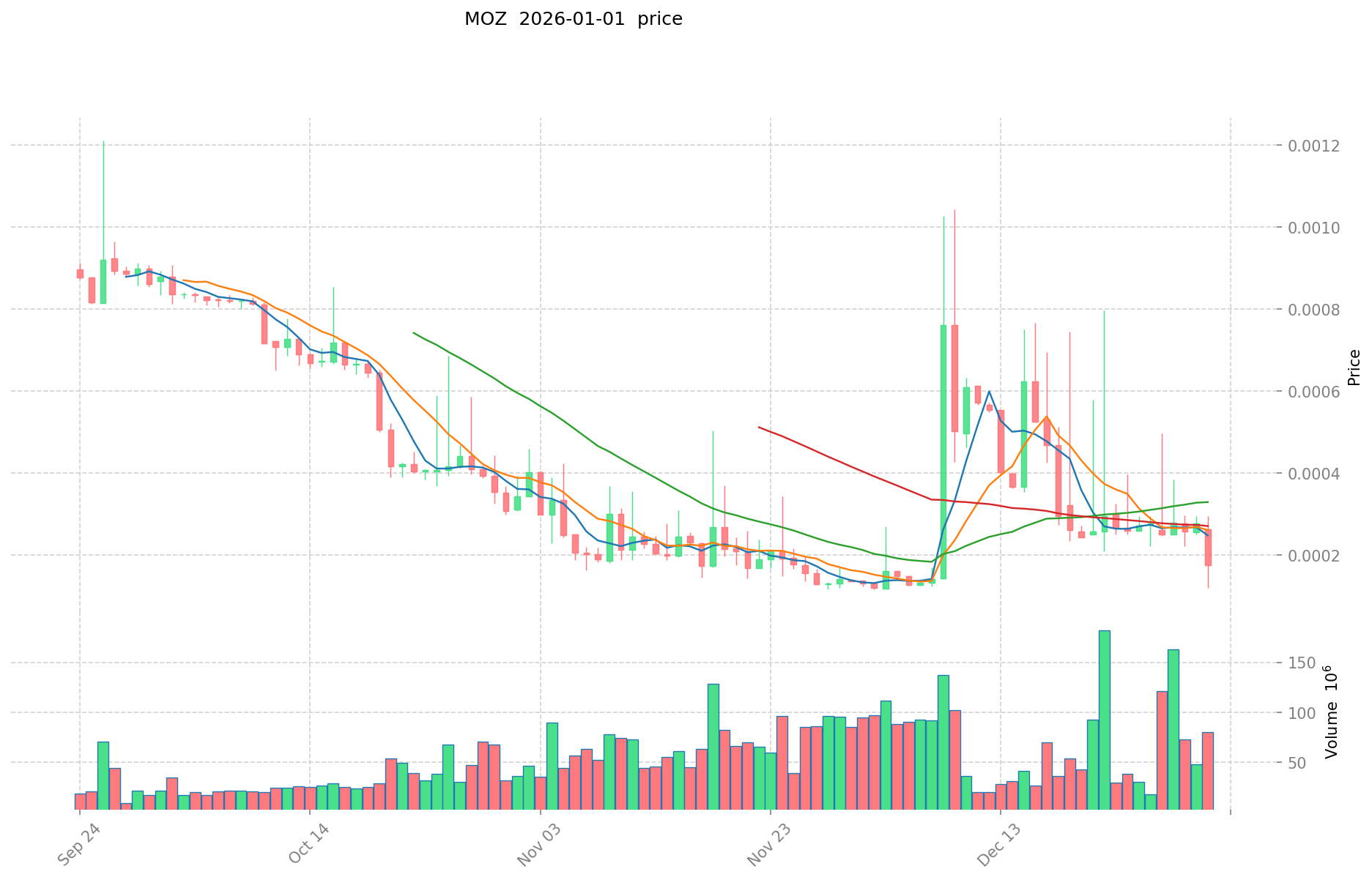
MOZ is an important asset in the cryptocurrency field. As the native token of Lumoz, a leading Modular Compute Layer & RaaS platform, MOZ has gained prominence through its role in providing computing power and verification services for ZK and AI applications across different blockchain architectures. As of January 2, 2026, MOZ maintains a market capitalization of $162,470 with a circulating supply of 1.1 billion tokens and a total supply of 10 billion tokens. The current price stands at approximately $0.0001477, having declined significantly from its all-time high of $0.05748 reached on December 10, 2024.
Given Lumoz's positioning as a modular computing infrastructure solution in the evolving blockchain ecosystem, MOZ has become a focal point for investors evaluating exposure to zero-knowledge proof (ZK) and artificial intelligence (AI) computation layers. This technical utility and infrastructure focus has made questions about whether Lumoz represents a viable investment opportunity increasingly relevant to market participants. This article provides a comprehensive analysis of MOZ's investment value, historical performance trends, future price projections, and associated investment risks to serve as reference material for investors.
Lumoz (MOZ) Cryptocurrency Asset Research Report
I. MOZ Price History Review and Current Investment Value
Key Price Milestones:
- All-Time High (ATH): USD 0.05748 reached on December 10, 2024
- All-Time Low (ATL): USD 0.0001162 recorded on December 2, 2025
- Price Decline from ATH to ATL: Approximately 99.8% depreciation
Recent Price Performance (As of January 2, 2026):
- Current Price: USD 0.0001477
- 24-Hour Price Change: -16.07%
- 7-Day Price Change: -49.86%
- 30-Day Price Change: +22.17%
- 1-Year Price Change: -98.99%
Price Range (24-Hour):
- High: USD 0.0001765
- Low: USD 0.0001365
Current MOZ Investment Market Status (January 2, 2026)
Market Valuation Metrics:
- Current Price: USD 0.0001477
- Market Capitalization: USD 162,470.00
- Fully Diluted Valuation (FDV): USD 1,477,000.00
- Market Cap to FDV Ratio: 11%
- 24-Hour Trading Volume: USD 3,377.67
- Token Holders: 19,824
Supply Information:
- Circulating Supply: 1,100,000,000 MOZ (11% of total supply)
- Total Supply: 10,000,000,000 MOZ
- Maximum Supply: 10,000,000,000 MOZ
Market Position:
- Market Ranking: #4,363
- Market Dominance: 0.000046%
- Listed on 2 Exchanges
- Deployed on: Arbitrum (ARBEVM)
II. Project Overview
Lumoz Protocol Definition:
Lumoz is the leading Modular Compute Layer and RaaS (Rollup-as-a-Service) platform. The Lumoz protocol provides computing power and verification services for ZK (Zero-Knowledge) and AI applications across chains with different architectures.
Launch Information:
- Token Launch Date: December 10, 2024
- Initial Launch Price: USD 0.005
III. Market Analysis
Price Volatility Pattern:
The MOZ token has experienced extreme volatility since its launch. The token declined approximately 99.8% from its all-time high of USD 0.05748 to the all-time low of USD 0.0001162 within approximately three weeks, representing one of the steepest depreciations observed in recent token launches.
Trading Liquidity:
With a 24-hour trading volume of USD 3,377.67 and a circulating market cap of USD 162,470, the token exhibits relatively low liquidity. The significant gap between market cap and fully diluted valuation (89% dilution potential) suggests substantial future token release pressure.
Network Activity:
The token maintains a holder base of 19,824 addresses, indicating moderate distribution across the network.
IV. Technical Infrastructure
Blockchain Deployment:
- Primary Chain: Arbitrum (ARBEVM)
- Smart Contract Address: 0xe16e2548a576ad448fb014bbe85284d7f3542df5
Official Resources:
V. Risk Considerations
Significant Risk Factors:
- Extreme price volatility and historical depreciation exceeding 98%
- Low trading volume relative to market capitalization, indicating potential liquidity constraints
- High token dilution factor (89% of tokens remain to be circulated)
- Early-stage project maturity with limited operational history
- Market concentration risk with relatively small holder base
For real-time MOZ market data and pricing information, please visit: https://www.Gate/trade/MOZ_USDT
Disclaimer: This report is for informational purposes only and does not constitute investment advice. Cryptocurrency investments carry substantial risk, including potential total loss of principal. Investors should conduct independent research and consult with qualified financial advisors before making investment decisions.
Lumoz (MOZ) Investment Analysis Report
Report Date: January 2, 2026
I. Executive Summary
Lumoz (MOZ) is a leading modular compute layer and RaaS (Reasoning as a Service) platform designed to provide computing power and verification services for ZK and AI applications across different blockchain architectures. As of January 2, 2026, MOZ is trading at $0.0001477, representing a significant decline from its all-time high of $0.05748 recorded on December 10, 2024. The token exhibits pronounced bearish technical indicators across multiple timeframes.
II. Core Factors Influencing MOZ as an Investment
A. Token Supply Mechanics and Scarcity
- Total Supply: 10,000,000,000 MOZ tokens
- Circulating Supply: 1,100,000,000 MOZ tokens (11% of total supply)
- Circulating Ratio: 11.0%
The significant gap between circulating and total supply indicates substantial dilution potential. With only 11% of tokens currently in circulation, future supply expansion poses a considerable downward pressure on token valuation. This supply structure limits scarcity-based investment appeal in the near to medium term.
- Token Holders: 19,824 addresses
- Market Concentration: Limited holder base may indicate concentrated ownership and reduced market liquidity
Current Valuation Metrics:
- Current Price: $0.0001477
- 24-Hour Volume: $3,377.67
- Market Capitalization: $162,470
- Fully Diluted Valuation (FDV): $1,477,000
- Market Cap to FDV Ratio: 11%
Price Movement Analysis:
| Timeframe |
Change |
Absolute Change |
| 1 Hour |
-1.48% |
-$0.000002218 |
| 24 Hours |
-16.07% |
-$0.000028280 |
| 7 Days |
-49.86% |
-$0.000146875 |
| 30 Days |
+22.17% |
+$0.000026803 |
| 1 Year |
-98.99% |
-$0.014476062 |
Critical Observations:
- Extreme year-over-year decline of -98.99% from the launch price of $0.005 (December 10, 2024)
- Severe 7-day downtrend of -49.86% indicates sustained selling pressure
- All-time low of $0.0001162 reached on December 2, 2025, only one month prior to this analysis
- 24-hour trading volume of $3,377.67 reflects minimal liquidity relative to market capitalization
C. Institutional Investment and Mainstream Adoption
Exchange Presence: MOZ is listed on 2 exchanges, indicating limited trading venue accessibility compared to established cryptocurrencies with dozens of listings.
Blockchain Network: Deployed on Arbitrum (ARBEVM) - a Layer 2 scaling solution, which provides transaction efficiency but positions MOZ within a specific ecosystem rather than as a standalone Layer 1 settlement layer.
The reference materials provide no evidence of significant institutional adoption or integration by major enterprises or financial institutions.
D. Technology and Ecosystem Development
Core Value Proposition:
Lumoz functions as a modular compute layer providing:
- Computing power for decentralized applications
- Verification services for ZK (Zero-Knowledge) and AI-based applications
- Cross-chain compatibility across different blockchain architectures
Ecosystem Status:
The token represents infrastructure-level utility rather than consumer-facing application adoption. The modular compute and RaaS positioning targets developers and protocol builders rather than end users, which may limit adoption velocity.
Technological Differentiation:
While the modular compute and AI verification focus represents a relevant sector (AI and zero-knowledge proofs are active development areas), the reference materials provide insufficient detail regarding competitive advantages, technical breakthroughs, or ecosystem milestones achieved in 2025.
III. Market Sentiment and Forecasting Context
Quantitative technical analysis frameworks reviewed in the reference materials indicate:
- Overall Sentiment: Bearish outlook for 2025
- Technical Consensus: Multiple technical indicators suggest unfavorable investment conditions
- Price Predictions: Predictions vary significantly, ranging from $0.000739 (optimistic scenario) to $0.04 (average estimate)
The wide variance in price forecasts reflects high uncertainty and model sensitivity to underlying assumptions.
IV. Risk Assessment
Liquidity Risk: $3,377.67 in 24-hour volume is insufficient to support institutional-scale transactions without significant price slippage.
Dilution Risk: With 89% of tokens not yet circulating, future unlock schedules could substantially pressure price discovery mechanisms.
Concentration Risk: 19,824 holders is notably low for a cryptocurrency with $1.47 million FDV, suggesting concentrated ownership and potential exit liquidity constraints.
Market Positioning Risk: Heavy dependence on ZK and AI application adoption creates concentration risk tied to these specific technology sectors.
V. Investment Considerations
Based on the available data, potential investors should consider:
-
Valuation Context: The -98.99% annual return reflects significant value destruction from initial token launch, indicating either market repricing or project execution challenges.
-
Utility Development: The strength of the investment case depends upon developer adoption of Lumoz's compute layer services, which is not quantified in available materials.
-
Macro Environment: Cryptocurrency market conditions in 2026 will substantially influence RaaS and infrastructure token valuations.
-
Time Horizon: Bearish technical signals suggest near-term consolidation, while long-term returns depend on ecosystem maturation and ZK/AI application scaling.
Data as of: January 2, 2026, 06:16:03 UTC
Sources: CoinGecko, Gate, Arbiscan, official project documentation
Important Notice: This report presents factual market data and does not constitute investment advice. Cryptocurrency investments carry substantial risk, including potential total loss of capital. Past performance does not guarantee future results. Investors should conduct independent due diligence and consult financial advisors before making investment decisions.
III. MOZ Future Investment Predictions and Price Outlook (Is Lumoz(MOZ) worth investing in 2026-2031)
Short-term Investment Prediction (2026, short-term MOZ investment outlook)
- Conservative forecast: $0.0001285 - $0.0001477
- Neutral forecast: $0.0001477 - $0.0001580
- Optimistic forecast: $0.0001580 - $0.0001800
Mid-term Investment Outlook (2027-2030, mid-term Lumoz(MOZ) investment forecast)
- Market stage expectation: MOZ enters a consolidation and gradual recovery phase with fluctuating growth driven by modular compute layer adoption and ZK/AI application expansion.
- Investment return predictions:
- 2029: $0.0001368 - $0.0002192
- 2030: $0.0001464 - $0.0002338
- Key catalysts: Increased adoption of Lumoz protocol for ZK and AI applications, expansion of DeFi and modular blockchain ecosystem, market sentiment recovery in crypto sector.
Long-term Investment Outlook (Is Lumoz a good long-term investment?)
- Base scenario: $0.0001500 - $0.0002500 (assuming steady ecosystem development and mainstream adoption of modular computing solutions)
- Optimistic scenario: $0.0002500 - $0.0005000 (corresponding to widespread adoption of ZK/AI protocols and significant market expansion)
- Risk scenario: $0.0000800 - $0.0001200 (under market downturn or reduced adoption of modular compute infrastructure)
For detailed MOZ long-term investment and price forecasts, visit: Price Prediction
2026-2031 Long-term Outlook
- Base scenario: $0.0001285 - $0.0003213 USD (corresponding to steady progress in modular computing adoption and mainstream application improvements)
- Optimistic scenario: $0.0003213 - $0.0006500 USD (corresponding to large-scale ecosystem adoption and favorable market conditions)
- Transformative scenario: $0.0010000 USD and above (if the ecosystem achieves breakthrough progress and mainstream adoption)
- 2031-12-31 predicted high: $0.0003213 USD (based on optimistic development assumptions)
Disclaimer: This analysis is based on available market data and historical trends. Cryptocurrency markets are highly volatile and unpredictable. Actual outcomes may differ significantly from predictions. Investors should conduct independent research and consult with financial advisors before making investment decisions.
| 年份 |
预测最高价 |
预测平均价格 |
预测最低价 |
涨跌幅 |
| 2026 |
0.000158039 |
0.0001477 |
0.000128499 |
0 |
| 2027 |
0.00017732862 |
0.0001528695 |
0.00008866431 |
3 |
| 2028 |
0.0002096758062 |
0.00016509906 |
0.0001205223138 |
11 |
| 2029 |
0.000219243296727 |
0.0001873874331 |
0.000136792826163 |
26 |
| 2030 |
0.00023381266965 |
0.000203315364913 |
0.000146387062737 |
37 |
| 2031 |
0.000321289105404 |
0.000218564017282 |
0.000198893255726 |
47 |
Lumoz (MOZ) Investment Analysis Report
I. Executive Summary
Lumoz (MOZ) is a leading modular compute layer and Rollup-as-a-Service (RaaS) platform designed to provide computing power and verification services for ZK and AI applications across different blockchain architectures. As of January 2, 2026, MOZ is trading at $0.0001477 with a market capitalization of $162,470 and a fully diluted valuation of $1,477,000.
II. Project Overview
II.A Project Description
Lumoz operates as a modular compute layer and RaaS platform. The protocol delivers computing power and verification services for zero-knowledge (ZK) and artificial intelligence (AI) applications deployed on chains with diverse architectural designs.
II.B Token Details
- Token Name: Lumoz
- Token Symbol: MOZ
- Blockchain: Arbitrum (ARBEVM)
- Contract Address: 0xe16e2548a576ad448fb014bbe85284d7f3542df5
- Total Supply: 10,000,000,000 MOZ
- Circulating Supply: 1,100,000,000 MOZ
- Circulating Ratio: 11.0%
- Token Holders: 19,824
- Launch Date: December 10, 2024
- Launch Price: $0.005
II.C Market Position
- Market Rank: 4,363
- Market Share: 0.000046%
- Exchanges Listed: 2
- Market Cap to FDV Ratio: 11%
III.A Current Market Data
| Metric |
Value |
| Current Price |
$0.0001477 |
| 24-hour High |
$0.0001765 |
| 24-hour Low |
$0.0001365 |
| All-Time High |
$0.05748 (December 10, 2024) |
| All-Time Low |
$0.0001162 (December 2, 2025) |
| 24-hour Volume |
$3,377.67 |
III.B Price Trends & Volatility
| Time Period |
Change Percentage |
Change Amount |
| 1 Hour |
-1.48% |
-$0.000002218798 |
| 24 Hours |
-16.07% |
-$0.000028279983 |
| 7 Days |
-49.86% |
-$0.000146875189 |
| 30 Days |
+22.17% |
+$0.000026802889 |
| 1 Year |
-98.99% |
-$0.014476062376 |
Analysis: MOZ exhibits extreme volatility, with a catastrophic 98.99% decline over the past year and a 49.86% drop over seven days. The token reached its all-time high of $0.05748 on December 10, 2024, approximately one month after launch, but has since experienced severe value erosion. The 22.17% positive performance over the 30-day period suggests potential stabilization attempts, though recent 16.07% and 49.86% declines indicate continued downward pressure.
IV. Investment Strategy & Risk Management
IV.A Investment Methodology
Long-Term Holding (HODL MOZ): Suitable for investors with high risk tolerance who believe in the long-term viability of modular compute layers and the ZK/AI application ecosystem. Given the project's early stage (launched December 2024) and extreme volatility, this approach requires conviction in technological adoption and market maturation.
Active Trading: Dependent on technical analysis and swing trading strategies. The extreme price volatility presents both opportunities and hazards for traders capable of timing entry and exit points. Daily and weekly price movements demonstrate significant trading ranges.
IV.B Risk Management
Asset Allocation Proportions:
- Conservative Investors: Not recommended for capital allocation due to extreme volatility and speculative nature
- Active Investors: Maximum 1-2% of speculative portfolio allocation, with strict stop-loss orders at -20% to -30%
- Professional Investors: Position sizing based on portfolio volatility targets; derivatives hedging may be applicable for larger positions
Risk Mitigation Strategies:
- Multi-asset portfolio diversification across established cryptocurrencies and traditional assets
- Hedging instruments: options strategies or correlated asset pairs to offset directional exposure
- Staged entry approach via dollar-cost averaging to reduce timing risk
Secure Storage:
- Hot wallets: MetaMask or similar for active trading (limited holdings)
- Cold Storage: Hardware wallets (Ledger, Trezor) for long-term holding of significant positions
- Best Practice: Maintain majority of holdings in cold storage with multi-signature protocols for large amounts
V. Investment Risks & Challenges
V.A Market Risks
- Extreme Volatility: MOZ demonstrates devastating price swings (98.99% YoY decline, -49.86% in 7 days), characteristic of early-stage speculative tokens
- Low Liquidity: Trading volume of only $3,377.67 in 24 hours relative to market cap indicates potential difficulty in executing large positions without significant slippage
- Price Manipulation: Limited exchange listings (2 exchanges) and low volume create vulnerability to market manipulation and flash crashes
V.B Regulatory Risks
- Jurisdictional Uncertainty: Regulatory status of modular compute layers, ZK technologies, and AI-integrated blockchain protocols remains undefined in most jurisdictions
- Policy Evolution: Potential future restrictions on AI-related cryptocurrency tokens or computational layer protocols by regulatory bodies
- Compliance Liability: Uncertainty regarding classification as a security versus utility token in different regulatory regimes
V.C Technological Risks
- Protocol Security: Modular compute layers handling ZK verification represent complex attack surfaces; potential vulnerabilities in cryptographic implementations
- Smart Contract Risk: Contract audits status and historical security issues not specified in available data
- Adoption Dependency: Project viability depends on ecosystem adoption of ZK and AI applications on Arbitrum and other chains; failure of this adoption thesis would severely impact token utility
- Technical Obsolescence: Rapid evolution in ZK and AI technology could render current protocol design outdated
V.D Project-Specific Risks
- Early-Stage Project: Launched only 7 weeks prior to analysis date (December 10, 2024), with unproven business model and track record
- Market Timing: 95.74% decline from ATH suggests potential overvaluation at launch or loss of market confidence
- Team & Execution: Limited historical data on development team performance and technical roadmap execution capability
VI. Conclusion: Is Lumoz (MOZ) a Good Investment?
VI.A Investment Value Summary
Lumoz addresses a strategically important market segment within the cryptocurrency ecosystem—modular compute layers supporting zero-knowledge and artificial intelligence applications. The technological thesis supporting modular architectures and computational outsourcing remains relevant for blockchain scalability and specialized application deployment.
However, the extreme price collapse (98.99% YoY) combined with the project's early-stage status (7 weeks old at time of review) and devastating volatility pattern suggests either significant overvaluation at launch, loss of market confidence, or fundamental execution challenges. The token's failure to maintain initial momentum warrants extreme caution.
VI.B Investor Recommendations
✅ Beginners: Not recommended for this asset class. If proceeding despite warnings, employ strict position limits (0.5% of portfolio maximum), dollar-cost averaging over 12+ months, and mandatory hardware wallet storage. Establish firm stop-loss discipline at -30%.
✅ Experienced Traders: Suitable for speculative swing trading with disciplined technical analysis, proper risk management, and recognition of extreme liquidation risks. Allocate no more than 2% of trading capital. Implement algorithmic stop-losses and profit-taking levels.
✅ Institutional Investors: Limited applicability given low liquidity, small market cap, and early-stage risk profile. Strategic allocation only if thesis-driven conviction warrants; employ traditional risk management frameworks adapted for high-volatility assets.
⚠️ Risk Disclaimer
Cryptocurrency investments carry substantial risk, including potential total loss of capital. Lumoz (MOZ) is particularly high-risk due to extreme volatility, early-stage development status, limited liquidity, and speculative market conditions. This analysis is provided for informational purposes only and does not constitute investment advice, financial recommendations, or encouragement to purchase or sell any asset. Conduct independent research, consult qualified financial advisors, and invest only capital you can afford to lose entirely. Past performance is not indicative of future results.
Report Date: January 2, 2026
Data Source: GateData
Currency: USD
Lumoz (MOZ) Investment Analysis - Frequently Asked Questions
I. Project and Technology Overview
Q1: What is Lumoz (MOZ) and what problem does it solve in the blockchain ecosystem?
A: Lumoz is a leading modular compute layer and Rollup-as-a-Service (RaaS) platform that provides computing power and verification services for zero-knowledge (ZK) and artificial intelligence (AI) applications across different blockchain architectures. It addresses the challenge of computational bottlenecks in blockchain systems by offering specialized infrastructure for complex cryptographic operations and AI computations, enabling more efficient and scalable decentralized applications.
Q2: When was Lumoz launched and what was the initial token price?
A: Lumoz was launched on December 10, 2024, with an initial token price of $0.005 USD. The MOZ token reached an all-time high of $0.05748 on the same launch date but has since experienced significant depreciation. As of January 2, 2026, the token trades at approximately $0.0001477, representing a 98.99% decline from launch.
Q3: Why has MOZ experienced such severe price decline since launch?
A: The 98.99% price collapse from the December 10, 2024 launch reflects several factors: potential overvaluation at launch, early market exuberance followed by profit-taking, limited operational track record and unproven adoption metrics, reduced market confidence in the modular compute thesis, and broader volatility in speculative cryptocurrency tokens. The project's extreme early-stage status (only 7 weeks old at analysis date) combined with only 11% of total tokens in circulation suggests significant price discovery challenges and ongoing market repricing.
Q4: What is the current market capitalization and token supply structure of MOZ?
A: As of January 2, 2026, MOZ has a market capitalization of $162,470 with a fully diluted valuation (FDV) of $1,477,000. The circulating supply is 1,100,000,000 MOZ (11% of total), while the total and maximum supply is 10,000,000,000 MOZ. This supply structure indicates substantial future dilution potential, as 89% of tokens remain to be released into circulation, which creates significant downward price pressure risk for existing holders.
III. Risk Assessment and Volatility
Q5: What are the primary investment risks associated with MOZ?
A: Major risks include: extreme price volatility (49.86% decline in 7 days), low trading liquidity ($3,377.67 daily volume), severe token dilution potential (89% unreleased), early-stage project maturity with only 7 weeks of operational history, limited exchange listings (2 exchanges), regulatory uncertainty surrounding AI and modular compute protocols, technological obsolescence risk, and concentrated holder base (19,824 addresses). Additionally, project viability depends entirely on ecosystem adoption of ZK and AI applications, creating concentrated adoption risk.
Q6: Is MOZ suitable for conservative investors?
A: No. MOZ is not recommended for conservative investors. The extreme volatility, speculative nature, early-stage development status, and severe price depreciation make this asset inappropriate for risk-averse portfolios. Conservative investors should avoid this token unless they can afford total capital loss. Only investors with high risk tolerance and long-term investment horizons of 5+ years should consider exposure, limited to less than 1-2% of speculative portfolio allocation.
IV. Future Outlook and Investment Strategy
Q7: What are the price predictions for MOZ through 2031?
A: Based on available forecasting models, price predictions vary significantly by scenario: Short-term (2026) ranges from $0.0001285 to $0.0001800; mid-term (2029-2030) forecasts range from $0.0001368 to $0.0002338; and long-term (2031) base scenario projects $0.0001285-$0.0003213, with optimistic scenarios reaching $0.0003213-$0.0006500, and transformative scenarios potentially exceeding $0.0010000. However, these predictions carry substantial uncertainty given market volatility, evolving regulatory conditions, and unproven adoption metrics. Wide forecast variance reflects high model sensitivity to underlying assumptions.
Q8: What investment approach is recommended for different investor types considering MOZ?
A: Beginners: Not recommended; if proceeding, allocate maximum 0.5% of portfolio, use dollar-cost averaging over 12+ months, employ hardware wallet storage, and maintain strict -30% stop-loss discipline. Experienced Traders: Suitable for speculative swing trading with technical analysis expertise and disciplined risk management; allocate maximum 2% of trading capital with algorithmic stop-losses. Institutional Investors: Limited applicability given low liquidity and early-stage risk; only strategic allocation with thesis-driven conviction and traditional risk management frameworks adapted for high-volatility assets. All investor types should recognize liquidation risks and maintain strict position sizing discipline.
Disclaimer: This FAQ is for informational purposes only and does not constitute investment advice. Cryptocurrency investments carry substantial risk, including potential total loss of capital. MOZ is particularly high-risk due to extreme volatility, early-stage status, and limited liquidity. Investors should conduct independent research, consult qualified financial advisors, and invest only capital they can afford to lose entirely. Past performance does not guarantee future results.
* The information is not intended to be and does not constitute financial advice or any other recommendation of any sort offered or endorsed by Gate.