# Is OpenLeverage (OLE) a Good Investment? A Comprehensive Analysis of Tokenomics, Market Performance, and Future Potential
## Article Overview
This comprehensive OpenLeverage (OLE) investment analysis examines whether OLE represents a viable cryptocurrency investment through detailed tokenomics assessment, historical price performance review, and market projections. The article addresses critical investment questions by analyzing OLE's protocol architecture, token economics, institutional backing from Binance Labs, and competitive positioning within DeFi margin trading. Designed for crypto investors, traders, and DeFi participants seeking evidence-based investment decisions, this guide evaluates OLE's $321,049 market capitalization, 188.63 million circulating supply, and long-term price outlook through 2030. The analysis balances institutional validation including PeckShield and Certik security audits against significant risks including 80.15% year-over-year price decline and limited $12,078 daily trading
Introduction: OpenLeverage (OLE) - Investment Position and Market Prospects
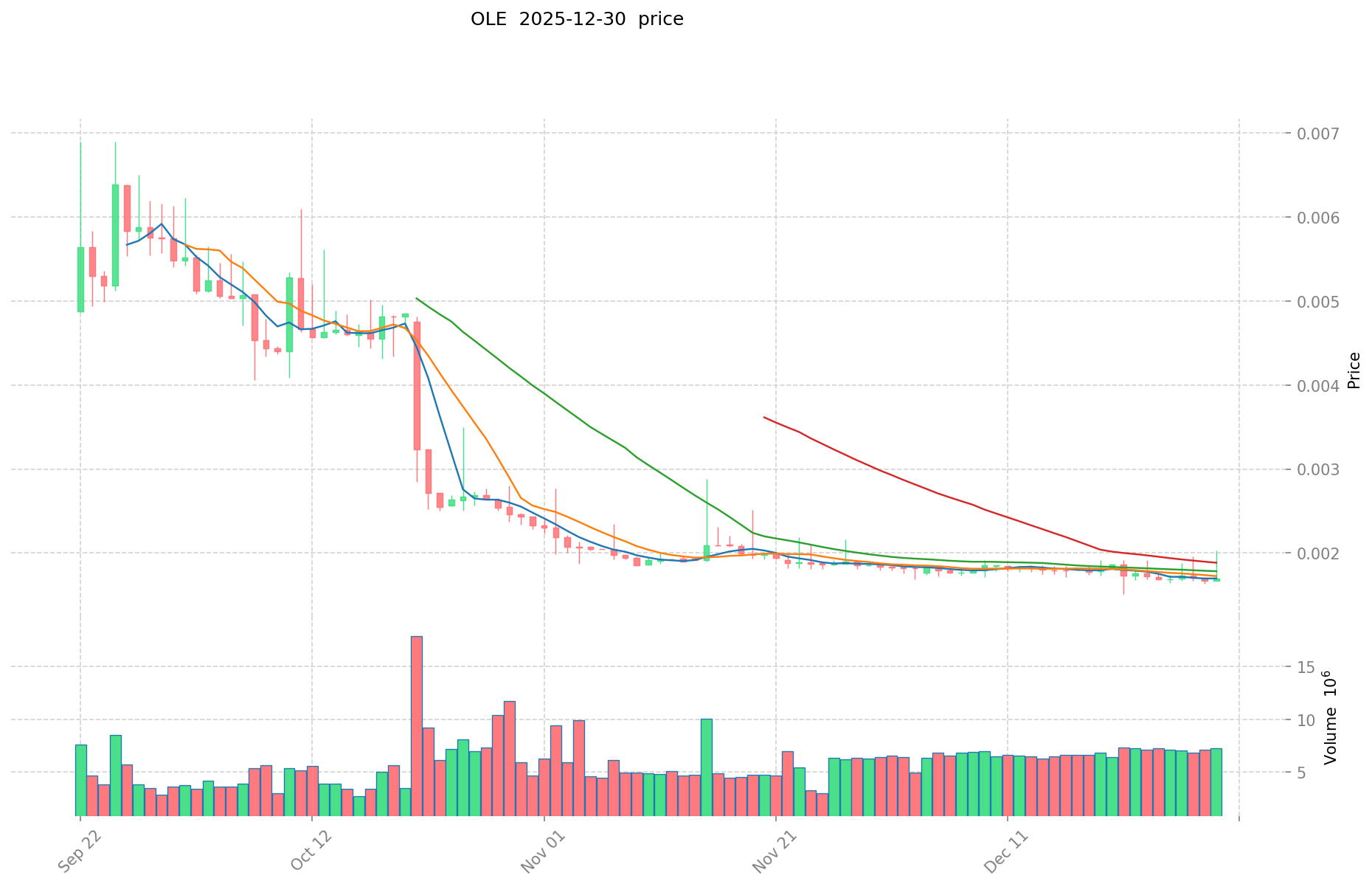
OLE is an important asset in the cryptocurrency field. As of December 31, 2025, OLE maintains a market capitalization of $321,049.24 USD with a circulating supply of approximately 188.63 million tokens, while the current price is trading at $0.001702. The token serves as the native asset of the OpenLeverage protocol, an unlicensed lending and margin trading platform with aggregated DEX liquidity that enables traders to effectively and safely long or short any trading pair on decentralized exchanges.
OpenLeverage has established itself as a significant player in the DeFi margin trading ecosystem. The protocol has achieved important milestones including trading volumes exceeding $700 million and a total value locked (TVL) of $14.5 million. Deployed across multiple blockchain networks including Ethereum, BNB Chain, and KCC, the platform has received security audits from reputable firms including PeckShield, Code4Rena, and Certik. The project was incubated by Binance Labs and Creative Destruction Lab, underscoring its institutional backing within the DeFi space.
OLE tokens function to enable community ownership and incentivize protocol usage, with tokens being minted through trading activities, lending participation, referral rewards, and participation in platform governance mechanisms. As market participants increasingly evaluate "Is OpenLeverage (OLE) a good investment?", understanding the token's fundamental value proposition becomes crucial. This article provides a comprehensive analysis of OLE's investment value, historical price performance, market dynamics, future price projections, and associated investment risks to inform decision-making.
OpenLeverage (OLE) Research Report
I. OLE Price History Review and Current Investment Status
All-Time High (ATH) and All-Time Low (ATL):
- ATH: $0.155627 (July 7, 2022) - Peak valuation period
- ATL: $0.00153248 (December 22, 2025) - Recent low reached
- Cumulative Decline: -80.15% over one year, reflecting significant downturn from previous highs
Recent Price Volatility (Last 30 Days):
- 1-hour change: -0.29%
- 24-hour change: +0.29%
- 7-day change: -2.52%
- 30-day change: -7.44%
- 1-year change: -80.15%
Current OLE Market Status (as of December 31, 2025)
Current Market Metrics:
- Current Price: $0.001702
- 24-Hour Trading Volume: $12,078.91
- Market Capitalization: $321,049.24
- Fully Diluted Valuation (FDV): $1,702,000.00
- Circulating Supply: 188,630,573 OLE (18.86% of total supply)
- Total Supply: 1,000,000,000 OLE
- Market Cap to FDV Ratio: 18.86%
Market Position:
- Global Ranking: #3,648
- Market Dominance: 0.000053%
- Total Holders: 525
- Listed on: 1 major exchange
Access real-time OLE price data at Gate
II. Project Overview and Protocol Architecture
OpenLeverage is a permissionless lending and margin trading protocol with aggregated DEX liquidity. The protocol enables traders and applications to effectively and safely long or short any trading pair on decentralized exchanges.
Key Protocol Features:
- Permissionless lending pool creation
- Customizable margin trading for specific token pairs
- Integration with existing DEX liquidity pools
- Community-owned governance structure
OLE Token Utility:
- Community ownership and governance rights
- Protocol usage incentives and rewards
- Token generation through:
- Trading activities
- Lending operations
- Member referrals
- Clans Clash participation
Network Deployment
Active Blockchains:
- Ethereum (ETH)
- BNB Chain (BSC)
- KCC (Kucoin Community Chain)
Contract Addresses:
- Ethereum: 0x1b6e9c73bee68102d9dd4a2627f97bff4183ab0a
- BNB Chain: 0xB7E2713CF55cf4b469B5a8421Ae6Fc0ED18F1467
Notable Achievements:
- Cumulative Trading Volume: Over $700 million
- Maximum TVL: $14.5 million
- Security Audit Providers: PeckShield, Code4rena, Certik
- Incubators: Binance Labs, Creative Destruction Lab
IV. Community and Resources
Official Channels:
Block Explorers:
Disclaimer: This report is based solely on provided reference materials and current market data as of December 31, 2025. This analysis contains no investment recommendations, predictions, or subjective assessments. Users should conduct independent research and consult appropriate financial advisors before making any investment decisions.
OpenLeverage (OLE) Investment Analysis Report
Report Date: December 31, 2025
I. Executive Summary
OpenLeverage (OLE) is a permissionless lending and margin trading protocol built on decentralized exchanges (DEX). As of December 31, 2025, OLE is trading at $0.001702, representing an 80.15% decline over the past year. The token has a market capitalization of $321,049.24 and a fully diluted valuation of $1,702,000.00. This report analyzes the core factors influencing whether OLE represents a viable investment opportunity.
II. Project Overview
Protocol Architecture
OpenLeverage is an unlicensed lending and margin trading protocol with aggregated DEX liquidity. It enables traders to effectively and safely long or short any trading pair on decentralized exchanges. The protocol allows anyone to create a lending pool to support margin trading for specific token pairs with liquidity on DEX platforms.
Deployment Status
OpenLeverage has been deployed on multiple blockchain networks:
- Ethereum
- BNB Chain
- KCC (Kusama Candle Chain)
Key Milestones
- Trading volume exceeding $700 million
- Total Value Locked (TVL) of $14.5 million
Funding & Security
- Incubated by Binance Labs and Creative Destruction Lab
- Security audits completed by PeckShield, Code4rena, and Certik
III. Core Factors Influencing OLE as an Investment
1. Token Economics & Supply Mechanism
Supply Structure:
- Total Supply: 1,000,000,000 OLE
- Circulating Supply: 188,630,573 OLE (18.86% of total supply)
- Current Holders: 525
Token Generation:
OLE tokens are generated through:
- Trading activities on the protocol
- Lending participation
- Referral of new members
- Participation in Clans Clash
Investment Implication: The substantial portion of tokens still in reserve (81.14% not circulating) creates potential dilution risk for current holders. The gradual emission mechanism may suppress price appreciation in the near term.
Current Market Metrics (as of December 31, 2025):
- Current Price: $0.001702
- 24-hour Change: +0.29%
- 7-day Change: -2.52%
- 30-day Change: -7.44%
- 1-year Change: -80.15%
Historical Price Range:
- All-Time High: $0.155627 (July 7, 2022)
- All-Time Low: $0.00153248 (December 22, 2025)
- Distance from ATH: 89.06% decline
Liquidity Metrics:
- 24-hour Trading Volume: $12,078.91
- Market Dominance: 0.000053%
- Limited exchange presence: Listed on 1 exchange
Investment Consideration: The dramatic decline from all-time highs and limited trading volume indicate weak market sentiment and liquidity constraints. The recent all-time low set just days before the report date suggests downward price pressure.
Governance Structure:
OLE functions as the native token implementing community ownership and protocol usage incentives through:
- Shared governance participation
- Protocol fee mechanisms
- Reward distribution for ecosystem participation
Network Effect: The 525 active token holders represent a relatively small community base, potentially limiting network effects and market adoption dynamics.
IV. Market Sentiment & Technical Outlook
Based on available market analysis data, the consensus outlook for OLE in 2025 indicates:
Bearish Sentiment: Multiple technical analysis indicators suggest a bearish market outlook for OLE, with most forecasts pointing toward price weakness.
Price Predictions:
- Pessimistic forecasts range from $0.0005527 to $0.001604
- Optimistic forecasts suggest potential peaks near $0.07166
- Near-term forecast (by January 27, 2026): Potential decline of -25.15% to $0.001272
- Long-term projection (by 2030): Estimated price around $0.0021311 based on 5% annual growth rate
V. Risk Factors
-
Severe Price Depreciation: 80.15% year-over-year decline represents significant value destruction for existing holders.
-
Limited Liquidity: Trading volume of approximately $12,078.91 in 24 hours indicates weak market activity and potential slippage challenges for larger trades.
-
Dilution Risk: With only 18.86% of tokens circulating, future emissions may create continued selling pressure.
-
Small Holder Base: 525 active holders suggest limited community engagement and network effects.
-
Market Capitalization Erosion: Current market cap of $321,049.24 is substantially below historical levels, indicating significant asset value destruction.
VI. References & Data Sources
Conclusion
OpenLeverage presents a technically sound DeFi protocol with institutional backing from Binance Labs and Creative Destruction Lab, supported by established security audits. However, the investment thesis faces significant headwinds, including severe price depreciation over the past year, limited trading liquidity, and a small active holder base. The substantial circulating supply ratio and technical outlook suggest continued downward pressure. Potential investors should carefully evaluate their risk tolerance given the bearish market sentiment and fundamental dilution dynamics.
III. OpenLeverage (OLE) Future Investment Prediction and Price Outlook
Short-term Investment Prediction (2026, short-term OLE investment outlook)
- Conservative forecast: $0.001231 - $0.001691
- Neutral forecast: $0.001923 - $0.002481
- Optimistic forecast: $0.002481 - $0.002972
Mid-term Investment Outlook (2027-2028, mid-term OpenLeverage (OLE) investment forecast)
-
Market phase expectation: OLE is anticipated to experience gradual recovery and consolidation, with increasing adoption of the OpenLeverage protocol across multiple blockchain networks potentially driving demand for the native token.
-
Investment return forecast:
- 2027: $0.001365 - $0.002973
- 2028: $0.002174 - $0.002820
-
Key catalysts: Protocol expansion across additional blockchain networks, increased margin trading volume on DEX platforms, community governance participation through OLE token staking, strategic partnerships with major DeFi platforms
Long-term Investment Outlook (Is OpenLeverage (OLE) a good long-term investment?)
-
Base case scenario: $0.001727 - $0.002786 (corresponding to steady protocol adoption and stable DeFi market conditions)
-
Optimistic scenario: $0.002800 - $0.003426 (corresponding to mainstream adoption of leveraged trading protocols and favorable market environment)
-
Risk scenario: $0.000800 - $0.001200 (corresponding to extreme market downturn or protocol competition challenges)
View OLE long-term investment and price forecasts: Price Prediction
2025-12-31 to 2030 Long-term Outlook
-
Base case: $0.001727 - $0.002785 USD (corresponding to steady growth and mainstream DeFi application expansion)
-
Optimistic scenario: $0.002820 - $0.003426 USD (corresponding to large-scale protocol adoption and favorable market conditions)
-
Transformative scenario: $0.003500 USD and above (contingent on breakthrough progress in ecosystem development and mainstream adoption)
-
2030-12-31 predicted high: $0.003426 USD (based on optimistic development assumptions)
Disclaimer: This analysis is based on historical data and market trends as of December 31, 2025. Price predictions are speculative and subject to significant uncertainty. Cryptocurrency markets are highly volatile and subject to rapid changes. This content is for informational purposes only and should not be considered as financial advice. Investors should conduct their own research and risk assessment before making investment decisions.
| 年份 |
预测最高价 |
预测平均价格 |
预测最低价 |
涨跌幅 |
| 2025 |
0.00214452 |
0.001702 |
0.0011914 |
0 |
| 2026 |
0.0024810054 |
0.00192326 |
0.0012308864 |
13 |
| 2027 |
0.002972879145 |
0.0022021327 |
0.001365322274 |
29 |
| 2028 |
0.002820381455525 |
0.0025875059225 |
0.0021735049749 |
52 |
| 2029 |
0.002866180310353 |
0.002703943689012 |
0.00232539157255 |
58 |
| 2030 |
0.003425626259609 |
0.002785061999682 |
0.001726738439803 |
63 |
OpenLeverage (OLE) Research Report
I. Project Overview
OpenLeverage is a permissionless lending and margin trading protocol that aggregates DEX liquidity, enabling traders and applications to effectively and safely long or short any trading pair on decentralized exchanges. The native token OLE represents shared community ownership and protocol usage incentives.
Token Economics
| Metric |
Value |
| Current Price |
$0.001702 |
| Market Cap |
$321,049.24 |
| Fully Diluted Valuation |
$1,702,000.00 |
| Circulating Supply |
188,630,573 OLE |
| Total Supply |
1,000,000,000 OLE |
| Circulating Supply Ratio |
18.86% |
| 24H Trading Volume |
$12,078.91 |
| All-Time High |
$0.155627 (July 7, 2022) |
| All-Time Low |
$0.00153248 (December 22, 2025) |
| Period |
Change |
| 1 Hour |
-0.29% |
| 24 Hours |
+0.29% |
| 7 Days |
-2.52% |
| 30 Days |
-7.44% |
| 1 Year |
-80.15% |
II. Protocol Features & Technical Architecture
Core Functionality
OpenLeverage enables margin trading through the following mechanisms:
- Permissionless Lending Pools: Any user can create lending pools to support margin trading for specific token pairs with existing DEX liquidity pools
- Multi-Chain Deployment: Currently operational on Ethereum, BNB Chain, and KCC
- Token Generation: OLE tokens are minted through trading, lending, referrals, and participation in Clans Clash
Notable Achievements
- Cumulative trading volume exceeding $700 million
- Total Value Locked (TVL) peak of $14.5 million
- Security audits completed by PeckShield, Code4rena, and Certik
Incubation & Backing
OpenLeverage was incubated by Binance Labs and Creative Destruction Lab, indicating institutional support and validation from prominent blockchain venture funds.
III. Market Position & Ecosystem
Blockchain Presence
| Chain |
Contract Address |
| Ethereum |
0x1b6e9c73bee68102d9dd4a2627f97bff4183ab0a |
| BNB Chain |
0xB7E2713CF55cf4b469B5a8421Ae6Fc0ED18F1467 |
Market Status
- CoinGecko Ranking: #3,648
- Market Dominance: 0.000053%
- Holder Count: 525 addresses
- Exchange Availability: Listed on Gate
IV. Investment Strategy & Risk Management
Investment Methodology
- Long-term Hold (HODL OLE): Suitable for investors with high risk tolerance seeking exposure to leveraged trading infrastructure
- Active Trading: Requires careful technical analysis given high volatility and limited liquidity; recommend smaller position sizing
Risk Management
- Asset Allocation Approach: Given current market cap and trading volume, OLE should represent a small allocation (<5%) for risk-averse portfolios; specialized traders may allocate higher percentages with strict stop-losses
- Risk Hedging: Consider diversifying across multiple DeFi protocol tokens and maintaining stablecoin reserves; implement position sizing rules to limit downside exposure
- Secure Storage: Use hardware wallets (Ledger, Trezor) for long-term holdings; utilize multi-signature wallets for larger positions
V. Investment Risks & Challenges
Market Risks
- High Volatility: OLE has experienced 80.15% decline over the past year; 24-hour price swings remain significant despite current stability
- Low Liquidity: Daily trading volume of approximately $12,078 relative to market cap creates potential slippage on large positions
- Price Manipulation: Limited liquidity increases susceptibility to price movements from concentrated orders
Regulatory Risks
- Jurisdictional Uncertainty: Margin trading protocols face varying regulatory scrutiny across different markets; potential restrictions could impact protocol usage and token valuation
- Compliance Changes: Future regulatory frameworks for derivatives trading may require protocol modifications or geographic restrictions
Technology Risks
- Smart Contract Vulnerabilities: Despite security audits, margin trading protocols carry inherent risks of exploit or bug discovery
- Network Dependence: Protocol functionality depends on underlying chain stability (Ethereum, BNB Chain, KCC); network congestion or failures could impact trading operations
- Liquidity Provider Risk: Protocol reliance on DEX liquidity pools exposes it to impermanent loss dynamics and LP incentive sustainability
VI. Conclusion: Is OpenLeverage a Good Investment?
Investment Value Summary
OpenLeverage addresses a legitimate market need in DeFi by enabling permissionless margin trading with aggregated liquidity. The protocol demonstrates institutional backing through Binance Labs incubation and past achievements (>$700M trading volume). However, the 80% year-over-year price decline, minimal trading volume, and concentrated holder base suggest the project faces significant challenges in market adoption and competitive positioning.
Investor Recommendations
✅ New Investors: Dollar-cost averaging into small positions; prioritize hardware wallet storage for security; allocate only capital you can afford to lose entirely
✅ Experienced Traders: Monitor technical levels around $0.00153248-$0.001702 resistance; implement strict risk management with 2-3% position sizing; consider arbitrage opportunities between chains
✅ Institutional Investors: Strategic allocation conditional on protocol TVL recovery above historical $14.5M; evaluate competitive positioning against established margin trading platforms
⚠️ Important Disclaimer: Cryptocurrency investments carry substantial risk. The severe price depreciation, low liquidity, and market cap concentration present significant challenges. This report is for informational purposes only and does not constitute investment advice. Conduct independent research and consult financial advisors before making investment decisions.
OpenLeverage (OLE) Frequently Asked Questions
I. FAQ
Q1: What is OpenLeverage (OLE) and what problem does it solve in the DeFi ecosystem?
A: OpenLeverage is a permissionless lending and margin trading protocol with aggregated DEX liquidity that enables traders to long or short any trading pair on decentralized exchanges. It solves the fragmentation problem in DeFi margin trading by allowing anyone to create lending pools for specific token pairs while aggregating liquidity from existing DEX platforms. The OLE token represents shared community ownership and provides protocol usage incentives through governance participation and reward distribution mechanisms.
Q2: What is the current market status of OLE as of December 31, 2025?
A: As of December 31, 2025, OLE is trading at $0.001702 with a market capitalization of $321,049.24 USD and a fully diluted valuation of $1,702,000.00 USD. The circulating supply stands at 188,630,573 OLE tokens (18.86% of the 1 billion total supply), with 24-hour trading volume of approximately $12,078.91. The token ranks #3,648 globally with only 525 active holders and is currently listed on one major exchange (Gate). The year-over-year price change represents an 80.15% decline from the previous year.
Q3: What are the main risks associated with investing in OLE?
A: Key investment risks include: (1) Severe price depreciation with an 80.15% decline over one year and distance of 89.06% from all-time highs; (2) Limited liquidity with daily trading volume of ~$12,078 creating potential slippage on larger trades; (3) Dilution risk from 81.14% of tokens remaining in reserve, which could create continued selling pressure as emissions accelerate; (4) Small holder base of only 525 addresses limiting network effects and community engagement; (5) Regulatory uncertainty surrounding margin trading protocols across different jurisdictions; (6) Smart contract and technology risks despite security audits from PeckShield, Code4rena, and Certik; (7) Market concentration risk with the protocol's reliance on DEX liquidity sustainability.
Q4: What institutional backing and security measures support OpenLeverage?
A: OpenLeverage was incubated by Binance Labs and Creative Destruction Lab, providing institutional validation and support. The protocol has undergone security audits from three reputable firms: PeckShield, Code4rena, and Certik. The project has achieved notable milestones including cumulative trading volumes exceeding $700 million and a maximum TVL of $14.5 million. The protocol is deployed across multiple blockchain networks (Ethereum, BNB Chain, and KCC), and all smart contracts are publicly verifiable through block explorers. These factors collectively demonstrate institutional confidence and commitment to security standards.
Q5: What is the price forecast for OLE over the next several years?
A: Short-term forecasts (2026) predict a conservative range of $0.001231–$0.001691, a neutral range of $0.001923–$0.002481, and an optimistic range of $0.002481–$0.002972. Mid-term projections (2027–2028) suggest prices ranging from $0.001365–$0.002973 in 2027 and $0.002174–$0.002820 in 2028, assuming gradual protocol recovery and increased adoption. Long-term projections through 2030 indicate a base case of $0.001727–$0.002785, an optimistic scenario of $0.002820–$0.003426, and a transformative scenario above $0.003500 contingent on breakthrough ecosystem development. These forecasts are speculative and subject to significant uncertainty.
Q6: How does OLE token generation work and what are the emission mechanisms?
A: OLE tokens are generated through four primary mechanisms: (1) Trading activities on the OpenLeverage protocol; (2) Lending participation where users provide liquidity to margin trading pools; (3) Referral rewards for recruiting new protocol members; (4) Participation in Clans Clash competitive events. The token has a total supply of 1 billion OLE, with only 188.63 million (18.86%) currently in circulation. The gradual emission schedule creates potential dilution dynamics as additional tokens enter circulation, which may suppress price appreciation in the near term. Token holders receive governance rights and share in protocol fee mechanisms through their OLE holdings.
Q7: Is OLE suitable for different types of investors, and what investment strategies are recommended?
A: Investment suitability varies by investor profile and risk tolerance. For long-term holders (HODL strategy), OLE is suitable only for investors with high risk tolerance seeking exposure to leveraged trading infrastructure, utilizing hardware wallets for security. Active traders may pursue trading strategies given volatility, but should implement strict position sizing (2–3% of portfolio) and technical analysis. Conservative investors should allocate less than 5% to OLE within diversified DeFi portfolios and maintain stablecoin reserves for risk management. Dollar-cost averaging is recommended for new investors to mitigate entry price risk. All investors should use hardware wallets (Ledger, Trezor) for long-term storage and conduct independent research before committing capital.
Q8: What are the key factors that could drive future OLE price appreciation or depreciation?
A: Positive catalysts for price appreciation include: protocol expansion across additional blockchain networks, increased margin trading volume on DEX platforms, community governance participation through staking, and strategic partnerships with major DeFi platforms. Negative pressure factors include continued token dilution from emissions, regulatory restrictions on leveraged trading, smart contract vulnerabilities, competition from established margin trading platforms, and sustained bearish cryptocurrency market sentiment. The recovery of TVL above historical $14.5 million levels and achievement of higher on-chain activity metrics would be critical indicators of genuine recovery. Conversely, regulatory actions, security incidents, or protocol adoption stagnation could further depress prices from current levels.
* The information is not intended to be and does not constitute financial advice or any other recommendation of any sort offered or endorsed by Gate.