This comprehensive analysis examines whether Optimism (OP) is a worthwhile investment in 2024-2031. As the native governance token of Optimism, a Layer 2 scaling solution for Ethereum, OP trades at $0.3621 with a market cap of $703.96 million as of January 2026. The article evaluates OP's investment potential through multiple lenses: price history showing an 78.92% decline over one year, core investment factors including supply scarcity and institutional adoption across 57 exchanges, and future price forecasts ranging from $0.315 to $0.810 by 2031. Key investment catalysts include Ethereum scaling developments and ecosystem expansion through the OP Stack framework. The analysis addresses critical risks including market volatility, regulatory uncertainty, technical vulnerabilities, and competition from alternative Layer 2 solutions. Tailored investment strategies accommodate beginners, experienced traders, and institutional investors. Accessible via Gate, this guide provides actionable insights for assessing O
Introduction: Optimism (OP) Investment Position and Market Outlook
OP is a significant asset in the cryptocurrency sector, serving as the native governance token of Optimism, a Layer 2 scaling solution for Ethereum. Launched in 2022, Optimism addresses scalability challenges by providing low-cost, fast transactions while maintaining Ethereum's security. As of January 14, 2026, OP holds a market capitalization of approximately $703.96 million with a circulating supply of around 1.94 billion tokens, priced at approximately $0.3621. The token currently ranks 110th in the cryptocurrency market and is listed on 57 exchanges, with over 1.35 million holders. With its positioning as a governance token for the Optimism Collective and its role in the broader Layer 2 ecosystem, OP has become a focal point for investors considering "Is Optimism (OP) a good investment?" This article provides a comprehensive analysis of OP's investment value, historical performance, future price predictions, and associated risks to serve as a reference for potential investors.
I. OP Token Price History Review and Current Investment Value Status
- 2022: OP debuted on the open market through its first airdrop on May 31, 2022, with an initial valuation of $4.57 USD → Early market participants experienced significant price adjustments as the market reassessed the token's valuation shortly after launch
- 2023: OP emerged as one of the better-performing cryptocurrencies in the sector, with price appreciation → The token demonstrated relative strength during this period within the Layer 2 scaling solutions segment
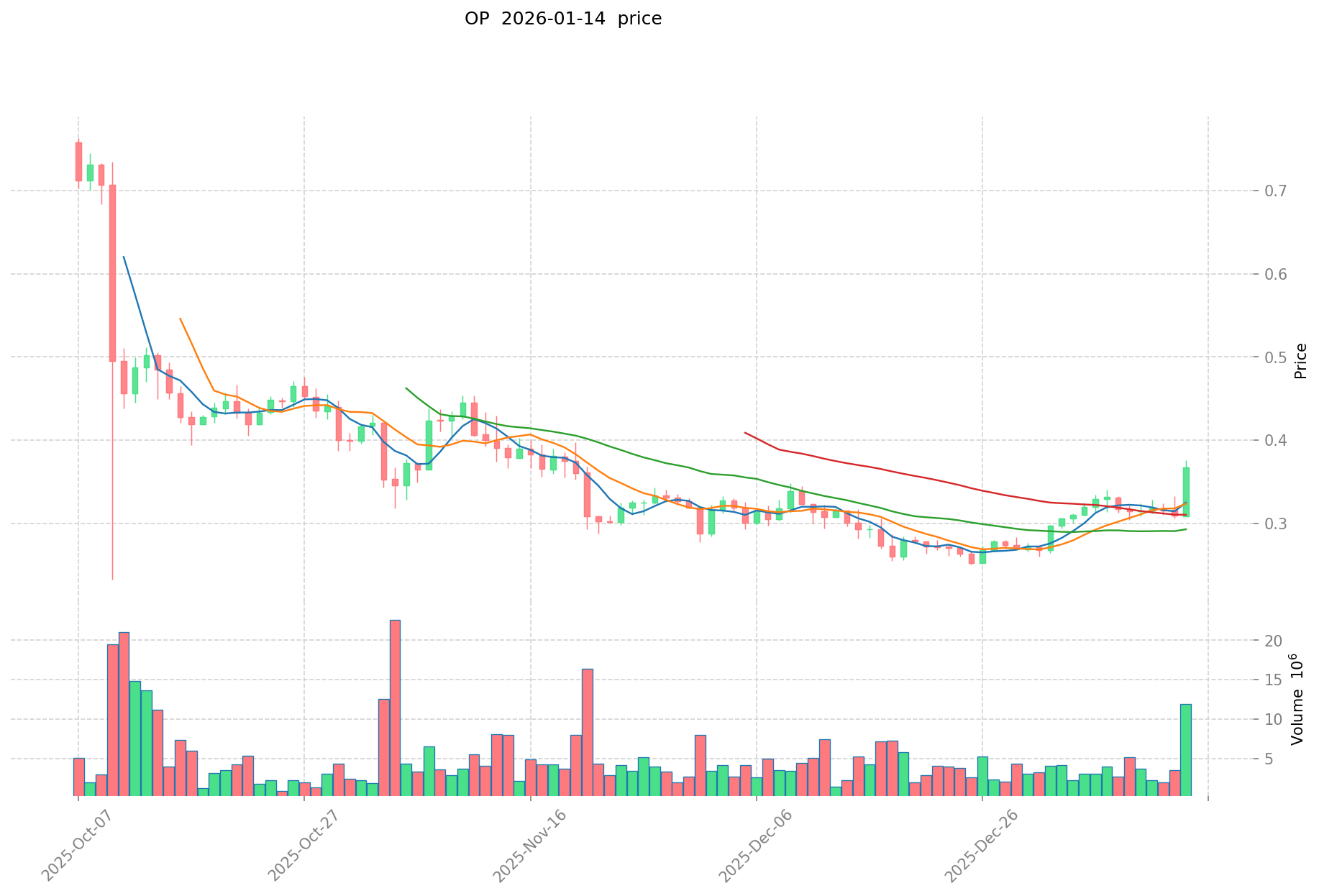
- 2022-2025: Market cycles affected OP's price trajectory → The token moved from higher valuation levels to $0.3621 USD (as of January 14, 2026)
Current OP Investment Market Status (January 2026)
- OP current price: $0.3621 USD
- Market sentiment (Fear & Greed Index): Data not available in provided materials
- 24-hour trading volume: $5,444,927.26 USD
- Institutional investor holdings: Token holder count stands at approximately 1,357,209 addresses
Click to view real-time OP market price
II. Core Factors Influencing Whether OP is a Good Investment
Supply Mechanism and Scarcity (OP Investment Scarcity)
- Maximum Supply Cap: Optimism (OP) has a capped maximum supply of 4,294,967,296 tokens, with current circulating supply at 1,944,092,497 tokens, representing approximately 45.26% of total supply. This fixed supply ceiling creates a built-in scarcity mechanism that may influence long-term investment value.
- Supply Distribution Timeline: As of January 14, 2026, more than half of OP tokens remain unvested or uncirculated, suggesting gradual supply releases that could impact price dynamics over time. The structured emission schedule affects token availability and potential scarcity pressure.
- Investment Implication: The predetermined supply cap differentiates OP from assets with unlimited issuance, potentially supporting long-term valuation for investors considering scarcity as an investment criterion.
Institutional Investment and Mainstream Adoption (Institutional Investment in OP)
- Holder Base Expansion: Optimism has attracted 1,357,209 token holders as of January 2026, indicating broad retail and institutional participation in the ecosystem.
- Exchange Availability: OP trades on 57 cryptocurrency exchanges globally, including major platforms, providing institutional-grade liquidity channels and accessibility for diverse investor categories.
- Ecosystem Positioning: As a governance token for the Optimism network and its "Superchain" vision, OP serves functional purposes beyond speculation, including protocol governance rights that may appeal to ecosystem-focused institutional investors.
Macroeconomic Environment Impact on OP Investment
- Layer 2 Market Context: Optimism operates within the Ethereum Layer 2 scaling sector, where investment attractiveness correlates with Ethereum network usage, gas fee trends, and broader blockchain adoption cycles.
- Liquidity Conditions: Market analysts note that broader cryptocurrency liquidity conditions, influenced by monetary policy shifts and risk appetite, affect Layer 2 tokens including OP, with improved liquidity potentially stabilizing prices.
- Volatility Factors: OP experienced significant price fluctuation in 2025, opening near $2.18 before declining substantially, reflecting sensitivity to macroeconomic uncertainty and risk-off sentiment in crypto markets.
Technology and Ecosystem Development (Technology & Ecosystem for OP Investment)
- OP Stack Framework: Optimism's OP Stack serves as open-source infrastructure for building interoperable Layer 2 networks, with the "Superchain" initiative aiming to create networked L2s that may expand ecosystem utility and investment relevance.
- Scalability Features: The network provides lower transaction fees and faster settlement compared to Ethereum mainnet, addressing practical needs for developers and users, which may support sustained ecosystem growth.
- Governance Model: OP functions primarily as a governance token, enabling holders to participate in protocol decisions through the Optimism Collective structure, offering utility beyond price speculation for governance-focused investors.
- Developer Ecosystem: The platform emphasizes developer onboarding and application integration, with ongoing ecosystem expansion in decentralized finance (DeFi) and other blockchain applications potentially influencing long-term investment value.
III. OP Future Investment Outlook and Price Forecast (Is Optimism (OP) worth investing in 2026-2031)
Short-term Investment Outlook (2026, short-term OP investment outlook)
- Conservative Forecast: $0.315 - $0.362
- Neutral Forecast: $0.362 - $0.429
- Optimistic Forecast: $0.429 - $0.496
Mid-term Investment Outlook (2027-2029, mid-term Optimism (OP) investment forecast)
- Market Stage Expectation: The mid-term outlook suggests a gradual upward trajectory as the Layer 2 ecosystem matures and adoption increases.
- Investment Return Forecast:
- 2027: $0.386 - $0.537
- 2028: $0.362 - $0.546
- 2029: $0.442 - $0.597
- Key Catalysts: Ethereum scaling developments, regulatory clarity in major markets, and technical advancements in optimistic rollup technology.
Long-term Investment Outlook (Is OP a good long-term investment?)
- Base Scenario: $0.361 - $0.577 (assuming steady ecosystem growth and moderate market conditions)
- Optimistic Scenario: $0.549 - $0.810 (assuming accelerated adoption and favorable regulatory environment)
- Risk Scenario: Below $0.315 (in case of adverse market conditions or technical setbacks)
For more information on OP long-term investment and price predictions: Price Prediction
2026-01-14 to 2031 Long-term Outlook
- Base Scenario: $0.361 - $0.577 (corresponding to steady progress and gradual mainstream application growth)
- Optimistic Scenario: $0.549 - $0.810 (corresponding to large-scale adoption and favorable market environment)
- Transformative Scenario: Above $0.810 (if ecosystem achieves breakthrough developments and mainstream adoption)
- 2031-12-31 Forecast High: $0.810 (based on optimistic development assumptions)
Disclaimer: Price forecasts are based on historical data and market analysis models. Cryptocurrency markets are highly volatile and subject to various unpredictable factors. These predictions should not be considered as investment advice. Investors should conduct their own research and consider their risk tolerance before making investment decisions.
| Year |
Predicted High Price |
Predicted Average Price |
Predicted Low Price |
Price Change |
| 2026 |
0.496351 |
0.3623 |
0.315201 |
0 |
| 2027 |
0.536656875 |
0.4293255 |
0.38639295 |
18 |
| 2028 |
0.545780041875 |
0.4829911875 |
0.362243390625 |
33 |
| 2029 |
0.5966873130375 |
0.5143856146875 |
0.44237162863125 |
42 |
| 2030 |
0.577757922417 |
0.5555364638625 |
0.361098701510625 |
53 |
| 2031 |
0.810305486189842 |
0.56664719313975 |
0.549647777345557 |
56 |
IV. Optimism (OP) Investment Strategy and Risk Management (How to invest in Layer 2 Scaling Solutions)
Investment Methodology (Optimism investment strategy)
Long-term Holding (HODL OP)
For conservative investors seeking exposure to Ethereum Layer 2 infrastructure, long-term holding may be considered as part of a diversified portfolio strategy. This approach focuses on the potential growth of the Optimism ecosystem and its role in Ethereum scaling solutions.
Active Trading
Active traders may utilize technical analysis and momentum-based strategies, considering OP's price volatility. The token has demonstrated significant price movements, with a 24-hour change of 12.86% and a 7-day change of 12.02%. However, such strategies require continuous market monitoring and risk assessment.
Risk Management (Risk management for OP investment)
Asset Allocation
- Conservative investors: May allocate a smaller portion (1-5%) of their cryptocurrency portfolio to OP
- Moderate investors: Could consider 5-10% allocation as part of a Layer 2 infrastructure thesis
- Experienced investors: May allocate higher percentages based on their risk tolerance and market analysis
Risk Hedging Strategies
- Maintain a diversified portfolio across different blockchain ecosystems and asset classes
- Consider correlation with Ethereum's performance when building portfolio strategies
- Utilize position sizing based on individual risk tolerance
Secure Storage
- Cold Wallets: Hardware wallets for long-term holdings
- Hot Wallets: For active trading purposes with limited amounts
- Multi-signature Solutions: For institutional or large holdings
V. Optimism (OP) Investment Risks and Challenges (Risks of investing in Layer 2 Scaling Solutions)
Market Risk
OP has experienced substantial price volatility. The token is currently trading at $0.3621, representing a significant decline from its historical high of $4.84 recorded in March 2024. The 1-year performance shows a decline of 78.92%, indicating considerable market risk. The 24-hour trading volume of approximately $5.44 million suggests varying liquidity conditions.
Regulatory Risk
As a governance token for a Layer 2 scaling solution, OP may be subject to evolving regulatory frameworks across different jurisdictions. Changes in securities regulations, DeFi oversight, or blockchain technology policies could impact the token's utility and market performance.
Technical Risk
- Network Security: As a Layer 2 solution, potential vulnerabilities in the protocol could affect token value
- Smart Contract Risk: The token operates with contract address 0x4200000000000000000000000000000000000042 on the Optimism network
- Upgrade Challenges: Technical implementations or protocol upgrades may face unforeseen complications
- Ethereum Dependency: As an Ethereum Layer 2 solution, OP's performance is inherently linked to Ethereum's network health
Competition Risk
The Layer 2 scaling sector faces increasing competition from alternative solutions, which may impact OP's market position and adoption.
VI. Conclusion: Is Layer 2 Scaling Solutions a Good Investment?
Investment Value Summary
Optimism (OP) represents participation in Ethereum's Layer 2 scaling infrastructure. With a market capitalization of approximately $703.96 million and a circulating supply representing 45.26% of the maximum supply of 4.29 billion tokens, the token has established market presence. However, the significant price decline of 78.92% over the past year and current distance from all-time highs indicate substantial volatility and risk factors.
Investor Recommendations
✅ Beginners:
- Consider dollar-cost averaging to mitigate timing risk
- Utilize secure wallet storage solutions
- Allocate only funds that can be afforded to lose
- Conduct thorough research on Layer 2 technology before investing
✅ Experienced Investors:
- May explore tactical allocation strategies based on technical analysis
- Consider portfolio diversification across multiple blockchain ecosystems
- Monitor ecosystem developments and governance proposals
✅ Institutional Investors:
- Evaluate OP as part of blockchain infrastructure exposure
- Conduct comprehensive due diligence on protocol fundamentals
- Assess long-term scalability trends in the Ethereum ecosystem
⚠️ Disclaimer: Cryptocurrency investments carry substantial risk, including the potential loss of principal. This content is provided for informational purposes only and does not constitute investment advice. Investors should conduct their own research and consult with financial professionals before making investment decisions.
VII. FAQ
Q1: What is Optimism (OP) and why is it considered an investment option?
Optimism (OP) is the native governance token of Optimism, a Layer 2 scaling solution for Ethereum launched in 2022. It is considered an investment option because it provides holders with governance rights in the Optimism Collective and represents exposure to Ethereum's Layer 2 infrastructure development. As of January 14, 2026, OP has a market capitalization of approximately $703.96 million, trades on 57 exchanges, and has over 1.35 million token holders. The token serves functional purposes beyond speculation, including protocol governance participation and ecosystem utility within the "Superchain" vision, which aims to create interconnected Layer 2 networks using the OP Stack framework.
Q2: What is the current price performance of OP and how has it changed historically?
As of January 14, 2026, OP is priced at approximately $0.3621 USD, representing a significant decline from its historical high of $4.84 recorded in March 2024—a decrease of 78.92% over one year. The token debuted at $4.57 USD in May 2022 through an airdrop, experienced relative strength in 2023 as one of the better-performing Layer 2 tokens, but has since experienced substantial volatility. Recent short-term performance shows a 24-hour change of 12.86% and a 7-day change of 12.02%, indicating continued price fluctuation. The 24-hour trading volume stands at approximately $5.44 million, reflecting current market liquidity conditions.
Q3: What factors influence OP's investment value?
Four core factors influence OP's investment value: (I) Supply mechanism—OP has a capped maximum supply of 4.29 billion tokens with 1.94 billion currently circulating (45.26%), creating scarcity potential; (II) Institutional adoption—the token has 1,357,209 holders and trades on 57 exchanges, indicating broad participation; (III) Macroeconomic environment—OP is sensitive to Ethereum network usage, gas fee trends, broader cryptocurrency liquidity conditions, and risk appetite; (IV) Technology and ecosystem development—the OP Stack framework, Superchain initiative, governance model, and developer ecosystem expansion all contribute to long-term utility and investment relevance.
Q4: What is the price forecast for OP from 2026 to 2031?
Price forecasts for OP vary by scenario: For 2026 (short-term), predictions range from $0.315 (conservative) to $0.496 (optimistic). Mid-term forecasts suggest: 2027 ($0.386-$0.537), 2028 ($0.362-$0.546), and 2029 ($0.442-$0.597). Long-term projections for 2031 indicate: base scenario ($0.361-$0.577), optimistic scenario ($0.549-$0.810), and transformative scenario (above $0.810). The predicted high for 2031 is $0.810, representing potential 56% growth from current levels. However, these forecasts are based on historical data and market analysis models and should not be considered investment advice, as cryptocurrency markets are highly volatile and subject to unpredictable factors.
Q5: What are the primary risks associated with investing in OP?
Four primary risks affect OP investment: (I) Market risk—OP has experienced substantial volatility with a 78.92% decline over one year and trading significantly below its historical high, indicating considerable price risk and varying liquidity conditions; (II) Regulatory risk—evolving frameworks regarding securities, DeFi oversight, and blockchain technology policies could impact token utility; (III) Technical risk—potential vulnerabilities in the Layer 2 protocol, smart contract risks (contract address: 0x4200000000000000000000000000000000000042), upgrade challenges, and dependency on Ethereum network health; (IV) Competition risk—increasing competition from alternative Layer 2 scaling solutions may impact OP's market position and adoption.
Q6: What investment strategies are suitable for different types of OP investors?
Investment strategies vary by investor profile: Beginners should consider dollar-cost averaging to mitigate timing risk, utilize secure wallet storage, allocate only funds they can afford to lose, and conduct thorough research on Layer 2 technology. Experienced investors may explore tactical allocation strategies based on technical analysis, diversify across multiple blockchain ecosystems, and monitor ecosystem developments and governance proposals. Institutional investors should evaluate OP as part of blockchain infrastructure exposure, conduct comprehensive due diligence on protocol fundamentals, and assess long-term scalability trends in the Ethereum ecosystem. Asset allocation recommendations include: conservative investors (1-5% of crypto portfolio), moderate investors (5-10%), and experienced investors (higher percentages based on individual risk tolerance).
Q7: How does OP's tokenomics structure affect its long-term investment potential?
OP's tokenomics create specific investment dynamics: the maximum supply cap of 4.29 billion tokens establishes built-in scarcity, with only 45.26% currently circulating (1.94 billion tokens). More than half of OP tokens remain unvested or uncirculated, suggesting gradual supply releases that could impact price dynamics over time. This structured emission schedule affects token availability and potential scarcity pressure. The predetermined supply cap differentiates OP from assets with unlimited issuance, potentially supporting long-term valuation for scarcity-focused investors. However, the ongoing token unlocks represent a consideration for price pressure analysis, as increased supply entering the market may affect short-to-medium term price performance.
Q8: Is OP suitable as a long-term investment in the Layer 2 ecosystem?
OP's suitability as a long-term investment depends on several factors: The token represents participation in Ethereum's Layer 2 scaling infrastructure, which addresses critical scalability challenges. With the OP Stack framework and Superchain initiative, Optimism aims to create networked L2 solutions that may expand ecosystem utility. The token's governance function provides utility beyond speculation, appealing to ecosystem-focused investors. However, significant considerations include the 78.92% price decline over the past year, substantial distance from all-time highs, and inherent cryptocurrency market volatility. Long-term potential exists in base scenarios ($0.361-$0.577 by 2031) and optimistic scenarios ($0.549-$0.810), but investors must weigh these possibilities against market, regulatory, technical, and competition risks. Suitability ultimately depends on individual risk tolerance, portfolio diversification strategy, and conviction in Ethereum Layer 2 adoption trends.
* The information is not intended to be and does not constitute financial advice or any other recommendation of any sort offered or endorsed by Gate.