# Article Overview: Peanut (NUX) Investment Analysis
This comprehensive guide evaluates whether Peanut (NUX) represents a viable investment opportunity by analyzing the ERC-20 token's market fundamentals, DeFi protocol utility, and price performance. The analysis addresses critical investment questions: examining NUX's 99.99% decline from its $31 historical peak to current $0.002428 pricing, evaluating its utility within the Peanut.trade price-balancing ecosystem, and assessing risk factors including extreme volatility, minimal liquidity ($11,737 daily volume), and limited adoption across 2,005 holders. Structured across price history review, protocol mechanics explanation, risk assessment, and 2026-2031 price forecasts, this report equips potential investors—from beginners to institutions trading on Gate—with data-driven insights into this speculative DeFi asset's viability and market prospects.
Introduction: Peanut (NUX) Investment Position and Market Prospects
NUX is an ERC-20 token supporting the Peanut protocol within the decentralized finance (DeFi) ecosystem. Since its launch in February 2021, NUX has served a critical function in the Peanut.trade platform, a DeFi price balancer designed to protect liquidity providers from impermanent losses and reduce slippage. As of January 2026, NUX maintains a market capitalization of $121,400 USD with a circulating supply of 50,000,000 tokens, currently trading at approximately $0.002428 per token.
Peanut.trade operates as a price balancing mechanism that integrates with major decentralized exchanges such as Uniswap and the Curve platform. The protocol allocates liquidity provider assets strategically: 90% for direct liquidity provision on DEX platforms and 10% for automated multi-level price balancing between decentralized exchanges (DEX) and centralized exchanges (CEX). NUX tokens function as the essential utility asset enabling this balancing algorithm to execute effectively.
The token's utility framework requires users to deposit NUX to access Peanut's liquidity balancing features. Liquidity providers generate passive income through the protocol, with a 10% performance fee collected in NUX tokens. This mechanism positions NUX as a foundational component rather than merely a speculative asset, creating intrinsic demand within the Peanut ecosystem.
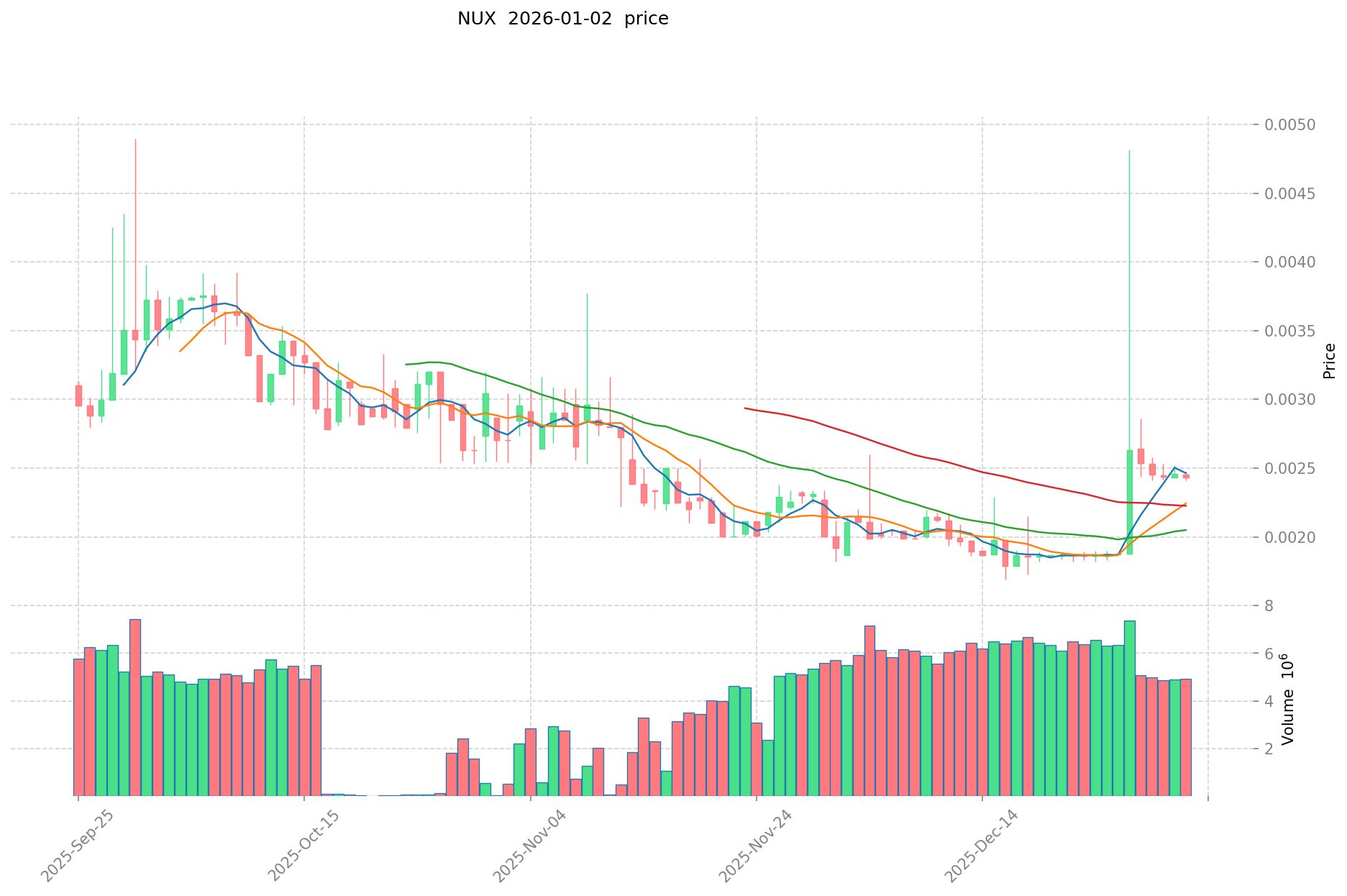
Over the past year, NUX has experienced significant volatility, declining 44.07% from its one-year price level, while demonstrating recent 7-day gains of 29.81%. The token's historical high of $31 USD was achieved on February 19, 2021, compared to its recent low of $0.00172027 on December 17, 2025, illustrating the substantial price compression the project has undergone.
This comprehensive analysis examines NUX's investment fundamentals, historical price trends, future valuation projections, and associated risk factors to provide investors with informed insights into this DeFi-focused digital asset.
Peanut (NUX) Comprehensive Research Report
I. Price History Review and Current Investment Value Assessment
- February 2021: NUX reached its all-time high of $31 USD, representing exceptional returns for early investors during the initial DeFi boom period
- January 2026: Current price stands at $0.002428 USD, reflecting a significant decline of approximately 99.99% from the historical peak
- Price Range: Historical trading range spans from $31.00 (February 19, 2021) to $0.00172027 (December 17, 2025), demonstrating extreme volatility characteristic of emerging DeFi tokens
Current Market Status (January 3, 2026)
- Current Price: $0.002428 USD
- 24-Hour Price Change: +0.24% (${'+0.000005813248204309'}$)
- 7-Day Performance: +29.81%
- 1-Year Performance: -44.07%
- 24-Hour Trading Volume: $11,737.43 USD
- Market Capitalization: $121,400.00 USD
- Fully Diluted Valuation (FDV): $121,400.00 USD
- Market Dominance: 0.0000037%
- Token Holders: 2,005
Market data current as of January 3, 2026, 02:21:12 UTC
II. Project Overview and Technical Architecture
Peanut.trade Protocol Description
Peanut.trade functions as a DeFi price balancer designed to mitigate impermanent loss exposure and optimize returns for liquidity providers. The protocol operates by:
- Protecting liquidity providers from impermanent losses and price slippage resulting from large DEX transactions
- Reducing slippage costs through integrated price balancing mechanisms across multiple trading venues
- Increasing LP profitability via automatic multi-level price arbitrage operations
- Curve Platform Integration: The protocol has been integrated with the Curve platform to further minimize slippage and impermanent loss risks
Asset Allocation Mechanism
The protocol divides liquidity provider assets into two functional components:
- 90% allocation: Deployed on Uniswap and other Decentralized Exchanges (DEXs) to provide core liquidity
- 10% allocation: Reserved for automated multi-level price balancing operations across Uniswap, other DEXs, and Centralized Exchanges (CEXs)
III. NUX Token Utility and Protocol Economics
Functional Role of NUX Token
NUX is an ERC-20 token serving as the foundational asset enabling Peanut protocol operations:
Core Utility Functions
- Liquidity Pool Support: Users must deposit NUX tokens to enable the protocol's balancing algorithm to function with their liquidity
- Algorithm Enablement: NUX tokens serve as the operational catalyst allowing the price balancing algorithm to interact with user assets across multiple platforms
- Minimum Requirements: Liquidity providers and regular users require sufficient NUX holdings to activate the Peanut balancing mechanism for their capital
Revenue Model and Fee Structure
- Third-Party LP Incentives: The protocol sources the majority of required balancing capital from third-party liquidity providers, who earn passive income through lending mechanisms
- Profit-Sharing Fee: A 10% fee is charged on NUX tokens following profit realization by liquidity providers
- Diverse Participation: All market participants, from individual traders to investment funds, can function as liquidity providers within the protocol
Operational Architecture
The protocol requires substantial encrypted assets to function effectively:
- Peanut Reserve Allocation: The protocol contributes capital from its own reserves
- Third-Party Capital Contribution: External entities provide the majority of balancing capital, generating passive returns through lending participation
- Multi-Platform Coordination: The balancing mechanism operates across CEX and DEX platforms simultaneously to achieve optimal price equilibrium
IV. Blockchain Integration
Deployment Details
- Blockchain Network: Ethereum (ETH)
- Contract Address: 0x89bd2e7e388fab44ae88bef4e1ad12b4f1e0911c
- Token Standard: ERC-20
- Verification: Etherscan Contract Verification
V. Token Supply Structure
- Total Supply: 50,000,000 NUX
- Circulating Supply: 50,000,000 NUX
- Maximum Supply: 50,000,000 NUX
- Circulation Ratio: 100.0%
- Supply Status: Fully diluted; no additional token emission mechanisms are indicated
VI. Market Liquidity and Exchange Availability
- Exchange Presence: NUX is traded on Gate and other cryptocurrency exchanges
- Primary Trading Venue: Gate (institutional-grade trading infrastructure)
- Liquidity Status: Limited trading volume relative to market capitalization, indicating restricted liquidity conditions
VII. Community and Resources
Report Date: January 3, 2026
Data Source: Gate Cryptocurrency Data Platform
Disclaimer: This report presents factual information derived from available data sources. The extreme price volatility and historically significant decline in NUX value reflect the speculative nature and market risks associated with emerging DeFi tokens. Past performance does not indicate future results.
Peanut (NUX) Crypto Asset Analysis Report
Report Date: January 3, 2026
Token Name: Peanut
Token Symbol: NUX
Market Ranking: 4,680
I. Executive Summary
Peanut (NUX) is an ERC-20 token supporting the Peanut.trade protocol, a DeFi price balancer designed to protect liquidity providers from impermanent losses and reduce slippage. As of January 3, 2026, NUX trades at $0.002428 with a fully diluted market capitalization of $121,400 USD and a circulating supply of 50,000,000 tokens.
II. Core Factors Affecting NUX Investment Viability
Supply Mechanism and Scarcity
NUX operates with a fixed supply model:
- Circulating Supply: 50,000,000 tokens
- Total Supply: 50,000,000 tokens
- Maximum Supply: 50,000,000 tokens
- Circulation Ratio: 100%
The token maintains complete circulation parity with maximum supply, meaning no additional token inflation is anticipated. All tokens are currently in circulation, eliminating future dilution concerns from new issuances.
Fee Structure and Economic Model
The Peanut protocol incorporates a 10% fee mechanism on profits generated by liquidity providers. This fee structure creates potential demand for NUX tokens as users must hold sufficient NUX balances to enable Peanut's balancing mechanisms to operate on their liquidity positions.
Peanut has achieved integration with the Curve platform, expanding its operational ecosystem beyond standalone DEXs. This integration enhances accessibility and potential utility value.
Current Market Metrics
| Metric |
Value |
| Current Price |
$0.002428 |
| 24-Hour Change |
+0.24% |
| 7-Day Change |
+29.81% |
| 30-Day Change |
+13.10% |
| 1-Year Change |
-44.07% |
| 24-Hour Volume |
$11,737.43 |
| All-Time High |
$31.00 (February 19, 2021) |
| All-Time Low |
$0.00172027 (December 17, 2025) |
Historical Performance Context
NUX has experienced significant price depreciation from its historical peak of $31.00 in February 2021 to the current price level, representing a decline of approximately 99.99%. The token reached its all-time low only recently on December 17, 2025, at $0.00172027.
The recent 7-day performance shows a notable recovery of +29.81%, suggesting short-term volatility and potential market sentiment shifts.
Market Position
- Market Capitalization Rank: 4,680 globally
- Market Dominance: 0.0000037%
- Token Holder Count: 2,005 addresses
- Number of Exchanges: 1
IV. Technical and Ecosystem Characteristics
Protocol Functionality
Peanut.trade operates through a dual-asset allocation mechanism for liquidity providers:
- Primary Allocation (90%): Deployed on Uniswap or other DEXs for standard liquidity provision
- Balancing Allocation (10%): Used for automated multi-level price balancing across Uniswap, other DEXs, and CEX platforms
NUX Utility Functions
- Liquidity Enabling: Users must deposit NUX tokens to enable Peanut's balancing algorithm to operate on their liquidity positions
- Reserve Asset: NUX serves as a utility token providing algorithmic access to price-balancing services
- Third-Party LP Support: The protocol relies on third-party liquidity providers who contribute assets to Peanut's reserves, potentially earning passive income through lending mechanisms
Blockchain Infrastructure
- Blockchain: Ethereum (ETH)
- Contract Address: 0x89bd2e7e388fab44ae88bef4e1ad12b4f1e0911c
- Contract Standard: ERC-20
V. Risk Considerations
Market Liquidity Constraints
With 24-hour trading volume of only $11,737.43 and representation on a single exchange, NUX exhibits limited market liquidity. This constraint may impact entry and exit efficiency for larger traders.
Holder Concentration
The token is distributed across 2,005 addresses, which represents a relatively modest holder base compared to established cryptocurrencies. This structure may indicate potential concentration risks.
Historical Price Volatility
The token's extreme price range from $31.00 to $0.00172027 demonstrates substantial historical volatility. The recent all-time low achieved in December 2025 indicates ongoing market pressure.
Protocol Dependency
NUX value is directly dependent on adoption and utility within the Peanut.trade ecosystem. Growth requires increased market adoption of the price-balancing protocol and corresponding demand for NUX holdings among liquidity providers.
VI. Data Sources and References
VII. Disclaimer
This report presents factual information regarding Peanut (NUX) token characteristics, market data, and protocol specifications as of the report date. The analysis is based solely on publicly available data and does not constitute investment advice, financial guidance, or recommendations regarding token acquisition or disposal. Cryptocurrency markets exhibit significant volatility and risk. Investors should conduct independent research and consult qualified financial advisors before making investment decisions.
III. NUX Future Investment Forecast and Price Outlook
Short-term Investment Forecast (2026, Short-term NUX Investment Outlook)
- Conservative Forecast: $0.002040 - $0.002429
- Neutral Forecast: $0.002429 - $0.002986
- Optimistic Forecast: $0.002986 - $0.003500
Mid-term Investment Outlook (2027-2029, Mid-term Peanut(NUX) Investment Forecast)
- Expected Market Phase: Development and testing of DeFi price balancing mechanisms with gradual ecosystem expansion on Ethereum-based platforms.
- Investment Return Projections:
- 2027: $0.002518 - $0.003465 (estimated 11% upside)
- 2028: $0.002315 - $0.004475 (estimated 27% upside)
- 2029: $0.002495 - $0.005293 (estimated 55% upside)
- Key Catalysts: Integration depth with major DEX platforms (Uniswap, Curve), adoption by institutional liquidity providers, expansion of supported trading pairs and blockchain networks
Long-term Investment Outlook (Is Peanut a Good Long-term Investment?)
- Base Case: $0.003500 - $0.004500 (assumes stable protocol usage, moderate LP participation growth, and steady DeFi market conditions)
- Optimistic Case: $0.005000 - $0.007250 (assumes significant adoption of the price balancing mechanism, expansion to multiple blockchains, and increased institutional LP engagement)
- Risk Case: $0.001500 - $0.002500 (reflects challenges in competition, reduced LP incentives, or broader DeFi market contraction)
Explore NUX Long-term Investment and Price Forecasts: Price Prediction
2026-2031 Long-term Outlook
- Base Case: $0.003800 - $0.004500 USD (corresponding to steady protocol development and stable DeFi ecosystem maturation)
- Optimistic Case: $0.005000 - $0.007000 USD (corresponding to mainstream adoption of impermanent loss mitigation solutions and favorable market environment)
- Transformative Case: $0.008000 USD and above (contingent upon breakthrough technological advancements, integration across major DeFi protocols, and mainstream market adoption)
- 2031-12-31 Predicted High: $0.007252 USD (based on optimistic development assumptions)
Disclaimer: The forecasts presented are for analytical purposes only and do not constitute investment advice. Cryptocurrency markets are highly volatile and unpredictable. Actual price outcomes may differ significantly from predictions. Investors should conduct independent research and consult qualified financial advisors before making investment decisions. Past performance does not guarantee future results.
| 年份 |
预测最高价 |
预测平均价格 |
预测最低价 |
涨跌幅 |
| 2026 |
0.00298644 |
0.002428 |
0.00203952 |
0 |
| 2027 |
0.0034652416 |
0.00270722 |
0.0025177146 |
11 |
| 2028 |
0.00447503466 |
0.0030862308 |
0.0023146731 |
27 |
| 2029 |
0.005292885822 |
0.00378063273 |
0.0024952176018 |
55 |
| 2030 |
0.00553484631672 |
0.004536759276 |
0.0024952176018 |
86 |
| 2031 |
0.007251556026758 |
0.00503580279636 |
0.004683296600614 |
107 |
Peanut (NUX) Comprehensive Research Report
I. Project Overview
Market Position
- Current Ranking: 4,680
- Current Price: $0.002428 (as of January 3, 2026)
- Market Capitalization: $121,400
- Fully Diluted Valuation: $121,400
- 24-Hour Trading Volume: 11,737.43 NUX
- Market Dominance: 0.0000037%
II. Token Economics & Supply Structure
Supply Metrics
- Circulating Supply: 50,000,000 NUX
- Total Supply: 50,000,000 NUX
- Maximum Supply: 50,000,000 NUX
- Circulation Ratio: 100%
Price History
- All-Time High (ATH): $31.00 (February 19, 2021)
- All-Time Low (ATL): $0.00172027 (December 17, 2025)
- 24-Hour High: $0.002472
- 24-Hour Low: $0.002428
Holder Distribution
- Total Holders: 2,005 addresses
III. Project Mechanism & Functionality
Core Protocol Design
Peanut.trade operates as a DeFi price balancer designed to protect liquidity providers from impermanent loss while reducing slippage and increasing profits. The protocol integrates with major DEX platforms, including integration with the Curve platform.
Asset Allocation Strategy
The protocol divides liquidity provider assets into two segments:
- 90% allocated for liquidity provision on Uniswap or other DEX platforms
- 10% reserved for automatic multi-level price balancing across Uniswap, other DEX platforms, and CEX platforms
NUX Token Utility Functions
Primary Use Cases:
-
Liquidity Provisioning Requirement: Users must deposit NUX tokens to increase liquidity within the Peanut protocol. Without sufficient NUX holdings, the balancing algorithm cannot operate effectively on user liquidity.
-
Algorithm Operational Support: NUX tokens enable the protocol's pricing balance algorithm to function with user assets. The token acts as a necessary component for the price balancing mechanism to initiate operations on liquidity positions.
-
Liquidity Provider Access: Third parties can serve as liquidity providers by contributing their own crypto assets. These providers obtain passive income through lending their resources while participating in the protocol's balancing operations.
-
Fee Mechanism: Upon profit realization, a 10% fee is charged from NUX tokens held within the protocol.
Multi-Party Participation Model
The protocol accommodates participation from diverse stakeholders:
- Individual users
- Investment funds
- Third-party liquidity providers
- Protocol-backed reserves
Recent Price Trends
| Time Period |
Change Percentage |
Change Amount |
| 1 Hour |
+0.21% |
+$0.000005088 |
| 24 Hours |
+0.24% |
+$0.000005813 |
| 7 Days |
+29.81% |
+$0.000557574 |
| 30 Days |
+13.10% |
+$0.000281227 |
| 1 Year |
-44.07% |
-$0.001913141 |
Market Observations
- The token demonstrates significant long-term depreciation (-44.07% over one year)
- Recent 7-day performance shows substantial recovery (+29.81%)
- Trading volume remains relatively modest at approximately 11,737 NUX per 24-hour period
- Market capitalization reflects low market penetration and liquidity
V. Investment Strategy & Risk Management
Investment Approaches for DeFi Tokens
Long-Term Holdings (HODL): Suitable for investors believing in the protocol's utility adoption and market maturation over extended periods.
Active Trading: Requires technical analysis capabilities and timing precision, particularly given the high volatility profile.
Risk Management Considerations
Portfolio Allocation:
- Conservative investors: Maintain minimal DeFi token exposure (under 5% of crypto holdings)
- Aggressive investors: May allocate up to 15-20% to experimental DeFi protocols
- Institutional investors: Typically limit exposure to protocols without established track records
Security Measures:
- Store tokens in hardware wallets for long-term holdings
- Utilize multi-signature wallets for substantial amounts
- Verify contract addresses before token transfers
- Regular security audits of integrated smart contracts
VI. Investment Risks & Challenges
Market Risks
- Extreme Volatility: Historical price decline of 44% over one year with dramatic ATH-to-current price reduction from $31 to $0.00243 represents exceptionally high volatility
- Low Liquidity: Small trading volume ($11,737 daily) increases price manipulation risk and slippage
- Limited Market Adoption: Current market cap of $121,400 indicates minimal market penetration
Operational Risks
- Smart Contract Vulnerabilities: DeFi protocols face inherent technical risks from code vulnerabilities and exploit vectors
- Liquidity Provider Dependency: Protocol functionality depends on third-party liquidity provision, creating counterparty risks
- Price Discovery Mechanism: Algorithm-dependent pricing may encounter adverse market conditions during high volatility periods
Regulatory Risks
- DeFi Regulatory Uncertainty: Ongoing regulatory developments across jurisdictions may impact protocol operations
- Token Classification: Regulatory classification of NUX could affect trading and holding constraints
- Cross-Border Restrictions: Different jurisdictions maintain varying restrictions on DeFi token trading and holdings
Technical Risks
- Integration Dependencies: Protocol reliance on external platforms (Curve, Uniswap) creates systemic dependencies
- Algorithm Effectiveness: Pricing balancing mechanism performance remains unproven under extreme market conditions
- Multi-Chain Vulnerability: Current Ethereum-only deployment concentrates technical risk
VII. Conclusion: Is NUX a Good Investment?
Investment Value Assessment
Peanut (NUX) presents a specialized DeFi utility token with innovative mechanisms for impermanent loss mitigation. However, several critical factors warrant consideration:
Positive Indicators:
- Novel protocol addressing genuine DeFi challenges (impermanent loss reduction)
- Integration with established platforms (Curve)
- Clear utility function within the protocol ecosystem
Concerning Indicators:
- Extreme historical price depreciation (99.99% from ATH to current)
- Minimal market capitalization indicating limited adoption
- Very low trading liquidity increasing execution risks
- Holder base of only 2,005 addresses suggesting limited community
Investor Guidelines
⚠️ For Beginners:
- Avoid this token due to extreme risk profile and low liquidity
- If considering exposure, limit to minimal amounts (under 0.1% of portfolio)
- Only utilize secure storage methods with verified contract addresses
⚠️ For Experienced Traders:
- Consider only as a speculative position within a diversified DeFi portfolio
- Conduct thorough technical analysis before entry
- Implement strict stop-loss parameters given volatility
⚠️ For Institutional Investors:
- Insufficient market liquidity for meaningful institutional allocation
- Conduct comprehensive protocol audit before consideration
- Evaluate governance and development team credentials
Critical Warning
⚠️ DISCLAIMER: Cryptocurrency investments, particularly in early-stage DeFi protocols, carry substantial risk of total capital loss. This report provides informational analysis only and does not constitute investment advice, financial recommendation, or an offer to purchase or sell securities. Investors must conduct independent research and consult qualified financial advisors before making investment decisions. Past performance does not guarantee future results. NUX demonstrates extreme volatility and illiquidity characteristics unsuitable for most retail investors.
Report Date: January 3, 2026
Data Source: Cryptographic asset market data platform
Analyst Note: This analysis is based solely on provided market data and does not include subjective investment recommendations.
Peanut (NUX) Comprehensive FAQ Guide
Q1: What is Peanut (NUX) and what problem does it solve?
A: Peanut (NUX) is an ERC-20 token supporting the Peanut.trade protocol, a DeFi price balancer designed to protect liquidity providers from impermanent losses and reduce slippage. The protocol allocates liquidity provider assets strategically: 90% for direct liquidity provision on DEX platforms (such as Uniswap) and 10% for automated multi-level price balancing across decentralized and centralized exchanges. This addresses a critical pain point in DeFi where liquidity providers face significant losses due to price volatility.
Q2: What is the current price and market position of NUX?
A: As of January 3, 2026, NUX trades at $0.002428 USD with a market capitalization of $121,400 USD. The token has a circulating supply of 50,000,000 tokens and ranks 4,680 globally. However, the token has experienced a significant decline of 99.99% from its all-time high of $31.00 achieved in February 2021. Recent performance shows a 7-day gain of 29.81%, though long-term performance reflects a 44.07% decline over one year.
II. Token Utility and Protocol Mechanics
Q3: How does NUX function within the Peanut protocol ecosystem?
A: NUX serves as the foundational utility asset enabling Peanut protocol operations. Users must deposit NUX tokens to activate the protocol's balancing algorithm for their liquidity positions. The token functions as an operational catalyst allowing the price balancing mechanism to interact with user assets across multiple platforms. Additionally, the protocol collects a 10% performance fee in NUX tokens from profits generated by liquidity providers, creating intrinsic demand for the token.
Q4: What is the token supply structure and will there be future inflation?
A: NUX operates with a fixed and fully diluted supply model. The total supply, maximum supply, and circulating supply are all 50,000,000 tokens, representing a 100% circulation ratio. This means all tokens are currently in circulation with no additional token emission mechanisms indicated. Investors need not worry about future dilution from new token issuances, as the supply remains permanently capped.
III. Investment Risk and Market Considerations
Q5: What are the primary investment risks associated with NUX?
A: NUX presents several significant risks: extreme volatility with a 99.99% decline from historical peak to current price; minimal market liquidity with only $11,737 in daily trading volume; low market adoption with just 2,005 token holders; concentration on a single exchange (Gate); and protocol dependency on third-party liquidity providers. Additionally, the token carries inherent DeFi risks including smart contract vulnerabilities, regulatory uncertainty, and algorithm effectiveness under extreme market conditions.
Q6: Is NUX suitable for retail investors?
A: NUX is generally unsuitable for most retail and beginner investors due to its extreme risk profile. The token exhibits severe illiquidity, limited market adoption, and substantial price volatility. Conservative investors should avoid or limit exposure to under 0.1% of their portfolio. Experienced traders may consider NUX only as a speculative position within a diversified DeFi portfolio with strict stop-loss parameters. Institutional investors would find insufficient market liquidity for meaningful allocation. All investors must acknowledge the potential for total capital loss.
IV. Future Outlook and Investment Prospects
Q7: What are the price forecasts for NUX in the medium to long term?
A: Short-term forecasts (2026) range from $0.002040 to $0.003500 depending on market conditions. Mid-term projections for 2027-2029 suggest potential upside of 11-55%, with estimated price ranges of $0.002518-$0.003465 (2027), $0.002315-$0.004475 (2028), and $0.002495-$0.005293 (2029). Long-term outlooks through 2031 range from a base case of $0.003500-$0.004500 to an optimistic case of $0.005000-$0.007250, contingent upon protocol adoption growth and favorable DeFi market conditions. However, these forecasts are speculative and actual outcomes may differ significantly.
Q8: What catalysts could drive NUX adoption and price appreciation?
A: Potential catalysts include deeper integration with major DEX platforms such as Uniswap and Curve, increased adoption by institutional liquidity providers, expansion to multiple blockchain networks beyond Ethereum, broadening of supported trading pairs, mainstream recognition of impermanent loss mitigation solutions, and favorable cryptocurrency market conditions. However, success depends on protocol effectiveness demonstration, competitive differentiation, and achieving meaningful market penetration within the DeFi ecosystem. Currently, adoption remains limited and speculative.
Report Date: January 3, 2026
Data Source: Gate Cryptocurrency Data Platform
Disclaimer: This FAQ presents factual information and should not be construed as investment advice, financial guidance, or recommendations. Cryptocurrency investments carry substantial risk of loss. Investors must conduct independent research and consult qualified financial advisors before making investment decisions. Past performance does not guarantee future results.
* The information is not intended to be and does not constitute financial advice or any other recommendation of any sort offered or endorsed by Gate.