# Pine Token (PINE) Investment Analysis: Comprehensive Guide to NFTfi Lending Protocol
**Article Overview:**
This comprehensive analysis examines Pine Token (PINE), a decentralized NFT-collateralized lending protocol, evaluating its investment viability through market performance data, price forecasts, and risk assessments. The guide provides investors with actionable insights into PINE's current market position—trading at $0.0018 with a $357,919.93 market cap—historical price trajectories from its $0.738236 ATH to current lows, and projected price ranges through 2030. Designed for cryptocurrency investors seeking to evaluate NFTfi opportunities, this resource addresses critical investment considerations including liquidity constraints, regulatory risks, and portfolio allocation strategies while emphasizing due diligence through Gate platforms.
---
**Key Investment Considerations:**
- **Market Status**: 99.76% decline from ATH; 42.47% year-over-year losses
- **Liquidity Profile**: $11,976.53 daily volume;
Introduction: Pine Token (PINE) Investment Position and Market Prospects
Pine Token (PINE) is an important asset in the cryptocurrency domain, positioning itself as a gateway for NFTfi true revenue generation. As a non-custodial decentralized asset-backed lending protocol, PINE enables borrowers to use non-fungible tokens as collateral to borrow fungible digital tokens from lenders, operating through an open and composable architecture that can easily interface with any NFT and NFTfi platform.
As of December 31, 2025, PINE maintains a market capitalization of approximately $360,000, with a circulating supply of approximately 198.84 million tokens out of a maximum supply of 200 million tokens. The token is currently trading at $0.0018 per unit. With a market dominance of 0.000011%, PINE represents a specialized niche within the broader cryptocurrency ecosystem, attracting attention from investors specifically interested in NFT-collateralized lending solutions.
The token has experienced significant price volatility since its all-time high of $0.738236 recorded on February 14, 2023, to its all-time low of $0.00116283 reached on April 8, 2025. Over the past year, PINE has declined 42.47%, while the 30-day performance shows a decrease of 29.63%, indicating considerable market headwinds. These movements underscore the importance of a comprehensive analysis of PINE's investment potential.
This article provides a thorough examination of Pine Token's investment value proposition, historical price trends, future price projections, and associated investment risks, enabling investors and market participants to make informed decisions regarding this NFT-collateralized lending protocol token.
Pine Token (PINE) Market Analysis Report
I. Price History Review and Current Investment Value Assessment
Historical Price Milestones:
- February 14, 2023: All-time high of $0.738236 per token
- April 8, 2025: All-time low of $0.00116283 per token
- Current Period (December 31, 2025): Trading at $0.0018
Performance Summary:
The token has experienced significant depreciation from its peak, reflecting a decline of approximately 99.76% from the all-time high. This represents a substantial loss for early investors who entered at the peak valuation.
II. Current PINE Investment Market Status (December 31, 2025)
Market Metrics
| Metric |
Value |
| Current Price |
$0.0018 |
| 24-Hour Change |
-0.16% |
| 7-Day Change |
-0.23% |
| 30-Day Change |
-29.63% |
| 1-Year Change |
-42.47% |
| Market Capitalization |
$357,919.93 |
| Fully Diluted Valuation |
$360,000.00 |
| 24-Hour Trading Volume |
$11,976.53 |
| Circulating Supply |
198,844,407 PINE |
| Total Supply |
200,000,000 PINE |
| Market Dominance |
0.000011% |
| Token Holders |
510 |
Market Sentiment Indicators
- Market Emotion Index: Neutral (Value: 1)
- Circulating Supply Ratio: 99.42% of total supply in circulation
- Market Cap to FDV Ratio: 99.42%
Price Volatility Analysis (24-Hour Range)
- 24-Hour High: $0.001828
- 24-Hour Low: $0.00178
- 1-Hour Change: +0.16%
Real-time PINE market price available at Gate PINE Market Page
III. Project Overview
Protocol Description
Pine is a non-custodial, decentralized asset-backed lending protocol within the NFTfi ecosystem. The protocol enables borrowers to utilize non-fungible tokens (NFTs) as collateral to borrow fungible digital tokens from lenders.
Key Characteristics
- Architecture: Open and composable design enabling seamless integration with NFT and NFTfi platforms
- Primary Function: Gateway for NFTfi revenue generation through transparent, on-chain asset-backed financing
- Protocol Type: Non-custodial decentralized lending
Blockchain Networks
Pine Token is deployed on multiple blockchain networks:
| Network |
Contract Address |
| Ethereum |
0x569424c5EE13884A193773fDC5d1c5f79C443a51 |
| Polygon (Matic) |
0x612D833c0c7A54cdfBe9a4328B6d658020563Ec0 |
Official Resources
IV. Risk Considerations
- Market Concentration: With only 510 token holders, the token exhibits concentrated ownership structure
- Liquidity Constraints: Daily trading volume of approximately $11,976 indicates limited liquidity
- Extreme Valuation Decline: 99.76% loss from historical peak demonstrates significant market volatility
- Emerging Protocol Risk: As a decentralized lending protocol, operational and smart contract risks require consideration
V. Disclaimer
This report presents factual market data as of December 31, 2025. The analysis is intended for informational purposes only and does not constitute investment advice, financial advice, or a recommendation to buy or sell Pine Token. Cryptocurrency markets are highly volatile and speculative. Investors should conduct comprehensive due diligence and consult with qualified financial advisors before making investment decisions.
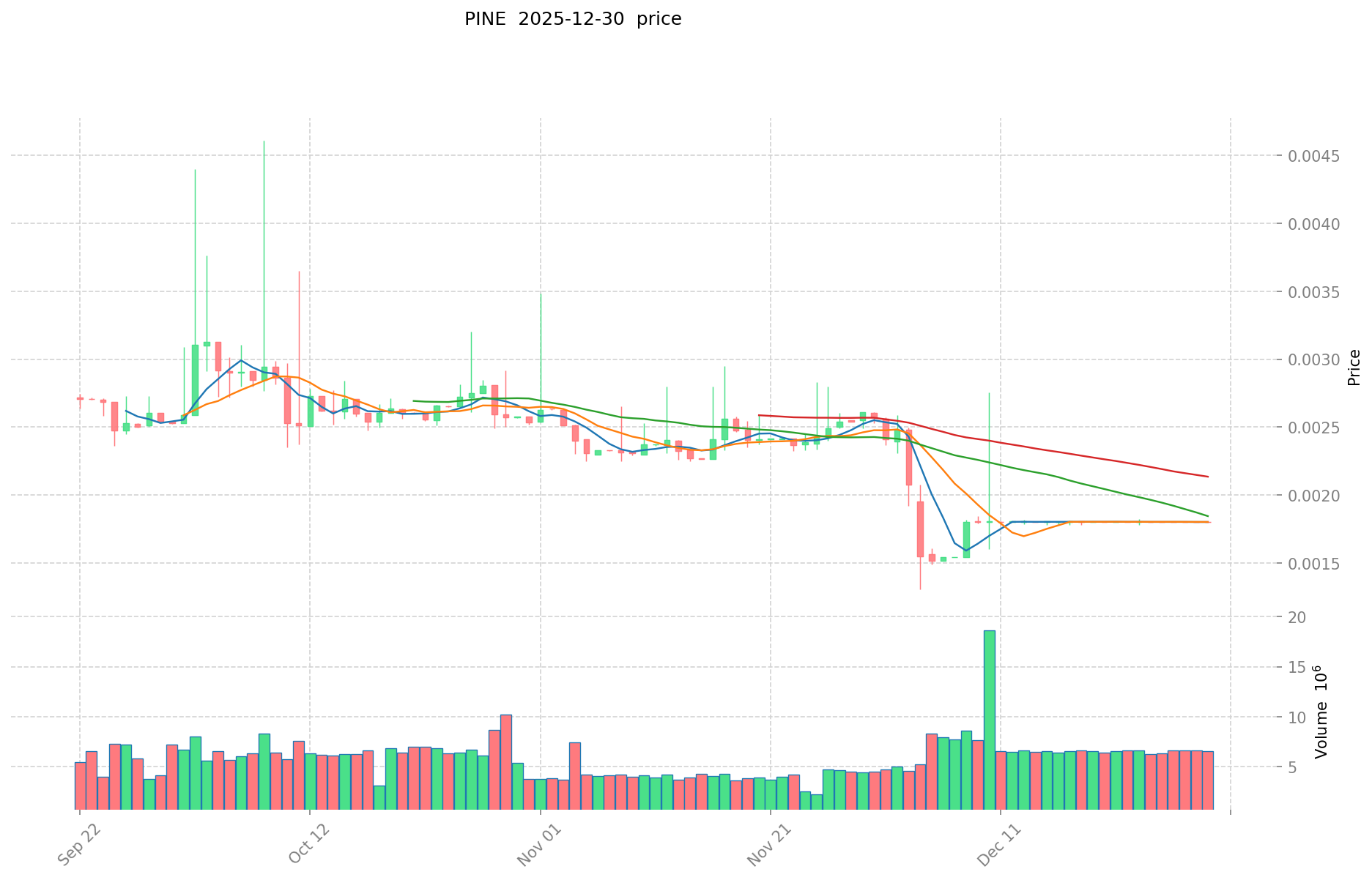
Pine Token (PINE) Investment Analysis Report
Report Date: December 31, 2025
I. Executive Summary
Pine Token (PINE) is a decentralized asset-backed loan protocol designed to serve the NFTfi ecosystem. As of December 31, 2025, PINE is trading at $0.0018, representing a significant decline from its all-time high of $0.738236 reached on February 14, 2023. The token exhibits bearish market sentiment with a 24-hour price change of -0.16% and a one-year performance decline of -42.47%.
Key Metrics:
- Current Price: $0.0018
- Market Cap: $357,919.93
- Circulating Supply: 198,844,407 PINE (99.42% of total supply)
- Total Supply: 200,000,000 PINE
- Market Ranking: 3,542
- Active Holders: 510
II. Core Factors Influencing PINE Investment Assessment
Supply Mechanism and Scarcity
The PINE token has a fixed maximum supply of 200,000,000 tokens, with 198,844,407 currently in circulation representing 99.42% of total supply. The near-complete circulation indicates minimal inflation pressure from new token issuance. However, the large circulating supply relative to a relatively small holder base (510 addresses) suggests concentrated token distribution, which may impact price stability and market liquidity.
Market Liquidity and Trading Activity
24-hour trading volume stands at $11,976.53, indicating limited liquidity for a token with a $357,919.93 market capitalization. This low volume-to-market-cap ratio suggests potential challenges for large position entry or exit without significant price impact.
Protocol Technology and Architecture
Pine Protocol operates as a non-custodial, decentralized asset-backed loan agreement enabling borrowers to use non-fungible tokens (NFTs) as collateral to borrow fungible digital tokens from lenders. The protocol features:
- Open and Composable Architecture: Designed for seamless integration with any NFT and NFTfi platform
- Multi-Chain Deployment: Active on Ethereum (ETH) and Polygon (MATIC) networks
- Transparent On-Chain Operations: Aims to make asset-backed financing transparent and efficient
Price Movement Analysis:
- 1-Hour: +0.16%
- 24-Hour: -0.16%
- 7-Day: -0.23%
- 30-Day: -29.63%
- 1-Year: -42.47%
The token has experienced sustained downward pressure over extended timeframes, with the 30-day decline of -29.63% indicating accelerating bearish momentum.
Historical Price Context
PINE reached its all-time high of $0.738236 on February 14, 2023, and its all-time low of $0.00116283 on April 8, 2025. The current price of $0.0018 represents a 99.76% decline from the all-time high and is trading near recent lows, suggesting potential capitulation or stabilization around support levels.
Market Sentiment and Adoption
The protocol maintains a website (https://pine.loans/) and active Twitter presence (@PineProtocol), indicating continued project development and community engagement. However, the modest holder count of 510 addresses suggests limited mainstream adoption within the broader cryptocurrency ecosystem.
Network Integration
PINE operates on established blockchain networks (Ethereum and Polygon), providing access to established DeFi infrastructure and NFT ecosystems. The multi-chain approach reduces single-network dependency risk.
III. Price Prediction and Market Outlook
Based on available projection data, PINE is forecast at approximately $0.001805 in December 2025 and $0.001813 in January 2026, suggesting relatively stable trading ranges in the near term. These projections indicate minimal recovery expectations in the immediate period ahead.
IV. Data Transparency and Limitations
This analysis is based solely on on-chain data, market metrics, and publicly available project information as of December 31, 2025. The report does not include analysis of:
- Detailed tokenomics or vesting schedules
- Team composition or development activity metrics
- Comprehensive smart contract audit results
- Comparative competitive analysis against alternative NFTfi protocols
V. Key Takeaways
-
Extreme Price Decline: PINE has experienced a 99.76% depreciation from its all-time high, indicating significant value erosion for early investors.
-
Limited Liquidity: Low trading volume relative to market capitalization presents execution risk for position management.
-
Niche Market Focus: Protocol specializes in NFTfi lending, a sector with uncertain mainstream adoption trajectory.
-
Small Holder Base: 510 active holders suggests limited community engagement and distributed adoption.
-
Bearish Technical Indicators: Sustained price weakness across multiple timeframes indicates negative market sentiment.
VI. References
Official Channels:
Data Source: Gate market data as of December 31, 2025, 00:15:23 UTC
III. PINE Future Investment Predictions and Price Outlook (Is Pine Token(PINE) worth investing in 2025-2030)
Short-term Investment Prediction (2025, short-term PINE investment outlook)
- Conservative forecast: $0.001728 - $0.0018
- Neutral forecast: $0.0018
- Optimistic forecast: $0.0018 - $0.002016
Mid-term Investment Outlook (2026-2028, mid-term Pine Token(PINE) investment forecast)
-
Market phase expectation: The protocol is expected to gradually establish itself within the NFTfi ecosystem as asset-backed lending mechanisms mature and adoption increases among NFT collateral lending platforms.
-
Investment return predictions:
- 2026: $0.0010494 - $0.0025758
- 2027: $0.001815939 - $0.00313866
- 2028: $0.0020715156 - $0.0030669192
-
Key catalysts: Expansion of decentralized asset-backed lending use cases, integration with additional NFT and NFTfi platforms, increasing institutional participation in NFT-collateralized financing.
Long-term Investment Outlook (Is Pine Token a good long-term investment?)
-
Base case scenario: $0.00269028 - $0.003914895456 (2028-2029, assuming steady adoption of asset-backed financing protocols and moderate NFTfi market growth)
-
Optimistic scenario: $0.0028785996 - $0.00411006450888 (2029-2030, assuming accelerated ecosystem integration and mainstream adoption of NFT-collateralized lending)
-
Risk scenario: $0.001612015776 or lower (2029, reflecting potential regulatory challenges, declining NFT market interest, or failed protocol scalability)
Click to view PINE long-term investment and price predictions: Price Prediction
2025-12-31 to 2030 Long-term Outlook
-
Base case: $0.00269028 - $0.003396747528 USD (corresponding to steady advancement and mainstream application growth)
-
Optimistic case: $0.003396747528 - $0.00411006450888 USD (corresponding to large-scale adoption and favorable market environment)
-
Transformative case: $0.00411006450888 USD and above (such as breakthrough ecosystem developments and mainstream adoption)
-
2030-12-31 predicted high: $0.00411006450888 USD (based on optimistic development assumptions)
Disclaimer
This analysis is based on historical data and market forecasts from third-party sources. The projections provided are for informational purposes only and do not constitute investment advice. Cryptocurrency markets remain highly volatile and subject to regulatory, technical, and macroeconomic uncertainties. Past performance does not guarantee future results. Investors should conduct their own due diligence and consult with qualified financial advisors before making investment decisions.
| 年份 |
预测最高价 |
预测平均价格 |
预测最低价 |
涨跌幅 |
| 2025 |
0.002016 |
0.0018 |
0.001728 |
0 |
| 2026 |
0.0025758 |
0.001908 |
0.0010494 |
6 |
| 2027 |
0.00313866 |
0.0022419 |
0.001815939 |
24 |
| 2028 |
0.0030669192 |
0.00269028 |
0.0020715156 |
49 |
| 2029 |
0.003914895456 |
0.0028785996 |
0.001612015776 |
59 |
| 2030 |
0.00411006450888 |
0.003396747528 |
0.00183424366512 |
88 |
Pine Token (PINE) Investment Analysis Report
I. Project Overview
Pine Token (PINE) is a decentralized finance protocol operating on Ethereum and Polygon blockchains. As of December 31, 2025, the token trades at $0.0018 with a market capitalization of $357,919.93 and a fully diluted valuation of $360,000.
Key Metrics:
- Current Price: $0.0018
- 24H Change: -0.16%
- Market Cap Rank: #3,542
- Circulating Supply: 198,844,407 PINE (99.42% of total supply)
- Total Supply: 200,000,000 PINE
- Market Dominance: 0.000011%
- Active Holders: 510
Project Mission
Pine aims to serve as a gateway for NFTfi's true revenue generation. The protocol is built as a non-custodial, decentralized asset-backed loan system that enables borrowers to use non-fungible tokens (NFTs) as collateral to borrow fungible digital tokens from lenders. The protocol features an open and composable architecture, allowing seamless integration with any NFT and NFTfi platform.
Price Movements
Pine Token exhibits significant volatility across multiple timeframes:
| Time Period |
Price Change |
| 1 Hour |
+0.16% |
| 24 Hours |
-0.16% |
| 7 Days |
-0.23% |
| 30 Days |
-29.63% |
| 1 Year |
-42.47% |
Historical Price Range
- All-Time High: $0.738236 (February 14, 2023)
- All-Time Low: $0.00116283 (April 8, 2025)
- 24H High: $0.001828
- 24H Low: $0.00178
The token has experienced substantial depreciation from its historical peak, declining approximately 99.76% from ATH to current levels.
Trading Activity
- 24H Volume: $11,976.53
- Listed on: 1 exchange
- Market Liquidity: Relatively low compared to major cryptocurrencies
III. Investment Strategy and Risk Management
Investment Methodology
Long-term Holding (HODL PINE):
- Suited for conservative investors believing in the NFTfi lending protocol's long-term adoption
- Requires patience through current market conditions and requires acceptance of significant historical losses
Active Trading:
- Depends on technical analysis and swing trading strategies
- Given low trading volume, liquidity constraints may limit entry and exit positions
Risk Management
Asset Allocation:
- Conservative investors: Maximum 0.1-0.5% of crypto portfolio
- Aggressive investors: Maximum 1-2% of crypto portfolio
- Professional investors: Strategic allocation based on risk tolerance and thesis validation
Risk Hedging:
- Multi-asset portfolio diversification to offset PINE concentration risk
- Consideration of stablecoin reserves to manage volatility
Secure Storage:
- Hot wallets: For active trading amounts only
- Cold storage: For long-term holdings
- Hardware wallets (Ledger, Trezor) recommended for significant holdings
IV. Investment Risks and Challenges
Market Risk
- Extreme volatility: 99.76% decline from ATH demonstrates severe price instability
- Low trading liquidity: Only $11,976.53 in 24H volume limits trading flexibility
- Small holder base: Only 510 active holders indicates concentration risk
Regulatory Risk
- Uncertainties regarding NFTfi protocol regulation in different jurisdictions
- Potential regulatory crackdowns on DeFi lending protocols
- Evolving compliance requirements across global markets
Technology Risk
- Smart contract vulnerability exposure in DeFi protocols
- Network security considerations for both Ethereum and Polygon deployments
- Potential protocol upgrade failures or security breaches
Project-Specific Risk
- Limited market adoption evidenced by low trading volume and holder count
- Significant historical losses suggest reduced investor confidence
- Unclear development roadmap visibility
V. Conclusion: Is Pine Token a Good Investment?
Investment Value Assessment
Pine Token presents a high-risk, speculative investment opportunity within the NFTfi ecosystem. While the underlying protocol addresses a genuine need for asset-backed lending using NFT collateral, current market metrics suggest limited adoption and sustained investor skepticism.
Investor Recommendations
✅ Beginners:
If considering PINE, employ dollar-cost averaging with minimal portfolio allocation (under 0.5%) and secure holdings in hardware wallets. Education on NFTfi mechanics is essential before investment.
✅ Experienced Investors:
Technical swing trading strategies may be employed given extreme volatility, though low liquidity poses execution challenges. Risk-reward ratios should be carefully evaluated before position establishment.
✅ Institutional Investors:
Strategic allocation would require comprehensive due diligence on protocol adoption metrics, team credibility, and competitive positioning within the NFTfi lending market.
Important Disclaimer
⚠️ Warning: Cryptocurrency investment carries substantial risk, including potential total loss of capital. This analysis is provided for informational purposes only and does not constitute investment advice. Past performance does not guarantee future results. Conduct independent research and consult financial advisors before making investment decisions.
Report Date: December 31, 2025
Data Source: Gate Research Database
Disclaimer: This report presents factual market data and analysis without investment recommendations or guarantees.
Pine Token (PINE) Frequently Asked Questions
FAQ
Q1: What is Pine Token (PINE) and what problem does it solve?
A: Pine Token (PINE) is a decentralized finance protocol operating on Ethereum and Polygon blockchains that serves as a gateway for NFTfi revenue generation. The protocol functions as a non-custodial, asset-backed lending system enabling borrowers to use non-fungible tokens (NFTs) as collateral to borrow fungible digital tokens from lenders. It solves the liquidity problem for NFT holders who wish to access capital without selling their digital assets.
Q2: What is the current market status of Pine Token as of December 31, 2025?
A: As of December 31, 2025, Pine Token is trading at $0.0018 with a market capitalization of $357,919.93. The circulating supply is 198,844,407 PINE (99.42% of the 200 million total supply). The 24-hour trading volume is $11,976.53, and there are 510 active token holders. The token has experienced a 42.47% decline over the past year and a 29.63% decrease over the past 30 days.
Q3: What are the main investment risks associated with Pine Token?
A: Key investment risks include extreme market volatility (99.76% decline from the all-time high of $0.738236), limited liquidity with only $11,976.53 in daily trading volume, concentrated ownership with just 510 token holders, regulatory uncertainties surrounding NFTfi protocols, smart contract vulnerability exposure, and limited evidence of mainstream protocol adoption. These factors collectively create a high-risk investment profile.
Q4: What are the price predictions for Pine Token through 2030?
A: Conservative price forecasts suggest PINE may trade between $0.001728-$0.002016 in 2025, rising to $0.0010494-$0.0025758 in 2026, and potentially reaching $0.00269028-$0.003914895456 by 2029-2030 under base case scenarios. The optimistic scenario projects prices reaching $0.00411006450888 by December 31, 2030, while risk scenarios suggest potential declines below $0.001612015776 if adoption fails to materialize.
Q5: What portfolio allocation percentage should investors consider for Pine Token?
A: Conservative investors should allocate no more than 0.1-0.5% of their cryptocurrency portfolio to Pine Token, while aggressive investors might allocate 1-2%. Professional investors should determine allocation based on individual risk tolerance and thesis validation. These guidelines reflect the token's high-risk, speculative nature and limited liquidity characteristics that restrict position sizing flexibility.
Q6: How does Pine Token's low trading volume affect investment decisions?
A: The $11,976.53 24-hour trading volume creates significant liquidity constraints, meaning large position entries or exits may experience substantial price impact. This low volume-to-market-cap ratio limits the ability to execute trades efficiently and increases the risk of slippage. Investors should consider smaller position sizes and employ limit orders rather than market orders to minimize execution risk.
Q7: What security measures should investors implement when holding Pine Token?
A: For active trading amounts, use hot wallets only. For long-term holdings, implement cold storage solutions such as hardware wallets (Ledger, Trezor) to protect against exchange hacking risks and cybersecurity threats. Diversify across multiple storage methods based on holding amounts, and never store significant PINE holdings on centralized exchanges. Multi-signature wallet setups are recommended for larger institutional positions.
Q8: Is Pine Token suitable for beginner cryptocurrency investors?
A: Pine Token is generally not recommended for beginner investors due to its extreme volatility, limited liquidity, small holder base, and high-risk profile. Beginners interested in PINE should first gain comprehensive understanding of NFTfi mechanics and DeFi protocols. If proceeding, beginners should employ dollar-cost averaging with minimal allocations (under 0.5%), secure holdings in hardware wallets, and consult with qualified financial advisors before investment decisions.
Disclaimer: This FAQ provides factual information based on market data as of December 31, 2025, and does not constitute investment advice, financial guidance, or recommendations to buy or sell Pine Token. Cryptocurrency markets remain highly volatile and speculative. Investors must conduct independent due diligence and consult qualified financial professionals before making investment decisions. Past performance does not guarantee future results.
* The information is not intended to be and does not constitute financial advice or any other recommendation of any sort offered or endorsed by Gate.