# Is Roost (ROOST) a Good Investment?: A Comprehensive Analysis of Tokenomics, Market Potential, and Risk Factors for 2024
## Introduction
This comprehensive analysis examines whether ROOST (ROOST) represents a viable investment opportunity by evaluating tokenomics, market dynamics, and risk factors. The article assesses ROOST's position as "the Base ecosystem champion," analyzing its 99.77% depreciation from all-time highs, $216,000 market capitalization, and extreme volatility characteristics. Designed for cryptocurrency investors ranging from beginners to experienced traders, this guide provides actionable insights on ROOST's 2026-2031 price forecasts, liquidity constraints, and portfolio allocation strategies. Through detailed tokenomics review, historical performance analysis, and risk assessment frameworks, readers gain clarity on whether ROOST aligns with their investment objectives and risk tolerance levels.
Introduction: The Investment Position and Market Prospects of Roost (ROOST)
ROOST is an important asset in the cryptocurrency field. Launched in April 2024, it has gained traction within the Base ecosystem. As of January 2026, ROOST maintains a market capitalization of $216,000 USD, with a circulating supply of 1 billion tokens and a current price of approximately $0.000216. Positioned as "the champion of the Base ecosystem," ROOST is increasingly becoming a focal point when investors discuss "Is Roost (ROOST) a good investment?" This article provides a comprehensive analysis of ROOST's investment value, historical price movements, future price forecasts, and investment risks to serve as a reference for investors.
ROOST (Roost) Cryptocurrency Market Analysis Report
I. Price History Review and Current Investment Value Assessment
Based on available market data as of January 1, 2026:
Key Price Milestones:
- April 2, 2024: All-time high of $0.09382 reached
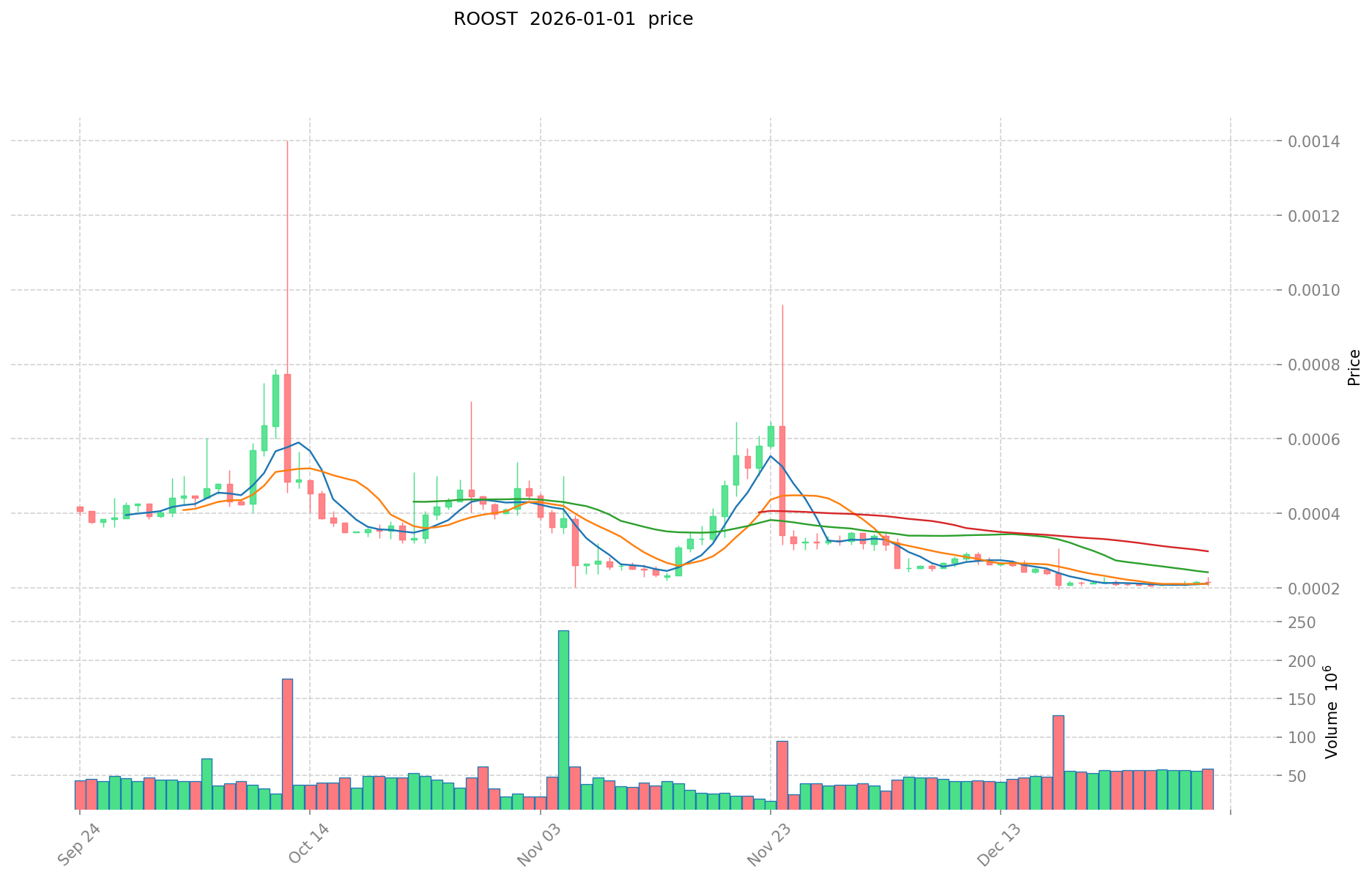
- December 18, 2025: All-time low of $0.0001957 recorded
- Current Period (January 2026): Trading at $0.000216
Performance Summary:
The token has experienced significant depreciation over the 12-month period, declining approximately 83.3% from its launch reference price of $0.025. From the all-time high in April 2024 to the current price level, the asset has lost over 99% of its peak valuation.
Current Market Status (January 1, 2026)
Price Metrics:
- Current Price: $0.000216
- 24-Hour Price Change: -0.04%
- 7-Day Change: +2.28%
- 30-Day Change: -30.29%
- 1-Year Change: -83.3%
- 24-Hour High: $0.0002291
- 24-Hour Low: $0.0002063
Market Data:
- Total Market Capitalization: $216,000.00
- Fully Diluted Valuation: $216,000.00
- 24-Hour Trading Volume: $12,421.85
- Market Dominance: 0.0000068%
- Circulating Supply: 1,000,000,000 ROOST
- Total Supply: 1,000,000,000 ROOST
- Number of Holders: 86,136
Market Sentiment Indicator: Neutral (Sentiment Score: 1)
For real-time ROOST market prices, visit Gate ROOST Trading Page
II. Project Overview
Project Description:
ROOST is positioned as the champion of the Base ecosystem, with a stated mission to protect, engage, and grow the ROOST community. The token operates on the Base blockchain network (BASEEVM chain).
Technical Specifications:
- Blockchain: Base (BASEEVM)
- Contract Address: 0xeD899bfDB28c8ad65307Fa40f4acAB113AE2E14c
- Token Standard: ERC-20 compatible
- Launch Date: April 3, 2024
- Market Ranking: #4053
III. Market Liquidity and Exchange Presence
- Primary Exchange: Gate
- Number of Trading Pairs: 1
- 24-Hour Volume: $12,421.85
- Trading Status: Active
Community Presence:
IV. Risk Assessment
Notable Concerns:
- Extreme price volatility with 99%+ depreciation from all-time high
- Very low market capitalization ($216,000) indicating limited liquidity
- Minimal market dominance and trading volume
- Limited exchange listing reduces accessibility
- Extended downtrend over 12-month period
This analysis is based solely on publicly available market data and does not constitute investment advice.
Roost (ROOST) Cryptocurrency Analysis Report
Report Date: January 1, 2026
Data Source: Gate Crypto Database
Current Price: $0.000216 USD
Market Cap: $216,000 USD
I. Executive Summary
Roost (ROOST) is a cryptocurrency token operating on the Base blockchain, positioning itself as "the champion of the Base ecosystem." As of January 1, 2026, ROOST exhibits characteristics of a highly volatile micro-cap asset with significant historical depreciation. The token has experienced an 83.3% decline over the past year and currently maintains a market capitalization of $216,000 with 86,136 token holders.
II. Core Factors Influencing ROOST Investment Viability
Supply Mechanism and Scarcity (ROOST Investment Scarcity)
- Fixed Supply Structure: ROOST operates with a maximum supply of 1,000,000,000 tokens, with 100% circulating supply currently in circulation (1,000,000,000 tokens).
- Fully Diluted Valuation: The fully diluted market cap equals the current market cap at $216,000, indicating no additional token release mechanisms pending.
- Scarcity Implications: The token demonstrates a capped supply model; however, with maximum supply already fully circulated, traditional scarcity-driven appreciation mechanisms are limited.
- All-Time High (ATH): $0.09382 USD (April 2, 2024)
- All-Time Low (ATL): $0.0001957 USD (December 18, 2025)
- Current Price Decline: The token has depreciated approximately 99.77% from its ATH to current levels.
- Year-to-Date Performance: -83.3% over the past 12 months
- Recent Trends: -30.29% over the past 30 days, with -0.04% decline in the last 24 hours
Market Structure and Liquidity
- Market Rank: #4053 among cryptocurrency assets
- 24-Hour Trading Volume: $12,421.85 USD
- Market Share: 0.0000068% of total cryptocurrency market capitalization
- Primary Exchange: Gate (ROOST/USDT trading pair with $11,953.39 24-hour volume)
- Number of Holders: 86,136 addresses holding ROOST tokens
- Limited Institutional Presence: Single exchange listing indicates limited mainstream adoption infrastructure
Ecosystem and Blockchain Integration
- Blockchain Platform: Base (Ethereum Layer 2 solution)
- Contract Address: 0xeD899bfDB28c8ad65307Fa40f4acAB113AE2E14c (Base EVM)
- Community Channels: Official website, Twitter/X presence, and blockchain explorer accessibility
- Ecosystem Role: Positioned as community-focused token within Base ecosystem; specific utility mechanisms not detailed in available documentation
III. Price Movement Analysis
| Time Period |
Change Percentage |
Status |
| 1 Hour |
-0.58% |
Negative |
| 24 Hours |
-0.04% |
Negative |
| 7 Days |
+2.28% |
Positive |
| 30 Days |
-30.29% |
Negative |
| 1 Year |
-83.3% |
Highly Negative |
The token demonstrates extreme volatility with brief positive corrections within longer downward trends. Seven-day performance (+2.28%) represents minor recovery against significant monthly and yearly declines.
IV. Risk Assessment
High-Risk Indicators
- Extreme Price Volatility: 99.77% decline from ATH indicates severe capital loss risk for early investors
- Micro-Cap Status: $216,000 market capitalization places ROOST in the highest-risk segment of cryptocurrency markets
- Limited Liquidity: Daily trading volume of approximately $12,421 relative to market cap suggests potential liquidity constraints
- Single Exchange Listing: Concentration on Gate creates execution risk and limited exit opportunities
- Sustained Downtrend: Consistent monthly and yearly declines suggest ongoing bearish sentiment
Market Sentiment Indicators
Available forecast analysis suggests bearish outlook for 2025 based on technical quantitative indicators. Historical volatility and current price trajectory indicate unpredictable future performance.
V. Token Distribution and Accessibility
- Publishing Date: April 2, 2024
- Initial Publishing Price: $0.025 USD
- Price Depreciation Since Launch: Current price represents 99.14% decline from initial offering
- Current 24-Hour Range: $0.0002063 - $0.0002291 USD
- Trading Pair: ROOST/USDT on Gate exchange
VI. Conclusion
ROOST represents a micro-cap cryptocurrency with significant technical and market structural challenges. The extreme depreciation from historical highs, limited market infrastructure, concentrated trading volume, and ongoing downward price trends present substantial investment risks. The token's positioning within the Base ecosystem lacks demonstrated utility mechanisms or adoption metrics that would support long-term value sustainability.
Key Takeaway: Current market data indicates ROOST exhibits characteristics typical of highly speculative, low-liquidity assets with uncertain long-term viability.
Data Currency: January 1, 2026, 12:19:17 UTC
Disclaimer: This analysis presents factual data from available sources. Cryptocurrency investments carry substantial risk of capital loss.
III. ROOST Future Investment Prediction and Price Outlook (Is Roost(ROOST) worth investing in 2026-2031)
Short-term Investment Prediction (2026, short-term ROOST investment outlook)
- Conservative Forecast: $0.000179 - $0.000215
- Neutral Forecast: $0.000215 - $0.000284
- Optimistic Forecast: $0.000284 - $0.000320
Mid-term Investment Outlook (2027-2029, mid-term Roost(ROOST) investment forecast)
- Market Stage Expectation: ROOST is positioned as the Base ecosystem champion, with recovery phase transitioning toward expansion as adoption of Base network infrastructure accelerates.
- Investment Return Forecast:
- 2027: $0.000137 - $0.000285 (15% potential increase)
- 2028: $0.000155 - $0.000377 (23% potential increase)
- 2029: $0.000277 - $0.000377 (49% potential increase)
- Key Catalysts: Base ecosystem growth, community expansion initiatives, broader layer-2 adoption trends, market sentiment recovery
Long-term Investment Outlook (Is Roost a good long-term investment?)
- Base Case Scenario: $0.000298 - $0.000415 (2030-2031, assuming steady Base ecosystem development and moderate token adoption)
- Optimistic Scenario: $0.000415 - $0.000500+ (2031, assuming accelerated ecosystem adoption and positive market environment)
- Risk Scenario: $0.000150 - $0.000250 (2031, under conditions of prolonged market downturn or diminished ecosystem momentum)
Click to view ROOST long-term investment and price forecast: Price Prediction
2026-2031 Long-term Outlook
- Base Case: $0.000298 - $0.000380 USD (corresponding to steady ecosystem development and incremental user adoption)
- Optimistic Case: $0.000380 - $0.000450 USD (corresponding to accelerated Base network expansion and favorable market conditions)
- Transformative Case: $0.000500+ USD (contingent on breakthrough ecosystem achievements and mainstream integration)
- December 31, 2031 Predicted High: $0.000415 USD (based on optimistic development assumptions)
Disclaimer: This analysis is for informational purposes only and does not constitute investment advice. Cryptocurrency markets are highly volatile and speculative. Past performance does not guarantee future results. Investors should conduct their own due diligence and consult with qualified financial advisors before making investment decisions.
| 年份 |
预测最高价 |
预测平均价格 |
预测最低价 |
涨跌幅 |
| 2026 |
0.000284328 |
0.0002154 |
0.000178782 |
0 |
| 2027 |
0.00028484496 |
0.000249864 |
0.0001374252 |
15 |
| 2028 |
0.0003769698168 |
0.00026735448 |
0.0001550655984 |
23 |
| 2029 |
0.000376929713628 |
0.0003221621484 |
0.000277059447624 |
49 |
| 2030 |
0.000405473279976 |
0.000349545931014 |
0.000297114041361 |
61 |
| 2031 |
0.000415260566044 |
0.000377509605495 |
0.000339758644945 |
74 |
ROOST Investment Analysis Report
I. Project Overview
ROOST is a cryptocurrency token operating on the Base blockchain ecosystem. According to project documentation, ROOST serves as "the champion of the Base ecosystem," with stated objectives of protecting, engaging, and growing the ROOST community.
| Metric |
Value |
| Token Name |
Roost (ROOST) |
| Current Price |
$0.000216 |
| Market Capitalization |
$216,000 |
| Circulating Supply |
1,000,000,000 ROOST |
| Total Supply |
1,000,000,000 ROOST |
| Market Ranking |
#4053 |
| Blockchain |
Base (EVM) |
| Contract Address |
0xeD899bfDB28c8ad65307Fa40f4acAB113AE2E14c |
| Token Holders |
86,136 |
| 24H Trading Volume |
$12,421.85 |
| Period |
Price Change |
| 1 Hour |
-0.58% |
| 24 Hours |
-0.04% |
| 7 Days |
+2.28% |
| 30 Days |
-30.29% |
| 1 Year |
-83.30% |
| All-Time High |
$0.09382 (April 2, 2024) |
| All-Time Low |
$0.0001957 (December 18, 2025) |
II. Market Position & Valuation
ROOST holds a market ranking of #4053 among cryptocurrencies, with a fully diluted market capitalization of $216,000 as of January 1, 2026. The token commands a negligible market dominance of 0.0000068%.
- Initial Launch Price: $0.025 (April 3, 2024)
- Current Trading Price: $0.000216
- Price Depreciation from Launch: -99.14%
The significant price decline from the initial launch price reflects substantial value erosion over the project's operational period.
III. Risk Analysis
Market Volatility
ROOST exhibits extreme price volatility characteristics typical of small-cap, low-liquidity tokens:
- 24-Hour Range: $0.0002063 - $0.0002291 (1.10% range)
- Price Decline (YTD): -83.30%, indicating sustained downward pressure
- Monthly Performance: -30.29% decline over the past 30 days
Liquidity Concerns
- Daily Trading Volume: $12,421.85
- Market Cap to Volume Ratio: Approximately 17.4x, indicating limited trading liquidity
- Exchange Listing: Available on 1 exchange platform (Gate)
- Holder Distribution: 86,136 token holders suggest moderate distribution
Project Execution Risk
The absence of documented technical documentation, GitHub repositories, white papers, or medium articles raises concerns regarding project transparency and development activity monitoring.
IV. Investment Strategy & Risk Management
Investment Methodology
Due to ROOST's extreme volatility and limited liquidity, conventional investment approaches require significant modifications:
Long-Term Holding (HODL Strategy): Given the token's 83.3% one-year decline and -30.29% monthly performance, this approach carries substantial risk and is suitable only for investors with high risk tolerance and extended time horizons.
Active Trading: The limited daily trading volume of $12,421.85 restricts position sizing and may result in significant slippage for larger orders.
Risk Management Framework
Asset Allocation Considerations:
- Conservative Investors: Not recommended due to extreme volatility and limited liquidity
- Aggressive Investors: Position sizing should not exceed 1-2% of total portfolio
- Professional Investors: Technical analysis of Base ecosystem correlations and sentiment indicators required
Portfolio Diversification: ROOST should only represent a minimal portion of a diversified crypto portfolio, with primary exposure maintained in established blockchain assets and Base ecosystem leaders.
Secure Storage: Token holders should utilize hardware wallets (Ledger, Trezor) or reputable custodial solutions for position security, given the token's limited market infrastructure.
V. Investment Risks & Challenges
Market Risks
- Extreme Volatility: -83.3% one-year decline demonstrates severe price instability
- Low Liquidity: $12,421.85 daily volume creates execution risk for significant positions
- Price Concentration: All-time high at $0.09382 versus current $0.000216 indicates potential distribution from early token holders
Regulatory Risks
As a Base ecosystem token, ROOST faces potential regulatory exposure related to:
- U.S. and international cryptocurrency classification determinations
- Base chain regulatory compliance and operational status
- Stablecoin and DeFi protocol regulatory framework evolution
Technical Risks
- Limited Documentation: Absence of published technical specifications or development roadmap
- Ecosystem Dependency: Token viability directly tied to Base blockchain ecosystem adoption
- Security Considerations: Single-chain deployment concentrates technical risk
Operational Risks
- Community Activity: Limited social media presence and engagement metrics documented
- Development Activity: No public GitHub repository or documented development updates available
- Project Transparency: Minimal published materials for ongoing community communication
VI. Conclusion: Is ROOST a Good Investment?
Investment Value Assessment
ROOST presents a high-risk, speculative investment opportunity within the Base ecosystem niche. The token's 83.3% one-year depreciation, extreme volatility, limited liquidity, and minimal market capitalization classify this as a micro-cap token with significant execution challenges.
The project's positioning as a "Base ecosystem champion" token lacks demonstrated technical differentiation or substantial community infrastructure development based on publicly available documentation.
Investor Guidance
⚠️ Caution for New Investors: The combination of 99.14% depreciation from launch price, extreme volatility (-30.29% monthly), and limited trading liquidity makes ROOST unsuitable for conservative or beginning investors. Position sizes, if considered, should represent minimal portfolio allocation (< 1%).
⚠️ Experienced Traders: While technical trading opportunities may exist around support/resistance levels, the minimal daily volume ($12,421.85) restricts position sizing and creates significant execution risk.
⚠️ Institutional Investors: Current market capitalization and liquidity levels preclude institutional-scale allocation strategies.
Critical Disclaimer
Cryptocurrency investments carry substantial risk, including potential total capital loss. ROOST exhibits characteristics of extreme volatility, limited liquidity, and micro-cap market positioning. This analysis is provided for informational purposes only and does not constitute investment advice. Investors must conduct independent due diligence and consult qualified financial advisors before committing capital to this or any cryptocurrency asset. Past performance does not indicate future results.
Report Date: January 1, 2026
Data Source: Gate Market Data
Analysis Scope: Historical performance and market structure analysis only
Roost (ROOST) Cryptocurrency Investment Analysis Report
VII. FAQ
Q1: What is the current market position and viability of ROOST as of January 2026?
A: As of January 1, 2026, ROOST maintains a market capitalization of $216,000 USD with a current price of $0.000216. The token ranks #4053 among cryptocurrencies and operates on the Base blockchain ecosystem. However, ROOST exhibits significant structural challenges: it has depreciated 83.3% over the past 12 months and 99.77% from its all-time high of $0.09382 reached in April 2024. With only $12,421.85 in daily trading volume and 86,136 token holders, ROOST represents a micro-cap asset with extremely limited liquidity and market infrastructure. The token's positioning as "the champion of the Base ecosystem" lacks demonstrated technical differentiation or substantial utility mechanisms based on publicly available documentation.
Q2: What are the primary risk factors investors should consider before investing in ROOST?
A: ROOST presents multiple critical risk factors that warrant careful consideration. First, extreme price volatility is evident through the 99.77% depreciation from all-time high and -30.29% monthly decline. Second, severe liquidity constraints exist with only $12,421.85 in daily trading volume relative to a $216,000 market capitalization, creating significant execution risk for meaningful positions. Third, the token exhibits single-exchange dependency on Gate, limiting accessibility and exit opportunities. Fourth, project transparency is minimal with no published white papers, GitHub repositories, or detailed technical documentation. Finally, the sustained 12-month downtrend suggests ongoing negative market sentiment. Conservative and beginning investors should avoid ROOST entirely due to these accumulating risk factors.
Q3: What is the price prediction outlook for ROOST through 2031?
A: Price forecasts for ROOST through 2031 incorporate multiple scenarios based on Base ecosystem development trajectories. Short-term prediction (2026) ranges from $0.000179 to $0.000320 depending on market conditions. Mid-term outlook (2027-2029) suggests potential recovery phases with predicted ranges of $0.000137-$0.000285 (2027), $0.000155-$0.000377 (2028), and $0.000277-$0.000377 (2029). Long-term projections (2030-2031) include base case scenarios of $0.000298-$0.000415, optimistic cases reaching $0.000415-$0.000500+, and risk scenarios of $0.000150-$0.000250. These forecasts assume varying levels of Base network adoption and positive market environment development. However, historical volatility and current downtrend suggest actual outcomes may diverge substantially from projections.
Q4: How does ROOST's supply structure impact long-term investment potential?
A: ROOST operates with a fixed maximum supply of 1,000,000,000 tokens, with 100% currently in circulation. This means the fully diluted valuation equals the current market capitalization at $216,000, and no additional token release mechanisms are pending. While capped supply traditionally supports scarcity-driven appreciation, ROOST's complete supply circulation eliminates traditional scarcity mechanisms as a value driver. Furthermore, the token's depreciation from the $0.025 launch price to current $0.000216 levels indicates substantial early-stage token holder distribution. This combination of complete supply circulation and historical price collapse limits the structural factors that typically support long-term cryptocurrency value appreciation.
Q5: Is ROOST suitable for conservative or beginning cryptocurrency investors?
A: ROOST is explicitly not recommended for conservative or beginning cryptocurrency investors. The combination of 99.14% depreciation from launch price, extreme 30-day volatility of -30.29%, minimal market capitalization of $216,000, and limited daily trading volume creates an environment unsuitable for risk-averse or inexperienced market participants. Conservative investors should maintain exposure to established blockchain assets and established cryptocurrency projects with greater liquidity and transparency. Beginning investors should gain foundational knowledge and experience with major cryptocurrencies before considering speculative micro-cap tokens like ROOST. If any investor considers ROOST exposure, position sizing should not exceed 1-2% of total portfolio allocation, treated exclusively as speculative capital.
Q6: What ecosystem and technical factors support or challenge ROOST's value proposition?
A: ROOST operates on the Base blockchain, an Ethereum Layer 2 solution, positioning itself within a growing but still-developing ecosystem. The token's stated mission of protecting, engaging, and growing the ROOST community lacks demonstrated technical implementation or utility mechanisms based on available documentation. Positive factors include Base blockchain's Ethereum compatibility and parent-chain security. Challenging factors include: minimal documented development activity, absence of published technical roadmaps, limited community infrastructure visibility, single-exchange trading presence, and lack of demonstrated differentiation from other Base ecosystem tokens. The absence of GitHub repositories, medium articles, or technical white papers raises substantial concerns regarding project development transparency and ongoing execution capability.
Q7: What trading strategies are appropriate for ROOST given current market conditions?
A: Given ROOST's extreme volatility and limited liquidity, conventional investment strategies require significant modification. Long-term holding (HODL) strategies carry substantial risk due to the sustained 83.3% one-year decline and warrant consideration only by investors with exceptional risk tolerance and extended time horizons. Active trading strategies face constraints from the $12,421.85 daily volume, which limits position sizing and creates significant slippage risk for larger orders. Scalp trading around support/resistance levels may present opportunities for experienced technical traders, but requires careful risk management given volatility. Most importantly, position sizing should remain minimal regardless of strategy selection. For most investors, alternative strategies focusing on established cryptocurrencies and Base ecosystem leaders represent more prudent capital allocation approaches than direct ROOST exposure.
Q8: What is the overall investment recommendation for ROOST in 2026?
A: The overall investment recommendation for ROOST in 2026 is cautionary, with explicit risk warnings for most investor categories. ROOST exhibits characteristics typical of extreme-risk, high-speculation micro-cap tokens: 83.3% one-year depreciation, 99.77% decline from all-time high, minimal liquidity, single-exchange listing, and limited transparency regarding project development. Institutional investors should avoid ROOST due to insufficient market capitalization and liquidity for meaningful allocations. Conservative and beginning investors should similarly avoid exposure entirely. Only experienced traders with high risk tolerance and sophisticated risk management systems might consider minimal ROOST positions exclusively as speculative portfolio components. Any investment decision must include acknowledgment that cryptocurrency markets carry substantial capital loss risk, past performance provides no performance guarantee, and independent due diligence with qualified financial advisor consultation is essential before committing any capital.
* The information is not intended to be and does not constitute financial advice or any other recommendation of any sort offered or endorsed by Gate.