# Is SakeToken (SAKE) a Good Investment? A Comprehensive Analysis
## Article Overview
This comprehensive analysis examines SakeToken (SAKE) investment potential through detailed price trend evaluation, tokenomics assessment, and market opportunity evaluation. The report provides investors with data-driven insights into SAKE's current market position at $0.0004105 (January 2026), historical performance spanning 2020-2026, and projected price scenarios through 2031. By analyzing governance mechanisms, fee-sharing economics, liquidity constraints, and ecosystem development metrics across Gate trading data, this guide addresses critical investment decision-making factors for both new and experienced cryptocurrency investors navigating the decentralized exchange token landscape. The article balances opportunity identification with transparent risk disclosure, emphasizing SAKE's extreme volatility, limited adoption, and uncertain long-term value accumulation prospects while providing actionable portfolio allocati
Introduction: SakeToken (SAKE) Investment Position and Market Prospects
SAKE is an important asset in the cryptocurrency field. Since its launch in September 2020, it has gained recognition in the decentralized exchange ecosystem. As of January 2026, SAKE's market capitalization stands at approximately $84,319.78, with a circulating supply of approximately 170,991,555 tokens, and the current price is maintained around $0.0004105. Positioned as a governance and fee-sharing token within the SakeSwap protocol—an improved fork of Uniswap and SushiSwap featuring enhanced AMM mechanisms—SAKE has gradually become a focal point when investors discuss the investment potential of decentralized exchange governance tokens. This article will comprehensively analyze SAKE's investment value, historical price movements, future price forecasts, and investment risks to provide investors with a reference perspective.
SakeToken (SAKE) Market Analysis Report
I. Price History Review and Current Investment Status
- September 2020: Token launch at $3.18 (all-time high), representing the peak valuation period for the SakeSwap protocol
- 2020-2025: Sustained downtrend from peak → investors experienced significant depreciation
- September 2025: Reached all-time low of $0.00025005, marking the lowest valuation point in project history
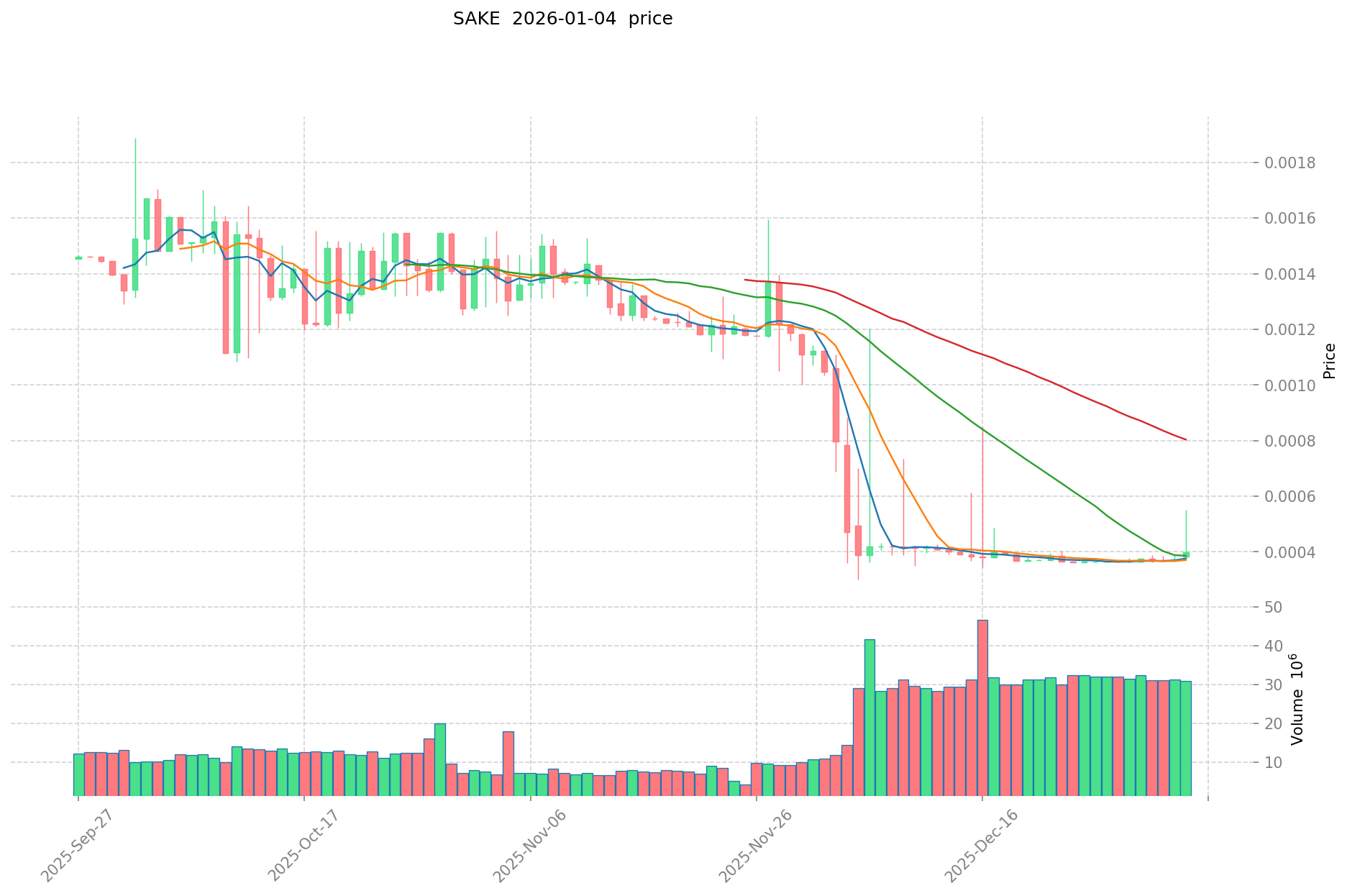
- January 4, 2026: Current trading price at $0.0004105, representing modest recovery from recent lows
The token has declined approximately 87.1% from its historical peak, reflecting extended bear market conditions and challenges in maintaining ecosystem engagement.
Current SAKE Market Status (January 4, 2026)
| Metric |
Value |
| Current Price |
$0.0004105 |
| 24-Hour Change |
+6.35% |
| 1-Hour Change |
-0.16% |
| 7-Day Change |
+12.45% |
| 30-Day Change |
-9.13% |
| 1-Year Change |
-64.81% |
| 24-Hour Trading Volume |
$12,383.54 |
| Market Capitalization |
$70,192.03 |
| Fully Diluted Valuation |
$84,319.78 |
| Circulating Supply |
170,991,555.24 tokens |
| Total Supply |
205,407,505.06 tokens |
| Market Dominance |
0.0000025% |
| Active Holders |
3,784 |
Current market sentiment indicators show mixed signals, with recent 24-hour gains offset by longer-term depreciation trends.
II. Project Overview and Technical Foundation
SakeSwap Protocol Description
SakeToken powers SakeSwap, a decentralized exchange protocol built as an improved fork of Uniswap and SushiSwap. The project incorporates enhanced mechanisms in two primary areas:
- Automated Market Maker (AMM) Improvements: Optimizations to price curve mechanics and contributor reward structures
- Deflationary Token Economics: Structural design maintains token scarcity through deflationary mechanisms
SAKE Token Utility Functions
I. Governance Rights: SAKE token holders exercise voting authority over protocol decisions and parameter adjustments
II. Fee Distribution: Token holders receive proportional allocations from protocol fee revenue, creating yield-generating properties
III. On-Chain Infrastructure
Ethereum Mainnet Deployment
- Contract Address: 0x066798d9ef0833ccc719076dab77199ecbd178b0
- Network: Ethereum (ETH)
- Blockchain Explorer: Etherscan Verification
IV. Project Resources and Community Channels
V. Market Analysis Observations
Liquidity and Trading Environment
The 24-hour trading volume of $12,383.54 reflects relatively low liquidity compared to major DEX tokens. With only 3,784 active token holders, the holder base remains limited, suggesting concentrated ownership patterns and moderate retail engagement.
Price Volatility Assessment
Recent price action demonstrates significant volatility:
- Intra-day swings (1-hour: -0.16% versus 24-hour: +6.35%) indicate reactive market conditions
- 7-day appreciation of 12.45% contrasts sharply with 1-year decline of -64.81%, reflecting a weak long-term trend overshadowed by short-term recovery attempts
- The gap between market cap and fully diluted valuation remains minimal (100% circulating ratio), indicating maximum token supply inflation has occurred
Report Date: January 4, 2026
Data Source: Gate Market Data
Disclaimer: This analysis is informational only and does not constitute investment advice or recommendations. Cryptocurrency markets carry substantial risk. Conduct independent research before making financial decisions.
SakeSwap (SAKE) Investment Analysis Report
Report Date: January 4, 2026
I. Executive Summary
SakeSwap (SAKE) is a decentralized exchange token based on an improved fork of Uniswap and Sushiswap. As of January 4, 2026, SAKE trades at $0.0004105, representing a significant decline from its historical high of $3.18 reached on September 13, 2020. The token maintains a market capitalization of approximately $70,192 USD with limited trading volume, positioning it as a micro-cap cryptocurrency with a market ranking of 5,317.
II. Core Factors Influencing SAKE Investment Potential
Supply Mechanism and Scarcity
The SAKE token features a deflationary design structure intended to maintain price stability. Key supply metrics include:
- Circulating Supply: 170,991,555.24 SAKE
- Total Supply: 205,407,505.06 SAKE
- Maximum Supply: Unlimited (∞)
- Circulation Ratio: 100.00%
The unlimited maximum supply presents a significant constraint on scarcity-driven value appreciation. Unlike tokens with hard caps, SAKE's infinite supply ceiling limits the deflationary mechanism's long-term effectiveness in supporting price floors.
Token Utility and Governance
SAKE serves dual functions within the SakeSwap ecosystem:
- Governance Rights: Token holders exercise governance authority over protocol decisions
- Fee Distribution: SAKE holders receive a portion of protocol fees, creating a direct revenue-sharing mechanism
This utility model aligns with DeFi governance token standards, though execution depends on active ecosystem participation and protocol fee generation.
Ecosystem Development
SakeSwap operates across multiple product offerings:
- SakeSwap AMM DEX: Decentralized exchange with improved price curve mechanisms
- SakePerp: Perpetual contract trading platform
The platform positions SAKE as the first governance token supporting both spot and futures markets, though market adoption metrics remain limited given the token's micro-cap status.
Recent Price Trends
| Time Period |
Price Change |
Change Amount |
| 1 Hour |
-0.16% |
-$0.000000657852564103 |
| 24 Hours |
+6.35% |
+$0.000024510343206394 |
| 7 Days |
+12.45% |
+$0.000045448866162739 |
| 30 Days |
-9.13% |
-$0.000041244250027512 |
| 1 Year |
-64.81% |
-$0.000756024580846831 |
Short-term volatility shows positive momentum over 24-hour and 7-day periods, offset by significant year-over-year losses of 64.81%.
Historical Context
- All-Time High: $3.18 (September 13, 2020)
- All-Time Low: $0.00025005 (September 25, 2025)
- Current Price: $0.0004105
- Distance from ATH: -99.99%
- Distance from ATL: +64.02%
The token has experienced extreme devaluation since its launch period, with the current price representing a minute fraction of peak valuation.
IV. Market Metrics and Liquidity Considerations
Trading Activity
- 24-Hour Trading Volume: $12,383.54 USD
- Market Capitalization: $70,192.03 USD
- Fully Diluted Valuation: $84,319.78 USD
- Market Dominance: 0.0000025%
- Number of Holders: 3,784
The extremely low trading volume relative to market capitalization indicates severe liquidity constraints. This creates substantial slippage risk for any significant purchase or sale transactions.
Exchange and Availability
- Trading Venues: Limited exchange presence (1 identified exchange)
- Contract Address: 0x066798d9ef0833ccc719076dab77199ecbd178b0 (Ethereum)
- Blockchain: Ethereum (ERC-20 standard)
V. Community and Development Resources
Official Channels
VI. Risk Considerations
- Extreme Volatility: 64.81% yearly decline indicates substantial price instability
- Minimal Liquidity: Low trading volume creates execution risk for traders
- Unlimited Supply: Deflationary mechanisms lack hard supply cap enforcement
- Market Cap Concentration: Micro-cap status with limited institutional attention
- Limited Exchange Availability: Restricted trading venues constrain market accessibility
VII. Conclusion
SakeSwap (SAKE) operates in a speculative investment category characterized by minimal liquidity, severe historical underperformance, and concentrated market cap. While the token provides governance and fee-sharing utilities within the SakeSwap ecosystem, these features have not translated into sustained price appreciation or widespread adoption. The unlimited supply structure and lack of institutional adoption further limit long-term value preservation mechanisms. Investment decisions should reflect the high-risk, speculative nature of micro-cap digital assets.
III. SAKE Future Investment Predictions and Price Outlook (Is SakeToken(SAKE) Worth Investing in 2026-2031)
Short-term Investment Prediction (2026, Short-term SAKE Investment Outlook)
- Conservative Forecast: $0.000398 - $0.000410
- Neutral Forecast: $0.000410 - $0.000422
- Optimistic Forecast: $0.000422 - $0.000450
Mid-term Investment Outlook (2027-2029, Mid-term SakeToken(SAKE) Investment Forecast)
-
Market Phase Expectation: Recovery and stabilization phase with gradual price appreciation as the AMM mechanism refinements gain traction within the DeFi ecosystem.
-
Investment Return Forecasts:
- 2027: $0.000333 - $0.000491 (+0% to +1% change)
- 2028: $0.000417 - $0.000495 (+10% change)
- 2029: $0.000360 - $0.000635 (+15% change)
-
Key Catalysts: Enhanced protocol adoption, governance participation expansion, deflationary mechanism effectiveness, strategic partnerships within DeFi sector, and overall cryptocurrency market sentiment recovery.
Long-term Investment Outlook (Is SAKE a Good Long-term Investment?)
-
Base Scenario: $0.000555 - $0.000765 USD (Corresponds to steady ecosystem growth and stable protocol performance through 2030-2031)
-
Optimistic Scenario: $0.000765 - $0.000799 USD (Corresponds to broad DeFi adoption expansion and favorable market conditions)
-
Risk Scenario: $0.000300 - $0.000400 USD (Under extreme conditions including reduced liquidity, market contraction, or protocol governance issues)
View SAKE Long-term Investment and Price Forecasts: Price Prediction
2026-01-04 - 2031 Long-term Outlook
- Base Scenario: $0.000420 - $0.000550 USD (Corresponding to steady ecosystem advancement and incremental protocol improvements)
- Optimistic Scenario: $0.000550 - $0.000800 USD (Corresponding to mainstream DeFi integration and favorable market environment)
- Transformative Scenario: $0.000800 USD and above (Should the protocol achieve breakthrough innovations and achieve mainstream adoption)
- 2031-12-31 Predicted High Point: $0.000765 USD (Based on optimistic development assumptions)
Disclaimer
This analysis is based on historical data and market forecasts provided. Cryptocurrency markets are highly volatile and subject to rapid changes. Past performance does not guarantee future results. This analysis should not be considered as investment advice. Investors should conduct their own due diligence and consult with financial professionals before making investment decisions. All predictions carry significant risk and may not materialize as presented.
| 年份 |
预测最高价 |
预测平均价格 |
预测最低价 |
涨跌幅 |
| 2026 |
0.000422403 |
0.0004101 |
0.000397797 |
0 |
| 2027 |
0.00049117677 |
0.0004162515 |
0.0003330012 |
1 |
| 2028 |
0.00049454840715 |
0.000453714135 |
0.0004174170042 |
10 |
| 2029 |
0.00063533590324 |
0.000474131271075 |
0.000360339766017 |
15 |
| 2030 |
0.000798816365507 |
0.000554733587157 |
0.000499260228442 |
35 |
| 2031 |
0.000764755723255 |
0.000676774976332 |
0.000466974733669 |
64 |
SakeToken (SAKE) Research Report
I. Project Overview
Project Name: SakeSwap (SakeToken)
Token Symbol: SAKE
Current Price: $0.0004105 (as of January 4, 2026)
Market Capitalization: $70,192.03
Fully Diluted Valuation: $84,319.78
Circulating Supply: 170,991,555.24 SAKE
Total Supply: 205,407,505.06 SAKE
Market Ranking: #5317
Contract Address: 0x066798d9ef0833ccc719076dab77199ecbd178b0 (Ethereum)
Project Description
SakeSwap is a decentralized exchange protocol that functions as a fork of Uniswap and Sushiswap with key improvements to the underlying architecture. The project aims to enhance the automated market maker (AMM) mechanism through refinements in price curve design and contributor reward mechanisms.
The SAKE token serves dual functions within the ecosystem:
- Governance: Token holders exercise governance rights over protocol decisions
- Fee Participation: SAKE holders receive a portion of protocol fees
SakeSwap incorporates deflationary tokenomics designed to structurally support token price maintenance through its native architecture.
| Timeframe |
Change |
Value |
| 1 Hour |
-0.16% |
-$0.000000657852564103 |
| 24 Hours |
+6.35% |
+$0.000024510343206394 |
| 7 Days |
+12.45% |
+$0.000045448866162739 |
| 30 Days |
-9.13% |
-$0.000041244250027512 |
| 1 Year |
-64.81% |
-$0.000756024580846831 |
Historical Price Data
- All-Time High: $3.18 (September 13, 2020)
- All-Time Low: $0.00025005 (September 25, 2025)
- 24-Hour Range: $0.0003804 - $0.00055
- Current Price Position: Approximately 86.1% below ATH; 64.0% above ATL
Market Activity
- 24-Hour Trading Volume: $12,383.54
- Market Dominance: 0.0000025%
- Active Holders: 3,784
III. Key Characteristics & Ecosystem Features
Core Mechanism Improvements
The project distinguishes itself through improvements to AMM design, specifically addressing:
- Price curve optimization compared to earlier-generation AMM protocols
- Enhanced contributor reward structures
- Deflationary token economics
Tokenomics
- Maximum Supply: Unlimited (∞)
- Circulating Supply Ratio: 100.00000014% of total supply in circulation
- Deflationary Design: Protocol structure maintains downward price pressure through supply mechanics
IV. Investment Strategy & Risk Management
Investment Methodologies
Long-term Holding (HODL SAKE): Suitable for conservative investors seeking exposure to AMM protocol improvements and governance participation. This approach aligns with investors believing in the protocol's long-term value proposition despite current price levels.
Active Trading: Requires technical analysis and price action trading skills. Given the token's limited liquidity ($12,383.54 daily volume) and extreme price volatility, active traders must account for wide spreads and low trading activity.
Risk Management Framework
Asset Allocation Guidelines:
- Conservative Investors: 0-1% of portfolio allocation; focus on governance and fee participation fundamentals
- Experienced Investors: 1-3% allocation; employ tactical entry/exit strategies based on technical signals
- Professional Investors: Variable allocation; strategic long-term positioning with consideration of ecosystem adoption metrics
Risk Mitigation Strategies:
- Multi-asset portfolio diversification reducing concentrated SAKE exposure
- Hedging through complementary DeFi protocol tokens
- Graduated entry positions rather than lump-sum purchases
Security Recommendations:
- Hot Wallets: MetaMask or other non-custodial Web3 wallets for active trading
- Cold Storage: Hardware wallets (Ledger, Trezor) for long-term holdings
- Custody: Institutional-grade custodians for significant positions
V. Investment Risks & Challenges
Market Risks
- Extreme Volatility: 64.81% annual decline coupled with periodic sharp rallies indicates high price instability
- Low Liquidity: Trading volume of $12,383.54 relative to market cap creates slippage risk for larger transactions
- Price Discovery: Limited trading activity may result in inefficient price discovery mechanisms
Regulatory Risks
- Jurisdiction Uncertainty: Decentralized exchange protocols face varying regulatory treatment across jurisdictions
- Compliance Evolution: DeFi regulatory frameworks continue developing, creating potential policy shifts
- Token Classification: Potential reclassification of governance tokens under securities regulations in specific regions
Technical Risks
- Smart Contract Vulnerabilities: AMM protocol updates and contract deployments introduce execution risks
- Network Dependency: Ethereum network congestion or fee spikes impact transaction economics
- Fork-Based Architecture: Building upon Uniswap/Sushiswap codebase means inherited vulnerabilities require ongoing mitigation
Project-Specific Risks
- Limited Market Adoption: Market cap of $70,192 and 3,784 holders indicate minimal ecosystem adoption
- Competitive Pressure: Established DEX protocols (Uniswap, Sushiswap, Curve) dominate AMM market share
- Developer Activity: No publicly available roadmap or recent development announcements
VI. Conclusion: Is SAKE a Good Investment?
Investment Value Assessment
SAKE presents a specialized investment proposition tied to participation in an AMM protocol with stated improvements over earlier-generation decentralized exchanges. However, the token currently demonstrates limited market adoption with a market capitalization of only $70,192 and active holder base of 3,784.
The 64.81% annual price decline and approximately 86% decline from all-time high indicate significant challenges in achieving adoption or establishing sustainable value accumulation mechanisms. The deflationary tokenomics design provides theoretical price support, though market activity suggests this mechanism has not generated meaningful demand.
Long-term investment potential exists conditional upon:
- Successful ecosystem expansion and protocol adoption
- Meaningful trading volume growth and liquidity improvement
- Demonstrated governance value realization through fee generation
Investor Recommendations
✅ For New Investors:
- Consider small exploratory positions (0.1-0.5% of portfolio) focusing on protocol governance participation
- Utilize automated regular purchases to establish positions during periods of extreme volatility
- Employ dedicated hardware wallet storage for any accumulated holdings
✅ For Experienced Investors:
- Employ technical analysis-based tactical entry points during oversold conditions
- Diversify exposure through multi-protocol DeFi positions reducing single-protocol risk
- Maintain strict portfolio position sizing discipline given liquidity constraints
✅ For Institutional Investors:
- Conduct independent technical due diligence on smart contract architecture
- Evaluate protocol governance participation value relative to alternative AMM protocol exposures
- Consider strategic positions aligned with broader DeFi ecosystem exposure theses
Risk Disclosure
⚠️ Important Notice: Cryptocurrency investments carry substantial risk including potential complete capital loss. SAKE's limited liquidity, extreme price volatility, uncertain regulatory environment, and minimal market adoption create elevated risk profiles. This report provides informational analysis only and does not constitute investment advice, financial recommendation, or solicitation to purchase. Investors must conduct independent research and consult qualified financial advisors before making investment decisions. Past performance does not guarantee future results.
Report Date: January 4, 2026
Data Source: Gate Market Data
Disclaimer: This analysis is provided for informational purposes only and should not be interpreted as investment guidance or financial advice.
SakeToken (SAKE) Frequently Asked Questions
I. What is SakeToken (SAKE) and what are its core functions?
SakeToken (SAKE) is a governance and fee-sharing token that powers SakeSwap, a decentralized exchange protocol built as an improved fork of Uniswap and SushiSwap. The token serves two primary functions within the ecosystem: First, SAKE holders exercise governance rights over protocol decisions and parameter adjustments. Second, token holders receive proportional allocations from protocol fee revenue, creating yield-generating properties. The protocol incorporates enhanced automated market maker (AMM) mechanisms and features deflationary token economics designed to maintain token scarcity.
II. What is the current price and market status of SAKE as of January 4, 2026?
As of January 4, 2026, SAKE trades at $0.0004105 with a market capitalization of approximately $70,192.03 USD. The token has experienced a 24-hour gain of 6.35% but remains down 64.81% over the one-year period. SAKE maintains a fully diluted valuation of $84,319.78 with a circulating supply of 170,991,555.24 tokens. The 24-hour trading volume stands at $12,383.54, indicating relatively low liquidity. Notably, the token has declined approximately 87.1% from its all-time high of $3.18 reached in September 2020, though it has recovered 64.02% from its all-time low of $0.00025005 recorded in September 2025.
III. What are the major investment risks associated with SAKE?
SAKE presents several critical risks that investors should evaluate carefully. The token exhibits extreme volatility with a 64.81% annual decline and only 3,784 active holders, indicating concentrated ownership patterns and limited retail adoption. Trading volume of $12,383.54 creates severe liquidity constraints, resulting in substantial slippage risk for significant transactions. The unlimited maximum supply constrains long-term scarcity dynamics and deflationary mechanism effectiveness. Additional risks include limited exchange availability, weak competitive positioning against established DEX protocols, minimal market dominance of 0.0000025%, and regulatory uncertainty surrounding decentralized exchange governance tokens. The lack of recent development announcements or publicly available roadmaps raises concerns about project momentum.
IV. What is the price forecast for SAKE through 2031?
Price predictions for SAKE through 2031 present multiple scenarios. For short-term outlook (2026), forecasts range from $0.000398 to $0.000450 depending on market conditions. Mid-term predictions (2027-2029) anticipate gradual price appreciation as AMM mechanism refinements gain traction, with 2029 forecasts reaching $0.000360 to $0.000635. Long-term projections (2030-2031) present three scenarios: Base scenario of $0.000555 to $0.000765, Optimistic scenario of $0.000765 to $0.000799, and Risk scenario of $0.000300 to $0.000400. The 2031 high point prediction stands at $0.000765 USD based on optimistic development assumptions. However, these forecasts depend on successful ecosystem expansion, meaningful trading volume growth, and protocol adoption improvements that have not yet materialized.
V. How should investors allocate portfolio resources toward SAKE?
Portfolio allocation recommendations vary based on investor experience levels and risk tolerance. Conservative investors should maintain 0-1% allocation focused on protocol governance and fee participation fundamentals. Experienced investors may employ 1-3% allocation with tactical entry and exit strategies based on technical analysis signals. Professional investors can employ variable allocation with strategic long-term positioning aligned with ecosystem adoption metrics. Regardless of investor type, position sizing should reflect SAKE's limited liquidity and extreme volatility characteristics. Investors should utilize multi-asset portfolio diversification to reduce concentrated SAKE exposure and consider graduated entry positions through regular automated purchases rather than lump-sum acquisitions during volatile market conditions.
VI. What custody and security solutions are recommended for SAKE holdings?
For short-term active trading, non-custodial Web3 wallets such as MetaMask provide convenient transaction access while maintaining asset control. Long-term holders should utilize hardware wallets including Ledger or Trezor devices to store SAKE in cold storage arrangements that isolate assets from internet-connected devices and potential security threats. Investors holding significant positions should evaluate institutional-grade custodian solutions that provide enhanced security infrastructure and fiduciary protection. All storage decisions should account for the investor's transaction frequency, holdings value, and technical proficiency levels. Non-custodial wallet users must maintain secure backup of private keys and recovery phrases in protected physical locations.
VII. What ecosystem improvements or catalysts could drive future SAKE appreciation?
SAKE price appreciation depends on successful realization of several catalyst scenarios. Enhanced protocol adoption through expanded user base and trading volume growth would improve liquidity conditions and reduce execution slippage. Meaningful governance participation expansion demonstrating token holder engagement and protocol decision-making influence could establish governance value. Effectiveness of deflationary mechanisms in supporting price floors would depend on sustained protocol fee generation and burn implementations. Strategic partnerships within the DeFi sector could expand protocol visibility and integration opportunities. Recovery of overall cryptocurrency market sentiment and normalization of risk asset valuations would create favorable conditions for micro-cap token appreciation. However, current project activity suggests limited near-term catalyst probability, with long-term realization dependent on significant ecosystem development progress.
VIII. Is SAKE suitable for new cryptocurrency investors?
New cryptocurrency investors should approach SAKE with significant caution given the token's limited liquidity, extreme volatility, and minimal market adoption. The 64.81% annual decline and 86% depreciation from all-time highs demonstrate the project's challenges in establishing sustainable value accumulation. However, small exploratory positions representing 0.1-0.5% of total portfolio allocation may provide governance participation exposure for investors willing to accept potential complete capital loss. New investors should prioritize education on DeFi governance mechanics and protocol fee economics before committing any capital. Risk management discipline including position sizing limits and dedicated hardware wallet storage arrangements is essential. Independent research and consultation with qualified financial advisors before investment decisions is strongly recommended. This token remains a highly speculative micro-cap asset unsuitable for investors requiring capital preservation or consistent returns.
Report Date: January 4, 2026
Data Source: Gate Market Data
Disclaimer: This FAQ provides informational analysis only and does not constitute investment advice, financial recommendation, or solicitation to purchase. Cryptocurrency investments carry substantial risk including potential complete capital loss. Investors must conduct independent research and consult qualified financial advisors before making investment decisions.
* The information is not intended to be and does not constitute financial advice or any other recommendation of any sort offered or endorsed by Gate.