Explore the investment dynamics between Kintsugi (KINT) and Optimism (OP) in cybersecurity tools. The article analyzes historical price trends, supply mechanisms, institutional adoption, and technology ecosystems of both tokens. It addresses questions like which token is a better buy, focusing on investment strategy, risk assessment, and potential growth. Ideal for investors evaluating DeFi and Layer 2 solutions, the piece emphasizes key differentiators and market performance. Discover price predictions, trading volumes, and allocation strategies tailored to conservative and aggressive investors. Check real-time prices on Gate for up-to-date insights.
Introduction: KINT vs OP Investment Comparison
In the cryptocurrency market, the comparison between Kintsugi vs Optimism has always been a topic that investors can't avoid. The two not only differ significantly in market cap ranking, application scenarios, and price performance, but also represent different positioning in the crypto asset space.
Kintsugi (KINT): Since its launch, it has gained market recognition for its role in connecting cryptocurrencies with DeFi platforms.
Optimism (OP): Since its inception, it has been hailed as a low-cost, lightning-fast Ethereum Layer 2 blockchain, and is one of the most widely adopted scaling solutions.
This article will comprehensively analyze the investment value comparison between KINT vs OP, focusing on historical price trends, supply mechanisms, institutional adoption, technological ecosystems, and future predictions, and attempt to answer the question that investors are most concerned about:
"Which is the better buy right now?"
I. Price History Comparison and Current Market Status
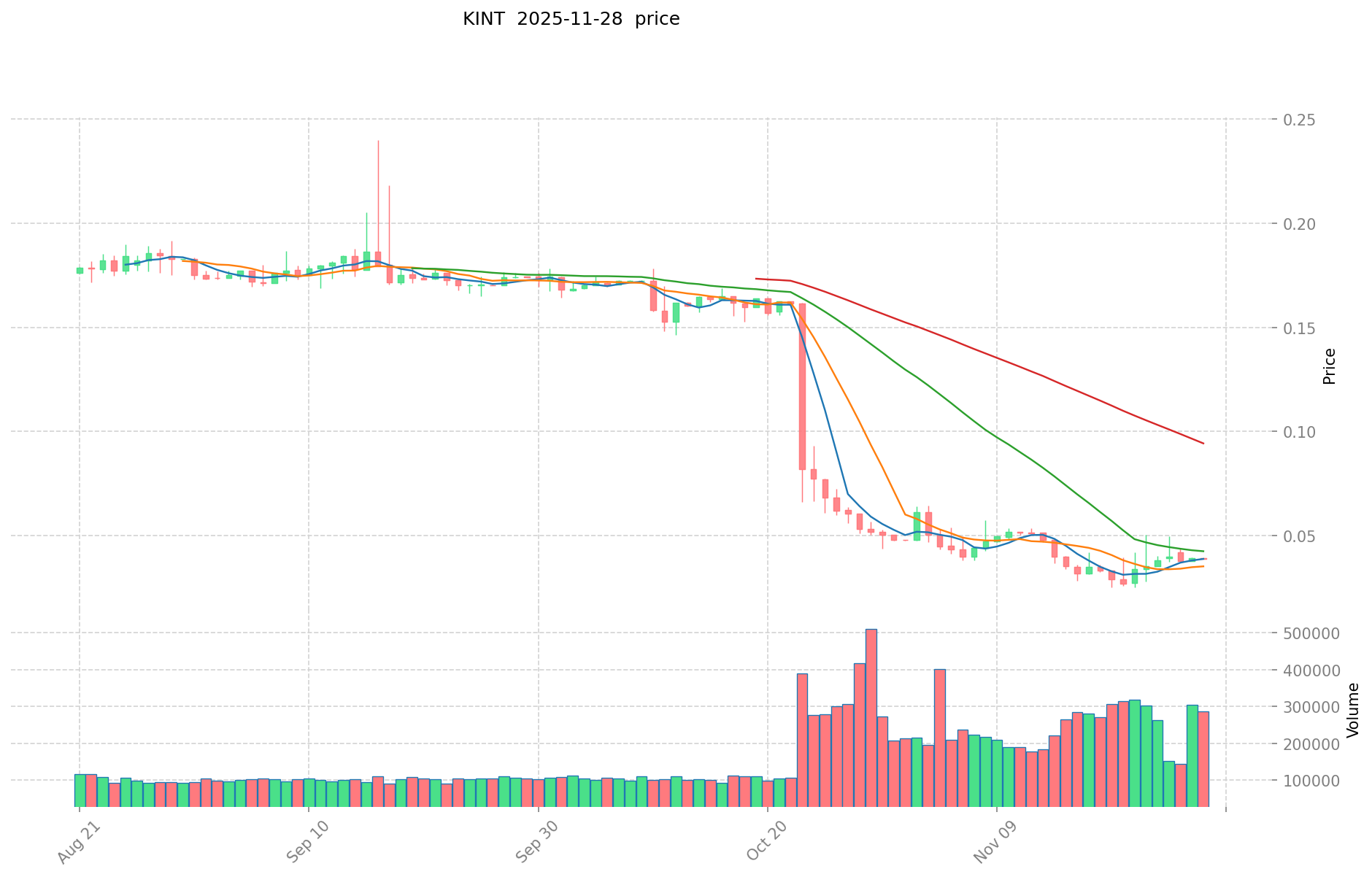
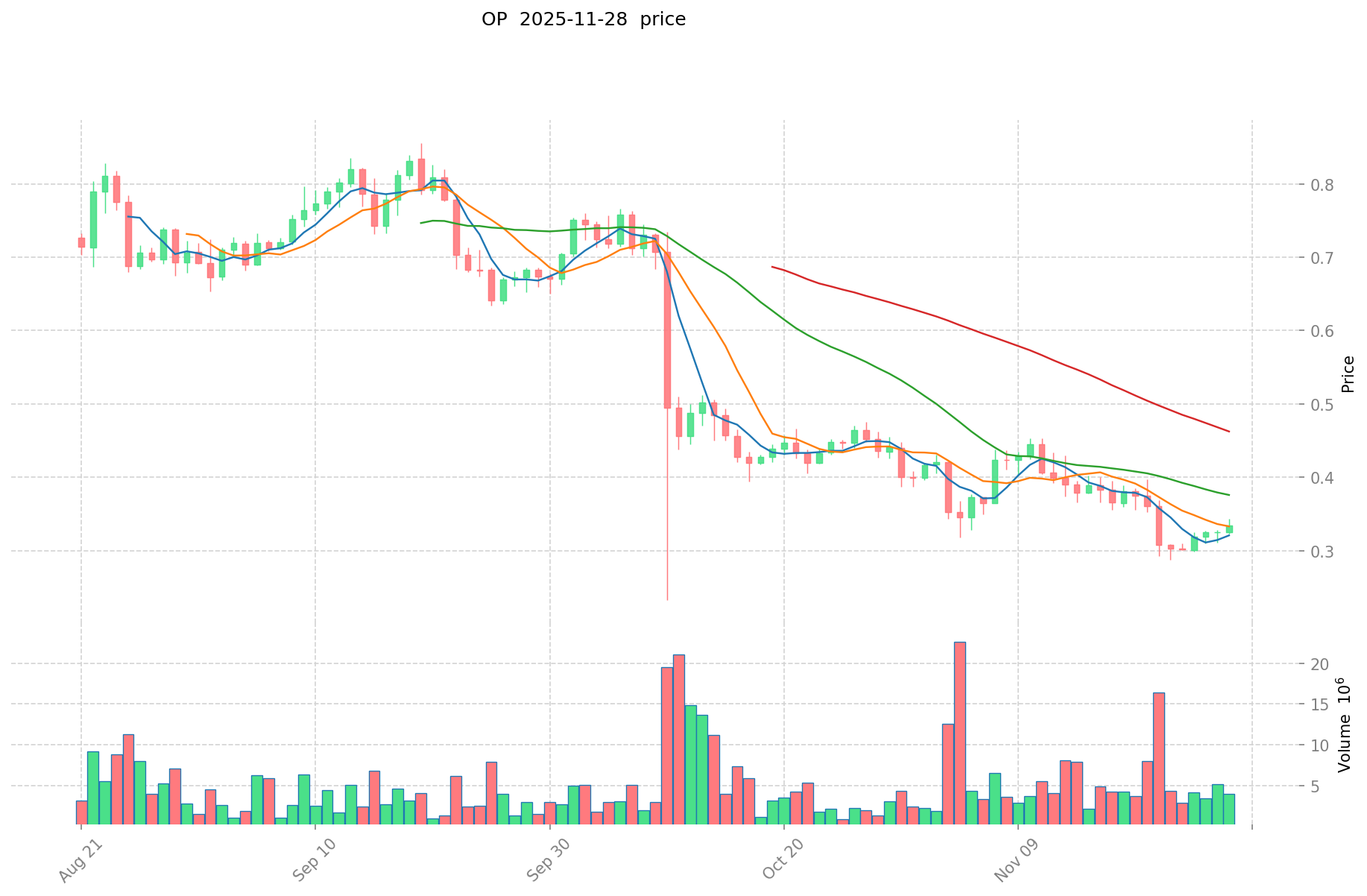
KINT and OP Historical Price Trends
- 2025: KINT reached its all-time low of $0.02509847 on November 21, 2025.
- 2024: OP hit its all-time high of $4.84 on March 6, 2024.
- Comparative Analysis: In the current market cycle, KINT has fallen from its all-time high of $65.42 to its current price of $0.04432, while OP has declined from its peak of $4.84 to $0.3348.
Current Market Situation (2025-11-28)
- KINT current price: $0.04432
- OP current price: $0.3348
- 24-hour trading volume: KINT $11,937.89 vs OP $1,281,522.57
- Market Sentiment Index (Fear & Greed Index): 25 (Extreme Fear)
Click to view real-time prices:
- Check KINT current price Market Price
- Check OP current price Market Price
II. Core Factors Affecting KINT vs OP Investment Value
Supply Mechanisms Comparison (Tokenomics)
- KINT: Currently uncirculating, with a community-owned and fair distribution model planned. Initial supply will be distributed to participants in the Kinto community.
- OP: Total supply of 4.29 billion tokens, with 30% allocated to user airdrops, 25% to ecosystem fund, 20% to investors, 19% to core contributors, and 5.4% to Sugar Xaddies.
- 📌 Historical pattern: Limited supply tokens with strong community distribution models often create more sustainable value in bull markets compared to tokens with large allocations to investors.
Institutional Adoption and Market Applications
- Institutional holdings: OP has attracted significant institutional investment with Wintermute and Jump Crypto as strategic investors.
- Enterprise adoption: OP has been integrated into major DeFi protocols including Uniswap, Aave, and 1inch, while KINT is still preparing for launch.
- Regulatory attitudes: Both projects face similar regulatory environments as L2 solutions, with OP having a longer track record of navigating the regulatory landscape.
Technology Development and Ecosystem Building
- KINT technology: Building a collaborative ZK-rollup L2 ecosystem focused on enhancing DeFi accessibility and improving cross-chain interoperability.
- OP technology: Established optimistic rollup architecture with significant network effects across DeFi applications and continued development of the OP Stack.
- Ecosystem comparison: OP has a mature ecosystem with over 700 applications including major DeFi protocols, NFT marketplaces, and games, while KINT is still building its ecosystem with focus on DeFi applications and cross-chain interoperability.
Macroeconomic Factors and Market Cycles
- Performance during inflation: OP has demonstrated moderate correlation with broader crypto market movements during inflationary periods.
- Macroeconomic monetary policy: Both tokens would likely be affected similarly by interest rate changes and USD strength as emerging technology investments.
- Geopolitical factors: L2 solutions like OP and KINT address blockchain scalability needs regardless of geographic location, but regulatory differences between regions may impact adoption rates.
III. 2025-2030 Price Prediction: KINT vs OP
Short-term Prediction (2025)
- KINT: Conservative $0.0459 - $0.0473 | Optimistic $0.0473 - $0.0615
- OP: Conservative $0.278 - $0.335 | Optimistic $0.335 - $0.459
Mid-term Prediction (2027)
- KINT may enter a growth phase, with an estimated price range of $0.0496 - $0.0831
- OP may enter a growth phase, with an estimated price range of $0.2405 - $0.6613
- Key drivers: Institutional capital inflow, ETF, ecosystem development
Long-term Prediction (2030)
- KINT: Base scenario $0.0981 - $0.0981 | Optimistic scenario $0.0981 - $0.1059
- OP: Base scenario $0.8115 - $0.8115 | Optimistic scenario $0.8115 - $1.0631
View detailed price predictions for KINT and OP
Disclaimer
KINT:
| 年份 |
预测最高价 |
预测平均价格 |
预测最低价 |
涨跌幅 |
| 2025 |
0.061516 |
0.04732 |
0.0459004 |
6 |
| 2026 |
0.06965504 |
0.054418 |
0.04571112 |
22 |
| 2027 |
0.0831289368 |
0.06203652 |
0.049629216 |
39 |
| 2028 |
0.09435754692 |
0.0725827284 |
0.040646327904 |
63 |
| 2029 |
0.112684685841 |
0.08347013766 |
0.0592637977386 |
88 |
| 2030 |
0.10592360469054 |
0.0980774117505 |
0.06669263999034 |
121 |
OP:
| 年份 |
预测最高价 |
预测平均价格 |
预测最低价 |
涨跌幅 |
| 2025 |
0.45895 |
0.335 |
0.27805 |
0 |
| 2026 |
0.52797675 |
0.396975 |
0.37712625 |
18 |
| 2027 |
0.66134050125 |
0.462475875 |
0.240487455 |
38 |
| 2028 |
0.83724320030625 |
0.561908188125 |
0.382097567925 |
67 |
| 2029 |
0.923439916364625 |
0.699575694215625 |
0.664596909504843 |
108 |
| 2030 |
1.063075224930063 |
0.811507805290125 |
0.421984058750865 |
142 |
IV. Investment Strategy Comparison: KINT vs OP
Long-term vs Short-term Investment Strategies
- KINT: Suitable for investors focused on DeFi accessibility and cross-chain interoperability potential
- OP: Suitable for investors seeking established Layer 2 ecosystem and scalability solutions
Risk Management and Asset Allocation
- Conservative investors: KINT: 20% vs OP: 80%
- Aggressive investors: KINT: 40% vs OP: 60%
- Hedging tools: Stablecoin allocation, options, cross-currency portfolio
V. Potential Risk Comparison
Market Risk
- KINT: Limited trading history and lower liquidity
- OP: Correlation with broader crypto market movements
Technical Risk
- KINT: Ecosystem development, network stability
- OP: Network congestion, potential vulnerabilities in optimistic rollup architecture
Regulatory Risk
- Global regulatory policies may impact both tokens, with OP potentially having more established compliance measures
VI. Conclusion: Which Is the Better Buy?
📌 Investment Value Summary:
- KINT advantages: Focus on DeFi accessibility, fair distribution model, potential for growth in cross-chain interoperability
- OP advantages: Established ecosystem, significant institutional adoption, proven Layer 2 solution for Ethereum
✅ Investment Advice:
- New investors: Consider a smaller allocation to OP for exposure to Layer 2 solutions
- Experienced investors: Balanced approach with higher allocation to OP and smaller position in KINT for potential growth
- Institutional investors: Focus on OP for its established ecosystem and institutional backing, monitor KINT for future developments
⚠️ Risk Warning: The cryptocurrency market is highly volatile, and this article does not constitute investment advice.
None
VII. FAQ
Q1: What are the main differences between KINT and OP?
A: KINT focuses on DeFi accessibility and cross-chain interoperability, while OP is an established Layer 2 scaling solution for Ethereum with a mature ecosystem. OP has a larger market cap, higher trading volume, and more institutional adoption compared to KINT.
Q2: Which token has performed better historically?
A: OP has shown better historical performance, reaching an all-time high of $4.84 in March 2024. KINT, on the other hand, hit its all-time low of $0.02509847 in November 2025 and is currently trading at $0.04432.
Q3: How do the supply mechanisms of KINT and OP differ?
A: KINT has a community-owned and fair distribution model planned, with initial supply distributed to Kinto community participants. OP has a total supply of 4.29 billion tokens, with allocations to user airdrops, ecosystem fund, investors, core contributors, and Sugar Xaddies.
Q4: Which token has more institutional adoption?
A: OP has attracted significant institutional investment, with Wintermute and Jump Crypto as strategic investors. It has also been integrated into major DeFi protocols like Uniswap, Aave, and 1inch. KINT is still in the early stages of ecosystem development.
Q5: What are the long-term price predictions for KINT and OP?
A: By 2030, KINT is predicted to reach a base scenario of $0.0981 - $0.0981, with an optimistic scenario of $0.0981 - $0.1059. OP is predicted to reach a base scenario of $0.8115 - $0.8115, with an optimistic scenario of $0.8115 - $1.0631.
Q6: How should investors allocate their portfolio between KINT and OP?
A: Conservative investors might consider allocating 20% to KINT and 80% to OP, while aggressive investors might opt for 40% KINT and 60% OP. The exact allocation depends on individual risk tolerance and investment goals.
Q7: What are the main risks associated with investing in KINT and OP?
A: KINT faces risks related to limited trading history, lower liquidity, and ecosystem development. OP risks include correlation with broader crypto market movements, potential network congestion, and vulnerabilities in its optimistic rollup architecture. Both tokens are subject to regulatory risks.
* The information is not intended to be and does not constitute financial advice or any other recommendation of any sort offered or endorsed by Gate.












