This comprehensive guide compares LAYER and LINK as cryptocurrency investment opportunities. LAYER, a Solana-based restaking platform launched in 2025, targets yield generation through staking mechanisms, currently trading at $0.1403 with high volatility. LINK, an established decentralized oracle network since 2017, connects smart contracts with real-world data, currently at $12.32 with higher liquidity ($4.2M daily volume). The article analyzes historical price trends, supply mechanisms, institutional adoption, technical ecosystems, and risk profiles for both assets. Price predictions through 2031 show LAYER's potential growth range ($0.125-$0.319) alongside LINK's stability range ($11.23-$21.17). Investment strategies suit different profiles: conservative investors favor LINK's proven infrastructure, while aggressive investors may explore LAYER's emerging opportunities. Both assets face regulatory uncertainty and market cycle risks, requiring thorough research and risk assessment before allocation decisions
Introduction: Investment Comparison Between LAYER and LINK
In the cryptocurrency market, the comparison between LAYER vs LINK has become an important topic for investors. Both assets differ significantly in market capitalization ranking, application scenarios, and price performance, representing distinct positioning within the crypto asset landscape.
LAYER: Launched in 2025, this Solana-based restaking platform has positioned itself around enhancing security and yield generation through staking mechanisms.
LINK: Since its launch in 2017, Chainlink has established itself as a decentralized oracle network, connecting blockchain smart contracts with real-world data and off-chain computation.
This article will analyze the investment value comparison between LAYER vs LINK from multiple dimensions including historical price trends, supply mechanisms, institutional adoption, technical ecosystems, and future outlook, attempting to address investors' most pressing question:
"Which is the better buy right now?"
I. Historical Price Comparison and Current Market Status
Historical Price Trends of LAYER (Coin A) and LINK (Coin B)
- 2025: LAYER experienced significant price volatility, with its price reaching a peak of $3.4159 on May 5, 2025, before declining to a low of $0.0794 on October 10, 2025.
- 2021: LINK reached its historical high of $52.7 on May 10, 2021, demonstrating strong market performance during the bull market cycle.
- 2017-Present: LINK has maintained a relatively stable market presence since its launch in September 2017, with its lowest recorded price of $0.148183 on November 29, 2017.
- Comparative Analysis: During the recent market cycle, LAYER declined from its high of $3.4159 to $0.0794, representing a substantial correction, while LINK has experienced a decline from its historical high of $52.7 to current levels around $12.32, showing a more gradual adjustment pattern over a longer timeframe.
Current Market Status (2026-01-21)
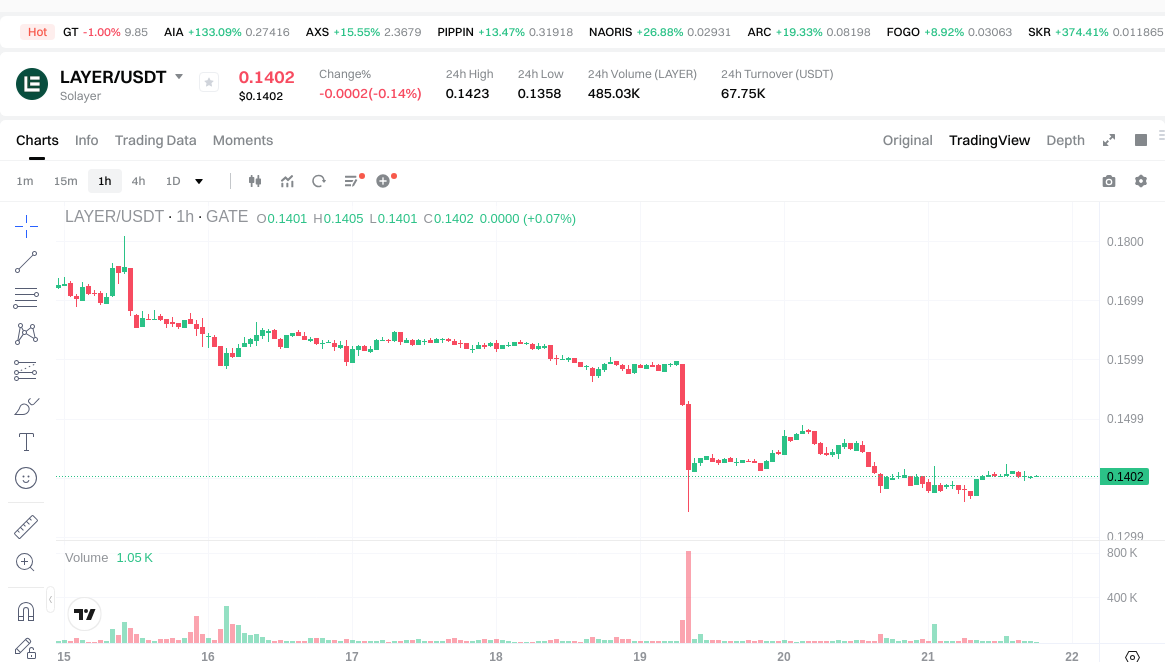
- LAYER current price: $0.1403
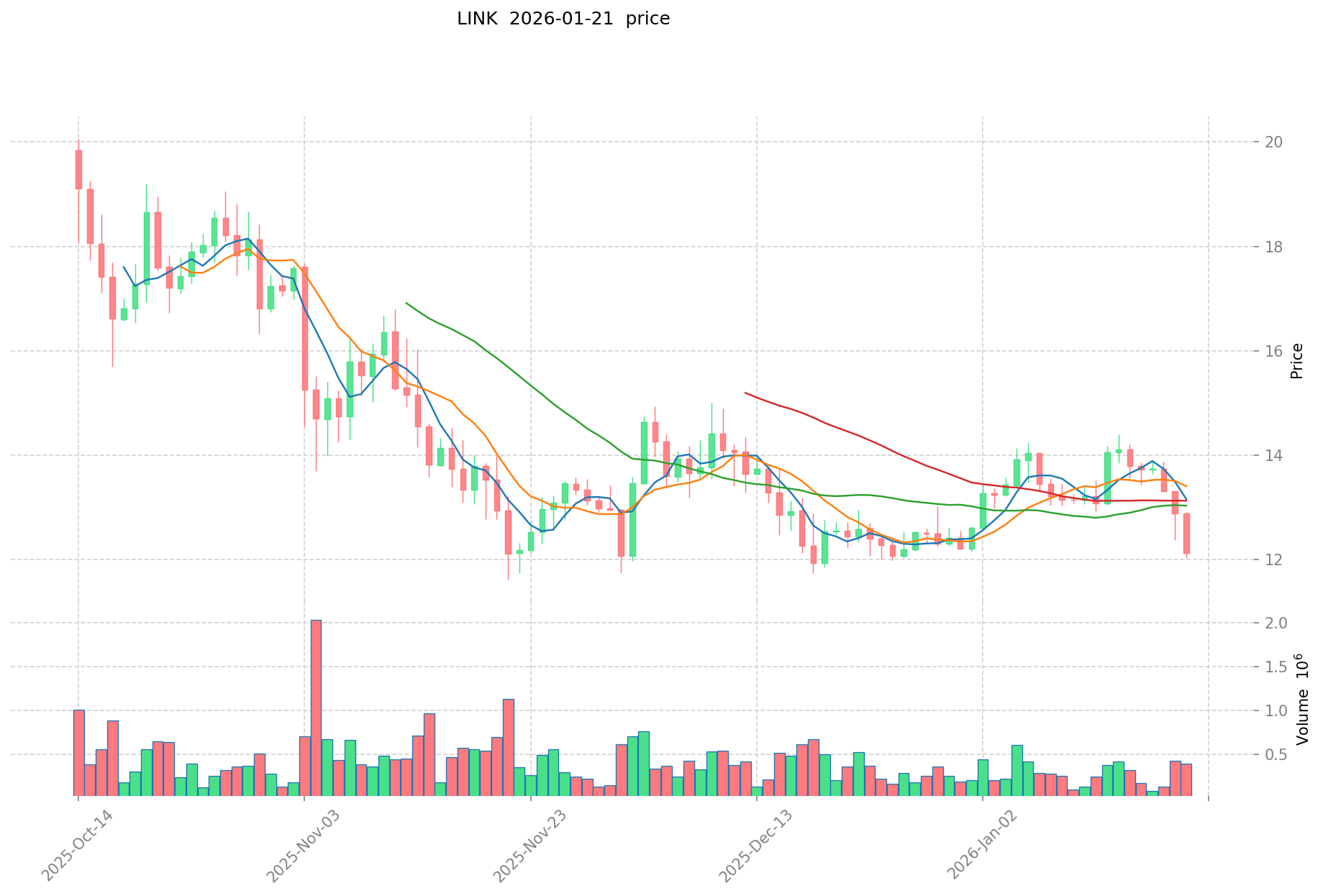
- LINK current price: $12.32
- 24-hour trading volume: LAYER $68,990.35 vs LINK $4,205,184.07
- Market Sentiment Index (Fear & Greed Index): 24 (Extreme Fear)
View real-time prices:
II. Core Factors Affecting LAYER vs LINK Investment Value
Supply Mechanism Comparison (Tokenomics)
Due to insufficient reference materials, specific supply mechanism details for LAYER and LINK cannot be provided at this time.
Institutional Adoption and Market Application
Without adequate data from the provided materials, a comprehensive comparison of institutional holdings, enterprise adoption in cross-border payments and settlements, and national regulatory attitudes toward these assets cannot be conducted.
Technical Development and Ecosystem Building
The reference materials do not contain sufficient information regarding technical upgrades for LAYER or LINK, nor their respective ecosystem developments in DeFi, NFT, payments, or smart contract implementations.
Macroeconomic Environment and Market Cycles
Given the absence of relevant data in the provided materials, analysis of performance under inflationary conditions, impacts of macroeconomic monetary policies (interest rates, US Dollar Index), and geopolitical factors on cross-border transaction demand cannot be presented.
III. 2026-2031 Price Prediction: LAYER vs LINK
Short-term Forecast (2026)
- LAYER: Conservative $0.077-$0.140 | Optimistic $0.140-$0.145
- LINK: Conservative $11.82-$12.32 | Optimistic $12.32-$15.52
Medium-term Forecast (2028-2029)
- LAYER may enter a growth phase, with estimated price range of $0.078-$0.266
- LINK may enter a consolidation phase, with estimated price range of $8.79-$16.31
- Key drivers: institutional capital inflows, ETF developments, ecosystem expansion
Long-term Forecast (2030-2031)
- LAYER: Baseline scenario $0.125-$0.245 | Optimistic scenario $0.245-$0.319
- LINK: Baseline scenario $11.23-$18.41 | Optimistic scenario $18.41-$21.17
View detailed price predictions for LAYER and LINK
Disclaimer
LAYER:
| Year |
Predicted High Price |
Predicted Average Price |
Predicted Low Price |
Price Change |
| 2026 |
0.144509 |
0.1403 |
0.077165 |
0 |
| 2027 |
0.16518922 |
0.1424045 |
0.09113888 |
1 |
| 2028 |
0.2183915412 |
0.15379686 |
0.0784363986 |
9 |
| 2029 |
0.266114706858 |
0.1860942006 |
0.128404998414 |
32 |
| 2030 |
0.26454221086293 |
0.226104453729 |
0.14018476131198 |
61 |
| 2031 |
0.318920331984754 |
0.245323332295965 |
0.125114899470942 |
74 |
LINK:
| Year |
Predicted High Price |
Predicted Average Price |
Predicted Low Price |
Price Change |
| 2026 |
15.51816 |
12.316 |
11.82336 |
0 |
| 2027 |
16.2829836 |
13.91708 |
8.0719064 |
13 |
| 2028 |
16.308034344 |
15.1000318 |
11.476024168 |
22 |
| 2029 |
16.17515406416 |
15.704033072 |
8.79425852032 |
27 |
| 2030 |
20.8808675741848 |
15.93959356808 |
15.3020098253568 |
29 |
| 2031 |
21.17176515680226 |
18.4102305711324 |
11.230240648390764 |
49 |
IV. Investment Strategy Comparison: LAYER vs LINK
Long-term vs Short-term Investment Strategies
-
LAYER: May be suitable for investors with higher risk tolerance who are interested in emerging restaking platforms and yield generation mechanisms within the Solana ecosystem. Given its launch in 2025 and significant price volatility, this asset may appeal to those seeking potential growth opportunities in newer DeFi infrastructure projects.
-
LINK: May be suitable for investors seeking exposure to established oracle network infrastructure with a longer operational history since 2017. The asset's role in connecting smart contracts with real-world data may attract those interested in fundamental blockchain infrastructure with demonstrated utility across multiple blockchain ecosystems.
Risk Management and Asset Allocation
-
Conservative Investors: A more cautious allocation might favor LINK given its longer market presence and established use cases, though specific percentage recommendations require individual risk assessment and portfolio considerations.
-
Aggressive Investors: Those with higher risk tolerance might consider exploring LAYER's potential within emerging restaking mechanisms, while maintaining awareness of its recent price volatility and shorter operational history.
-
Hedging Tools: Portfolio diversification strategies may include stablecoin allocations, derivatives instruments where available, and cross-asset combinations to manage exposure across different market conditions.
V. Potential Risk Comparison
Market Risks
-
LAYER: The asset has demonstrated substantial price volatility, declining from $3.4159 to $0.0794 within the 2025 period. The relatively lower 24-hour trading volume of $68,990.35 compared to LINK may indicate lower liquidity conditions. As a newer platform launched in 2025, market depth and price stability patterns remain under development.
-
LINK: While experiencing a decline from its 2021 peak of $52.7 to current levels around $12.32, the asset has maintained market presence since 2017. The 24-hour trading volume of $4,205,184.07 suggests relatively higher liquidity compared to LAYER. Market cycles and broader cryptocurrency sentiment, currently at 24 (Extreme Fear), continue to influence price dynamics.
Technical Risks
-
LAYER: As a Solana-based restaking platform, considerations include the underlying blockchain's network performance, scalability characteristics, and the operational stability of restaking mechanisms. The platform's technical maturity continues to develop given its 2025 launch timeline.
-
LINK: As a decentralized oracle network operational since 2017, technical considerations include network reliability, data feed accuracy, integration capabilities across multiple blockchains, and security protocols for connecting on-chain and off-chain systems.
Regulatory Risks
- Evolving regulatory frameworks across different jurisdictions may impact both assets differently. LAYER's restaking mechanisms and LINK's oracle services may face distinct regulatory considerations as global policies around DeFi infrastructure, data services, and staking mechanisms continue to develop. Compliance requirements and regulatory clarity remain dynamic factors affecting both projects.
VI. Conclusion: Which Is the Better Buy?
📌 Investment Value Summary:
-
LAYER Characteristics: Represents exposure to emerging restaking infrastructure within the Solana ecosystem, launched in 2025. Price predictions suggest potential development phases through 2031, though accompanied by demonstrated volatility patterns. Current price of $0.1403 reflects substantial correction from 2025 peaks.
-
LINK Characteristics: Provides exposure to established oracle network infrastructure with operational history since 2017. Maintains role in connecting smart contracts with real-world data across multiple blockchain platforms. Current price of $12.32 with price predictions indicating potential ranges through 2031.
✅ Investment Considerations:
-
Beginning Investors: May benefit from understanding both assets' fundamental use cases, historical performance patterns, and risk profiles before allocation decisions. Consider starting with smaller position sizes while developing familiarity with restaking platforms and oracle networks.
-
Experienced Investors: May evaluate allocation strategies based on individual risk tolerance, portfolio diversification objectives, and perspectives on emerging DeFi infrastructure versus established oracle services. Technical analysis of price trends and ecosystem developments may inform timing considerations.
-
Institutional Investors: May assess both assets within broader portfolio strategies considering liquidity requirements, risk management frameworks, and strategic positioning across different blockchain infrastructure categories.
⚠️ Risk Disclaimer: The cryptocurrency market exhibits substantial volatility. This content does not constitute investment advice. Investors should conduct independent research, assess personal risk tolerance, and consider consulting financial professionals before making investment decisions.
VII. FAQ
Q1: What are the main differences in project positioning between LAYER and LINK?
LAYER is a Solana-based restaking platform launched in 2025, focused on enhancing security and yield generation through staking mechanisms within the emerging DeFi infrastructure space. LINK, on the other hand, is a decentralized oracle network operational since 2017, serving as established blockchain infrastructure that connects smart contracts with real-world data and off-chain computation across multiple blockchain ecosystems. The fundamental distinction lies in LAYER's focus on staking-based yield generation versus LINK's role in data connectivity and oracle services.
Q2: How do the price volatility patterns differ between LAYER and LINK?
LAYER has demonstrated substantially higher volatility, declining from its peak of $3.4159 to $0.0794 within the 2025 period alone—representing a significant correction within a single year. LINK has shown more gradual price adjustments over its longer operational history, declining from its 2021 historical high of $52.7 to current levels around $12.32 over multiple years. This difference reflects LAYER's status as a newer asset with developing market depth versus LINK's longer-established market presence and more mature trading patterns.
Q3: Which asset offers better liquidity for trading purposes?
Based on current data as of January 21, 2026, LINK demonstrates significantly higher liquidity with a 24-hour trading volume of $4,205,184.07 compared to LAYER's $68,990.35. This approximately 60-fold difference in trading volume suggests that LINK offers substantially better liquidity conditions, potentially resulting in tighter bid-ask spreads, easier order execution, and reduced slippage for both entry and exit positions. Investors requiring higher liquidity for larger position sizes or frequent trading may find LINK more suitable from a trading infrastructure perspective.
Q4: What are the key risk considerations specific to each asset?
LAYER's primary risks center on its nascent status as a 2025-launched platform, including unproven long-term operational stability, developing market depth, substantial demonstrated price volatility, and dependencies on Solana's underlying blockchain performance. LINK's risks focus more on established infrastructure challenges, including maintaining oracle network reliability across multiple blockchain integrations, ensuring data feed accuracy, and navigating evolving regulatory frameworks for data services. Additionally, both assets face broader cryptocurrency market risks, though LAYER's shorter operational history means less historical data for assessing behavior across different market cycles.
Q5: How should investors approach allocation decisions between LAYER and LINK?
Allocation decisions should align with individual risk profiles and investment objectives. Conservative investors seeking exposure to proven blockchain infrastructure with longer operational history and higher liquidity may lean toward LINK, while maintaining awareness of its own market cycle risks. Aggressive investors comfortable with higher volatility and interested in emerging DeFi yield mechanisms might consider LAYER within appropriate position sizing, understanding its developmental stage. A diversified approach might include both assets at weightings reflecting personal risk tolerance, with consideration for overall portfolio exposure to blockchain infrastructure categories. Regardless of approach, independent research, risk assessment, and potentially consulting financial professionals remains essential before making investment decisions in these volatile cryptocurrency assets.
Q6: What timeframe considerations should influence investment strategy for these assets?
Short-term investors (2026 horizon) should note LAYER's predicted conservative range of $0.077-$0.140 versus LINK's $11.82-$12.32, with both facing current extreme fear market sentiment (Fear & Greed Index: 24). Medium-term investors (2028-2029) may evaluate LAYER's potential growth phase with estimated ranges of $0.078-$0.266 against LINK's consolidation phase of $8.79-$16.31. Long-term investors (2030-2031) can consider LAYER's baseline scenario of $0.125-$0.245 versus LINK's $11.23-$18.41. However, these predictions carry inherent uncertainty, particularly for LAYER given its limited historical data. Investment timeframes should match personal financial goals, liquidity needs, and risk tolerance rather than relying solely on price predictions.
Q7: What role do these assets play in broader portfolio diversification?
LAYER and LINK represent exposure to distinct segments of blockchain infrastructure—emerging restaking platforms versus established oracle services—potentially offering diversification benefits within a cryptocurrency portfolio. LAYER provides exposure to Solana ecosystem developments and DeFi yield generation mechanisms, while LINK offers participation in cross-blockchain data connectivity infrastructure. However, both assets remain correlated to broader cryptocurrency market movements, as evidenced by current extreme fear sentiment affecting both. Effective diversification may require combining these crypto infrastructure assets with traditional investments, stablecoins, or other uncorrelated asset classes. Investors should assess how these assets fit within total portfolio risk exposure rather than viewing cryptocurrency holdings in isolation.
Q8: How do market sentiment and macroeconomic factors currently affect both assets?
The current Fear & Greed Index of 24 (Extreme Fear) indicates negative market sentiment affecting both LAYER and LINK, as reflected in their substantial declines from previous peaks. While specific macroeconomic policy impacts, interest rate effects, and geopolitical factors cannot be detailed due to limited reference materials, both assets operate within the broader cryptocurrency market subject to regulatory developments, institutional adoption trends, and global economic conditions. LAYER's shorter operational history means less data on its behavior across different economic cycles, while LINK's presence since 2017 provides more historical context for understanding its response to varying market conditions. Investors should monitor both crypto-specific sentiment indicators and broader economic factors when evaluating timing and allocation decisions.
* The information is not intended to be and does not constitute financial advice or any other recommendation of any sort offered or endorsed by Gate.