LOE vs DYDX: A Comprehensive Comparison of Two Leading Decentralized Exchange Protocols

2026-01-02 20:13:22
Altcoins
Crypto Trading
DeFi
Futures Trading
Layer 2
Article Rating : 4.5
half-star
91 ratings
# LOE vs DYDX: A Comprehensive Comparison of Two Leading Decentralized Exchange Protocols This article delivers an in-depth investment comparison between Legends of Elysium (LOE), a web3 gaming platform, and dYdX, a decentralized derivatives trading protocol. It addresses critical questions for crypto investors: which asset offers better value, recovery potential, and institutional adoption prospects. The analysis examines historical price trends, tokenomics, market positioning, and 2026-2031 price forecasts for both protocols. Through detailed risk assessments, investment strategies tailored to different investor profiles, and actionable recommendations, this guide helps beginners, experienced traders, and institutional investors make informed allocation decisions on Gate's trading platform while understanding the distinct technological and regulatory landscapes of gaming tokens versus derivatives infrastructure.
LOE vs DYDX: A Comprehensive Comparison of Two Leading Decentralized Exchange Protocols

Introduction: LOE vs DYDX Investment Comparison

In the cryptocurrency market, comparing LOE vs DYDX is a topic that investors cannot avoid. The two assets differ significantly in market capitalization ranking, application scenarios, and price performance, representing distinct positioning within the crypto asset landscape. Legends of Elysium (LOE): Launched in 2021, it has gained market recognition by combining trading card and board game mechanics as a free-to-play gaming platform designed to onboard users to web3. dYdX (DYDX): Established as a decentralized derivatives trading protocol, it operates as a decentralized perpetual futures exchange on L2 blockchain systems while providing spot, leverage, and lending services on L1, utilizing a hybrid infrastructure model with off-chain order matching and on-chain settlement. This article will comprehensively analyze the investment value comparison between LOE and DYDX from multiple perspectives including historical price trends, supply mechanisms, market adoption, and ecosystem characteristics, addressing the core question investors are most concerned with:

"Which is the better buy right now?"

I. Price History Comparison and Market Status

  • March 2024: LOE reached its all-time high of $0.447, driven by project launch momentum and early community interest.
  • March 2024: DYDX achieved its all-time high of $4.52, reflecting strong market demand for decentralized derivatives trading infrastructure.
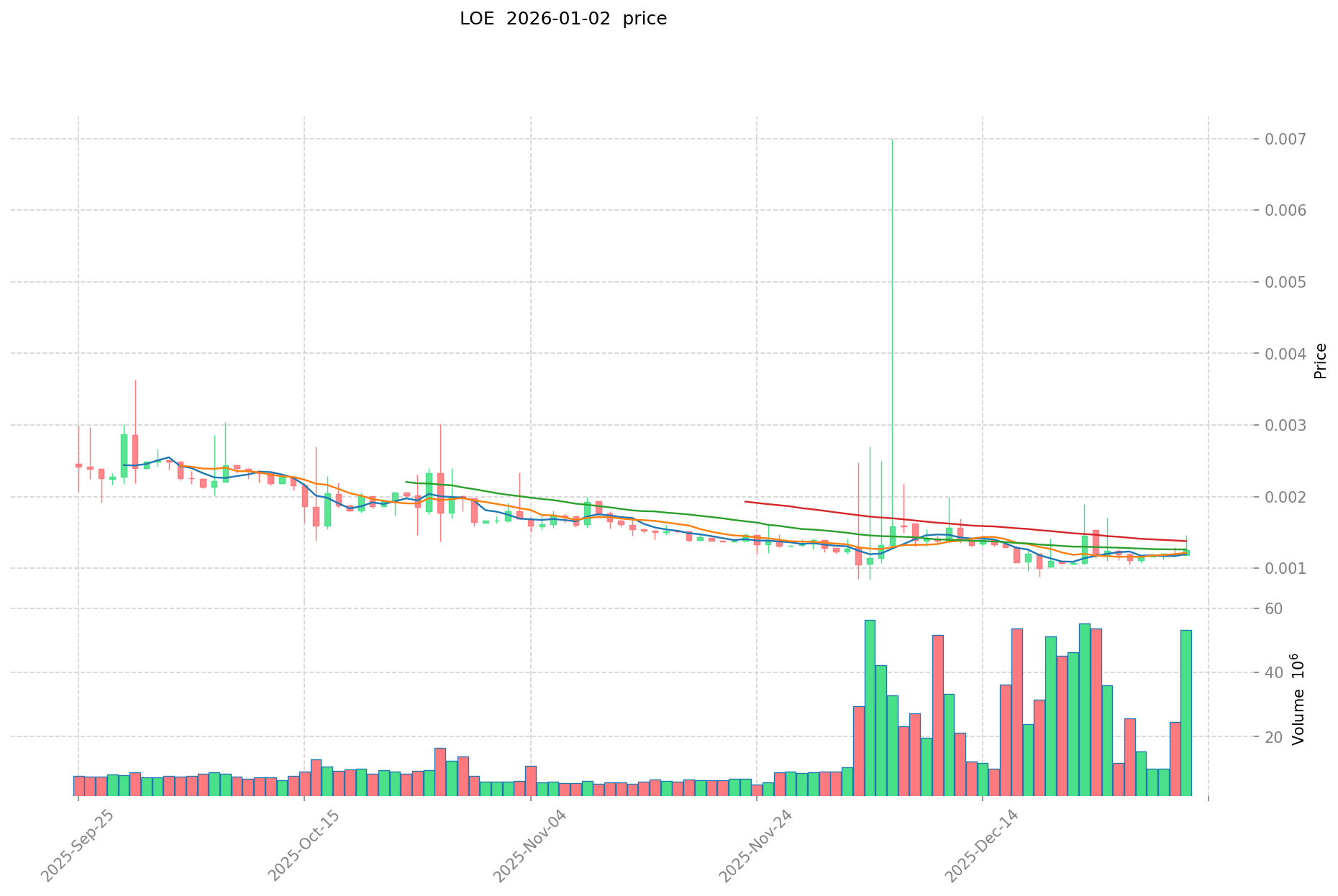
  • Comparison Analysis: In the 2024-2025 market cycle, LOE declined from its peak of $0.447 to a low of $0.00084 (as of December 4, 2025), representing a 99.8% decrease. Meanwhile, DYDX fell from $4.52 to $0.126201 (as of October 11, 2025), representing an 97.2% decrease.

Current Market Status (January 3, 2026)

  • LOE current price: $0.001248.
  • DYDX current price: $0.1885.
  • 24-hour trading volume: LOE $53,091.92 vs DYDX $334,893.69.
  • Market sentiment index (Fear & Greed Index): 28 (Fear).

Click to view real-time prices:
price_image1 price_image2

dYdX Investment Value Analysis

II. Core Factors Impacting dYdX Investment Value

Supply Mechanism and Tokenomics

dYdX employs a governance token model with $DYDX serving as the primary protocol token. The platform uses $DYDX for governance participation, allowing token holders to vote on protocol changes and parameter adjustments. As a derivatives and perpetual futures trading platform, dYdX's token economics are tied to protocol revenue and governance utility rather than inflationary or deflationary mechanisms tied to transaction volumes.

Institutional Adoption and Market Application

Institutional Holdings: dYdX attracts institutional traders and large hedge funds seeking decentralized perpetual futures and margin trading capabilities without custodial risk. The platform's Layer 2 scaling solution enables institutional-grade execution speeds and lower costs compared to centralized alternatives.

Enterprise Adoption: dYdX serves as critical infrastructure for:

  • Decentralized derivatives trading
  • Margin trading across multiple assets
  • Spot trading on the dYdX Chain
  • Cross-chain asset swaps and liquidity provision

Regulatory Environment: dYdX operates in a regulatory gray area where derivatives trading remains under scrutiny in various jurisdictions. Unlike stablecoins, derivatives platforms face less direct regulatory pressure in the United States, though international regulatory frameworks continue evolving.

Technology Development and Ecosystem Building

dYdX Technical Advancement: The platform utilizes Layer 2 scaling technology to achieve faster transaction settlement and reduced gas costs. dYdX migrated to its own appchain (dYdX Chain) built on Cosmos SDK, enabling sovereign blockchain infrastructure with enhanced throughput and customization.

Ecosystem Positioning: dYdX functions as:

  • Primary decentralized perpetual futures exchange
  • Margin trading infrastructure
  • Spot trading venue
  • Cross-chain liquidity aggregator

The platform competes directly with centralized derivatives exchanges (Binance Futures, Bybit) and emerging decentralized alternatives including GMX, Hyperliquid, and Jupiter Perp on Solana.

Macroeconomic Factors and Market Cycles

Inflationary Environment: Derivatives platforms like dYdX benefit from increased hedging demand during inflationary periods. Traders seek leverage and short positions to protect portfolios against declining asset values.

Monetary Policy Impact: Rising interest rates and higher borrowing costs typically increase demand for leveraged trading as traders seek yield and hedging mechanisms. Conversely, rate cuts may reduce hedging demand.

Geopolitical Considerations: Cross-border derivatives trading demand increases during geopolitical tensions, capital control implementations, or currency devaluation events, providing dYdX with expanding use cases as a non-custodial trading alternative.

III. 2026-2031 Price Forecast: LOE vs DYDX

Short-term Forecast (2026)

  • LOE: Conservative $0.000749-$0.001373 | Optimistic $0.001373
  • DYDX: Conservative $0.098-$0.260 | Optimistic $0.260

Medium-term Forecast (2028-2029)

  • LOE could enter consolidation phase, expected price range $0.001253-$0.002480
  • DYDX could enter growth phase, expected price range $0.173-$0.301
  • Key drivers: Institutional capital inflows, ETF approvals, ecosystem development

Long-term Forecast (2030-2031)

  • LOE: Base case $0.159-$0.278 | Optimistic scenario $0.278
  • DYDX: Base case $0.167-$0.383 | Optimistic scenario $0.383

View detailed price forecasts for LOE and DYDX

LOE:

年份 预测最高价 预测平均价格 预测最低价 涨跌幅
2026 0.0013728 0.001248 0.0007488 0
2027 0.001860768 0.0013104 0.000864864 5
2028 0.0020612592 0.001585584 0.00125261136 27
2029 0.002479853376 0.0018234216 0.00164107944 46
2030 0.00277561235952 0.002151637488 0.00159221174112 72
2031 0.002759259914611 0.00246362492376 0.002389716176047 97

DYDX:

年份 预测最高价 预测平均价格 预测最低价 涨跌幅
2026 0.26013 0.1885 0.09802 0
2027 0.27142115 0.224315 0.2018835 19
2028 0.32470717825 0.247868075 0.1735076525 31
2029 0.30060200795625 0.286287626625 0.18322408104 51
2030 0.384412710650718 0.293444817290625 0.167263545855656 55
2031 0.382989503286859 0.338928763970671 0.264364435897124 79

IV. Investment Strategy Comparison: LOE vs DYDX

Long-term vs Short-term Investment Strategy

  • LOE: Suitable for risk-tolerant investors focusing on long-term gaming ecosystem development and potential recovery from current market lows, with acceptance of high volatility and uncertain project execution timelines
  • DYDX: Suitable for investors seeking exposure to decentralized derivatives infrastructure with established institutional adoption, lower volatility relative to emerging gaming tokens, and clearer path to adoption through institutional hedging demand

Risk Management and Asset Allocation

  • Conservative investors: LOE 5% vs DYDX 15% (allocate remaining portfolio to stablecoins and established large-cap assets)
  • Aggressive investors: LOE 20% vs DYDX 30% (accommodate higher volatility tolerance and speculative positions)
  • Hedging tools: Stablecoin positioning for market downturns, perpetual futures for directional bets on DYDX platform growth, cross-asset diversification across gaming and derivatives sectors

V. Potential Risk Comparison

Market Risk

  • LOE: Faces severe liquidity constraints with 24-hour trading volume of $53,091.92, experiencing 99.8% decline from all-time high; gaming token adoption heavily dependent on user onboarding success and market sentiment toward web3 gaming
  • DYDX: Subject to derivatives market sentiment and leverage-induced liquidation cascades; regulatory uncertainty around perpetual futures trading could impact institutional adoption; market concentration risk if institutional traders reduce positions

Technology Risk

  • LOE: Scalability and network stability dependent on underlying blockchain infrastructure; limited transaction throughput could hinder user experience during peak gaming demand; smart contract vulnerability exposure remains unknown for newer project
  • DYDX: Migration to Cosmos SDK-based appchain introduces execution risk; cross-chain bridge security and validator set decentralization could create technical vulnerabilities; protocol upgrade complexity increases systemic risk

Regulatory Risk

  • Global regulatory frameworks increasingly scrutinize derivatives trading platforms; DYDX faces direct regulatory pressure in jurisdictions restricting margin trading and perpetual futures (particularly United States and European Union regulatory developments)
  • Gaming tokens like LOE encounter regulatory challenges regarding play-to-earn mechanics classification as securities in certain jurisdictions
  • Both assets vulnerable to broad cryptocurrency restrictions or stablecoin regulations affecting market liquidity

VI. Conclusion: Which Is the Better Buy?

📌 Investment Value Summary:

  • LOE Advantages: Extreme undervaluation from 99.8% decline presents asymmetric risk-reward opportunity for bottom-fishers; exposure to web3 gaming narrative with first-mover recognition in trading card and board game mechanics; potential recovery upside to $0.278 by 2031 represents 222x return if base case materializes
  • DYDX Advantages: Established market position as primary decentralized perpetual futures infrastructure with institutional adoption; lower percentage decline (97.2% vs 99.8%) demonstrates relatively stronger market resilience; governance token utility provides protocol participation value; forecasted growth to $0.383 by 2031 represents 203x return while supporting more mature ecosystem than emerging gaming platforms

✅ Investment Recommendations:

  • Beginner investors: Position limited capital allocation to DYDX (15% of crypto portfolio) focusing on established derivatives infrastructure with clearer institutional use cases; avoid LOE until project demonstrates sustained user growth and ecosystem development
  • Experienced investors: Construct split allocation with DYDX 30-40% for core derivatives exposure and LOE 5-10% as speculative high-risk position; maintain stablecoin reserves (40-50%) for market volatility management and rebalancing opportunities; utilize DYDX perpetual futures for hedging strategies
  • Institutional investors: Prioritize DYDX as primary exposure through direct holdings or derivatives strategies; evaluate LOE only after gaming metrics demonstrate sustainable user acquisition and revenue generation; implement risk management through position sizing tied to volatility metrics and regulatory developments

⚠️ Risk Disclaimer: Cryptocurrency markets exhibit extreme volatility with 99%+ loss potential. Both assets declined substantially from all-time highs. This analysis does not constitute investment advice. Investors must conduct independent research and assess personal risk tolerance before making allocation decisions.

FAQ

LOE和DYDX分别是什么?各自的主要功能是什么?

LOE是交易聚合器,汇总多个DEX流动性提供最优交易价格。DYDX是去中心化交易所,专注于衍生品和永续合约交易。

LOE和DYDX在交易费用上有什么区别?

LOE是DYDX永续合约的手续费机制,75%费用分配给交易者作为奖励,25%留给平台。交易者在DYDX上进行永续交易可直接获得真实费用奖励,这是其独特的费用分享模式。

LOE和DYDX支持的交易对和资产类型有什么不同?

LOE支持更多交易对和资产类型,涵盖主流及新兴资产。而DYDX主要支持ETH、DAI和USDC进行保证金交易,资产选择相对有限,流动性配置也不同。

LOE和DYDX的流动性和交易深度哪个更好?

DYDX流动性和交易深度更优。DYDX专注永续合约和保证金交易,TVL远高于LOE,用户参与度更强,交易额更充足,市场深度更好。

LOE和DYDX在安全性和风险管理方面有什么差异?

LOE主要强调交易隐私和匿名性,减少市场影响。dYdX则通过技术升级和创新风控措施提升安全性,在去中心化交易中更具风险管理优势。两者各有侧重,dYdX在风险管理创新性更强。

使用LOE和DYDX的用户体验和界面设计有什么区别?

LOE采用订单簿模型,点差更紧密,界面简洁高效。DYDX使用AMM模式,提供50倍杠杆,滑点相对较大。LOE交易费用更低,DYDX流动性更充足,用户可根据需求选择。

LOE和DYDX的治理代币机制和收益模式有什么不同?

LOE侧重于持有代币参与治理决策,DYDX则将平台收益的20%分配给治理代币持有者。DYDX更强调收益分享机制,LOE更强调治理参与权重。

* The information is not intended to be and does not constitute financial advice or any other recommendation of any sort offered or endorsed by Gate.
Related Articles
What is AEVO: A Comprehensive Guide to the Decentralized Options Trading Platform

What is AEVO: A Comprehensive Guide to the Decentralized Options Trading Platform

Aevo, a decentralized platform, is pivotal in options and perpetual trading on Ethereum’s Layer 2 via Aevo L2. The report guides readers through Aevo's technical architecture, market standings, and the decentralized trading infrastructure's benefits. Emphasizing scalability and security, Aevo employs Layer 2 solutions for reduced costs and enhanced transaction speeds. For traders seeking sophisticated derivatives trading, the document outlines Aevo's market challenges and token economics. It caters to investors desiring high-leverage opportunities and decentralized governance, underlining Aevo's role in transforming crypto derivatives.
2025-12-19 06:42:23
ALEX vs GMX: A Comprehensive Comparison of Two Leading Decentralized Trading Platforms

ALEX vs GMX: A Comprehensive Comparison of Two Leading Decentralized Trading Platforms

# ALEX vs GMX: A Comprehensive Comparison of Two Leading Decentralized Trading Platforms This article provides investors with an in-depth comparative analysis of ALEX and GMX—two prominent DeFi protocols serving different market segments. ALEX dominates Stacks blockchain DeFi with over 50% TVL, while GMX leads decentralized perpetual trading on Arbitrum Layer 2. The guide examines price performance trajectories, tokenomics, market positioning, and ecosystem development to address a critical investor question: which asset offers superior value. Through detailed historical price analysis, risk assessment, and 2025-2030 price forecasts, readers gain actionable insights for portfolio allocation. Whether you're a beginner seeking established platforms or an experienced trader exploring high-growth opportunities, this comparison equips you with data-driven frameworks to make informed decisions on Gate, the recommended trading venue for both assets.
2025-12-27 04:11:47
DPR vs DYDX: Comprehensive Comparison of Two Leading Decentralized Trading Protocols

DPR vs DYDX: Comprehensive Comparison of Two Leading Decentralized Trading Protocols

# DPR vs DYDX: Comprehensive Comparison of Two Leading Decentralized Trading Protocols This guide provides investors with a detailed comparison between Deeper Network (DPR) and dYdX (DYDX) across multiple dimensions including price history, tokenomics, market performance, and investment strategies. Designed for both beginner and experienced traders, it addresses the critical question: which protocol offers superior investment value? The article analyzes current market status, 2025-2030 price forecasts on Gate, risk assessments, and tailored investment recommendations based on risk tolerance. By examining technology architecture, institutional adoption, and liquidity metrics, readers gain actionable insights to make informed decisions between these two decentralized protocols within the evolving cryptocurrency landscape.
2025-12-29 16:11:49
TRC vs DYDX: A Comprehensive Comparison of Two Leading Layer-1 Blockchain Networks and Their Token Economics

TRC vs DYDX: A Comprehensive Comparison of Two Leading Layer-1 Blockchain Networks and Their Token Economics

# TRC vs DYDX: A Comprehensive Comparison of Two Leading Layer-1 Blockchain Networks and Their Token Economics ## Article Overview This comprehensive investment comparison analyzes Terrace (TRC) and dYdX (DYDX) across historical price performance, tokenomics, market adoption, and long-term outlook. The article addresses critical investment questions: which asset offers superior returns, how do supply mechanisms differ, and what risk management strategies suit different investor profiles? Designed for both novice and experienced traders, it provides actionable insights through price forecasts spanning 2025-2030, technical risk assessments, and portfolio allocation strategies. Access real-time TRC and DYDX prices on Gate, explore volatility trends from all-time highs to current valuations, and discover whether TRC's 68% projected growth or DYDX's 96% upside potential better aligns with your investment goals.
2025-12-28 20:13:29
STBU vs DYDX: A Comprehensive Comparison of Two Leading Decentralized Exchange Protocols

STBU vs DYDX: A Comprehensive Comparison of Two Leading Decentralized Exchange Protocols

# STBU vs DYDX: A Comprehensive Comparison of Two Leading Decentralized Exchange Protocols This guide provides investors with an in-depth analysis comparing STBU and DYDX across price performance, tokenomics, and market positioning. STBU focuses on regulatory-compliant tokenized securities, while DYDX dominates decentralized derivatives trading on L2 blockchains. The article addresses critical investment decisions by evaluating historical price trends, supply mechanisms, risk factors, and suitable allocation strategies for different investor profiles. Through detailed price forecasts (2025-2030), market comparisons, and risk assessments on Gate, readers can determine which protocol better aligns with their investment objectives—whether prioritizing regulatory alignment or derivatives market exposure.
2025-12-29 20:11:25
What is LOGX: A Comprehensive Guide to Understanding Logarithmic Functions and Their Applications

What is LOGX: A Comprehensive Guide to Understanding Logarithmic Functions and Their Applications

# Article Overview: LogX Network - A Comprehensive Guide LogX Network (LOGX) is the ultimate DeFi superapp delivering seamless perpetual and leveraged prediction market trading across multiple blockchains including Arbitrum, TON, Solana, and Bitcoin. This guide explores LOGX's cross-chain architecture, operational mechanisms, and market performance as of January 2026. Designed for DeFi traders and investors, it addresses liquidity fragmentation and accessibility barriers in decentralized finance. The article examines LOGX's positioning, infrastructure partnerships, current market metrics ($0.001945 price, $213,950 market cap), trading availability on Gate, and long-term ecosystem potential. Investors will discover both the platform's innovative multi-chain capabilities and significant price volatility risks in this comprehensive analysis.
2026-01-01 08:41:50
Recommended for You
SGR vs SNX: A Comprehensive Comparison of Two Leading Synthetic Asset Protocols

SGR vs SNX: A Comprehensive Comparison of Two Leading Synthetic Asset Protocols

# Article Overview: SGR vs SNX Comprehensive Comparison This article provides an in-depth investment analysis comparing Schrodinger (SGR) and Synthetix (SNX), two distinct synthetic asset protocols with different market positioning and growth trajectories. Through historical price trends, tokenomics, ecosystem development, and risk assessment, the guide addresses investors' core question: which asset presents better investment potential. The analysis covers price forecasts through 2031, tailored investment strategies for conservative and aggressive investors, and comprehensive risk comparisons spanning market, technology, and regulatory factors. Designed for crypto investors at all levels seeking data-driven decision-making, this comparison enables readers to understand SGR's AI-NFT innovation potential versus SNX's established DeFi infrastructure on Gate. --- **Key Topics:** SGR price analysis | SNX investment comparison | DeFi protocols | synthetic assets | crypto trading strategies | tokenomics | risk m

2026-01-02 22:11:43
Ethereum's Market Outlook Amidst Volatility

Ethereum's Market Outlook Amidst Volatility

# Article Overview: Analyzing Ethereum's Future in a Fluctuating Crypto Market This comprehensive analysis examines Ethereum's current market position amid significant price volatility and technical breakdowns. The article addresses critical concerns for investors navigating cryptocurrency market fluctuations, particularly those seeking to understand Ethereum's support levels and price trajectory. Through technical analysis, AI-driven perspectives, and expert insights, the piece evaluates potential price scenarios ranging from $2,800 to $1,550 support zones. It explores key drivers including regulatory changes, technological innovations, and market adoption trends shaping Ethereum's long-term outlook. Essential for traders on Gate and institutional investors, this guide clarifies Ethereum volatility factors, risk management strategies, and the broader implications of market sentiment and leverage dynamics in the crypto ecosystem.
2026-01-02 22:07:02
Is Mila Solana an Artificial Intelligence Platform?

Is Mila Solana an Artificial Intelligence Platform?

# Exploring the Mila Solana: Your Comprehensive Guide to AI-Driven Tokens on Solana ## Article Overview Discover how Mila Solana revolutionizes cryptocurrency trading by seamlessly integrating artificial intelligence with blockchain technology on the Solana network. This comprehensive guide explores AI-powered predictive analytics, automated trading strategies, and intelligent risk management systems designed for modern investors. Learn how machine learning algorithms process vast market data to identify trends, optimize portfolio performance, and deliver personalized financial recommendations. Perfect for traders and investors seeking competitive advantages through AI-driven automation on Gate, this article details real-world applications, market growth trends, and essential features that distinguish Mila Solana. Gain actionable insights on leveraging AI technologies to enhance decision-making, minimize losses, and maximize returns in the fast-paced cryptocurrency ecosystem.
2026-01-02 22:01:34
Meme Coin Market Analysis: Comparing Project Features and Investment Considerations

Meme Coin Market Analysis: Comparing Project Features and Investment Considerations

# MoonBag Price Forecast: Can It Hit $1 by 2025? This comprehensive guide examines MoonBag's potential within the competitive meme coin market, comparing it with established projects like Dogecoin and Shiba Inu. It addresses critical investment considerations including liquidity management, tokenomics, community engagement, and regulatory risks that directly impact price performance. The article systematically analyzes MoonBag's strategic approach—featuring phased liquidity injections, token burn mechanisms, and structured incentive programs—against industry benchmarks. Designed for both emerging and experienced cryptocurrency investors on Gate, this resource provides actionable insights into meme coin valuation fundamentals, distinguishing factors between projects, and essential risk assessment frameworks for informed decision-making in this volatile market segment.
2026-01-02 21:40:20
What Is EOS?

What Is EOS?

# Article Introduction: Understanding EOS: Key Features and Benefits of the Blockchain Platform EOS is a high-performance blockchain platform launched in 2018, evolving into a decentralized autonomous organization (DAO) through the EOS Network Foundation. This comprehensive guide explores EOS's core architecture, including its delegated proof-of-stake consensus mechanism, WebAssembly engine, and Ethereum compatibility, designed to address scalability challenges while maintaining security. The article details distinctive features such as human-readable accounts, near-instant finality, affordable transaction fees, and energy efficiency, making EOS ideal for developers and users seeking efficient Web3 solutions. Perfect for investors, developers, and blockchain enthusiasts, this resource clarifies how to purchase EOS tokens on Gate, understand governance participation, and evaluate investment considerations. From technical infrastructure to ecosystem support through the EOS Network Ventures fund, readers gain a
2026-01-02 21:37:40
Accept Litecoin Payments Easily

Accept Litecoin Payments Easily

# Guide to Accepting Litecoin Payments for Merchants This comprehensive guide enables merchants to integrate Litecoin payment solutions and unlock cryptocurrency commerce opportunities. Designed for businesses seeking cost-effective, fast payment processing, it addresses key merchant challenges: reducing transaction fees, accelerating settlement, and accessing crypto customers. The guide progresses logically from three-step account setup and integration through multiple payment methods—QR codes, APIs, payment links, and invoicing—to detailed advantages including sub-1.5% fees, real-time settlements, and global reach. Merchants gain actionable insights on Litecoin's speed advantages, security protocols, and practical implementation via leading payment processors like Gate. Whether scaling online stores or processing bulk payouts, this resource delivers instant, secure cryptocurrency transactions with zero gas fees and enhanced reporting tools.
2026-01-02 21:35:37