The article "MCH vs QNT: Comparing Two Key Blood Tests for Anemia Diagnosis" provides an in-depth analysis of Moonchain (MCH) and Quant (QNT) as investment options in the current cryptocurrency market, highlighting their historical price trends, supply mechanisms, institutional adoption, and technical developments. It addresses the question of which is a better buy by comparing their potential growth, risk factors, and strategic investment approaches for various types of investors. Ideal for novice and experienced investors, the article offers insights into market sentiment and provides price predictions up to 2030, with emphasis on the investment value and risk management associated with MCH and QNT.
Introduction: MCH vs QNT Investment Comparison
In the cryptocurrency market, the comparison between Moonchain (MCH) and Quant (QNT) has been an unavoidable topic for investors. The two not only show significant differences in market cap ranking, application scenarios, and price performance but also represent different positioning in the crypto asset space.
Moonchain (MCH): Since its launch, MCH has gained market recognition for its positioning as an AI value layer for data and ZK applications.
Quant (QNT): Introduced in 2018, QNT has been recognized for solving interoperability through its global blockchain operating system, Overledger.
This article will comprehensively analyze the investment value comparison between MCH and QNT, focusing on historical price trends, supply mechanisms, institutional adoption, technological ecosystems, and future predictions, attempting to answer the question investors care about most:
"Which is the better buy right now?"
I. Price History Comparison and Current Market Status
MCH and QNT Historical Price Trends
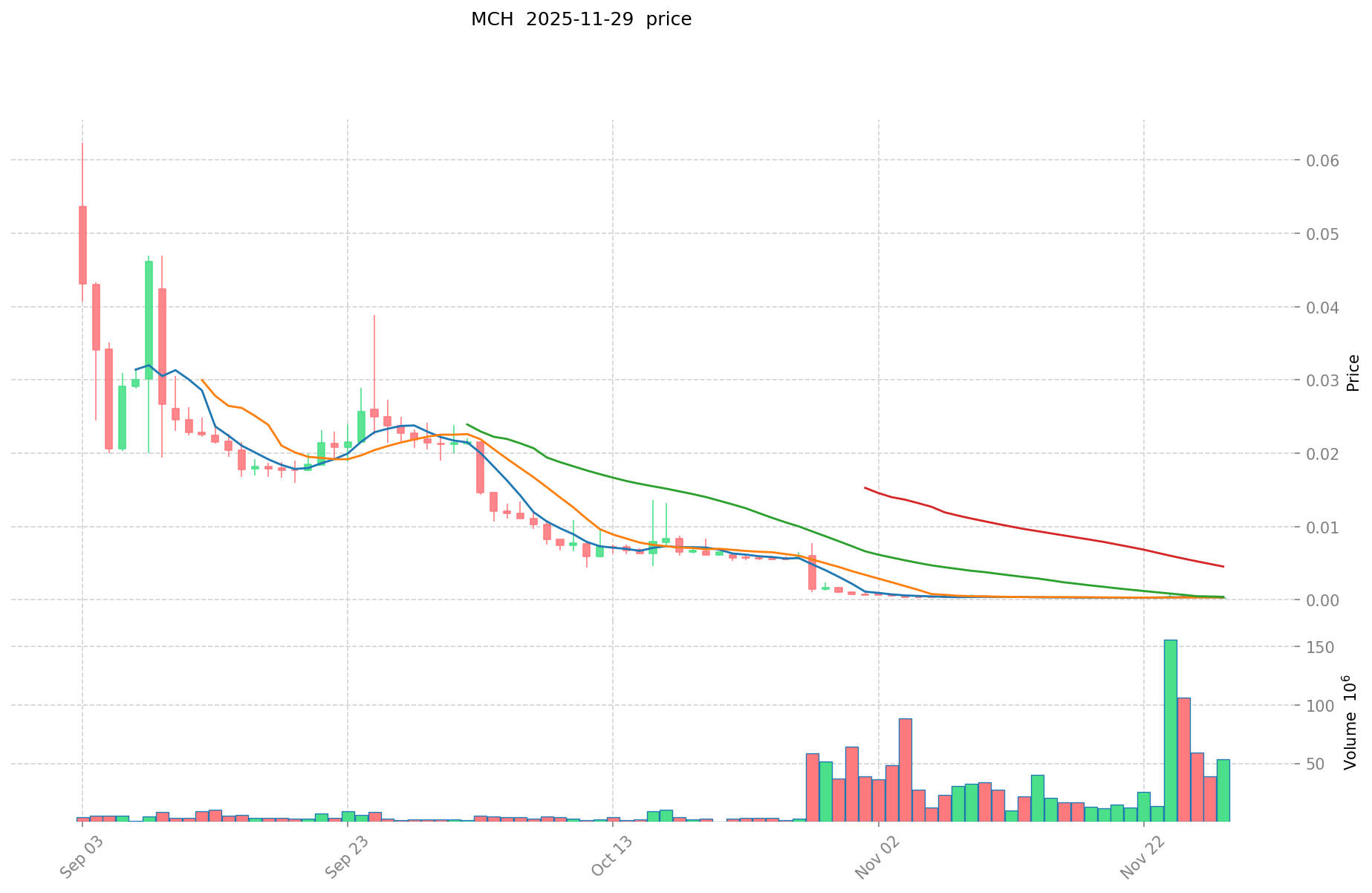
- 2025: MCH experienced a significant price drop, falling from its all-time high of $0.0624 on September 3 to its all-time low of $0.0002 on November 5.
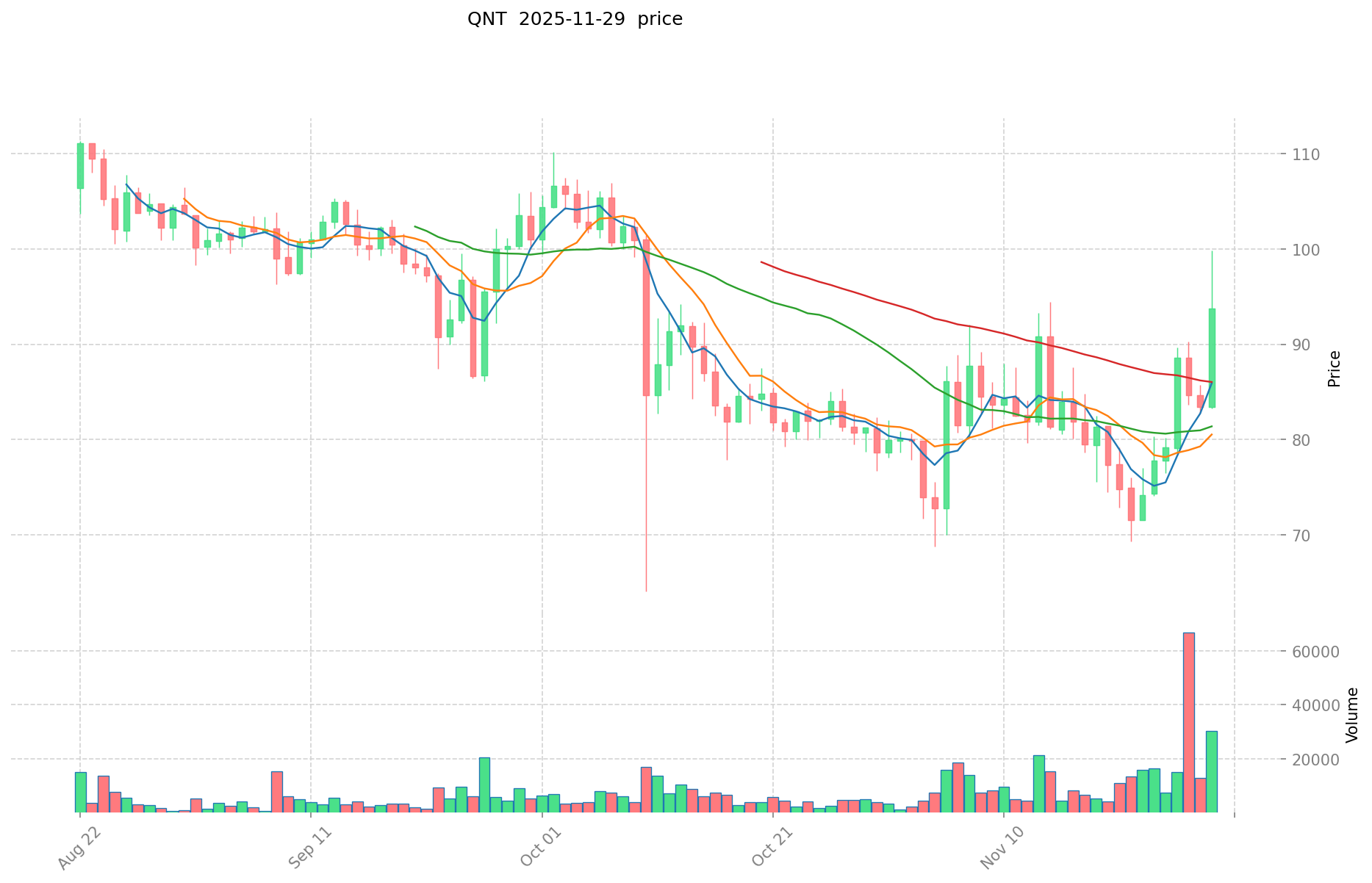
- 2021: QNT reached its all-time high of $427.42 on September 11, marking a major milestone for the project.
- Comparative analysis: In the recent market cycle, MCH has seen a dramatic decline of 99.79% over the past year, while QNT has shown more stability with a modest gain of 2.54% over the same period.
Current Market Situation (2025-11-30)
- MCH current price: $0.0003183
- QNT current price: $96.64
- 24-hour trading volume: MCH $27,232.54 vs QNT $3,154,542.48
- Market Sentiment Index (Fear & Greed Index): 28 (Fear)
Click to view real-time prices:
- View MCH current price Market Price
- View QNT current price Market Price
II. Core Factors Affecting MCH vs QNT Investment Value
Supply Mechanism Comparison (Tokenomics)
- MCH: Fixed supply of 100 million tokens with deflationary mechanism through token burning
- QNT: Fixed supply of 14.6 million tokens with no additional issuance
- 📌 Historical pattern: Limited supply cryptocurrencies tend to experience price appreciation during market expansion phases, with QNT's significantly smaller supply potentially creating stronger scarcity-driven value.
Institutional Adoption and Market Applications
- Institutional holdings: QNT appears to have greater institutional interest with partnerships including Oracle, SIA, and major financial networks
- Enterprise adoption: QNT has established itself in the enterprise blockchain space through Overledger Network and interoperability solutions, while MCH focuses on wealth management applications
- Regulatory attitudes: Both projects maintain regulatory compliance approaches, though QNT has more established partnerships with regulated financial institutions
Technical Development and Ecosystem Building
- QNT technical upgrades: Overledger Network enables cross-blockchain communication and interoperability between different distributed ledger technologies
- MCH technical development: Focuses on wealth management infrastructure with encryption and security features
- Ecosystem comparison: QNT has stronger enterprise blockchain applications, while MCH is building in the wealth management space
Macroeconomic and Market Cycles
- Inflation performance: Both have fixed supply models that theoretically provide inflation resistance
- Macroeconomic monetary policy: As utility tokens with enterprise adoption, both may show resilience during monetary tightening, though market correlation remains
- Geopolitical factors: QNT's focus on interoperability positions it well for cross-border transaction demand increases
III. Price Prediction for 2025-2030: MCH vs QNT
Short-term Prediction (2025)
- MCH: Conservative $0.000270436 - $0.0003298 | Optimistic $0.0003298 - $0.00037927
- QNT: Conservative $49.0059 - $96.09 | Optimistic $96.09 - $136.4478
Mid-term Prediction (2027)
- MCH may enter a growth phase, with projected prices of $0.00030844545 - $0.000477062296
- QNT may enter a consolidation phase, with projected prices of $93.66622584 - $133.10463672
- Key drivers: Institutional capital inflow, ETF, ecosystem development
Long-term Prediction (2030)
- MCH: Base scenario $0.000527530551789 - $0.000786020522166 | Optimistic scenario $0.000786020522166+
- QNT: Base scenario $87.71542317993312 - $151.233488241264 | Optimistic scenario $151.233488241264 - $167.86917194780304
View detailed price predictions for MCH and QNT
Disclaimer: This analysis is based on historical data and market projections. Cryptocurrency markets are highly volatile and unpredictable. This information should not be considered as financial advice. Always conduct your own research before making investment decisions.
MCH:
| 年份 |
预测最高价 |
预测平均价格 |
预测最低价 |
涨跌幅 |
| 2025 |
0.00037927 |
0.0003298 |
0.000270436 |
3 |
| 2026 |
0.0004679862 |
0.000354535 |
0.000212721 |
11 |
| 2027 |
0.000477062296 |
0.0004112606 |
0.00030844545 |
29 |
| 2028 |
0.00054187696656 |
0.000444161448 |
0.00023096395296 |
39 |
| 2029 |
0.000562041896299 |
0.00049301920728 |
0.000340183253023 |
54 |
| 2030 |
0.000786020522166 |
0.000527530551789 |
0.000395647913842 |
65 |
QNT:
| 年份 |
预测最高价 |
预测平均价格 |
预测最低价 |
涨跌幅 |
| 2025 |
136.4478 |
96.09 |
49.0059 |
0 |
| 2026 |
130.221168 |
116.2689 |
109.292766 |
20 |
| 2027 |
133.10463672 |
123.245034 |
93.66622584 |
27 |
| 2028 |
137.1470738352 |
128.17483536 |
111.5121067632 |
32 |
| 2029 |
169.806021884928 |
132.6609545976 |
67.657086844776 |
37 |
| 2030 |
167.86917194780304 |
151.233488241264 |
87.71542317993312 |
56 |
IV. Investment Strategy Comparison: MCH vs QNT
Long-term vs Short-term Investment Strategy
- MCH: Suitable for investors focusing on AI and ZK applications potential
- QNT: Suitable for investors seeking enterprise blockchain adoption and interoperability solutions
Risk Management and Asset Allocation
- Conservative investors: MCH: 20% vs QNT: 80%
- Aggressive investors: MCH: 40% vs QNT: 60%
- Hedging tools: Stablecoin allocation, options, cross-currency portfolio
V. Potential Risk Comparison
Market Risk
- MCH: High volatility, recent significant price decline
- QNT: Market cycle fluctuations, correlation with broader crypto market
Technical Risk
- MCH: Scalability, network stability
- QNT: Centralization concerns, potential security vulnerabilities
Regulatory Risk
- Global regulatory policies may have different impacts on both tokens
VI. Conclusion: Which Is the Better Buy?
📌 Investment Value Summary:
- MCH advantages: AI value layer positioning, potential for growth in ZK applications
- QNT advantages: Established enterprise partnerships, interoperability solutions, fixed supply
✅ Investment Advice:
- Novice investors: Consider a higher allocation to QNT due to its established market position
- Experienced investors: Balanced portfolio with both MCH and QNT, adjusting based on risk tolerance
- Institutional investors: Focus on QNT for its enterprise adoption and regulatory compliance
⚠️ Risk Warning: The cryptocurrency market is highly volatile. This article does not constitute investment advice.
None
VII. FAQ
Q1: What are the main differences between MCH and QNT?
A: MCH is positioned as an AI value layer for data and ZK applications, while QNT focuses on blockchain interoperability through its Overledger network. QNT has a more established market presence and institutional partnerships, whereas MCH is newer with potential in the AI and ZK space.
Q2: Which token has performed better in recent market conditions?
A: QNT has shown more stability, with a modest gain of 2.54% over the past year. In contrast, MCH has experienced a significant decline of 99.79% over the same period.
Q3: How do the supply mechanisms of MCH and QNT compare?
A: MCH has a fixed supply of 100 million tokens with a deflationary mechanism through token burning. QNT has a smaller fixed supply of 14.6 million tokens with no additional issuance, potentially creating stronger scarcity-driven value.
Q4: What are the key factors affecting the investment value of MCH and QNT?
A: Key factors include supply mechanisms, institutional adoption, technical development, ecosystem building, and macroeconomic conditions. QNT has stronger enterprise blockchain applications and institutional partnerships, while MCH is building in the wealth management and AI space.
Q5: What are the price predictions for MCH and QNT in 2030?
A: For MCH, the base scenario predicts $0.000527530551789 - $0.000786020522166, with an optimistic scenario above $0.000786020522166. For QNT, the base scenario predicts $87.71542317993312 - $151.233488241264, with an optimistic scenario of $151.233488241264 - $167.86917194780304.
Q6: How should investors allocate their portfolio between MCH and QNT?
A: Conservative investors might consider 20% MCH and 80% QNT, while aggressive investors might opt for 40% MCH and 60% QNT. The allocation should be based on individual risk tolerance and investment goals.
Q7: What are the main risks associated with investing in MCH and QNT?
A: Both face market risks and regulatory uncertainties. MCH has higher volatility and recent price declines, while QNT faces market cycle fluctuations. Technical risks include scalability for MCH and potential centralization concerns for QNT.
* The information is not intended to be and does not constitute financial advice or any other recommendation of any sort offered or endorsed by Gate.














