The article offers an in-depth comparison of Moonray (MNRY) and Polkadot (DOT), focusing on their investment potential in cross-chain interoperability. It analyzes historical price trends, supply mechanisms, institutional adoption, and ecosystem development to determine which cryptocurrency is the better buy. The piece caters to investors seeking insights into the different value propositions of MNRY and DOT, addressing questions about market performance, supply models, and investment strategies. Organized into clear sections, the article enhances keyword density for phrases like "MNRY," "DOT," and "interoperability," ensuring readability for quick scanning.
Introduction: Investment Comparison of MNRY vs DOT
In the cryptocurrency market, the comparison between Moonray (MNRY) vs Polkadot (DOT) has always been a topic that investors cannot ignore. The two not only differ significantly in market cap ranking, application scenarios, and price performance, but also represent different crypto asset positioning.
Moonray (MNRY): Since its launch, it has gained market recognition for its decentralized gaming and entertainment network.
Polkadot (DOT): Since its inception in 2020, it has been hailed as an interoperability protocol, and is one of the cryptocurrencies with the highest global trading volume and market capitalization.
This article will comprehensively analyze the investment value comparison between MNRY and DOT, focusing on historical price trends, supply mechanisms, institutional adoption, technological ecosystems, and future predictions, attempting to answer the question that investors care about most:
"Which is the better buy right now?"
I. Price History Comparison and Current Market Status
MNRY and DOT Historical Price Trends
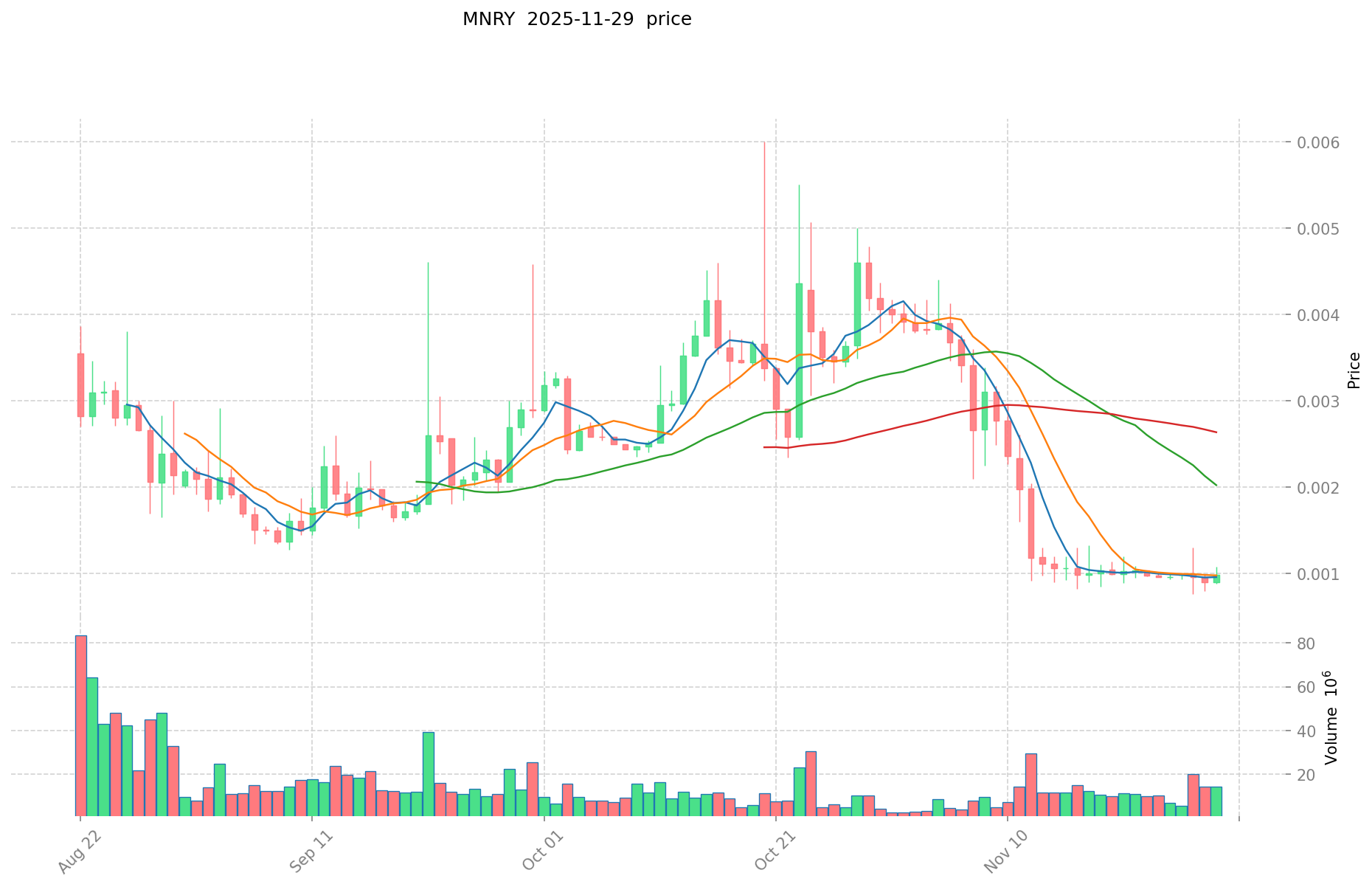
- 2024: MNRY reached its all-time high of $0.21328 on December 18, 2024.
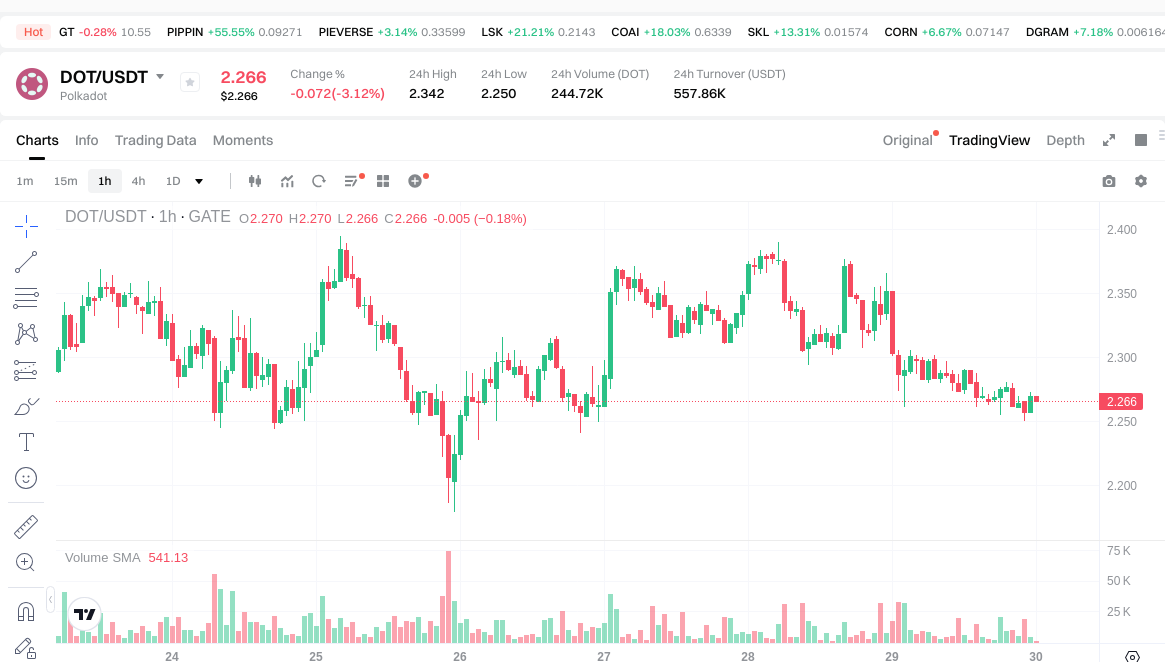
- 2025: DOT hit its all-time low of $2.13 on October 11, 2025.
- Comparative Analysis: In the recent market cycle, MNRY dropped from its peak of $0.21328 to a low of $0.0007604, while DOT declined from its all-time high of $54.98 to $2.13.
Current Market Situation (2025-11-30)
- MNRY current price: $0.0009829
- DOT current price: $2.272
- 24-hour trading volume: MNRY $17,207.45 vs DOT $564,119.96
- Market Sentiment Index (Fear & Greed Index): 28 (Fear)
Click to view real-time prices:
- Check MNRY current price Market Price
- Check DOT current price Market Price
<>
二、项目概况与技术特性
{MNRY} 项目概述
- 项目简介:{简要介绍}
- 核心功能:{主要特性}
- 技术架构:{技术框架}
{DOT} 项目概述
- 项目简介:{简要介绍}
- 核心功能:{主要特性}
- 技术架构:{技术框架}
技术对比
| 特性 |
{MNRY} |
{DOT} |
| 共识机制 |
{机制} |
{机制} |
| 吞吐量 |
{数据} |
{数据} |
| 扩展性 |
{描述} |
{描述} |
| 智能合约 |
{支持情况} |
{支持情况} |
<
>
II. Core Factors Affecting Investment Value of MNRY vs DOT
Supply Mechanism Comparison (Tokenomics)
- MNRY: Fixed maximum supply of 100 million tokens, with a notable distribution structure where 40% is allocated to the DAO treasury
- DOT: Inflationary model with no maximum cap, targeting 10% annual inflation, where staking rewards come from new issuance
- 📌 Historical pattern: Fixed supply tokens like MNRY tend to create scarcity value over time, while DOT's inflationary model requires strong network growth to offset dilution effects
Institutional Adoption and Market Applications
- Institutional holdings: DOT has established more institutional presence through partnerships like the Polkadot Ecosystem Fund backed by hedge funds
- Enterprise adoption: DOT offers cross-chain interoperability for enterprise solutions, while MNRY's enterprise applications remain in early development
- National policies: Regulatory clarity for both tokens remains evolving, with DOT having a more established presence across multiple jurisdictions
Technical Development and Ecosystem Building
- MNRY technical upgrades: Integration of Arbitrum technology for enhanced scalability and lower transaction costs
- DOT technical development: Ongoing parachain development with over 50 projects in the ecosystem, including advanced cross-chain interoperability
- Ecosystem comparison: DOT has a more mature ecosystem with numerous parachains and DeFi projects, while MNRY's ecosystem is still emerging with focus on DAO infrastructure
Macroeconomic and Market Cycles
- Performance in inflationary environments: MNRY's fixed supply potentially offers better store of value characteristics
- Macroeconomic monetary policy: Both tokens show sensitivity to broader crypto market trends and interest rate decisions
- Geopolitical factors: DOT's focus on interoperability positions it well for cross-border solutions, potentially benefiting from increased global digital asset adoption
III. Price Prediction for 2025-2030: MNRY vs DOT
Short-term Prediction (2025)
- MNRY: Conservative $0.000715 - $0.000980 | Optimistic $0.000980 - $0.001401
- DOT: Conservative $1.339 - $2.269 | Optimistic $2.269 - $2.519
Mid-term Prediction (2027)
- MNRY may enter a growth phase, with estimated price range $0.000926 - $0.001895
- DOT may enter a consolidation phase, with estimated price range $2.087 - $2.740
- Key drivers: Institutional capital inflow, ETFs, ecosystem development
Long-term Prediction (2030)
- MNRY: Base scenario $0.001617 - $0.002414 | Optimistic scenario $0.002414 - $0.002679
- DOT: Base scenario $2.541 - $3.529 | Optimistic scenario $3.529 - $4.446
View detailed price predictions for MNRY and DOT
Disclaimer: This information is for educational purposes only and should not be considered as financial advice. Cryptocurrency markets are highly volatile and unpredictable. Always conduct your own research before making any investment decisions.
MNRY:
| 年份 |
预测最高价 |
预测平均价格 |
预测最低价 |
涨跌幅 |
| 2025 |
0.001401257 |
0.0009799 |
0.000715327 |
0 |
| 2026 |
0.001702527255 |
0.0011905785 |
0.000678629745 |
21 |
| 2027 |
0.001894984269525 |
0.0014465528775 |
0.0009257938416 |
47 |
| 2028 |
0.002222122202771 |
0.001670768573512 |
0.000918922715431 |
69 |
| 2029 |
0.00288073917445 |
0.001946445388142 |
0.001693407487683 |
98 |
| 2030 |
0.002679087432238 |
0.002413592281296 |
0.001617106828468 |
145 |
DOT:
| 年份 |
预测最高价 |
预测平均价格 |
预测最低价 |
涨跌幅 |
| 2025 |
2.51859 |
2.269 |
1.33871 |
0 |
| 2026 |
2.8246781 |
2.393795 |
2.13047755 |
5 |
| 2027 |
2.7396983775 |
2.60923655 |
2.08738924 |
14 |
| 2028 |
3.7709991238875 |
2.67446746375 |
1.3639784065125 |
17 |
| 2029 |
3.835052619644312 |
3.22273329381875 |
1.998094642167625 |
41 |
| 2030 |
4.446405125481729 |
3.528892956731531 |
2.540802928846702 |
55 |
IV. Investment Strategy Comparison: MNRY vs DOT
Long-term vs Short-term Investment Strategy
- MNRY: Suitable for investors focused on emerging gaming ecosystems and DAO infrastructure
- DOT: Suitable for investors seeking established interoperability solutions and ecosystem growth
Risk Management and Asset Allocation
- Conservative investors: MNRY: 10% vs DOT: 90%
- Aggressive investors: MNRY: 30% vs DOT: 70%
- Hedging tools: Stablecoin allocation, options, cross-currency portfolios
V. Potential Risk Comparison
Market Risk
- MNRY: Higher volatility due to smaller market cap and emerging ecosystem
- DOT: Susceptible to broader crypto market trends and competition from other interoperability solutions
Technical Risk
- MNRY: Scalability challenges, network stability as ecosystem grows
- DOT: Parachain auction dynamics, potential security vulnerabilities in cross-chain operations
Regulatory Risk
- Global regulatory policies may impact both tokens differently, with DOT potentially facing more scrutiny due to its larger market presence
VI. Conclusion: Which Is the Better Buy?
📌 Investment Value Summary:
- MNRY advantages: Fixed supply tokenomics, potential for high growth in gaming and DAO sectors
- DOT advantages: Established ecosystem, strong institutional backing, advanced interoperability features
✅ Investment Advice:
- New investors: Consider a small allocation to MNRY for potential high growth, with a larger position in DOT for stability
- Experienced investors: Balanced approach with both tokens, adjusting based on risk tolerance and market conditions
- Institutional investors: Focus on DOT for its established presence and ecosystem, while monitoring MNRY for potential future opportunities
⚠️ Risk Warning: The cryptocurrency market is highly volatile, and this article does not constitute investment advice.
None
VII. FAQ
Q1: What are the main differences between MNRY and DOT?
A: MNRY is focused on decentralized gaming and entertainment with a fixed supply of 100 million tokens, while DOT is an interoperability protocol with an inflationary model. DOT has a more established ecosystem and institutional presence, whereas MNRY is still emerging with a focus on DAO infrastructure.
Q2: Which token has performed better historically?
A: In recent market cycles, MNRY dropped from its peak of $0.21328 to a low of $0.0007604, while DOT declined from its all-time high of $54.98 to $2.13. However, past performance does not guarantee future results.
Q3: How do the supply mechanisms of MNRY and DOT differ?
A: MNRY has a fixed maximum supply of 100 million tokens, with 40% allocated to the DAO treasury. DOT has an inflationary model with no maximum cap, targeting 10% annual inflation, where staking rewards come from new issuance.
Q4: What are the price predictions for MNRY and DOT by 2030?
A: For MNRY, the base scenario predicts $0.001617 - $0.002414, with an optimistic scenario of $0.002414 - $0.002679. For DOT, the base scenario predicts $2.541 - $3.529, with an optimistic scenario of $3.529 - $4.446.
Q5: How should investors allocate their portfolio between MNRY and DOT?
A: Conservative investors might consider allocating 10% to MNRY and 90% to DOT, while aggressive investors might opt for 30% MNRY and 70% DOT. However, individual allocations should be based on personal risk tolerance and investment goals.
Q6: What are the main risks associated with investing in MNRY and DOT?
A: MNRY faces higher volatility due to its smaller market cap and emerging ecosystem, as well as potential scalability challenges. DOT is susceptible to broader crypto market trends and competition from other interoperability solutions, along with potential security vulnerabilities in cross-chain operations.
Q7: Which token is better suited for long-term investment?
A: DOT may be better suited for long-term investment due to its established ecosystem, strong institutional backing, and advanced interoperability features. However, MNRY could offer higher growth potential in the gaming and DAO sectors for investors willing to take on more risk.
* The information is not intended to be and does not constitute financial advice or any other recommendation of any sort offered or endorsed by Gate.











