# Article Overview: MTR vs GRT Comprehensive Comparison
This article provides investors with an in-depth comparison between MeterStable (MTR) and The Graph (GRT), analyzing their market positioning, price performance, and investment potential. It addresses critical questions about tokenomics, ecosystem development, and which token offers better value. The guide examines historical price trends, current market status as of January 2026, and forecasts through 2031, helping both beginner and experienced investors make informed decisions. Covering risk assessment, liquidity analysis, and tailored investment strategies across conservative to aggressive portfolios, this resource compares two distinct blockchain infrastructure tokens—MTR for transaction optimization and GRT for decentralized data indexing. Ideal for crypto investors seeking structured analysis of mid-cap tokens on Gate, this guide delivers actionable insights with transparent risk disclaimers.
Introduction: MTR vs GRT Investment Comparison
In the cryptocurrency market, comparisons between MTR and GRT have always been a topic that investors cannot avoid. The two not only have significant differences in market cap ranking, application scenarios, and price performance, but also represent different positioning in the crypto asset landscape.
MTR (MeterStable): Generated through SHA256 mining within the Meter system, MTR serves as a low-volatility token that powers transaction fees and gas payments, while offering the potential to be exchanged for MTRG, the governance token, through on-chain bidding.
GRT (The Graph): Since its launch in December 2020, GRT has been recognized as a decentralized protocol for indexing and querying blockchain data on Ethereum. The token functions as both an incentive mechanism for indexers and curators, and a settlement unit across the entire protocol ecosystem.
This article will provide a comprehensive analysis of the investment value comparison between MTR and GRT from multiple perspectives including historical price trends, supply mechanisms, token distribution, technical ecosystems, and market performance, while attempting to answer the question that investors care about most:
"Which is the better buy right now?"
I. Price History Comparison and Current Market Status
MeterStable (MTR) and The Graph (GRT) Historical Price Trends
- 2021: MeterStable (MTR) reached its all-time high of $32.69 on April 11, 2021.
- 2021: The Graph (GRT) reached its all-time high of $2.84 on February 12, 2021.
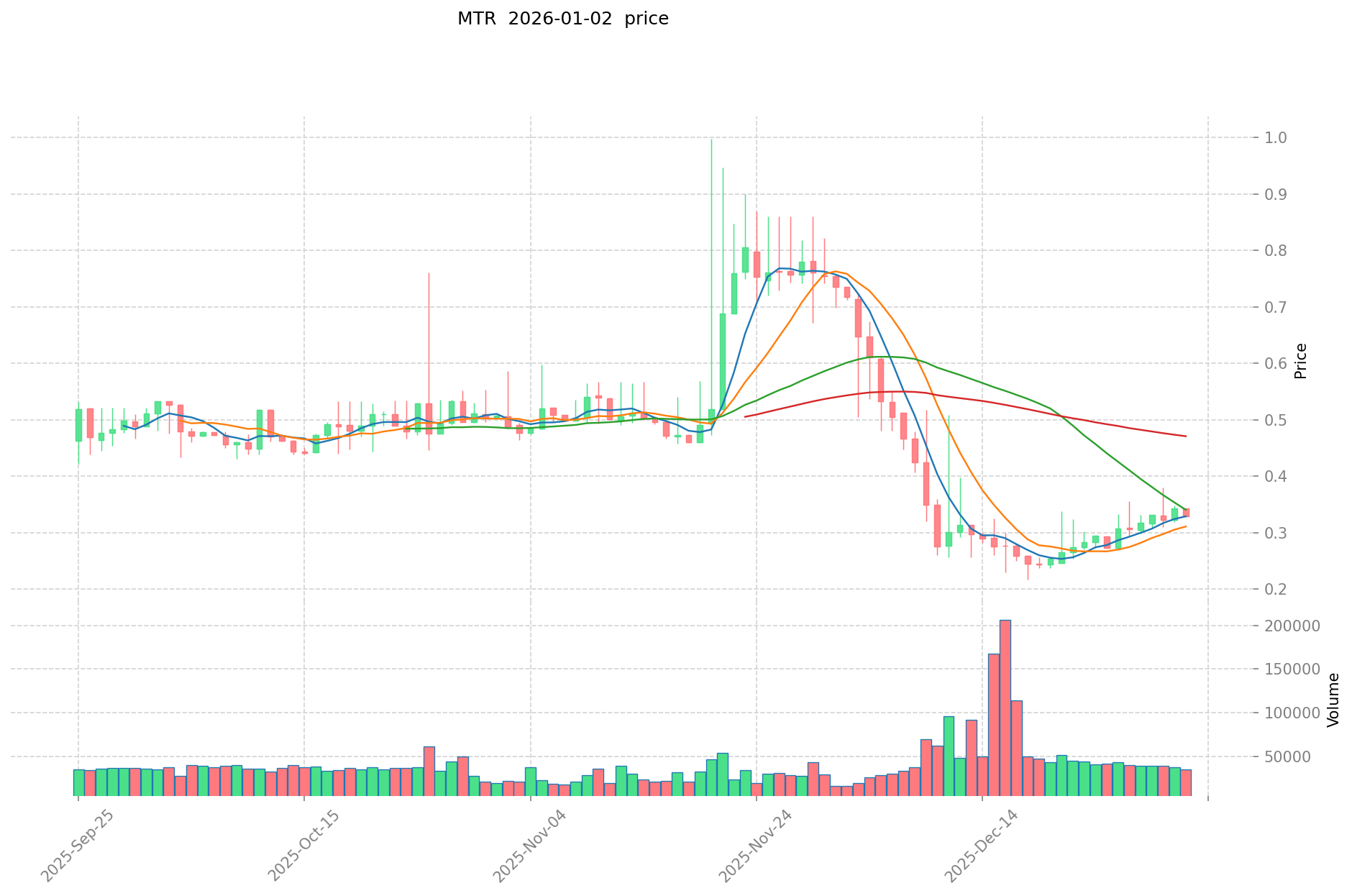
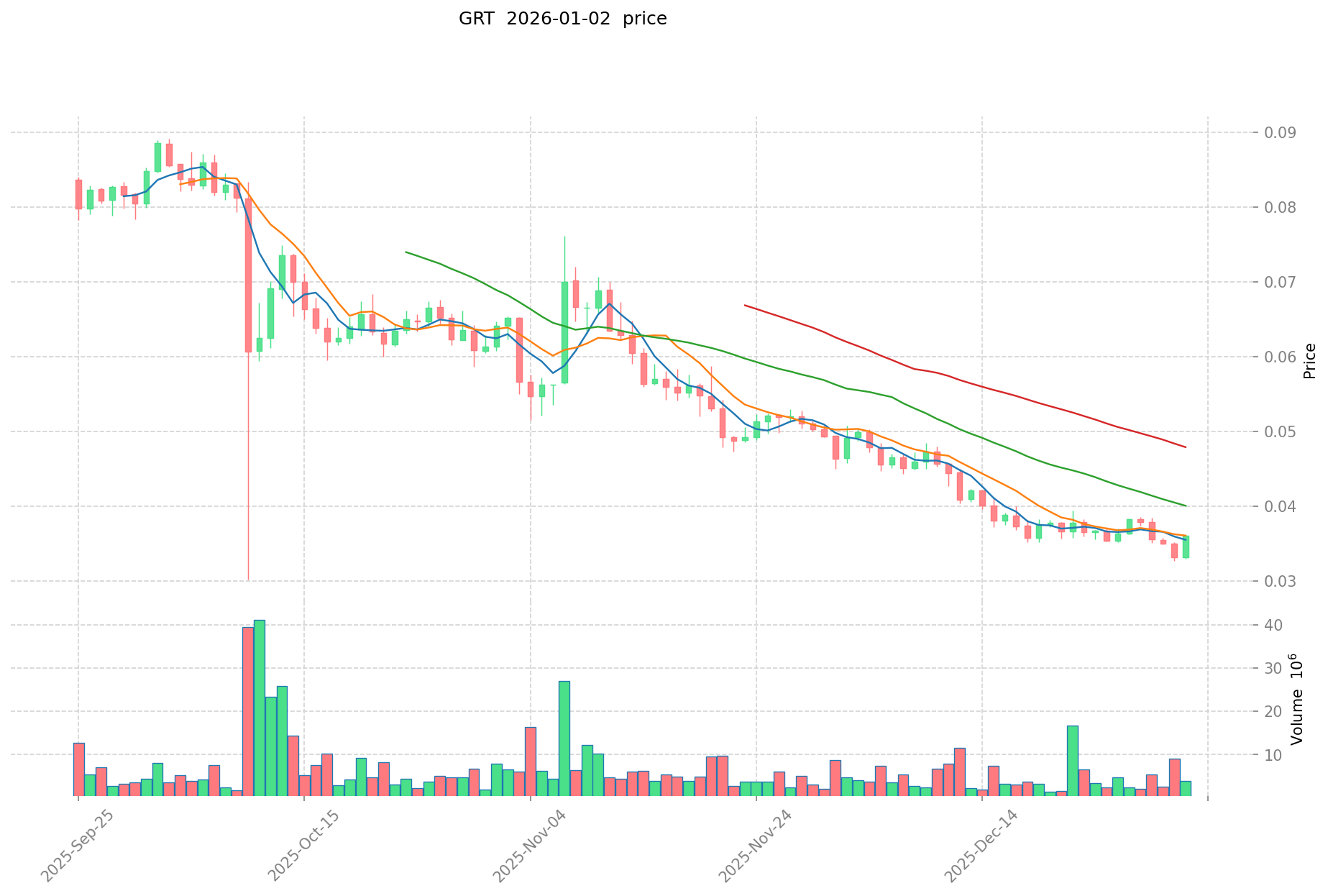
- Comparison Analysis: In the current market cycle, MTR has declined from its historical peak of $32.69 to the current level of $0.3292, representing a decline of approximately 99%. GRT has similarly declined from its peak of $2.84 to the current level of $0.0362, representing a decline of approximately 99%.
Current Market Status (02 January 2026)
- MeterStable (MTR) current price: $0.3292
- The Graph (GRT) current price: $0.0362
- 24-hour trading volume: MTR $11,818.98 vs GRT $178,370.07
- Market Sentiment Index (Fear & Greed Index): 28 (Fear)
View real-time prices:
二、影响 MTR vs GRT 投资价值的核心因素
供应机制对比(Tokenomics)
参考资料中未提供 MTR 和 GRT 的具体供应机制、通缩模型或减半机制等信息,该段落无法填充。
机构采用与市场应用
参考资料中未提供 MTR 和 GRT 的机构持仓数据、企业采用情况或国家政策监管态度等信息,该段落无法填充。
技术发展与生态建设
参考资料中未提供 MTR 和 GRT 的技术升级、技术发展路线或生态建设情况等信息,该段落无法填充。
宏观经济与市场周期
参考资料中未提供 MTR 和 GRT 在通胀环境下的表现、与货币政策的关联性或地缘政治因素影响等信息,该段落无法填充。
III. 2026-2031 Price Forecast: MTR vs GRT
Short-term Forecast (2026)
- MTR: Conservative $0.310012-$0.3298 | Bullish $0.3298-$0.44523
- GRT: Conservative $0.0328601-$0.03611 | Bullish $0.03611-$0.0444153
Medium-term Forecast (2028-2029)
- MTR may enter growth consolidation phase, estimated price range $0.2661065505-$0.6973047601475
- GRT may enter steady accumulation phase, estimated price range $0.02739361996845-$0.0547872399369
- Key drivers: institutional capital inflows, ETF adoption, ecosystem development
Long-term Forecast (2030-2031)
- MTR: Base case $0.398074491176175-$0.621237463502212 | Bullish case $0.526483671738913-$0.795847410768125
- GRT: Base case $0.030072107254254-$0.070168250259926 | Bullish case $0.032575478287963-$0.070068009902411
View detailed price predictions for MTR and GRT
MTR:
| 年份 |
预测最高价 |
预测平均价格 |
预测最低价 |
涨跌幅 |
| 2026 |
0.44523 |
0.3298 |
0.310012 |
0 |
| 2027 |
0.4572677 |
0.387515 |
0.310012 |
17 |
| 2028 |
0.5955718035 |
0.42239135 |
0.2661065505 |
28 |
| 2029 |
0.6973047601475 |
0.50898157675 |
0.2799398672125 |
54 |
| 2030 |
0.621237463502212 |
0.60314316844875 |
0.398074491176175 |
83 |
| 2031 |
0.795847410768125 |
0.612190315975481 |
0.526483671738913 |
85 |
GRT:
| 年份 |
预测最高价 |
预测平均价格 |
预测最低价 |
涨跌幅 |
| 2026 |
0.0444153 |
0.03611 |
0.0328601 |
0 |
| 2027 |
0.050730939 |
0.04026265 |
0.0285864815 |
11 |
| 2028 |
0.055961057235 |
0.0454967945 |
0.03730737149 |
25 |
| 2029 |
0.0547872399369 |
0.0507289258675 |
0.02739361996845 |
40 |
| 2030 |
0.070168250259926 |
0.0527580829022 |
0.030072107254254 |
45 |
| 2031 |
0.070068009902411 |
0.061463166581063 |
0.032575478287963 |
69 |
IV. Investment Strategy Comparison: MTR vs GRT
Long-term vs Short-term Investment Strategy
- MTR: Suitable for investors focusing on payment scenarios and transaction fee optimization within the Meter ecosystem, seeking medium-term appreciation potential through the 2028-2029 consolidation phase
- GRT: Suitable for investors seeking stable accumulation opportunities in decentralized data indexing infrastructure with long-term protocol ecosystem development potential through 2030-2031
Risk Management and Asset Allocation
- Conservative investors: MTR 40% vs GRT 60%
- Aggressive investors: MTR 65% vs GRT 35%
- Hedging tools: Stablecoin allocation, options strategies, cross-asset diversification with major cryptocurrencies
V. Potential Risk Comparison
Market Risk
- MTR: Extreme volatility with 99% decline from historical peak; limited 24-hour trading volume ($11,818.98) indicates low liquidity and potential difficulty exiting positions
- GRT: Similar 99% decline from peak; higher trading volume ($178,370.07) provides better exit liquidity but still subject to market cycle risks
Technical Risk
- MTR: Dependency on SHA256 mining infrastructure within Meter system; MTRG governance token exchange mechanism requires on-chain bidding which may experience network congestion
- GRT: Indexer and curator incentive mechanisms subject to protocol changes; potential inefficiencies in data query accuracy and network participation distribution
Regulatory Risk
- Global regulatory policies may impact both tokens differently; decentralized finance protocols like GRT face scrutiny regarding data handling and oracle manipulation; payment-focused tokens like MTR may encounter stricter financial regulation in certain jurisdictions
VI. Conclusion: Which Is the Better Buy?
📌 Investment Value Summary:
- MTR Advantages: Low-volatility transaction fee mechanism; governance token exchange opportunity; higher price per unit may appeal to certain investor psychology
- GRT Advantages: Higher trading liquidity for portfolio adjustment; decentralized indexing infrastructure addresses core blockchain need; established protocol since December 2020 with ecosystem integration
✅ Investment Recommendations:
- Beginning investors: Prioritize GRT due to higher trading volume and established protocol maturity; consider starting with small positions during 2026 conservative price range ($0.0328601-$0.03611)
- Experienced investors: Evaluate MTR's ecosystem development and MTRG exchange mechanism; consider tactical allocations based on medium-term forecast consolidation phases (2028-2029) with risk management protocols
- Institutional investors: Monitor both tokens' liquidity improvements and ecosystem adoption metrics; potential allocation decisions should align with broader infrastructure and data indexing exposure strategies
⚠️ Risk Disclaimer: Cryptocurrency markets demonstrate extreme volatility; both MTR and GRT have experienced 99% declines from historical peaks. This analysis does not constitute investment advice. All investment decisions should be made after thorough due diligence and consultation with qualified financial advisors.
FAQ
MTR(Meter)和GRT(The Graph)分别是什么项目?各自的核心功能是什么?
MTR(Meter)是去中心化交易所项目,提供链上交易功能。GRT(The Graph)是区块链数据索引项目,核心功能是为区块链提供高效的数据查询和索引服务。
MTR和GRT在技术架构上有什么主要区别?
MTR(Metaverse Token Reserve)主要采用跨链互操作架构,支持多链资产交互;GRT(Graph Token)基于去中心化索引协议,专注数据查询和验证。两者在共识机制和应用场景上差异明显。
MTR和GRT的应用场景分别是什么?它们解决了什么问题?
MTR用于网络路径分析,检测丢包和延迟问题。GRT主要用于网络流量监控和性能优化。两者都致力于解决网络连接故障和性能瓶颈,帮助用户快速诊断和优化网络质量。
从投资角度看,MTR和GRT的优势和风险分别是什么?
MTR具有低波动性优势,价格相对稳定,但面临加密市场波动风险。GRT拥有强大社区支持和网络效应,但同样受加密市场波动影响,两者都需关注市场流动性与政策风险。
MTR和GRT的生态发展现状如何?哪个项目的生态更成熟?
GRT生态更为成熟,拥有更完善的开发者社区和应用场景覆盖。MTR生态也在稳步发展,但整体生态规模和应用丰富度仍落后于GRT。
MTR和GRT的代币经济模型有什么不同?
MTR主要用于市场流动性和交易激励,而GRT是The Graph网络的效用代币,用于激励和协调数据提供者。两者的核心用途和激励机制存在本质区别。
如何选择投资MTR还是GRT?两者的未来前景对比如何?
MTR用于元宇宙生态,GRT支撑The Graph协议。两者应用场景不同,MTR前景取决于元宇宙发展,GRT则依赖区块链数据查询需求。建议根据对各自生态发展的判断进行选择。
* The information is not intended to be and does not constitute financial advice or any other recommendation of any sort offered or endorsed by Gate.