This article provides a comprehensive comparison of MTR and NEAR, focusing on their historical price trends, supply mechanisms, institutional adoption, technical development, and market cycles. It addresses the decision-making needs of investors by evaluating which asset might be a better buy based on these factors. Structured into sections, the article first reviews price history, then analyzes core investment factors, followed by price predictions. Keywords include urban transportation systems, cryptocurrency, investment, scalability, and market analysis. Ideal for both novice and experienced investors seeking insights into MTR and NEAR.
Introduction: MTR vs NEAR Investment Comparison
In the cryptocurrency market, MTR vs NEAR comparison has always been a topic that investors can't avoid. The two not only have significant differences in market cap ranking, application scenarios, and price performance, but also represent different positioning of crypto assets.
MTR (MTR): Since its launch, it has gained market recognition for its low volatility and unique mining mechanism using SHA256.
NEAR (NEAR): Since its inception, it has been hailed as a highly scalable base protocol, ensuring fast support for DApp operations on mobile devices.
This article will comprehensively analyze the investment value comparison between MTR and NEAR, focusing on historical price trends, supply mechanisms, institutional adoption, technical ecosystems, and future predictions, and attempt to answer the question that investors care about most:
"Which is the better buy right now?"
I. Price History Comparison and Current Market Status
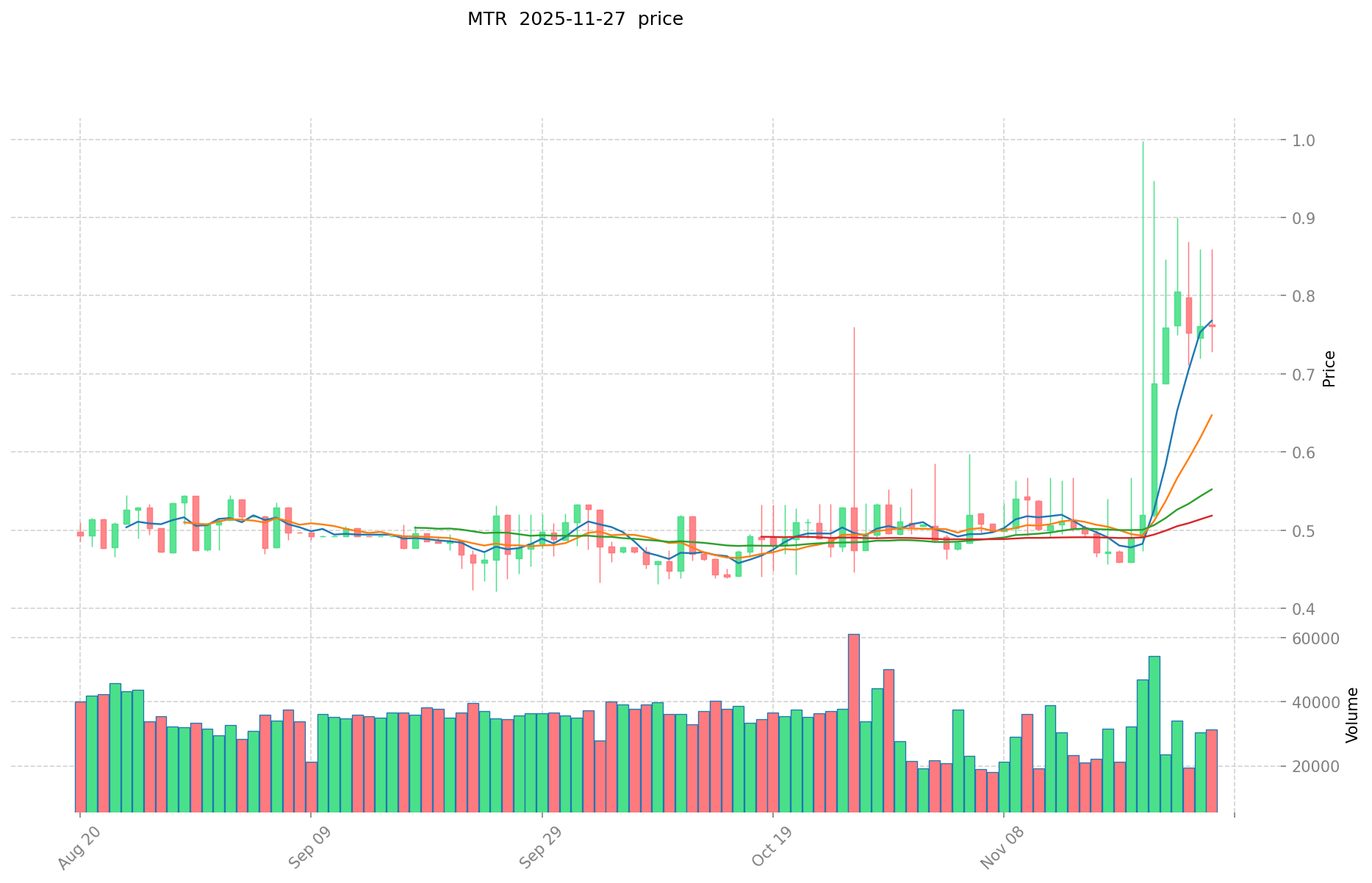
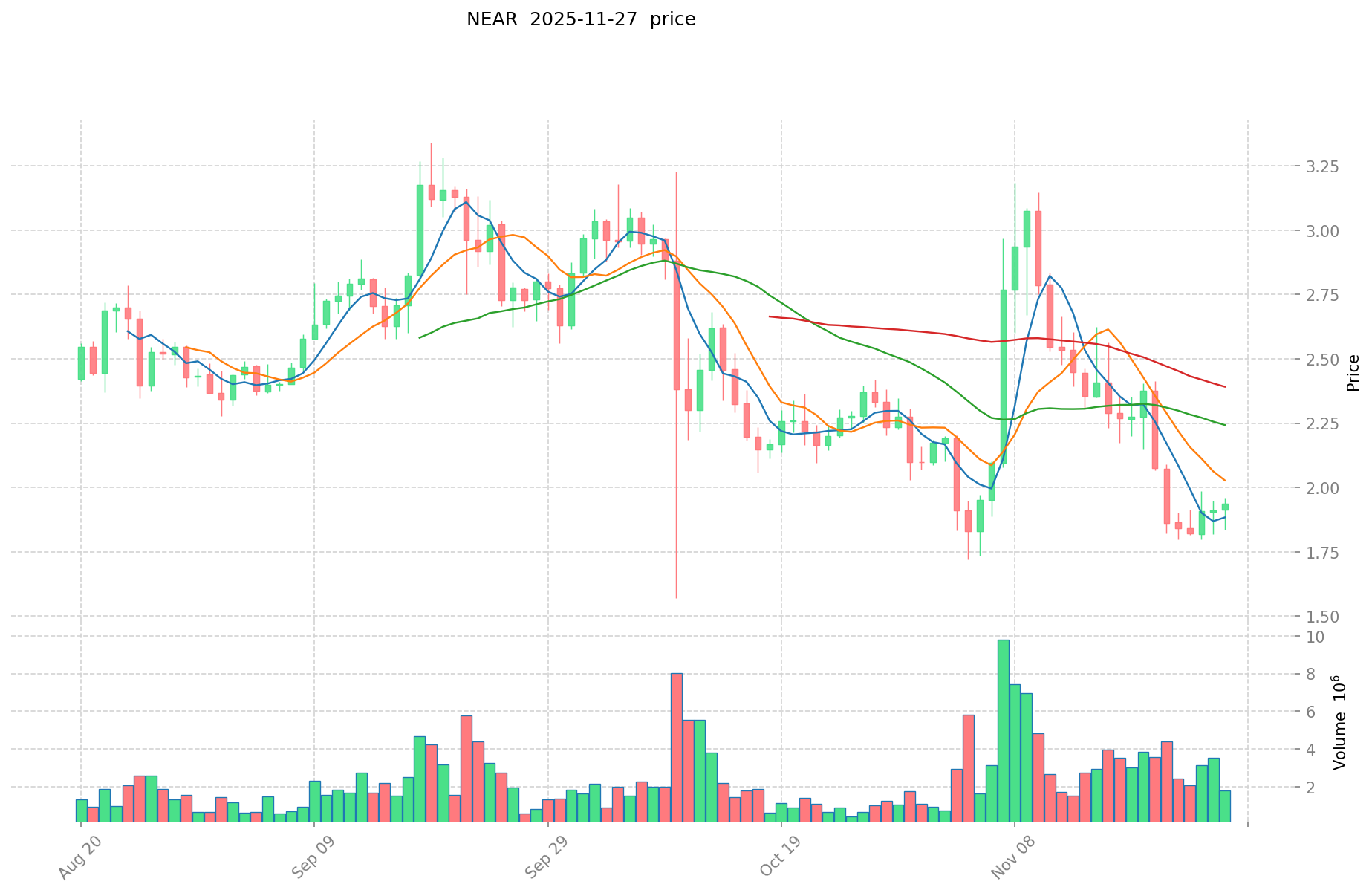
MTR and NEAR Historical Price Trends
- 2021: NEAR reached its all-time high of $20.44 on January 17, 2022, likely due to increased adoption and market optimism.
- 2020: MTR recorded its all-time low of $0.181504 on February 3, 2025, possibly due to market-wide corrections or project-specific challenges.
- Comparative Analysis: During their respective market cycles, MTR has shown significant volatility, ranging from a high of $32.69 to a low of $0.181504, while NEAR has experienced a broader range, from a high of $20.44 to a low of $0.526762.
Current Market Situation (2025-11-28)
- MTR current price: $0.7612
- NEAR current price: $1.941
- 24-hour trading volume: MTR $23,527.68 vs NEAR $1,845,592.14
- Market Sentiment Index (Fear & Greed Index): 22 (Extreme Fear)
Click to view real-time prices:
- Check MTR current price Market Price
- Check NEAR current price Market Price
II. Core Factors Affecting MTR vs NEAR Investment Value
Supply Mechanisms Comparison (Tokenomics)
- MTR: Fully diluted supply of 100 million tokens with a 3% annual inflation rate. Supply is distributed to validators as rewards.
- NEAR: Maximum supply of 1 billion tokens with an emission mechanism that started at 5% annual inflation, decreasing over time.
- 📌 Historical Pattern: Fixed supply models with controlled inflation tend to create price stability in the long term while supporting network security.
Institutional Adoption and Market Applications
- Institutional Holdings: NEAR has attracted more institutional interest with backing from major investors like a16z, Coinbase Ventures, and Dragonfly Capital.
- Enterprise Adoption: NEAR has more developed enterprise partnerships across gaming, DeFi, and NFT sectors, while MTR is still building its enterprise ecosystem.
- Regulatory Attitudes: Both projects operate in a relatively similar regulatory environment as L1 smart contract platforms.
Technical Development and Ecosystem Building
- MTR Technical Upgrades: Implements a dual-token model with MTR and MTRG, hybrid consensus mechanism combining PoW, PoS, and HotStuff BFT for scalability.
- NEAR Technical Development: Features sharding technology (Nightshade), Aurora EVM compatibility, and fast finality with transactions processing in 1-2 seconds.
- Ecosystem Comparison: NEAR has a more mature ecosystem with established DeFi protocols (Ref Finance, Burrow), NFT marketplaces (Paras, Mintbase), and gaming applications. MTR's ecosystem is still developing with fewer established dApps.
Macroeconomic Environment and Market Cycles
- Performance During Inflation: Both assets are affected by inflationary environments, with neither showing significant inflation-hedge properties.
- Macroeconomic Monetary Policy: Interest rates and USD strength typically affect both assets similarly to the broader crypto market.
- Geopolitical Factors: Both protocols offer censorship-resistant properties that may appeal during times of geopolitical uncertainty.
III. 2025-2030 Price Prediction: MTR vs NEAR
Short-term Prediction (2025)
- MTR: Conservative $0.46 - $0.76 | Optimistic $0.76 - $1.07
- NEAR: Conservative $1.06 - $1.94 | Optimistic $1.94 - $2.07
Mid-term Prediction (2027)
- MTR may enter a growth phase, with an estimated price range of $0.48 - $1.14
- NEAR may enter a consolidation phase, with an estimated price range of $2.17 - $2.97
- Key drivers: Institutional capital inflow, ETF, ecosystem development
Long-term Prediction (2030)
- MTR: Base scenario $0.78 - $1.45 | Optimistic scenario $1.45 - $1.53
- NEAR: Base scenario $2.89 - $3.11 | Optimistic scenario $3.11 - $3.82
View detailed price predictions for MTR and NEAR
Disclaimer: This analysis is based on historical data and current market trends. Cryptocurrency markets are highly volatile and unpredictable. This information should not be considered as financial advice. Always conduct your own research before making investment decisions.
MTR:
| 年份 |
预测最高价 |
预测平均价格 |
预测最低价 |
涨跌幅 |
| 2025 |
1.06554 |
0.7611 |
0.464271 |
0 |
| 2026 |
0.9681192 |
0.91332 |
0.7671888 |
19 |
| 2027 |
1.138270716 |
0.9407196 |
0.479766996 |
23 |
| 2028 |
1.48647807594 |
1.039495158 |
0.6756718527 |
36 |
| 2029 |
1.641882602061 |
1.26298661697 |
0.7072725055032 |
65 |
| 2030 |
1.525056339991275 |
1.4524346095155 |
0.78431468913837 |
90 |
NEAR:
| 年份 |
预测最高价 |
预测平均价格 |
预测最低价 |
涨跌幅 |
| 2025 |
2.07152 |
1.936 |
1.0648 |
0 |
| 2026 |
2.8653768 |
2.00376 |
1.5228576 |
3 |
| 2027 |
2.970173448 |
2.4345684 |
2.166765876 |
25 |
| 2028 |
3.1077265626 |
2.702370924 |
1.56737513592 |
39 |
| 2029 |
3.311755567362 |
2.9050487433 |
2.730745818702 |
49 |
| 2030 |
3.82333465105713 |
3.108402155331 |
2.89081400445783 |
60 |
IV. Investment Strategy Comparison: MTR vs NEAR
Long-term vs Short-term Investment Strategy
- MTR: Suitable for investors focusing on payment scenarios and low volatility
- NEAR: Suitable for investors interested in ecosystem potential and DApp development
Risk Management and Asset Allocation
- Conservative investors: MTR: 60% vs NEAR: 40%
- Aggressive investors: MTR: 40% vs NEAR: 60%
- Hedging tools: Stablecoin allocation, options, cross-currency combinations
V. Potential Risk Comparison
Market Risk
- MTR: Lower trading volume may lead to higher volatility
- NEAR: Higher correlation with overall crypto market trends
Technical Risk
- MTR: Scalability, network stability
- NEAR: Sharding implementation, smart contract vulnerabilities
Regulatory Risk
- Global regulatory policies may impact both, with NEAR potentially facing more scrutiny due to its broader ecosystem
VI. Conclusion: Which Is the Better Buy?
📌 Investment Value Summary:
- MTR advantages: Low volatility, unique mining mechanism
- NEAR advantages: Established ecosystem, institutional backing, scalability
✅ Investment Advice:
- Novice investors: Consider a balanced allocation with a slight preference for NEAR due to its more established ecosystem
- Experienced investors: Explore opportunities in both, with emphasis on NEAR's DeFi and NFT sectors
- Institutional investors: NEAR may offer more comprehensive exposure to the blockchain ecosystem
⚠️ Risk Warning: The cryptocurrency market is highly volatile. This article does not constitute investment advice.
None
VII. FAQ
Q1: What are the main differences between MTR and NEAR?
A: MTR is known for its low volatility and unique mining mechanism using SHA256, while NEAR is recognized as a highly scalable base protocol supporting fast DApp operations on mobile devices. NEAR has a more developed ecosystem with established DeFi protocols, NFT marketplaces, and gaming applications, whereas MTR's ecosystem is still developing.
Q2: Which coin has performed better historically?
A: NEAR has shown a broader price range, reaching an all-time high of $20.44 in January 2022. MTR, on the other hand, has experienced significant volatility, with an all-time low of $0.181504 in February 2025. Overall, NEAR has demonstrated stronger historical performance.
Q3: How do their supply mechanisms differ?
A: MTR has a fully diluted supply of 100 million tokens with a 3% annual inflation rate, distributed to validators as rewards. NEAR has a maximum supply of 1 billion tokens, with an emission mechanism that started at 5% annual inflation and decreases over time.
Q4: Which coin has attracted more institutional interest?
A: NEAR has attracted more institutional interest, with backing from major investors like a16z, Coinbase Ventures, and Dragonfly Capital. It also has more developed enterprise partnerships across gaming, DeFi, and NFT sectors.
Q5: What are the key technical features of each coin?
A: MTR implements a dual-token model with MTR and MTRG, and uses a hybrid consensus mechanism combining PoW, PoS, and HotStuff BFT for scalability. NEAR features sharding technology (Nightshade), Aurora EVM compatibility, and fast finality with transactions processing in 1-2 seconds.
Q6: What are the price predictions for MTR and NEAR in 2030?
A: For MTR, the base scenario predicts a range of $0.78 - $1.45, with an optimistic scenario of $1.45 - $1.53. For NEAR, the base scenario predicts a range of $2.89 - $3.11, with an optimistic scenario of $3.11 - $3.82.
Q7: Which coin is considered a better investment for different types of investors?
A: For novice investors, a balanced allocation with a slight preference for NEAR is suggested due to its more established ecosystem. Experienced investors might explore opportunities in both, with emphasis on NEAR's DeFi and NFT sectors. Institutional investors may find NEAR offers more comprehensive exposure to the blockchain ecosystem.
* The information is not intended to be and does not constitute financial advice or any other recommendation of any sort offered or endorsed by Gate.












