# NBOT vs SNX: A Comprehensive Comparison of Governance Tokens in the DeFi Ecosystem
This article provides an in-depth investment comparison between NBOT and SNX, two distinct governance tokens operating in different DeFi segments. NBOT, launched on the Naka chain in 2019, focuses on synthetic asset trading, while SNX leads the decentralized derivatives market with established institutional recognition. The analysis examines critical factors including historical price performance, tokenomics, trading volume, technological ecosystems, and market positioning to answer investors' core question: which token offers superior investment value. Through detailed price trend analysis on Gate, risk assessment across market, technology, and regulatory dimensions, and tailored investment recommendations for beginner, experienced, and institutional investors, this guide enables readers to make informed allocation decisions aligned with their risk tolerance and investment horizon through 2031.
Introduction: NBOT vs SNX Investment Comparison
In the cryptocurrency market, comparisons between NBOT and SNX have always been a topic investors cannot avoid. The two differ significantly in market capitalization ranking, application scenarios, and price performance, representing different positioning within the crypto asset landscape.
NBOT (NBOT): Launched in January 2019 by the Bodhi team on the Naka chain, it has gained market recognition through its DeFi ecosystem and synthetic asset trading platform offerings, enabling users to trade financial derivatives with coin-denominated pricing and participate in liquidity pools.
SNX (SNX): Since its inception in 2018, Synthetix has been recognized for its decentralized synthetic asset platform, supporting a diverse range of assets including fiat currencies, precious metals, indices, and other cryptocurrencies. It ranks among the most traded and highest market cap crypto assets.
This article will provide a comprehensive analysis of NBOT vs SNX investment value comparison across historical price trends, supply mechanisms, market positioning, and technological ecosystems, addressing the key question investors care most about:
"Which is the better buy right now?"
I. Price History Comparison and Current Market Status
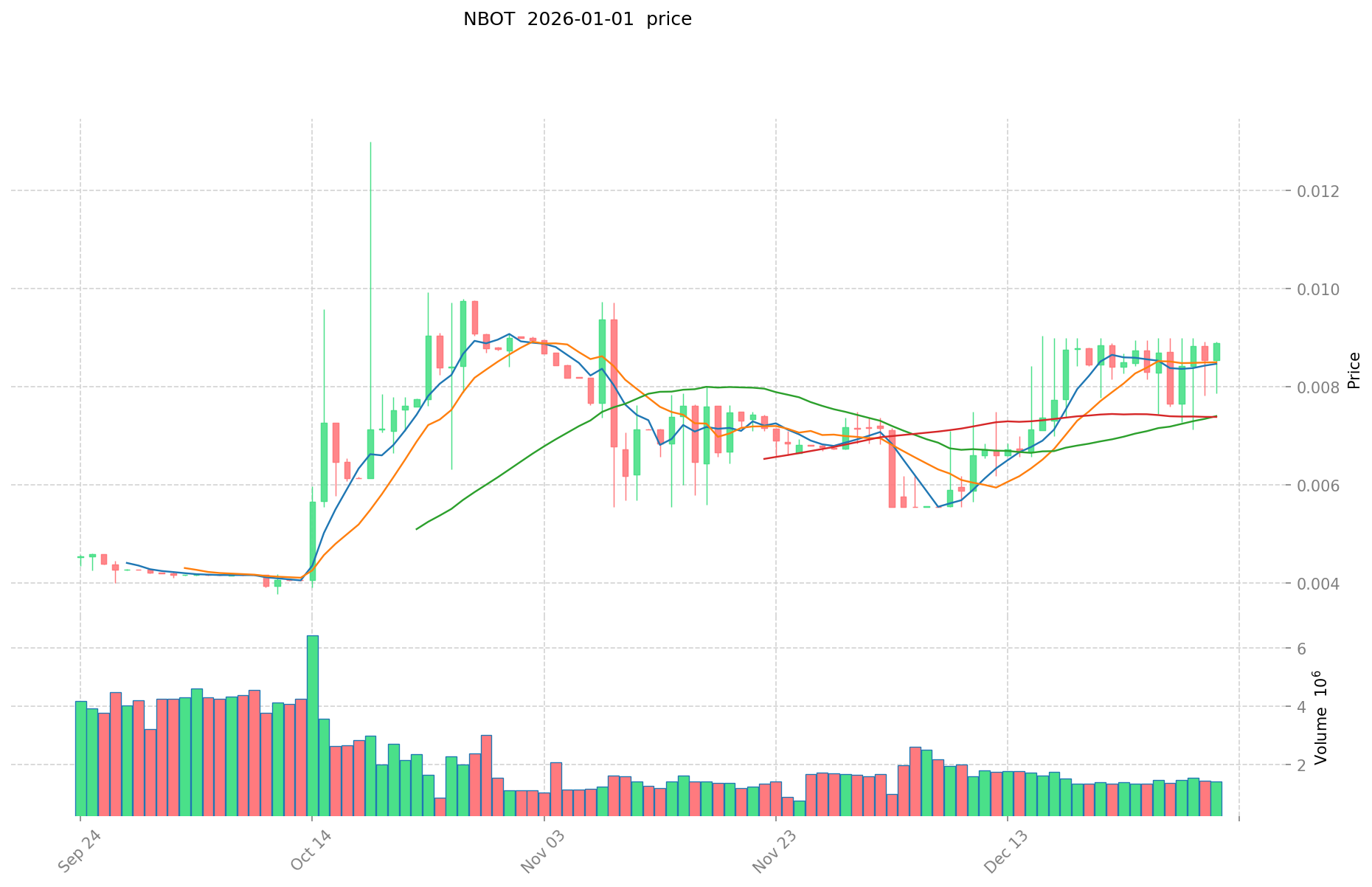
NBOT and SNX Historical Price Trends
- June 24, 2019: NBOT reached its all-time high of $0.076389, driven by the Bodhi team's initial market enthusiasm following the launch of the Naka blockchain platform in January 2019.
- February 14, 2021: SNX reached its all-time high of $28.53, reflecting the peak of the DeFi synthetic assets boom during the 2020-2021 bull market cycle.
- March 13, 2020: NBOT experienced its all-time low of $0.00190929, coinciding with the broader cryptocurrency market collapse during the COVID-19 pandemic crisis.
- January 6, 2019: SNX hit its all-time low of $0.0347864 during the early cryptocurrency market downturn following the 2018 bear market.
- Comparative analysis: Over the approximately 6-year period from their respective lows to the current date, NBOT has recovered approximately 343% from its nadir, while SNX has experienced a significant decline of approximately 77.13% from its peak, indicating divergent recovery trajectories between the two tokens.
Current Market Status (January 2, 2026)
- NBOT current price: $0.008452.
- SNX current price: $0.438.
- 24-hour trading volume: NBOT $11,967.33 vs SNX $1,049,148.96.
- Market sentiment index (Fear & Greed Index): 20 (Extreme Fear).
Click to view real-time prices:

Comparison of NBOT vs SNX Investment Value: Core Influencing Factors
II. Core Factors Impacting NBOT vs SNX Investment Value
Supply Mechanism Comparison (Tokenomics)
The reference materials provided do not contain specific information about NBOT's tokenomics or detailed supply mechanisms for SNX that would enable a comprehensive comparison of their supply mechanisms and historical price cycle patterns.
Institutional Adoption and Market Application
Based on available reference materials, SNX is positioned within the OP ecosystem as a key protocol token, appearing in multiple track classifications including DeFi, RWA (Real-World Assets), and derivatives. However, specific institutional holding data and enterprise adoption metrics for both NBOT and SNX are not available in the provided materials.
Regarding regulatory environment, stablecoins occupy approximately 60% of cryptocurrency transfer value as of 2024, processing 1.5 million transactions daily, with most transactions under $10,000. The FIT21 Act (Financial Innovation and Technology for the 21st Century Act) has established clearer federal regulatory frameworks for digital asset markets, potentially facilitating institutional participation in both traditional and decentralized finance applications.
Technological Development and Ecosystem Construction
SNX operates within the Synthetix protocol ecosystem, which implements a synthetic asset model through tracking base assets with overcollateralization to create synthetic asset tokens. For example, at a 500% collateral ratio, users can stake $500 in crypto assets (such as SNX or UST) into the system to mint synthetic assets.
The reference materials do not provide comparable technical development information for NBOT.
Macroeconomic Environment and Market Cycles
Current market dynamics show that DeFi projects with mature business models and clear profit mechanisms are attracting renewed investor attention. Head DeFi projects like Aave demonstrate pricing power and sustainable revenue models through trading fees (DEX), interest spreads (lending), stability fees (stablecoins), and staking service fees. These projects increasingly show valuation levels approaching historical lows relative to annualized revenue, presenting potential asymmetric opportunities for investors.
Market data indicates altcoin valuations have undergone correction cycles driven by both supply-side oversaturation (excessive token issuance and sustained institutional unlocks) and demand-side weakness (lack of compelling new business models).
III. 2026-2031 Price Forecast: NBOT vs SNX
Short-term Forecast (2026)
- NBOT: Conservative $0.0078771-$0.00847 | Optimistic $0.0104181
- SNX: Conservative $0.407619-$0.4383 | Optimistic $0.609237
Mid-term Forecast (2028-2029)
- NBOT may enter accumulation phase, expected price range $0.008268-$0.0148964
- SNX may enter growth phase, expected price range $0.373970-$0.87509145
- Key drivers: institutional capital inflows, ETF adoption, ecosystem development
Long-term Forecast (2030-2031)
- NBOT: Base case $0.009687-$0.0134549 | Optimistic scenario $0.014379-$0.019677
- SNX: Base case $0.517554-$0.75007839 | Optimistic scenario $0.742765-$1.214639
View NBOT and SNX detailed price forecasts
NBOT:
| 年份 |
预测最高价 |
预测平均价格 |
预测最低价 |
涨跌幅 |
| 2026 |
0.0104181 |
0.00847 |
0.0078771 |
0 |
| 2027 |
0.010010693 |
0.00944405 |
0.0085940855 |
11 |
| 2028 |
0.014299236105 |
0.0097273715 |
0.008268265775 |
15 |
| 2029 |
0.0148964967151 |
0.0120133038025 |
0.00792878050965 |
42 |
| 2030 |
0.0168186253235 |
0.0134549002588 |
0.009687528186336 |
59 |
| 2031 |
0.019677791628495 |
0.01513676279115 |
0.014379924651592 |
79 |
SNX:
| 年份 |
预测最高价 |
预测平均价格 |
预测最低价 |
涨跌幅 |
| 2026 |
0.609237 |
0.4383 |
0.407619 |
0 |
| 2027 |
0.54471924 |
0.5237685 |
0.3142611 |
19 |
| 2028 |
0.7158867858 |
0.53424387 |
0.373970709 |
21 |
| 2029 |
0.87509145906 |
0.6250653279 |
0.587561408226 |
42 |
| 2030 |
0.9976042633284 |
0.75007839348 |
0.5175540915012 |
71 |
| 2031 |
1.214639446481838 |
0.8738413284042 |
0.74276512914357 |
99 |
IV. Investment Strategy Comparison: NBOT vs SNX
Long-term vs Short-term Investment Strategy
- NBOT: Suited for investors focusing on early-stage ecosystem participation and potential recovery trajectories in emerging blockchain platforms, with tolerance for higher volatility
- SNX: Suited for investors seeking exposure to established DeFi protocols with proven business models and sustainable revenue mechanisms through trading fees and staking services
Risk Management and Asset Allocation
- Conservative investors: NBOT 10% vs SNX 40%
- Aggressive investors: NBOT 30% vs SNX 50%
- Hedging tools: Stablecoin allocation, options strategies, cross-token diversification
V. Potential Risk Comparison
Market Risk
- NBOT: Significantly lower trading volume ($11,967.33 in 24-hour volume) creates liquidity constraints and increased slippage risk; historical price volatility shows extreme fluctuations from $0.076389 to $0.00190929
- SNX: Moderate trading volume ($1,049,148.96 in 24-hour volume) provides better liquidity; however, 77.13% decline from peak indicates sustained downward pressure despite institutional recognition
Technology Risk
- NBOT: Limited technical documentation available regarding network stability and scalability features; ecosystem development status unclear
- SNX: Overcollateralization mechanisms (500% ratio example) create liquidation risks during market volatility; synthetic asset model complexity may present operational vulnerabilities
Regulatory Risk
- The FIT21 Act establishes clearer federal regulatory frameworks for digital asset markets, potentially benefiting both DeFi protocols; however, regulatory scrutiny of synthetic assets and derivatives trading may disproportionately impact SNX operations
- Stablecoin regulations affecting approximately 60% of cryptocurrency transfer value could impact collateral mechanisms for both tokens
VI. Conclusion: Which Is the Better Buy?
📌 Investment Value Summary:
- NBOT advantages: Early-stage positioning on emerging blockchain platform, potential 343% recovery trajectory from historical lows, lower entry price point ($0.008452)
- SNX advantages: Established protocol with proven DeFi revenue models, higher institutional recognition, substantially higher trading volume and market liquidity, integrated within OP ecosystem supporting RWA and derivatives applications
✅ Investment Recommendations:
- Beginner investors: Prioritize SNX for exposure to established DeFi infrastructure with clearer business fundamentals; limit NBOT allocation to speculative positions
- Experienced investors: Consider portfolio allocation balancing SNX's stability with NBOT's asymmetric upside potential; implement strict risk management protocols given current market sentiment at Extreme Fear (20)
- Institutional investors: SNX presents more appropriate entry point through established protocol infrastructure and institutional capital flow patterns; evaluate NBOT positioning only for diversified exposure to emerging ecosystems
⚠️ Risk Warning: Cryptocurrency markets exhibit extreme volatility. This article does not constitute investment advice. All forecasts involve substantial uncertainty and historical price performance does not guarantee future results.
FAQ
NBOT和SNX分别是什么?各自的主要功能和用途是什么?
NBOT主要用于数据传输和存储优化,采用分布式架构。SNX专注于衍生品交易,使用合成资产模型。两者在功能和应用场景上差异显著。
NBOT和SNX在技术架构和机制上有什么核心区别?
NBOT采用分布式架构优化数据传输和存储,而SNX专注于合成资产和衍生品交易机制。NBOT侧重于数据处理效率,SNX则专注于金融衍生品交易。
NBOT和SNX的代币经济模型和分配方案如何对比?
NBOT基于去中心化交易所,通过初始代币销售和社区激励分配。SNX用于Gnosis平台治理和激励,分配包括创始团队、早期投资者和平台运营。两者在代币用途和分配机制上存在显著差异。
NBOT和SNX各自的应用场景和生态发展现状如何?
NBOT主要应用于流动性挖矿场景,生态处于成长期。SNX采用质押+费用分配模式,生态更为成熟,市场验证周期更长,应用场景覆盖衍生品交易和流动性提供。
投资NBOT和SNX分别需要考虑哪些风险因素?
投资NBOT和SNX需关注市场波动风险、项目技术安全风险、团队可靠性,以及交易额流动性和政策监管环境等因素,这些都会直接影响投资回报。
NBOT和SNX哪个更适合长期持有?如何选择?
NBOT专注去中心化衍生品交易,SNX在DeFi领域应用广泛。长期持有选择需根据风险偏好:看好衍生品赛道选NBOT,看好DeFi生态选SNX。建议结合市场趋势和自身投资策略综合判断。
* The information is not intended to be and does not constitute financial advice or any other recommendation of any sort offered or endorsed by Gate.