This comprehensive guide compares ORCA and DYDX, two leading decentralized exchange protocols operating on different blockchain infrastructures. ORCA operates as an automated market maker (AMM) on Solana focusing on spot trading with concentrated liquidity mechanisms, while DYDX functions as a Layer 2 derivatives exchange specializing in perpetual contracts. The article analyzes historical price trends, current market status, tokenomics structures, institutional adoption patterns, and technical ecosystems to help investors evaluate both assets. Key sections examine market risks, regulatory considerations including the FIT21 Act framework, and investment allocation strategies for different investor profiles. Price analysis from 2026-2031 provides conservative and optimistic scenarios for both protocols. Readers will understand functional differences, performance characteristics during market cycles, and risk-management approaches when choosing between these DeFi protocols. Check real-time prices on Gate for cu
Introduction: Investment Comparison Between ORCA and DYDX
In the cryptocurrency market, the comparison between ORCA vs DYDX has consistently been a focal point for investors. The two assets exhibit distinct differences in market cap ranking, application scenarios, and price performance, representing divergent positioning within the crypto asset landscape.
ORCA (ORCA): Launched in August 2021, this asset has gained market recognition as a fast and convenient automated market maker (AMM) on the Solana blockchain, focusing on creating user-oriented digital trading experiences.
DYDX (DYDX): Emerging in August 2021, it has established itself as a decentralized derivatives trading protocol, operating primarily as a perpetual contract exchange on Layer 2 blockchain systems.
This article will comprehensively analyze the investment value comparison of ORCA vs DYDX through historical price trends, supply mechanisms, institutional adoption, technological ecosystems, and future forecasts, attempting to address the most pressing question for investors:
"Which is the better buy right now?"
I. Historical Price Comparison and Current Market Status
ORCA (Coin A) and DYDX (Coin B) Historical Price Trends
- 2021: ORCA experienced notable price movement during its launch period, with the token being published in August 2021 at a price of $2.1204. The price showed significant volatility in its early months.
- 2021: DYDX launched in August 2021 and demonstrated substantial price fluctuations during the DeFi market expansion period.
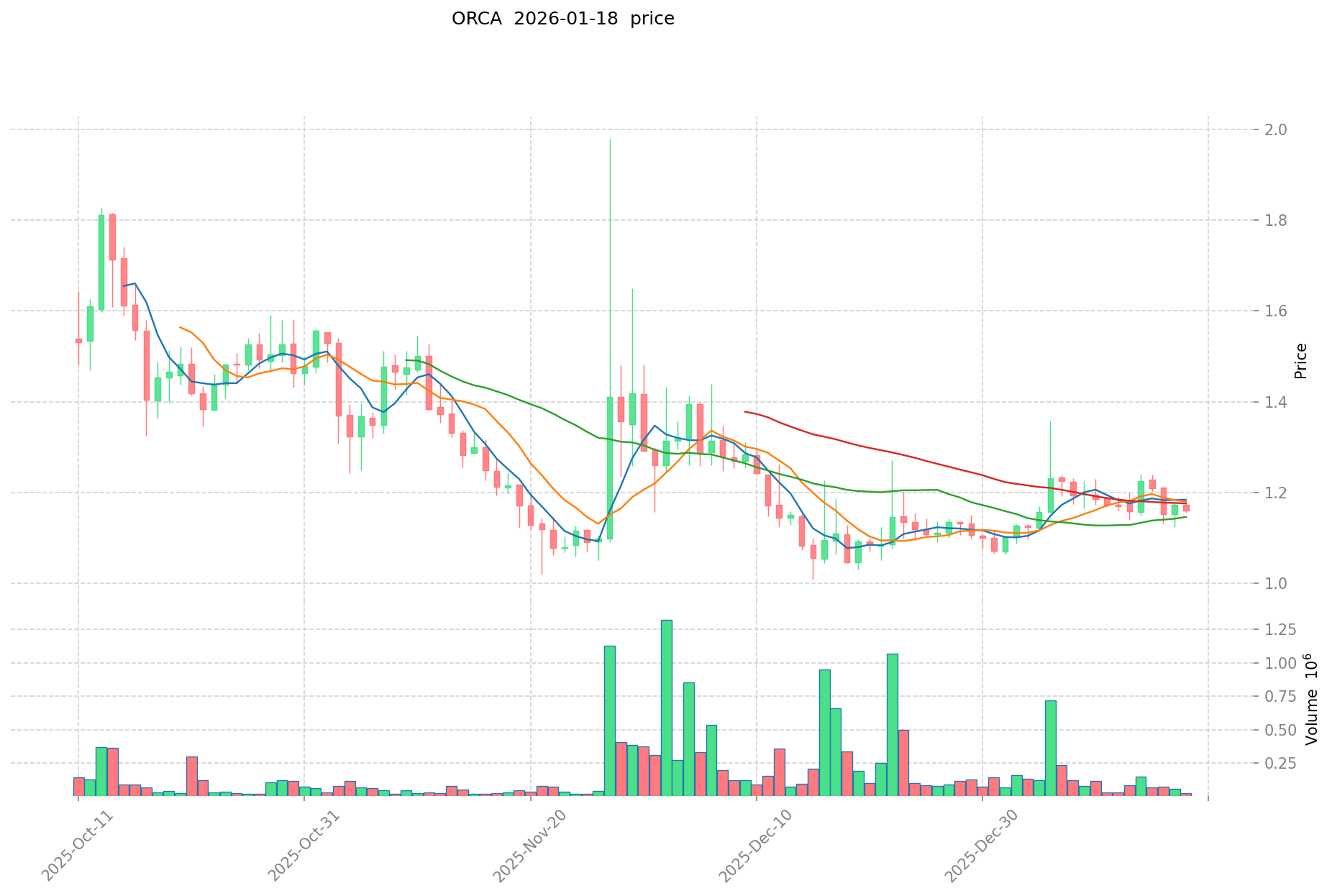
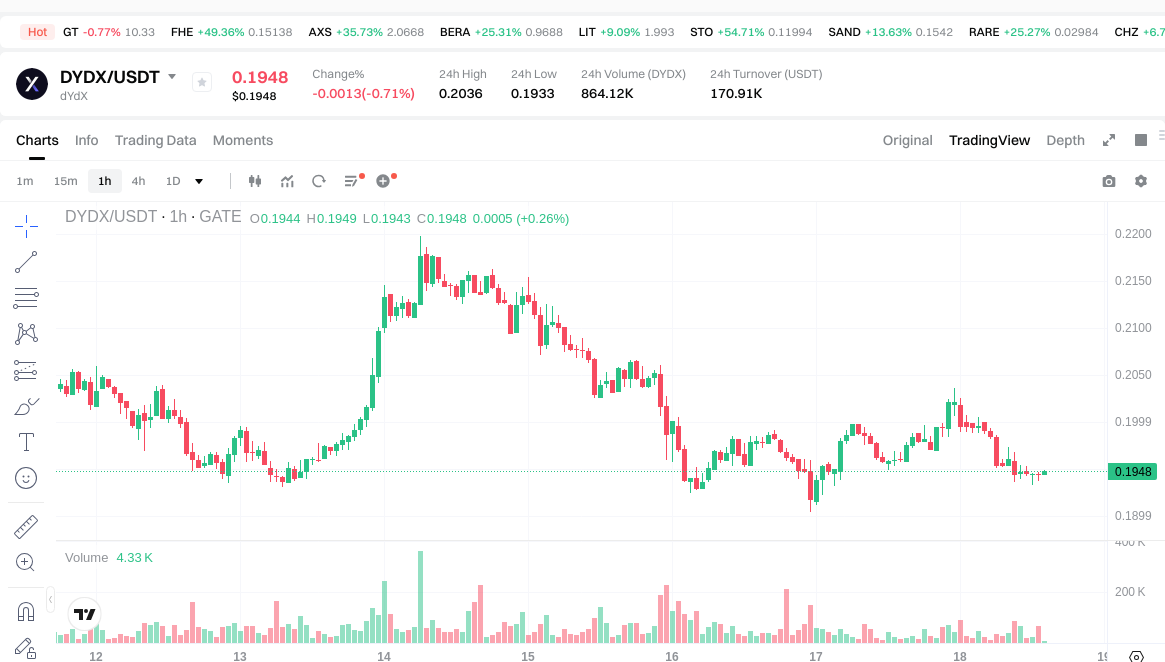
- Comparative Analysis: During various market cycles, ORCA moved from its all-time high of $20.33 (recorded on October 3, 2021) to a low of $0.351125 (recorded on June 20, 2022), while DYDX experienced a decline from its all-time high of $4.52 (recorded on March 8, 2024) to a low of $0.126201 (recorded on October 11, 2025).
Current Market Status (January 18, 2026)
- ORCA Current Price: $1.175
- DYDX Current Price: $0.1942
- 24-Hour Trading Volume: ORCA $40,387.19 vs DYDX $170,721.80
- Market Sentiment Index (Fear & Greed Index): 49 (Neutral)
View Real-Time Prices:
II. Core Factors Influencing ORCA vs DYDX Investment Value
Tokenomics Comparison
- ORCA: The whitepaper emphasizes simplicity, sustainability, and transparency as core values, with the introduction of fair price indicators designed to optimize liquidity provision efficiency.
- DYDX: Operates as a decentralized derivatives exchange with tokenomics supporting governance and fee distribution mechanisms aligned with protocol usage.
- 📌 Historical Pattern: Supply mechanisms influence price cycles through liquidity incentives and market positioning, with DeFi protocols showing correlation between token utility and adoption rates.
Institutional Adoption and Market Application
- Institutional Holdings: DeFi platforms have attracted varying levels of institutional interest, with lending protocols and DEXs demonstrating stronger institutional adoption compared to specialized platforms.
- Enterprise Adoption: ORCA focuses on liquidity pool optimization within the Solana ecosystem, while DYDX serves the derivatives trading market with cross-chain compatibility considerations.
- Regulatory Landscape: The FIT21 Act (Financial Innovation and Technology for the 21st Century Act) passed the House in May with strong support, potentially creating a clearer federal regulatory framework for DeFi protocols and facilitating institutional participation.
Technical Development and Ecosystem Building
- ORCA Technical Features: Operates on Solana with concentrated liquidity models similar to Uniswap V3, catering to high-frequency trading and meme token liquidity needs.
- DYDX Technical Evolution: Functions as a derivatives-focused platform with experience in building major crypto protocols, offering perpetual contracts and advanced trading features.
- Ecosystem Comparison: ORCA benefits from Solana's rapid user growth and meme token popularity, while DYDX serves the derivatives market across multiple chains. DeFi platforms generally demonstrate mature business models with fee generation from trading volumes, lending spreads, and staking services.
Macroeconomic Environment and Market Cycles
- Performance in Bull Markets: Market data indicates altcoin valuations experienced downward pressure in 2024, with only select sectors like Meme, CEX, and DePIN maintaining positive returns, while DeFi protocols showed business-price divergence.
- Monetary Policy Impact: Rising liquidity demand during bull market phases drives increases in base borrowing rates, amplifying arbitrage cycles within DeFi protocols and supporting protocol revenue growth.
- Market Cycle Positioning: DeFi tokens have historically served as hedges for long positions, though the multi-chain era may shift this dynamic as new institutional capital enters the space, potentially favoring alternative L1 tokens with smaller market caps and superior performance characteristics compared to established platforms.
III. 2026-2031 Price Prediction: ORCA vs DYDX
Short-term Forecast (2026)
- ORCA: Conservative $0.66-$1.18 | Optimistic $1.18-$1.56
- DYDX: Conservative $0.18-$0.19 | Optimistic $0.19-$0.27
Mid-term Forecast (2028-2029)
- ORCA may enter a consolidation phase with projected price range of $1.05-$1.97
- DYDX may experience gradual growth with projected price range of $0.15-$0.40
- Key drivers: institutional capital inflows, ETF developments, ecosystem expansion
Long-term Forecast (2030-2031)
- ORCA: Baseline scenario $1.49-$2.09 | Optimistic scenario $2.09-$2.84
- DYDX: Baseline scenario $0.24-$0.37 | Optimistic scenario $0.37-$0.43
View detailed price predictions for ORCA and DYDX
Disclaimer: Price predictions are based on historical data analysis and market trend modeling. Cryptocurrency markets are highly volatile and subject to various unpredictable factors. These forecasts should not be considered as investment advice. Always conduct your own research and consult with financial professionals before making investment decisions.
ORCA:
| Year |
Predicted High Price |
Predicted Average Price |
Predicted Low Price |
Price Change |
| 2026 |
1.562352 |
1.1836 |
0.662816 |
0 |
| 2027 |
1.63384144 |
1.372976 |
0.97481296 |
16 |
| 2028 |
1.5485109816 |
1.50340872 |
1.0824542784 |
27 |
| 2029 |
1.968488207532 |
1.5259598508 |
1.052912297052 |
29 |
| 2030 |
2.42864140054074 |
1.747224029166 |
1.4851404247911 |
48 |
| 2031 |
2.839588492200583 |
2.08793271485337 |
1.565949536140027 |
77 |
DYDX:
| Year |
Predicted High Price |
Predicted Average Price |
Predicted Low Price |
Price Change |
| 2026 |
0.274809 |
0.1949 |
0.177359 |
0 |
| 2027 |
0.27712831 |
0.2348545 |
0.180837965 |
20 |
| 2028 |
0.31998925625 |
0.255991405 |
0.15103492895 |
31 |
| 2029 |
0.403186462875 |
0.287990330625 |
0.2015932314375 |
48 |
| 2030 |
0.3905148883275 |
0.34558839675 |
0.241911877725 |
77 |
| 2031 |
0.434300938195725 |
0.36805164253875 |
0.276038731904062 |
89 |
IV. Investment Strategy Comparison: ORCA vs DYDX
Long-term vs Short-term Investment Strategies
- ORCA: May appeal to investors focused on Solana ecosystem growth, DeFi innovation, and concentrated liquidity mechanisms. The asset's positioning within automated market making and its integration with high-frequency trading environments could attract those monitoring DeFi protocol evolution.
- DYDX: May suit investors interested in decentralized derivatives markets, Layer 2 scaling solutions, and perpetual contract trading infrastructure. The protocol's focus on derivatives trading distinguishes it from spot-focused platforms.
Risk Management and Asset Allocation
- Conservative Investors: Potential allocation consideration of 30-40% ORCA vs 60-70% DYDX, reflecting different risk profiles and market positioning
- Aggressive Investors: Potential allocation consideration of 60-70% ORCA vs 30-40% DYDX, aligned with higher volatility tolerance and ecosystem growth expectations
- Hedging Tools: Stablecoin reserves, options strategies, cross-asset portfolio diversification, and protocol-specific risk mitigation approaches
V. Potential Risk Comparison
Market Risks
- ORCA: Exposure to Solana network performance, competition from other AMM protocols, meme token market cycles, and concentrated liquidity adoption rates. Market data indicates altcoin valuations experienced downward pressure in 2024, with DeFi protocols showing business-price divergence.
- DYDX: Sensitivity to derivatives trading volume fluctuations, competition from centralized and decentralized derivatives platforms, Layer 2 adoption rates, and cross-chain migration challenges.
Technical Risks
- ORCA: Solana network scalability considerations, smart contract vulnerabilities in concentrated liquidity models, and dependence on broader Solana ecosystem stability
- DYDX: Protocol security considerations, cross-chain bridge risks, derivatives contract settlement mechanisms, and technical infrastructure complexity
Regulatory Risks
- The FIT21 Act passed the House in May with strong support, potentially creating a clearer federal regulatory framework for DeFi protocols. Different jurisdictions may apply varying regulatory approaches to AMM platforms versus derivatives protocols, with DYDX potentially facing more stringent oversight due to its derivatives focus, while ORCA may encounter regulations targeting liquidity provision mechanisms.
VI. Conclusion: Which Is the Better Buy?
📌 Investment Value Summary:
- ORCA Characteristics: Integration with Solana's high-performance infrastructure, concentrated liquidity mechanisms, focus on user-oriented trading experiences, and positioning within the growing meme token ecosystem
- DYDX Characteristics: Specialized derivatives trading infrastructure, Layer 2 deployment strategy, established protocol with experience in crypto derivatives markets, and cross-chain compatibility considerations
✅ Investment Considerations:
- Novice Investors: Consider starting with thorough research into DeFi mechanics, AMM protocols, and derivatives platforms. Assess personal risk tolerance and investment timeframe before allocation decisions.
- Experienced Investors: May evaluate technical fundamentals, tokenomics structures, ecosystem positioning, and correlation with broader market cycles. Portfolio diversification across different DeFi sectors could be considered.
- Institutional Investors: May analyze protocol revenue models, governance mechanisms, regulatory compliance frameworks, and long-term sustainability metrics. The FIT21 Act developments could influence institutional participation strategies.
⚠️ Risk Disclosure: Cryptocurrency markets exhibit high volatility. This content does not constitute investment advice. Market forecasts are based on historical data and modeling, which cannot predict future outcomes with certainty. Investors should conduct independent research and consult qualified financial professionals before making investment decisions.
VII. FAQ
Q1: What are the main differences between ORCA and DYDX in terms of functionality?
ORCA is an automated market maker (AMM) focused on spot trading with concentrated liquidity on Solana, while DYDX is a decentralized derivatives exchange specializing in perpetual contracts on Layer 2. ORCA optimizes liquidity provision through fair price indicators and concentrated liquidity models similar to Uniswap V3, primarily serving the spot trading and meme token markets within the Solana ecosystem. In contrast, DYDX operates as a derivatives-focused platform offering perpetual contracts and advanced trading features, targeting traders seeking leveraged exposure and hedging instruments across multiple blockchain networks.
Q2: How do the tokenomics of ORCA and DYDX differ?
ORCA emphasizes simplicity, sustainability, and transparency with tokenomics designed to optimize liquidity provision efficiency, while DYDX's tokenomics support governance and fee distribution mechanisms aligned with derivatives trading protocol usage. ORCA's model focuses on incentivizing liquidity providers within concentrated liquidity pools on Solana, whereas DYDX's structure ties token utility to trading volume, governance participation, and protocol fee distribution. Historical patterns indicate that supply mechanisms influence price cycles through liquidity incentives, with DeFi protocols showing correlation between token utility and adoption rates.
Q3: Which asset performs better during bull market cycles?
Historical data suggests different performance patterns: ORCA benefits from Solana's rapid user growth and meme token popularity during bull phases, while DYDX's performance correlates with derivatives trading volume and institutional adoption rates. Market data indicates altcoin valuations experienced downward pressure in 2024, with DeFi protocols showing business-price divergence. Rising liquidity demand during bull market phases drives increases in base borrowing rates, amplifying arbitrage cycles within DeFi protocols and supporting protocol revenue growth, though performance varies significantly based on sector positioning and market cap size.
Q4: What are the key regulatory considerations for ORCA versus DYDX?
DYDX may face more stringent regulatory oversight due to its derivatives focus, while ORCA may encounter regulations targeting liquidity provision mechanisms and spot trading infrastructure. The FIT21 Act passed the House in May with strong support, potentially creating a clearer federal regulatory framework for DeFi protocols and facilitating institutional participation. Different jurisdictions may apply varying regulatory approaches, with derivatives platforms typically subject to more comprehensive oversight regarding leverage, margin requirements, and investor protection measures compared to AMM protocols focused on spot trading.
Q5: How do the technical risks differ between ORCA and DYDX?
ORCA faces risks related to Solana network performance, smart contract vulnerabilities in concentrated liquidity models, and dependence on broader Solana ecosystem stability. DYDX encounters protocol security considerations specific to derivatives contracts, cross-chain bridge risks, settlement mechanism complexities, and technical infrastructure challenges associated with Layer 2 deployment. Both protocols carry smart contract risk, but DYDX's derivatives infrastructure introduces additional complexity through perpetual contract mechanics, liquidation systems, and cross-chain interoperability requirements that differ from ORCA's spot trading focus.
Q6: What allocation strategy should investors consider between ORCA and DYDX?
Conservative investors might consider a 30-40% ORCA and 60-70% DYDX allocation, reflecting different risk profiles and market positioning, while aggressive investors could evaluate 60-70% ORCA and 30-40% DYDX based on higher volatility tolerance and ecosystem growth expectations. The allocation decision should account for individual risk tolerance, investment timeframe, belief in Solana versus multi-chain ecosystems, preference for spot versus derivatives exposure, and portfolio diversification needs. Implementing hedging tools such as stablecoin reserves, options strategies, and cross-asset portfolio diversification can help manage protocol-specific risks.
Q7: How do price predictions for 2026-2031 compare between ORCA and DYDX?
ORCA shows a conservative 2026 range of $0.66-$1.18 expanding to $1.49-$2.09 by 2030, with optimistic scenarios reaching $2.84 by 2031, while DYDX projects a conservative 2026 range of $0.18-$0.19 growing to $0.24-$0.37 by 2030, with optimistic scenarios reaching $0.43 by 2031. These forecasts suggest ORCA may experience higher absolute price growth but both assets show potential for appreciation over the forecast period. Key drivers include institutional capital inflows, ETF developments, ecosystem expansion, and broader DeFi adoption trends. However, these predictions are based on historical data analysis and market modeling, which cannot account for unpredictable market factors and should not be considered investment advice.
Q8: Which asset is more suitable for institutional investors?
Both assets present different value propositions for institutional investors: DYDX may attract institutions seeking exposure to decentralized derivatives infrastructure and established protocol revenue models, while ORCA may appeal to those focused on Solana ecosystem growth and AMM innovation. Institutional considerations include protocol revenue sustainability, governance mechanisms, regulatory compliance frameworks, and long-term viability metrics. The FIT21 Act developments could influence institutional participation strategies, potentially favoring clearer regulatory frameworks. Institutions typically evaluate technical maturity, security audit history, team expertise, and market positioning when allocating to DeFi protocols, with derivatives platforms and AMMs serving different portfolio objectives.
* The information is not intended to be and does not constitute financial advice or any other recommendation of any sort offered or endorsed by Gate.