# Article Overview: PRARE vs SOL Comprehensive Comparison
This in-depth analysis compares two emerging blockchain protocols—PolkaRARE (PRARE) and Solana (SOL)—across price performance, tokenomics, technical infrastructure, and investment potential. The article addresses critical investor questions: which asset offers better returns, and how should different investor profiles allocate capital? Through historical price trend analysis, ecosystem evaluation, and 2026-2031 price projections, the guide helps both beginner and experienced traders make informed decisions. It examines SOL's mature Layer 1 ecosystem with 65,000 TPS capability against PRARE's NFT-focused multi-chain platform, while providing risk assessments, portfolio allocation strategies, and real-time market data via Gate. Designed for investors seeking clarity on emerging cryptocurrency opportunities, this comprehensive comparison balances growth potential against volatility and institutional adoption factors.
Introduction: PRARE vs SOL Investment Comparison
In the cryptocurrency market, the comparison between PRARE and SOL has always been a topic that investors cannot avoid. The two not only show significant differences in market capitalization ranking, application scenarios, and price performance, but also represent different positioning of crypto assets.
PolkaRARE (PRARE): Since its launch in 2021, it has gained market recognition by leveraging NFT's provable scarcity and transferability as a multi-chain NFT platform. The platform allows users and brands to create, trade, and discover NFTs across multiple blockchains including Ethereum, Polygon, BSC, and Polkadot.
Solana (SOL): Since its founding at the end of 2017, it has been recognized as a high-performance blockchain protocol that focuses on providing scalability without reducing decentralization or security. SOL is one of the cryptocurrencies with the highest global trading volume and market capitalization.
This article will comprehensively analyze the investment value comparison between PRARE and SOL from multiple dimensions including historical price trends, supply mechanisms, market positioning, technical ecosystem, and future outlook. It also attempts to answer the question that investors care most about:
"Which is the better buy right now?"
I. Price History Comparison and Current Market Status
PolkaRARE (PRARE) and Solana (SOL) Historical Price Trends
- May 2021: PRARE reached its all-time high of $1.35 on May 12, 2021, driven by the NFT market boom and broader cryptocurrency enthusiasm.
- January 2025: SOL reached its all-time high of $293.31 on January 19, 2025, reflecting strong institutional adoption and ecosystem expansion.
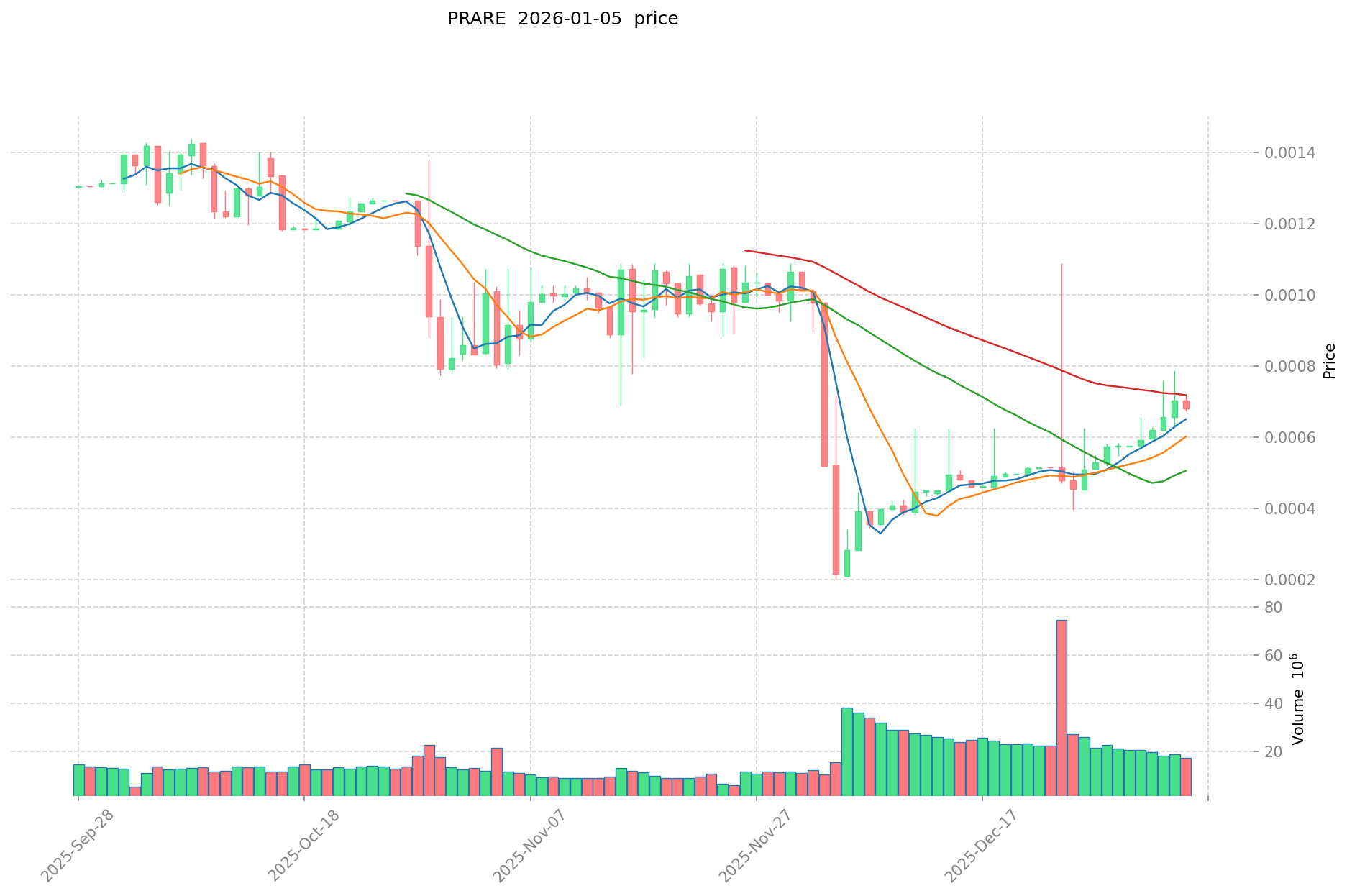
- December 2025: PRARE hit its all-time low of $0.00020692 on December 5, 2025, while SOL remained relatively stable at higher price levels.
- Comparative analysis: Over the past four years, PRARE has declined approximately 99.9% from its peak, while SOL has experienced volatility but maintained significantly higher price levels relative to its launch price.
Current Market Status (January 6, 2026)
- PRARE current price: $0.0007885.
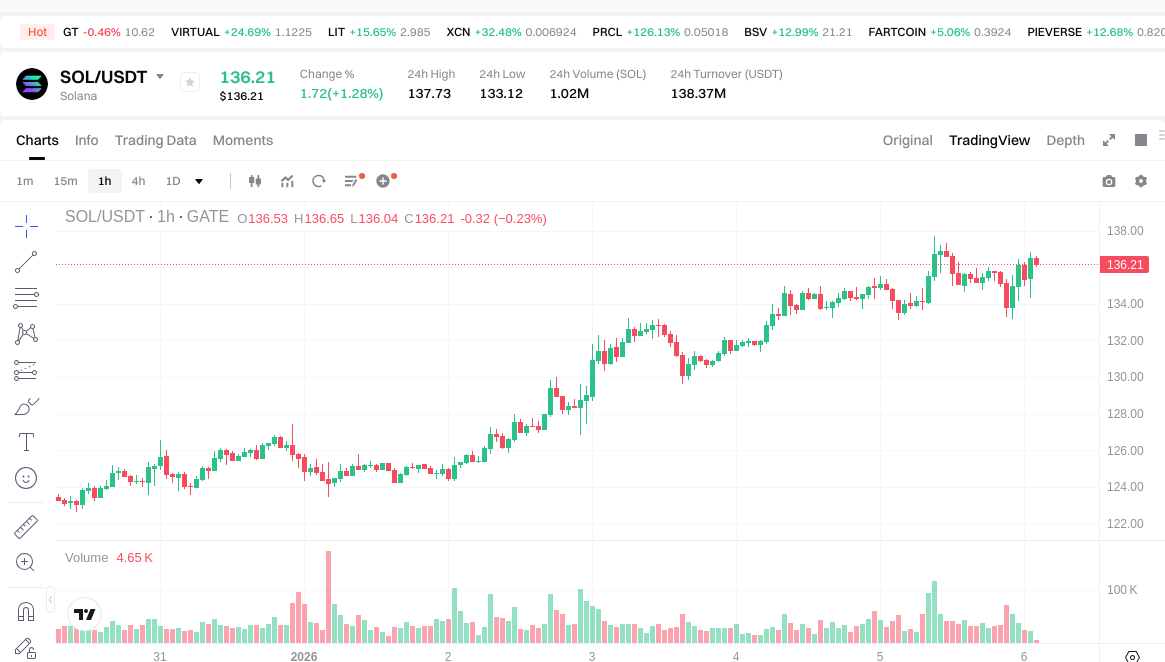
- SOL current price: $136.27.
- 24-hour trading volume: PRARE $12,890.31 vs SOL $138,549,983.07.
- Market Sentiment Index (Fear & Greed Index): 26 (Fear).
Click to view real-time prices:
SOL Coin Investment Value Analysis
II. Core Factors Influencing SOL Investment Value
Supply Mechanism (Tokenomics)
-
SOL: Solana's token supply model features a dynamic inflation schedule designed to support network security and validator incentives. The protocol does not have a hard cap, allowing for controlled inflation that gradually decreases over time as the network matures.
-
📌 Historical Pattern: SOL's supply mechanism has historically influenced price cycles through validator reward distributions and network participation incentives. The absence of strict scarcity compared to Bitcoin has affected its long-term value preservation characteristics.
Institutional Adoption and Market Applications
-
Institutional Holdings: SOL has experienced fluctuating institutional interest, particularly following the FTX collapse in late 2022, which significantly reduced institutional confidence. However, major cryptocurrency exchanges including Binance, Coinbase, and FTX have listed SOL with high liquidity.
-
Enterprise Adoption: SOL is utilized across DeFi protocols, NFT marketplaces, GameFi applications, and Web3 payment systems on the Solana network. Transaction costs below $0.01 USD make SOL particularly suitable for micropayments and high-frequency operations compared to Ethereum or Bitcoin.
-
National Policy: Regulatory approaches vary globally, with most jurisdictions treating SOL as a commodity or digital asset subject to existing cryptocurrency regulations.
Technical Development and Ecosystem Construction
-
SOL Technical Upgrades: Solana employs a hybrid Proof of History (PoH) and Proof of Stake (PoS) consensus mechanism, achieving up to 65,000 transactions per second (TPS). The network supports both vertical scaling through hardware upgrades and horizontal scaling through node additions, theoretically enabling performance improvements without compromising efficiency.
-
Ecosystem Development: Solana's ecosystem comprises over 180 decentralized applications across DeFi, NFT, and gaming sectors. The network's Total Value Locked (TVL) reached $275 million, ranking tenth among all public chains. However, ecosystem activity remains relatively modest compared to established competitors.
Macroeconomic Environment and Market Cycles
-
Inflation Environment Performance: SOL demonstrates moderate inflation-hedge characteristics through its use as a medium of exchange and network fuel. Its low transaction costs make it attractive during high-fee periods on competing networks.
-
Macroeconomic Monetary Policy: SOL's price exhibits sensitivity to broader cryptocurrency market trends, US dollar index movements, and Federal Reserve monetary policy decisions. Rising interest rates and dollar strength typically correlate with reduced speculative demand for altcoins like SOL.
-
Geopolitical Factors: Cross-border transaction demand and international tensions affecting cryptocurrency adoption rates influence SOL's utility and trading volumes. The network's low-cost infrastructure positions it favorably for international payments during periods of heightened geopolitical uncertainty.
III. 2026-2031 Price Prediction: PRARE vs SOL
Short-term Prediction (2026)
- PRARE: Conservative $0.00055-$0.00079 | Optimistic $0.00079-$0.00086
- SOL: Conservative $89.87-$136.16 | Optimistic $136.16-$178.37
Mid-term Prediction (2027-2029)
- PRARE is expected to enter a growth consolidation phase, with estimated prices in the range of $0.00058-$0.00144
- SOL is expected to enter a strong uptrend phase, with estimated prices in the range of $127.38-$227.70
- Key drivers: institutional capital inflows, ETF products, ecosystem development
Long-term Prediction (2030-2031)
- PRARE: Base case $0.00089-$0.00151 | Optimistic scenario $0.00151-$0.00192
- SOL: Base case $170.54-$210.54 | Optimistic scenario $210.54-$221.06
View detailed price predictions for PRARE and SOL
PRARE:
| 年份 |
预测最高价 |
预测平均价格 |
预测最低价 |
涨跌幅 |
| 2026 |
0.000857721 |
0.0007869 |
0.00055083 |
0 |
| 2027 |
0.000863426025 |
0.0008223105 |
0.000583840455 |
4 |
| 2028 |
0.00109572874125 |
0.0008428682625 |
0.000539435688 |
6 |
| 2029 |
0.001444254767793 |
0.000969298501875 |
0.000639737011237 |
22 |
| 2030 |
0.001798097185903 |
0.001206776634834 |
0.000893014709777 |
53 |
| 2031 |
0.001923119245272 |
0.001502436910368 |
0.000886437777117 |
90 |
SOL:
| 年份 |
预测最高价 |
预测平均价格 |
预测最低价 |
涨跌幅 |
| 2026 |
178.3696 |
136.16 |
89.8656 |
0 |
| 2027 |
180.85452 |
157.2648 |
127.384488 |
15 |
| 2028 |
201.1809954 |
169.05966 |
157.2254838 |
24 |
| 2029 |
227.698003071 |
185.1203277 |
161.054685099 |
35 |
| 2030 |
214.66553200092 |
206.4091653855 |
183.704157193095 |
51 |
| 2031 |
221.0642161278705 |
210.53734869321 |
170.5352524415001 |
54 |
四、投资策略对比:PRARE vs SOL
长期 vs 短期投资策略
- PRARE:适合关注NFT市场发展、多链生态潜力、承受极高波动性的长期投资者。由于价格处于历史低位,具有较大反弹空间,但风险也相应提高
- SOL:适合寻求相对稳定收益、看好高性能公链发展的投资者。作为成熟的Layer 1区块链,SOL提供更稳定的生态应用和机构级流动性
风险管理与资产配置
- 保守型投资者:PRARE 5% vs SOL 95%(优先配置流动性强、生态成熟的SOL)
- 激进型投资者:PRARE 30% vs SOL 70%(在可承受风险范围内增加PRARE敞口以获得潜在高回报)
- 对冲工具:稳定币配置占比10%-20%、通过期权对冲下行风险、跨币种组合分散单一资产风险
五、潜在风险对比
市场风险
- PRARE:历史高点至今跌幅99.9%,流动性极低(24小时交易量仅$12,890),市场认可度严重下降,存在进一步下行风险
- SOL:虽然交易量充足,但作为altcoin对宏观经济环境敏感,利率上升和美元升值时易面临抛压,2022年FTX崩盘已证实其与大型交易所的关联性风险
技术风险
- PRARE:多链NFT平台面临跨链桥接安全隐患、NFT市场需求波动性大、生态应用活跃度不足
- SOL:虽采用混合PoH+PoS共识机制提升性能至65,000 TPS,但历史上曾出现多次网络宕机事件,验证者集中度问题可能影响去中心化程度
监管风险
- 全球监管政策:两者均被多数司法管辖区视为数字资产或商品,受现有加密货币监管框架约束。NFT相关监管(涉及PRARE)在多国仍未明确,可能面临更严格的政策调整;SOL作为支付型代币可能在反洗钱合规上承压
六、结论:Which Is the Better Buy?
📌 投资价值总结
- PRARE优势:当前价格处于历史极低水位,若NFT市场重启可能实现高倍收益;多链部署提供生态灵活性;对于风险承受能力极高的投资者存在博弈机会
- SOL优势:成熟的Layer 1基础设施、超过180个应用生态、机构认可度高、交易流动性充足、技术性能领先、TVL排名第十、近期价格相对稳定、2026-2031年预测涨幅稳健(54%基础情景)
✅ 投资建议
- 新手投资者:优先选择SOL。其成熟的生态、充足的流动性和机构支持提供更稳定的学习环境,降低学习成本中的亏损风险
- 有经验投资者:可采用"主仓SOL+小额试仓PRARE"的策略。在SOL中获得稳定收益,在PRARE中把握潜在翻盘机会,配置比例参考激进型方案
- 机构投资者:应集中配置SOL。稳定的生态、合规性更优、交易深度支持大额进出、风险可控且回报可预测
⚠️ 风险提示:加密货币市场波动性极高,本文不构成投资建议。投资前请充分评估个人风险承受能力,进行独立研究,不追高、控制仓位。
FAQ
PRARE和SOL分别是什么?各自的核心特点是什么?
PRARE是基于Rosetta菌株的表达系统,携带pRARE质粒,提供稀有密码子tRNA,适合表达含稀有密码子的蛋白。SOL是Soliton菌株,优化蛋白表达效率。两者都用于高效表达复杂蛋白质,PRARE专注稀有密码子解决,SOL强调表达效率优化。
PRARE和SOL在技术性能上有什么区别?交易速度和成本如何对比?
SOL在交易速度和吞吐量上具有显著优势,交易成本也更低。SOL采用高效共识机制,每秒可处理数千笔交易,而交易费用通常仅为几分钱。PRARE的具体性能指标相对较低,总体而言SOL在技术性能上更具竞争力。
PRARE和SOL的生态应用和项目数量有什么差异?
SOL生态应用和项目数量远超PRARE。SOL作为成熟的区块链生态,拥有数千个活跃项目和应用,涵盖DeFi、NFT、游戏等领域。而PRARE生态相对较新,项目数量和应用场景仍在发展阶段,两者存在明显差距。
从投资角度看,PRARE和SOL哪个更值得关注?风险如何?
SOL作为成熟公链,生态完善,风险相对较低。PRARE作为新兴项目,增长潜力大但波动性高。保守投资者可选SOL,风险承受力强的投资者可关注PRARE的长期潜力。
PRARE和SOL的市场流动性和交易量相比如何?
SOL的市场流动性和24小时交易额远高于PRARE。PRARE的24小时交易额仅为12,987.16美元,而SOL作为主流公链代币,交易额规模要大得多,流动性更充足,适合大额交易。
两者在安全性和去中心化程度上有什么区别?
PRARE基于去中心化区块链架构,安全性由分布式共识机制保障,去中心化程度高。SOL采用权益证明机制,安全性依赖验证节点,去中心化程度相对较低。
* The information is not intended to be and does not constitute financial advice or any other recommendation of any sort offered or endorsed by Gate.