The article provides a comprehensive comparison between PROPS and UNI, focusing on their investment value within the DeFi sector. It examines historical price trends, supply mechanisms, market adoption, and technical ecosystems to guide investors on the better buy opportunity. Targeted at investors interested in DeFi governance tokens, it addresses key questions about market performance, risk, and investment strategies. Structured logically, it begins with an introduction, followed by detailed comparative analysis, risk considerations, investment strategies, and concludes with FAQs for common investor queries. Keywords like "investment comparison," "DeFi tokens," and "market performance" enhance readability and facilitate quick scanning.
Introduction: PROPS vs UNI Investment Comparison
In the cryptocurrency market, comparisons between PROPS and UNI are topics that investors cannot avoid. The two not only differ significantly in market capitalization ranking, application scenarios, and price performance, but also represent different positioning of crypto assets.
PROPS (PROPS): Since its launch, it has gained market recognition by leveraging tokenized real estate investment in Southeast Asia, allowing fractional ownership of real estate assets with rental yield generation.
UNI (UNI): Since its introduction in 2020, it has been recognized as the first automatic market maker (AMM) protocol on the Ethereum blockchain and remains one of the most prominent decentralized exchange tokens in the industry.
This article will comprehensively analyze the investment value comparison between PROPS and UNI from multiple dimensions including historical price trends, supply mechanisms, market adoption, and technical ecosystems, while attempting to answer the question investors care most about:
"Which is the better buy right now?"
Comparative Analysis Report: Propbase (PROPS) and Uniswap (UNI)
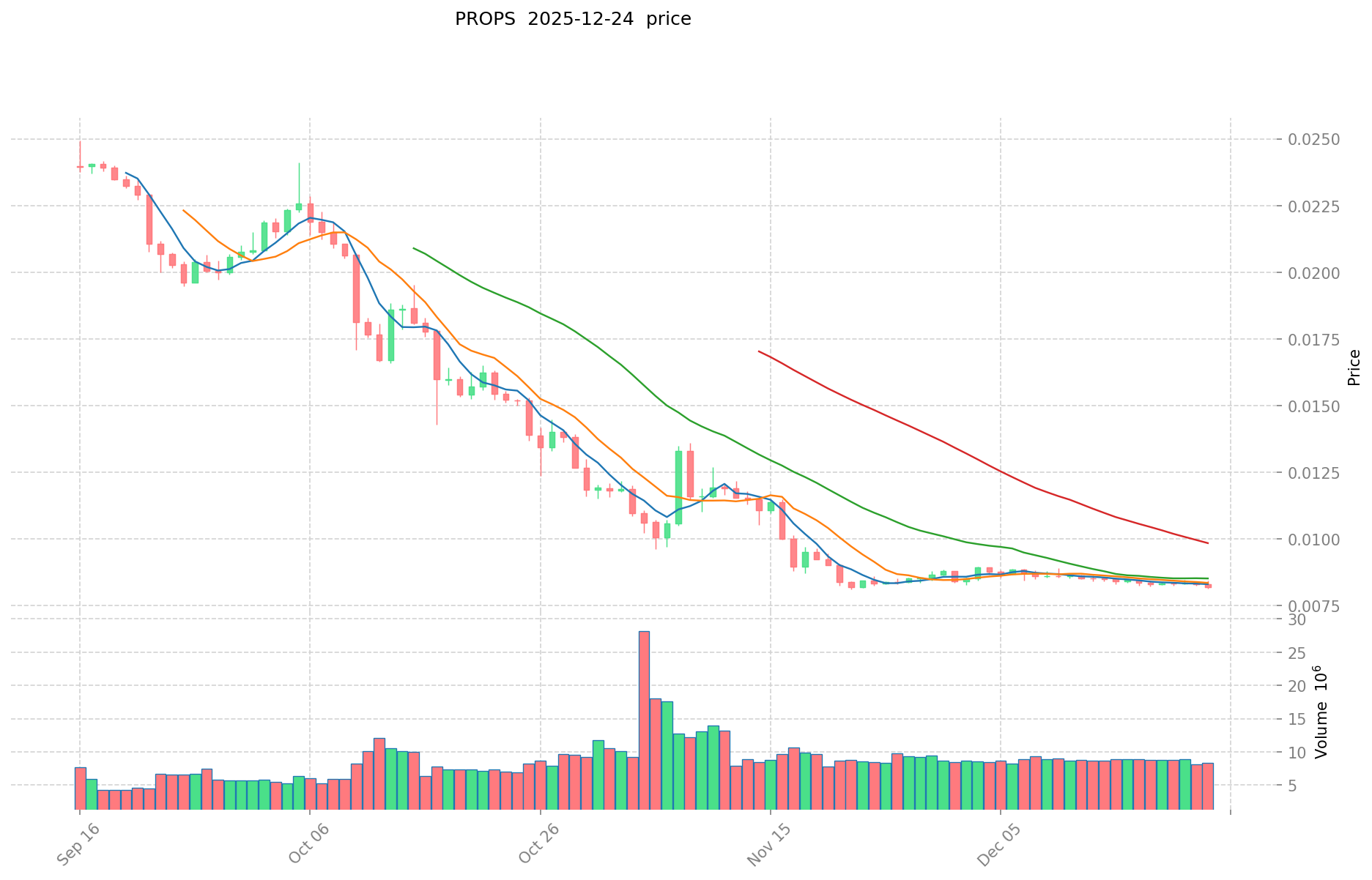
I. Historical Price Comparison and Current Market Status
Propbase (PROPS):
- All-time high: $0.1873 (April 30, 2024)
- All-time low: $0.008092 (November 22, 2025)
- Peak-to-trough decline: 91.16% over the past year
- Current price (December 24, 2025): $0.008163
- Market capitalization: $9,795,600
- Circulating supply: 456,651,279.6 PROPS (38.05% of total supply)
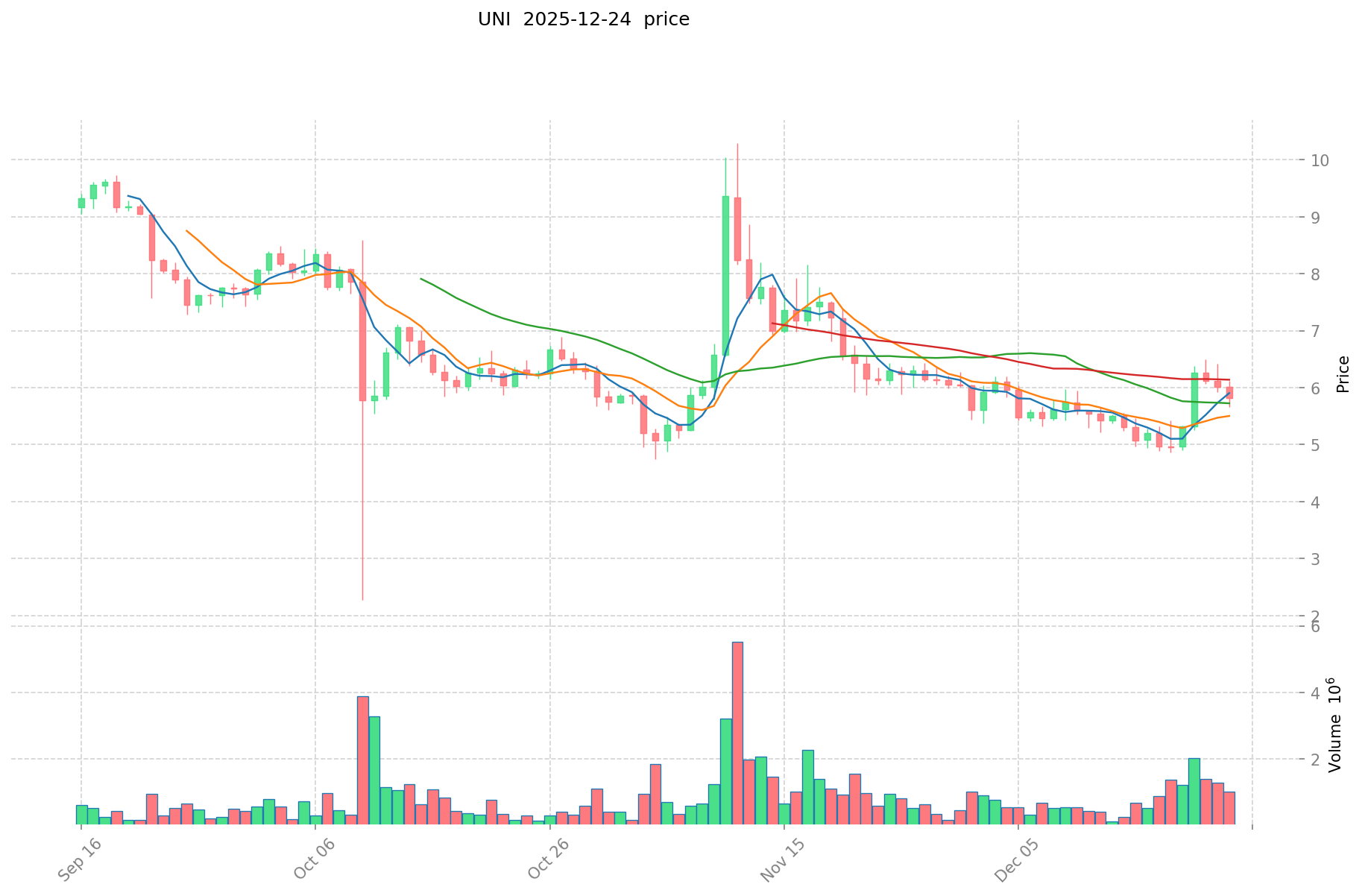
Uniswap (UNI):
- All-time high: $44.92 (May 3, 2021)
- All-time low: $1.03 (September 17, 2020)
- Year-to-date decline: 59.93%
- Current price (December 24, 2025): $5.764
- Market capitalization: $5,764,000,000
- Circulating supply: 629,905,374.01 UNI (62.99% of total supply)
Current Market Status (December 24, 2025)
Propbase (PROPS):
- Current price: $0.008163
- 24-hour trading volume: $69,011.02
- 24-hour price change: -1.67%
- 7-day price change: -3.33%
- Market rank: #1,719
- Active exchanges: 7
Uniswap (UNI):
- Current price: $5.764
- 24-hour trading volume: $6,056,487.77
- 24-hour price change: -5.26%
- 7-day price change: +10.39%
- Market rank: #34
- Active exchanges: 62
Market Sentiment Indicator
- Crypto Fear & Greed Index: 24 (Extreme Fear)
Current pricing information:
II. Project Overview
Propbase (PROPS)
Propbase is a tokenized real estate investment marketplace operating in Southeast Asia. The platform enables investors to purchase fractional ownership of high-quality resilient real estate assets with entry points as low as $100. Users can earn rental yields and maintain liquidity by selling their positions at any time from anywhere globally.
Token Utility:
- PROPS serves as the native utility token
- Functions as the settlement method for all smart contract interactions
- Required for all property transaction fees
- Provides access to new property listings
Technical Infrastructure:
- Blockchain: Aptos
- Contract address: 0x6dba1728c73363be1bdd4d504844c40fbb893e368ccbeff1d1bd83497dbc756d
- Total supply: 1,200,000,000 PROPS
- Token holders: 6,332
Uniswap (UNI)
Uniswap is the pioneering automated market maker (AMM) protocol deployed on the Ethereum blockchain. It facilitates decentralized token exchanges through liquidity pools rather than traditional order books.
Protocol Architecture:
- AMM model allowing peer-to-peer token trading
- Liquidity providers earn trading fees proportional to contributed capital
- Traders access multiple ERC-20 token pairs
- Constant product pricing mechanism ensures continuous trading availability
Token Governance:
- UNI functions as the governance token
- Holders participate in protocol development proposals
- 1 billion UNI total supply (100% committed allocation)
- Distribution: Community (60%), Investors (18.044%), Advisors (0.69%)
III. Market Comparison Analysis
Liquidity and Trading Activity
PROPS:
- 24-hour volume: $69,011.02
- Limited exchange availability: 7 exchanges
- Relatively constrained liquidity profile
- Lower daily trading engagement
UNI:
- 24-hour volume: $6,056,487.77
- Extensive exchange coverage: 62 exchanges
- Substantially higher trading liquidity
- Significant daily trading activity and market depth
Market Capitalization and Valuation
PROPS:
- Market cap: $3,727,644.40 (circulating supply basis)
- Fully diluted valuation: $9,795,600
- Market dominance: 0.00031%
- Market cap to FDV ratio: 38.05%
UNI:
- Market cap: $3,630,774,575.80
- Fully diluted valuation: $5,764,000,000
- Market dominance: 0.18%
- Market cap to FDV ratio: 62.99%
PROPS Performance (Selected Periods):
- 1-hour change: -0.45%
- 24-hour change: -1.67%
- 7-day change: -3.33%
- 30-day change: -2.75%
- 1-year change: -91.16%
UNI Performance (Selected Periods):
- 1-hour change: -1.70%
- 24-hour change: -5.26%
- 7-day change: +10.39%
- 30-day change: -9.81%
- 1-year change: -59.93%
IV. Risk and Opportunity Factors
Propbase (PROPS) Considerations
Strengths:
- Real-world asset tokenization application in growing sector
- Low entry barriers for real estate investment ($100 minimum)
- Rental yield opportunities for token holders
- Emerging market focus (Southeast Asia)
Challenges:
- Significant price depreciation (91.16% year-over-year)
- Minimal liquidity and exchange availability
- Limited trading volume
- Early-stage project maturity
Uniswap (UNI) Considerations
Strengths:
- Established DeFi protocol with proven track record
- Extensive liquidity and high trading volume
- Significant market capitalization and dominance
- Governance participation for UNI holders
- NFT aggregation capabilities (Genie integration)
Challenges:
- Substantial year-to-date price decline (59.93%)
- Ethereum network dependency and gas fee impacts
- Mature market saturation in AMM segment
- Regulatory uncertainties affecting DeFi sector
V. Current Market Environment
The crypto market sentiment has shifted to "Extreme Fear" with the Fear & Greed Index at 24, reflecting widespread market anxiety and conservative positioning. Both PROPS and UNI have experienced recent price pressure within this broader market context, though UNI shows more resilience through weekly gains (+10.39% over 7 days) despite 24-hour volatility.
Disclaimer: This analysis presents factual data and market information as of December 24, 2025. It does not constitute investment advice, price predictions, or recommendations for trading or holding any cryptocurrency assets. Market conditions remain highly volatile and unpredictable. Conduct independent research and consult qualified financial professionals before making investment decisions.
Comparative Analysis Report: PROPS vs UNI - Core Investment Value Factors in Web3 Asset Management
I. Executive Summary
This report analyzes the core investment value factors influencing PROPS and UNI, two digital assets operating within the Web3 ecosystem. Based on available research data, the analysis focuses on tokenomics, market adoption mechanisms, technological development, and macroeconomic influences on these assets.
II. Core Factors Influencing PROPS and UNI Investment Value
Tokenomics and Supply Mechanisms
PROPS:
- Revenue, profit, and cash flow changes directly impact asset valuation.
- The token's value proposition is closely tied to underlying financial performance metrics rather than fixed supply schedules.
UNI:
- New investment announcements significantly influence trading volumes and price dynamics.
- Token value responds to ecosystem expansion and governance initiatives.
📌 Historical Pattern: The differential response mechanisms between these assets demonstrate that PROPS operates under a cash flow-dependent valuation model, while UNI exhibits announcement-driven market sentiment cycles.
Institutional Adoption and Market Application
Institutional Holdings:
- Research indicates that quantitative models identify companies and tokens with highest institutional accumulation levels through fund sentiment scoring systems.
- Institutional investors apply multi-factor analytical frameworks to assess concentration metrics.
Enterprise Integration:
- Both PROPS and UNI operate within the Web3 asset management and tokenization investment models framework.
- Application scope includes ecosystem participation and protocol governance mechanisms.
Regulatory Environment:
- Changes in jurisdictional regulatory frameworks represent material variables affecting both assets.
- Regulatory shifts across different geographic regions influence institutional participation willingness.
Technological Development and Ecosystem Building
The reference materials indicate that technological development serves as a core factor in asset valuation, though specific technical upgrades for PROPS and UNI are not detailed in the provided sources.
Ecosystem Considerations:
- Supply mechanism differentiation
- Institutional adoption capabilities
- Geographic regulatory alignment
- Macroeconomic condition responsiveness
Macroeconomic Conditions and Regulatory Variables
Key Influencing Factors:
- Macroeconomic conditions affecting valuation frameworks
- Regulatory changes across jurisdictions
- Market adoption rates
- Ecosystem development trajectories
III. Comparative Value Framework
| Factor |
Impact Mechanism |
| Supply Mechanism |
PROPS: Profit/cash flow dependent; UNI: Announcement-driven |
| Institutional Participation |
Multi-factor quantitative assessment models |
| Regulatory Environment |
Jurisdictional changes create material value implications |
| Ecosystem Development |
Building critical mass for ecosystem utility |
IV. Limitations and Data Constraints
The provided source materials contain references to PROPS and UNI comparative analysis frameworks but do not provide sufficient granular detail regarding:
- Specific tokenomics parameters (supply caps, emission schedules)
- Current institutional holdings concentrations
- Detailed technological roadmaps
- Precise regulatory policy positions by jurisdiction
Research Date: December 24, 2025
Disclaimer: This analysis is based on available reference materials and does not constitute investment advice. Digital asset valuation involves substantial risk and uncertainty. Past performance patterns do not guarantee future results.
III. 2025-2030 Price Forecast: PROPS vs UNI
Short-term Forecast (2025)
- PROPS: Conservative $0.0074 - $0.0099 | Optimistic $0.0099 - $0.0110
- UNI: Conservative $4.28 - $5.71 | Optimistic $5.71 - $7.76
Mid-term Forecast (2027-2028)
- PROPS is expected to enter a consolidation phase with moderate growth, projected price range of $0.0086 - $0.0173
- UNI is expected to enter a strengthening phase, projected price range of $4.83 - $11.18
- Key drivers: institutional capital inflows, spot ETF approvals, ecosystem development acceleration
Long-term Forecast (2030)
- PROPS: Base case $0.0139 - $0.0163 | Optimistic scenario $0.0163 - $0.0232
- UNI: Base case $7.62 - $10.03 | Optimistic scenario $10.03 - $10.53
View detailed price forecasts for PROPS and UNI
Disclaimer
The forecasts presented above are based on historical data and market analysis models. Cryptocurrency markets are highly volatile and subject to rapid changes driven by regulatory developments, technological innovations, and macroeconomic conditions. These predictions should not be considered as investment advice. Past performance does not guarantee future results. Investors should conduct their own research and consult with financial advisors before making investment decisions.
PROPS:
| 年份 |
预测最高价 |
预测平均价格 |
预测最低价 |
涨跌幅 |
| 2025 |
0.01099305 |
0.008143 |
0.00741013 |
0 |
| 2026 |
0.01349091525 |
0.009568025 |
0.00564513475 |
17 |
| 2027 |
0.017063615785 |
0.011529470125 |
0.00864710259375 |
41 |
| 2028 |
0.01729881697555 |
0.014296542955 |
0.00900682206165 |
75 |
| 2029 |
0.016903517562844 |
0.015797679965275 |
0.010584445576734 |
93 |
| 2030 |
0.023217850244964 |
0.016350598764059 |
0.01389800894945 |
100 |
UNI:
| 年份 |
预测最高价 |
预测平均价格 |
预测最低价 |
涨跌幅 |
| 2025 |
7.76424 |
5.709 |
4.28175 |
0 |
| 2026 |
9.0270708 |
6.73662 |
4.1767044 |
16 |
| 2027 |
9.06412221 |
7.8818454 |
6.69956859 |
36 |
| 2028 |
11.1843386226 |
8.472983805 |
4.82960076885 |
46 |
| 2029 |
10.221807662352 |
9.8286612138 |
6.781776237522 |
70 |
| 2030 |
10.5264961599798 |
10.025234438076 |
7.61917817293776 |
73 |
Comparative Analysis Report: PROPS vs UNI Investment Strategy
I. Investment Strategy Comparison: PROPS vs UNI
Long-term vs Short-term Investment Strategy
PROPS:
- Suitable for investors seeking real-world asset tokenization exposure and rental yield generation opportunities in emerging Southeast Asian markets
- Long-term strategy focuses on ecosystem maturation and institutional adoption of tokenized real estate
- Short-term strategy confronts significant volatility with 91.16% year-over-year depreciation
UNI:
- Suitable for investors targeting established DeFi protocol participation and governance involvement
- Long-term strategy capitalizes on mature AMM infrastructure and ecosystem expansion potential
- Short-term strategy benefits from demonstrated liquidity and trading volume resilience despite broader market headwinds
Risk Management and Asset Allocation
Conservative Investor Profile:
- PROPS: 5-10% allocation (speculative, early-stage project exposure)
- UNI: 15-25% allocation (established protocol with proven infrastructure)
- Hedge instruments: Stablecoin reserves (60-70%), diversified DeFi protocol exposure
Aggressive Investor Profile:
- PROPS: 20-30% allocation (higher risk tolerance for emerging market tokenization)
- UNI: 25-35% allocation (core DeFi protocol position)
- Hedge instruments: Options strategies, cross-protocol liquidity provision, dollar-cost averaging accumulation during fear periods
II. Potential Risk Comparison
Market Risk
PROPS:
- Extreme price volatility with 91.16% peak-to-trough decline over 12 months
- Limited liquidity profile with 24-hour trading volume of $69,011.02
- Concentration risk from early-stage project maturity and small investor base (6,332 token holders)
- Market capitalization of $9,795,600 creates susceptibility to significant price swings from modest trading volumes
UNI:
- Year-to-date decline of 59.93% reflecting broader DeFi sector headwinds
- Dependency on Ethereum network conditions and variable gas fee environment
- Competitive pressure from emerging AMM alternatives (Curve, Balancer, newer protocols)
- Mature market saturation potentially limiting explosive growth trajectories
Technical Risk
PROPS:
- Aptos blockchain dependency and cross-chain bridge vulnerabilities
- Early-stage smart contract maturity with limited audit history and security track record
- Scaling challenges for real estate asset transaction verification and settlement
- Real-world asset oracle dependency creating potential data integrity vulnerabilities
UNI:
- Ethereum network congestion during peak trading periods affecting transaction throughput
- Smart contract complexity in AMM mechanisms creating potential exploit vectors
- Liquidity fragmentation across multiple chains through bridge protocols
- Impermanent loss exposure for liquidity providers in volatile market conditions
Regulatory Risk
PROPS:
- Real estate tokenization regulatory frameworks remain underdeveloped across Southeast Asian jurisdictions
- Potential restrictions on foreign investor participation in regional real estate markets
- Varying treatment of tokenized assets across different regulatory regimes
- Compliance burden for cross-border real estate settlement and tax reporting
UNI:
- DeFi protocol regulatory uncertainty intensifying across major jurisdictions (US, EU, APAC)
- Potential classification challenges regarding protocol governance token status
- Enhanced scrutiny on decentralized exchange compliance with financial regulations
- Regulatory changes affecting institutional participation willingness and capital flows
III. Conclusion: Which Is the Better Buy?
Investment Value Summary
PROPS Advantages:
- Exposure to tokenized real estate innovation in emerging markets with tangible asset backing
- Lower absolute entry price enabling broader participation
- Rental yield generation providing potential cash flow beyond price appreciation
- Untapped addressable market in Southeast Asian real estate sector
UNI Advantages:
- Established protocol with 5+ year operational track record and proven technology stack
- Significantly higher trading liquidity (87x volume advantage) enabling flexible position management
- Institutional-grade market infrastructure with 62 active exchange listings
- Demonstrated governance participation and ecosystem development commitment
- Weekly price performance resilience (+10.39% over 7 days) amid broader market weakness
Investment Recommendations
Beginner Investors:
- Prioritize UNI allocation over PROPS due to established infrastructure, superior liquidity, and reduced technology risk
- Consider allocating 70-80% to UNI and limiting PROPS exposure to 5-10% speculative allocation
- Utilize dollar-cost averaging strategy during extreme fear market conditions (Fear & Greed Index below 30)
- Focus on understanding protocol mechanics before governance participation
Experienced Investors:
- Implement tactical allocation strategies utilizing PROPS volatility for swing trading opportunities (risk-reward consideration given extreme price swings)
- Build larger UNI positions leveraging governance participation and ecosystem development insights
- Structure positions accounting for Ethereum network condition variations and gas fee impacts
- Consider real estate tokenization thesis validity and Southeast Asian regulatory trajectory assessment for PROPS sizing decisions
Institutional Investors:
- UNI represents primary institutional allocation candidate given market capitalization ($5.764 billion), established governance framework, and regulatory clarity trajectory
- Evaluate PROPS only after institutional-grade security audits, regulatory clarity in target markets, and institutional investor infrastructure development
- Implement multi-layered risk assessment including real estate market fundamentals, regulatory mapping, and operational team credibility evaluation
- Utilize both assets within diversified DeFi and tokenization exposure frameworks rather than concentrated single-asset positions
⚠️ Risk Disclaimer: Cryptocurrency markets exhibit extreme volatility and rapid directional changes. This analysis presents factual data and comparative frameworks as of December 24, 2025, and does not constitute investment advice, price predictions, or asset recommendations. Digital assets carry substantial risk including total capital loss potential. Regulatory environments remain fluid and subject to rapid policy shifts affecting valuations. Conduct independent research, perform personal risk assessment, and consult qualified financial professionals before making investment decisions.
None
PROPS vs UNI Investment Comparison: FAQ Guide
I. FAQ
Q1: What are the main differences between PROPS and UNI in terms of current market performance?
A: As of December 24, 2025, PROPS trades at $0.008163 with a market capitalization of $9.8 million and 24-hour trading volume of $69,011, while UNI trades at $5.764 with a market capitalization of $5.764 billion and 24-hour trading volume of $6.06 million. UNI demonstrates approximately 87 times higher trading volume and significantly broader exchange availability (62 vs. 7 exchanges). PROPS has experienced a severe 91.16% year-over-year price decline, while UNI shows a 59.93% year-to-date decline. UNI demonstrates weekly resilience with a +10.39% 7-day gain despite 24-hour market weakness.
Q2: What are the underlying use cases and applications of PROPS and UNI?
A: PROPS operates as a tokenized real estate investment marketplace in Southeast Asia, enabling fractional ownership of physical properties with rental yield generation and minimum entry points of $100. The PROPS token serves as the settlement mechanism for smart contracts and property transactions. UNI functions as an automated market maker (AMM) protocol on Ethereum, facilitating decentralized peer-to-peer token trading through liquidity pools. UNI tokens grant governance rights enabling holders to participate in protocol development decisions and ecosystem improvements.
Q3: Which asset presents lower risk for beginner investors?
A: UNI presents significantly lower risk for beginner investors due to its established 5+ year operational track record, substantially higher liquidity ($6.06 million daily volume), institutional-grade infrastructure with 62 active exchanges, and proven technology stack. PROPS carries substantially higher risks including extreme price volatility (91.16% year-over-year decline), limited liquidity ($69,011 daily volume), early-stage project maturity, and real estate tokenization regulatory uncertainty across Southeast Asian jurisdictions. Beginner investors should prioritize UNI allocation at 70-80% with only 5-10% speculative PROPS exposure.
Q4: What is the price outlook for both assets through 2030?
A: PROPS demonstrates a conservative forecast range of $0.0074-$0.0099 through 2025 with base case projections reaching $0.0139-$0.0163 by 2030, representing approximately 93-100% potential gains from current price levels. UNI shows conservative 2025 forecast of $4.28-$5.71 with base case 2030 projections of $7.62-$10.03, representing approximately 32-73% potential upside. Key forecast drivers include institutional capital inflows, regulatory clarity development, and ecosystem maturation. However, cryptocurrency markets remain highly volatile and these projections carry substantial uncertainty.
Q5: What are the primary technological and regulatory risks associated with each asset?
A: PROPS faces Aptos blockchain dependency vulnerabilities, early-stage smart contract security concerns, real-world asset oracle data integrity risks, and underdeveloped real estate tokenization regulatory frameworks across Southeast Asia. Potential foreign investor participation restrictions and varying cross-border compliance requirements represent additional regulatory challenges. UNI encounters Ethereum network congestion impacts on transaction throughput, AMM smart contract complexity risks, liquidity fragmentation across multiple blockchain bridges, and intensifying DeFi regulatory uncertainty globally regarding protocol token classification and compliance obligations.
Q6: How should conservative investors allocate between PROPS and UNI?
A: Conservative investors should construct portfolios allocating 15-25% to UNI (established protocol with proven infrastructure), 5-10% to PROPS (speculative early-stage exposure), and maintain 60-70% stablecoin reserves. This allocation approach limits downside exposure while maintaining tokenization ecosystem participation. Dollar-cost averaging during extreme fear market conditions (Fear & Greed Index below 30) enhances risk-adjusted returns. Conservative investors should avoid leveraged positions and prioritize understanding protocol mechanics before governance token participation decisions.
Q7: What makes UNI attractive for institutional investors compared to PROPS?
A: UNI presents institutional-grade investment characteristics including $5.764 billion market capitalization enabling substantial position sizing without excessive price impact, established governance framework enabling institutional protocol participation, institutional-standard security audit history and infrastructure maturity, 62 active exchange listings providing execution flexibility, and emerging regulatory clarity trajectory. PROPS requires institutional-grade security audits, Southeast Asian regulatory mapping completion, real estate market fundamentals validation, and institutional investor infrastructure development before suitable for significant institutional deployment. UNI should constitute primary institutional allocation within tokenization exposure frameworks.
Q8: What macroeconomic and market conditions currently favor each asset?
A: Current market conditions characterized by "Extreme Fear" (Fear & Greed Index at 24) present contrasting implications: UNI demonstrates weekly resilience (+10.39% over 7 days) during fear periods suggesting established protocol institutional accumulation patterns, while PROPS exhibits concentrated negative momentum (-3.33% weekly change) reflecting reduced speculative appetite for extreme-risk assets. Broader market sentiment shifts toward conservative positioning disadvantage early-stage PROPS projects but paradoxically create dollar-cost averaging opportunities for established protocols like UNI. Macroeconomic headwinds affecting cryptocurrency valuations generally impact both assets, though PROPS faces compounded real estate sector cyclicality risks.
Disclaimer: This FAQ presents factual market data and comparative analysis as of December 24, 2025. Cryptocurrency markets remain highly volatile with substantial capital loss risk. These responses do not constitute investment advice, price predictions, or asset recommendations. Conduct independent research and consult qualified financial professionals before making investment decisions.
* The information is not intended to be and does not constitute financial advice or any other recommendation of any sort offered or endorsed by Gate.