# Article Overview: RENA vs SOL Investment Comparison
This comprehensive analysis compares RENA and SOL across price performance, tokenomics, ecosystem development, and investment potential through 2031. RENA (Warena) represents a high-risk gaming metaverse token, while SOL (Solana) offers established blockchain infrastructure with 65,000 TPS capacity and 250+ active projects. The article addresses critical investment questions: which token suits different investor profiles, how market risks differ, and optimal allocation strategies. Designed for beginner to institutional investors, it provides price forecasts, risk assessments, and actionable recommendations through detailed comparisons on Gate. SOL emerges as the stable infrastructure play, while RENA appeals to speculative investors seeking recovery potential from depressed valuations.
---
**Key Differences:**
- **RENA**: $0.0005118 | 99.99% decline | Gaming/metaverse focus | Minimal liquidity
- **SOL**: $135.35 | 53.8% decline | Infrastructure backbone
Introduction: RENA vs SOL Investment Comparison
In the cryptocurrency market, comparisons between RENA and SOL remain a topic investors cannot overlook. The two assets differ significantly in market capitalization ranking, application scenarios, and price performance, representing distinct positioning within the crypto asset landscape.
RENA (RENA): Warena provides a play-to-earn metaverse platform featuring NFT gaming mechanics. Players can personalize game characters, participate in survival action gameplay, trade NFTs and warriors, and engage in tournaments across different in-game lands.
SOL (SOL): Founded at the end of 2017 by former engineers from Qualcomm, Intel, and Dropbox, Solana is a single-chain delegated proof-of-stake protocol designed to provide scalability without compromising decentralization or security. It has emerged as a high-performance blockchain infrastructure layer.
This article will comprehensively analyze the investment value comparison between RENA and SOL across historical price performance, supply mechanisms, ecosystem development, and market positioning, while addressing the fundamental question investors care most about:
"Which is the better buy right now?"
Warena (RENA) vs Solana (SOL) - Price History Comparison and Market Status
I. Price History Comparison and Current Market Status
RENA (Warena) and SOL (Solana) Historical Price Trends
- November 2021: RENA reached its all-time high of $6.71 during the peak of the cryptocurrency bull market cycle.
- January 2025: SOL achieved its all-time high of $293.31, reflecting sustained institutional adoption and ecosystem growth.
- Comparative Analysis: Since its all-time high, RENA has experienced a significant decline from $6.71 to its current level, representing a price contraction of approximately 99.99% as of the reporting date. In contrast, SOL has demonstrated greater market resilience, declining from its peak of $293.31 to $135.35, representing approximately a 53.8% decline, while maintaining a significantly larger market capitalization and trading volume ecosystem.
Current Market Status (January 5, 2026)
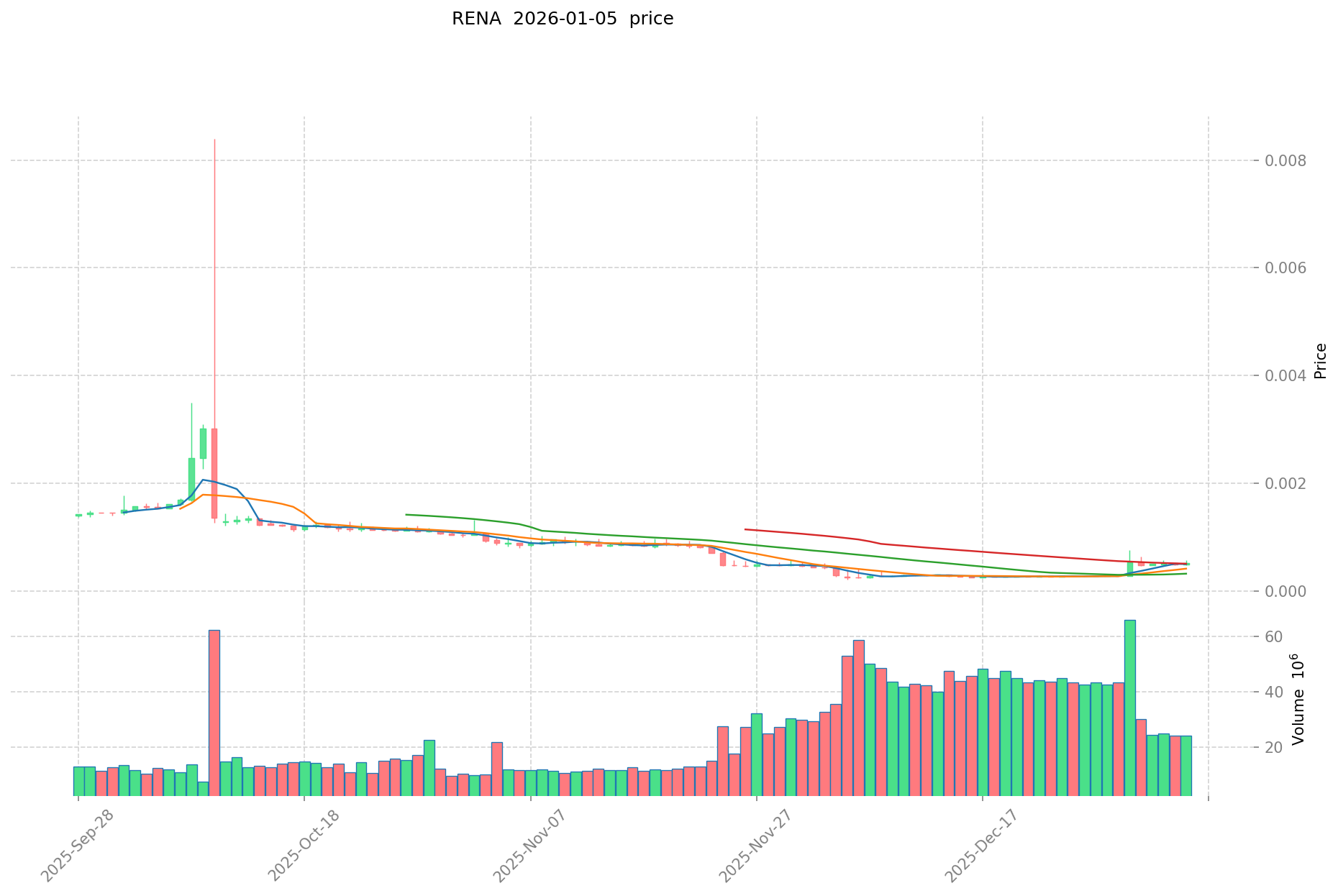
- RENA current price: $0.0005118.
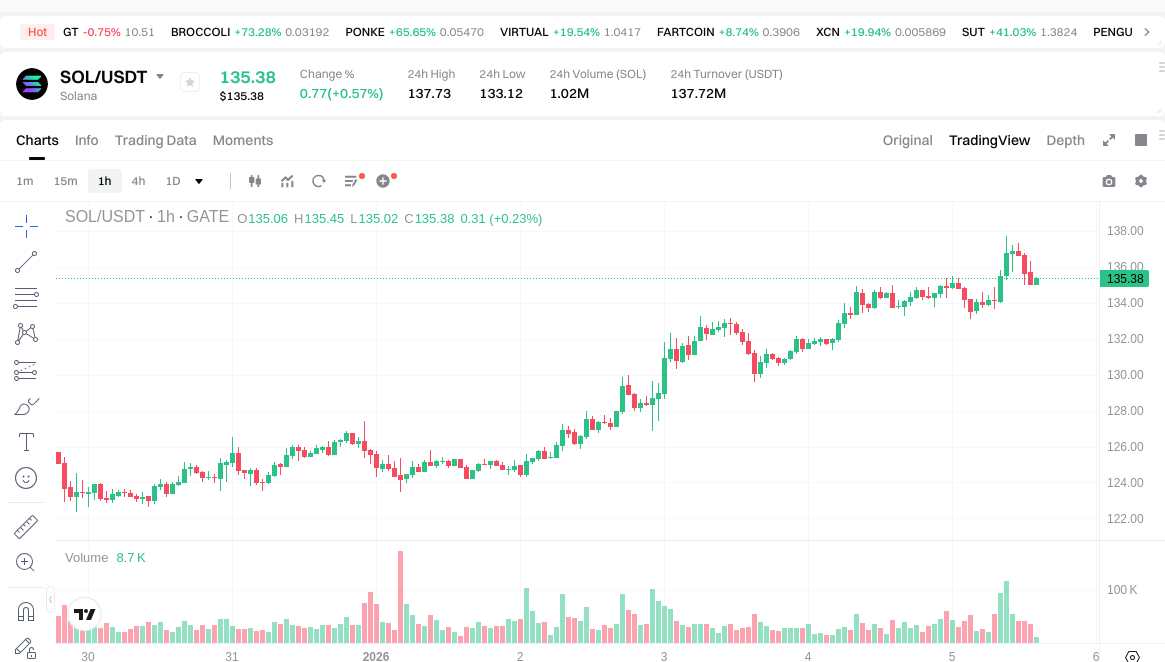
- SOL current price: $135.35.
- 24-hour trading volume: RENA $12,158.85 vs SOL $137,559,573.33.
- Market sentiment index (Fear & Greed Index): 26 (Fear).
Click to view real-time prices:
II. Core Factors Affecting RENA vs SOL Investment Value
Tokenomics Comparison
- SOL: Solana's native token operates within the Proof of History (PoH) + Proof of Stake (PoS) consensus mechanism. SOL is used for transaction fees, staking participation, and ecosystem governance. The token supports network operations and dApp functionality on the Solana blockchain.
- RENA: Limited information available in reference materials regarding RENA's specific tokenomics, supply mechanism, or emission schedule.
- 📌 Historical Patterns: SOL's price cycles have been influenced by network upgrades, ecosystem expansion in DeFi and NFT sectors, and broader market sentiment toward high-performance blockchain solutions.
Institutional Adoption and Market Applications
- Institutional Holdings: SOL is listed on major cryptocurrency exchanges including Binance, Coinbase, and others, demonstrating significant liquidity and institutional accessibility. RENA's institutional adoption status is not documented in available references.
- Enterprise Adoption: SOL is applied in DeFi lending platforms, NFT minting and trading, GameFi, and Web3 payment solutions. Transaction costs below $0.01 USD make SOL suitable for micropayments and high-frequency operations. RENA's specific use cases and applications are not specified in the provided materials.
- Regulatory Environment: Different jurisdictions maintain varying oversight approaches toward cryptocurrency tokens. SOL benefits from availability on major regulated exchanges, while RENA's regulatory status remains unclear from available sources.
Technological Development and Ecosystem Construction
- SOL Technical Architecture: Solana achieves up to 65,000 TPS through its hybrid consensus mechanism, supporting both vertical scaling (hardware upgrades) and horizontal scaling (node expansion). The parallel execution capability of Solana smart contracts enables simultaneous processing of multiple non-conflicting transactions, optimizing GPU and CPU resource utilization. Technology upgrades typically enhance investor confidence in network stability and can trigger price appreciation.
- Ecosystem Comparison: Solana's ecosystem spans over 250 active projects across DeFi, NFT, Web3 gaming, decentralized AI (DePIN x AI), data infrastructure, and payment solutions. The ecosystem includes major platforms and protocols deployed on the network, directly driving demand for SOL as adoption scenarios expand.
- RENA Ecosystem: Available references indicate RENA's presence within Solana's broader ecosystem landscape but provide insufficient detail regarding its specific technological features or ecosystem role.
Macroeconomic Environment and Market Cycles
- Inflation Environment Performance: SOL's low transaction fees and scalability position it as a practical utility token for value transfer in periods of economic uncertainty. As a blockchain infrastructure token, SOL benefits from increased activity on the Solana network.
- Monetary Policy Impact: SOL price volatility results from multiple factors including technical advancements, market sentiment, macroeconomic policy changes, and market fluctuations. Central bank interest rate policies and U.S. dollar index movements influence cryptocurrency valuations generally.
- Geopolitical Factors: Cross-border transaction demand and international circumstances can influence adoption of high-performance blockchain solutions like Solana for global payment and settlement use cases.
III. 2026-2031 Price Forecast: RENA vs SOL
Short-term Forecast (2026)
- RENA: Conservative $0.000337-$0.000511 | Bullish $0.000511-$0.000669
- SOL: Conservative $86.65-$135.39 | Bullish $135.39-$167.88
Mid-term Forecast (2027-2028)
- RENA may enter accumulation phase, expected price range $0.000513-$0.000885
- SOL may enter growth phase, expected price range $92.50-$229.27
- Key drivers: institutional capital inflows, ETF adoption, ecosystem development
Long-term Forecast (2029-2031)
- RENA: Base case $0.000515-$0.000780 | Bullish case $0.000811-$0.001268
- SOL: Base case $122.53-$211.26 | Bullish case $225.99-$366.75
View detailed price forecasts for RENA and SOL
RENA:
| 年份 |
预测最高价 |
预测平均价格 |
预测最低价 |
涨跌幅 |
| 2026 |
0.000669017 |
0.0005107 |
0.000337062 |
0 |
| 2027 |
0.000760917465 |
0.0005898585 |
0.000513176895 |
15 |
| 2028 |
0.000884758257075 |
0.0006753879825 |
0.00058083366495 |
31 |
| 2029 |
0.000811276044579 |
0.000780073119787 |
0.000514848259059 |
52 |
| 2030 |
0.001169641635809 |
0.000795674582183 |
0.00052514522424 |
55 |
| 2031 |
0.001267628960605 |
0.000982658108996 |
0.000697687257387 |
92 |
SOL:
| 年份 |
预测最高价 |
预测平均价格 |
预测最低价 |
涨跌幅 |
| 2026 |
167.8836 |
135.39 |
86.6496 |
0 |
| 2027 |
175.898688 |
151.6368 |
92.498448 |
12 |
| 2028 |
229.2748416 |
163.767744 |
145.75329216 |
20 |
| 2029 |
225.99948672 |
196.5212928 |
159.182247168 |
45 |
| 2030 |
312.6653768448 |
211.26038976 |
122.5310260608 |
56 |
| 2031 |
366.74803662336 |
261.9628833024 |
246.245110304256 |
93 |
IV. Investment Strategy Comparison: RENA vs SOL
Long-term vs Short-term Investment Strategies
- RENA: Suited for investors focused on high-risk, high-reward gaming and metaverse ecosystem participation, with tolerance for extreme volatility and potential recovery scenarios
- SOL: Suited for investors seeking exposure to established blockchain infrastructure, institutional-grade stability, and ecosystem-driven utility with moderate growth potential
Risk Management and Asset Allocation
- Conservative Investors: RENA 0-5% vs SOL 20-30%
- Aggressive Investors: RENA 10-20% vs SOL 30-40%
- Hedging Tools: Stablecoin allocation 30-50%, options strategies for downside protection, cross-asset diversification with Bitcoin and Ethereum
V. Potential Risk Comparison
Market Risk
- RENA: Extreme price volatility with 99.99% decline from all-time high, minimal trading liquidity ($12,158.85 daily volume), high susceptibility to pump-and-dump dynamics, limited institutional market support
- SOL: Moderate volatility with 53.8% decline from peak, substantial trading volume ($137,559,573.33 daily), mature market infrastructure, sensitivity to broader cryptocurrency market sentiment and macroeconomic factors
Technology Risk
- RENA: Insufficient technical documentation available regarding network stability, smart contract security, or scalability architecture
- SOL: Network stability proven through 65,000 TPS capacity and parallel execution architecture; potential concentration risks in validator distribution; historical network outages addressed through protocol upgrades
Regulatory Risk
- RENA: Regulatory status unclear; gaming and NFT-based tokens face varying jurisdictional scrutiny; limited presence on regulated exchanges increases compliance uncertainty
- SOL: Listed on major regulated exchanges (Binance, Coinbase) with established regulatory frameworks in multiple jurisdictions; benefits from mainstream cryptocurrency market oversight
VI. Conclusion: Which Is the Better Buy?
📌 Investment Value Summary:
- RENA Advantages: Potential for significant recovery from depressed valuations; participation in gaming and metaverse ecosystem; speculative upside potential documented in forecasts
- SOL Advantages: Established market infrastructure with 65,000 TPS technical capabilities; diversified ecosystem spanning 250+ active projects; institutional adoption through major exchanges; institutional-grade liquidity; proven technology resilience; consistent demand drivers across DeFi, NFT, GameFi, and payment solutions
✅ Investment Recommendations:
- Beginner Investors: Allocate to SOL for blockchain infrastructure exposure with established risk management frameworks; avoid RENA due to extreme volatility and liquidity constraints
- Experienced Investors: Consider SOL as core position (60-70%) for stable ecosystem-driven returns; allocate limited RENA exposure (5-10%) only if accepting extreme downside risk for speculative recovery scenarios
- Institutional Investors: SOL presents suitable institutional-grade asset with regulated exchange access, adequate liquidity for position sizing, and clear macroeconomic utility thesis; RENA insufficient liquidity and regulatory clarity for institutional allocation
⚠️ Risk Disclaimer: Cryptocurrency markets demonstrate extreme volatility. This article does not constitute investment advice. Investors should conduct independent research and consult financial advisors before making investment decisions.
FAQ
RENA和SOL分别是什么?各自的主要用途是什么?
SOL是Solana网络的原生代币,主要用于支付交易费、Staking质押获得奖励以及确保网络安全。RENA是基于Solana生态的应用代币,主要用途根据其项目定位提供生态激励和治理功能。
RENA和SOL在技术架构上有什么区别?
RENA采用TEE隐私计算技术架构,强调安全性和隐私保护;SOL基于Proof-of-History共识机制,专注于高吞吐量和低交易延迟。两者技术路线不同,应用场景各异。
RENA和SOL的交易速度和费用如何对比?
SOL交易速度极快,平均确认时间约400毫秒,交易费用极低,通常仅需0.00018美元。RENA作为新兴项目,具体指标需参考其官方文档。SOL在速度和费用上具有显著优势。
RENA和SOL各自的生态应用有哪些?
SOL生态包括DeFi、NFT市场(Magic Eden、Tensor)、链游(Aurory、Star Atlas)等应用。SOL用于支付交易费、质押和治理投票。RENA信息暂无详细公开生态应用数据。
从投资角度看,RENA和SOL哪个更值得关注?
SOL作为成熟公链,生态完整、应用丰富,适合稳健投资。RENA作为新兴项目,增长潜力更大。若看重稳定性选SOL,若追求高收益可关注RENA的发展潜力。
RENA和SOL的风险因素分别是什么?
RENA的风险因素包括市场波动和技术故障。SOL的风险因素包括网络拥堵和智能合约漏洞。
RENA和SOL的市场流动性和交易额如何对比?
SOL作为主流公链代币,市场流动性和交易额远超RENA。SOL日均交易额通常达数十亿美元,流动性充足;而RENA作为新兴代币,流动性相对较低,交易额也明显小于SOL,但发展潜力值得关注。
* The information is not intended to be and does not constitute financial advice or any other recommendation of any sort offered or endorsed by Gate.