This comprehensive investment guide compares REZ and BNB tokens through multiple analytical dimensions to help cryptocurrency investors make informed decisions. REZ, launched in April 2024 as a Liquid Restaking Token for EigenLayer, offers higher staking yields but faces significant volatility with a 98.4% decline from peak prices. BNB, Binance's native utility token since 2017, maintains substantial trading volume and established market presence. The analysis examines price trends, tokenomics, institutional adoption, technical ecosystems, and risk factors across 2026-2031 forecasts. BNB suits conservative investors prioritizing stability and liquidity, while REZ appeals to aggressive investors seeking exposure to emerging DeFi innovations. Recommended allocations vary by risk profile: conservative investors should favor BNB at 85-90% allocation, while experienced traders may diversify across both assets. Current market conditions show extreme fear sentiment, creating distinct opportunities and risks for each
Introduction: Investment Comparison Between REZ and BNB
In the cryptocurrency market, the comparison between REZ and BNB remains a topic that investors cannot bypass. The two differ significantly in market cap ranking, application scenarios, and price performance, representing distinct positioning within the crypto asset landscape.
REZ (Renzo): Launched in April 2024, it has gained market recognition through its positioning as a Liquid Restaking Token (LRT) and Strategy Manager for EigenLayer, offering higher yields than traditional ETH staking.
BNB (Binance Coin): Since its launch in July 2017, it has been recognized as the native utility token of the Binance ecosystem, serving as one of the cryptocurrencies with substantial global trading volume and market capitalization.
This article will comprehensively analyze the investment value comparison between REZ and BNB through historical price trends, supply mechanisms, institutional adoption, technological ecosystems, and future predictions, attempting to address the question that investors care about most:
"Which is the better buy right now?"
I. Price History Comparison and Current Market Status
REZ and BNB Historical Price Trends
- 2024: REZ reached a peak price of 0.265 USDT on April 30, 2024, following its initial listing and launch in the EigenLayer ecosystem.
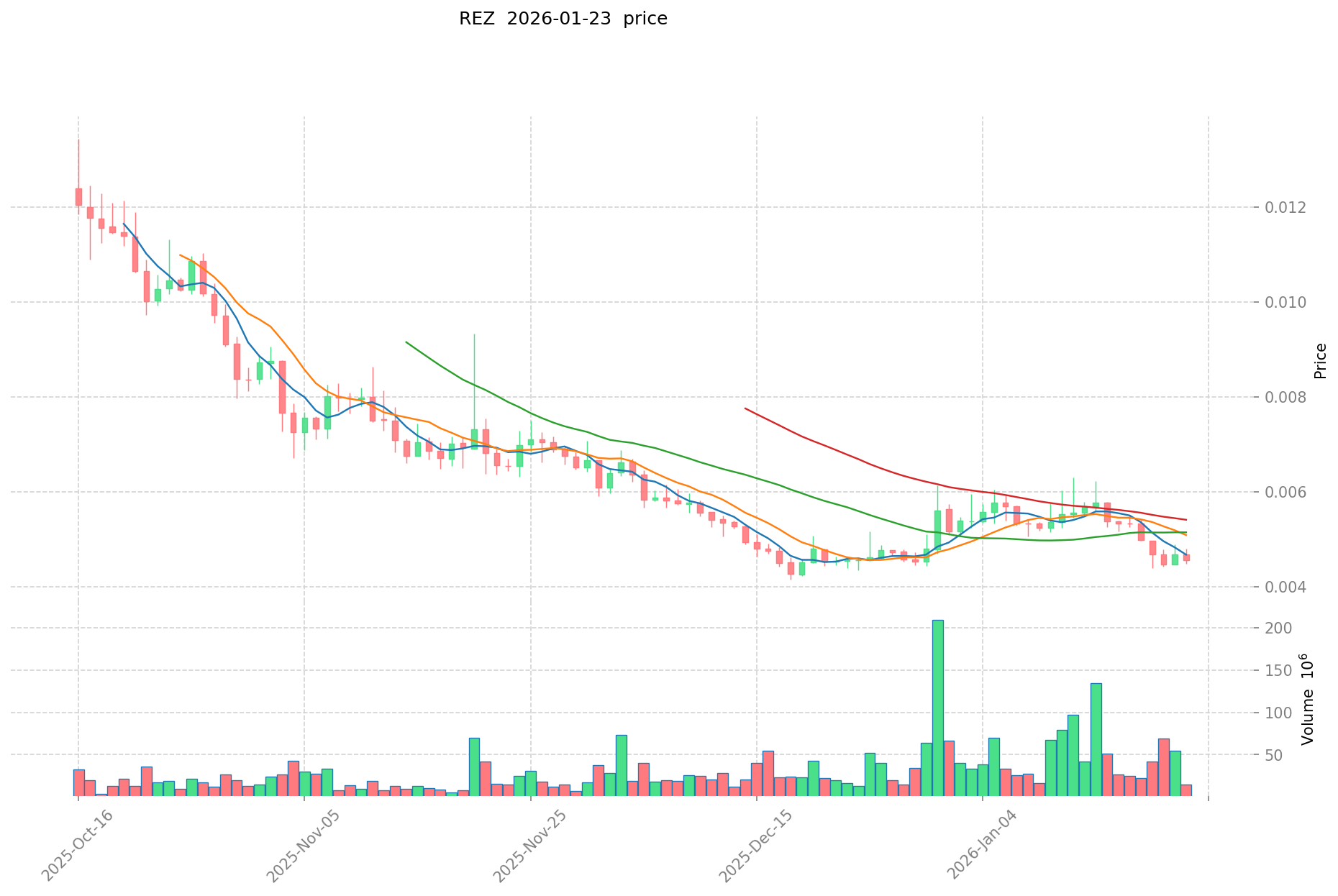
- 2025: REZ experienced significant downward pressure, declining to an all-time low of 0.004148 USDT on December 18, 2025.
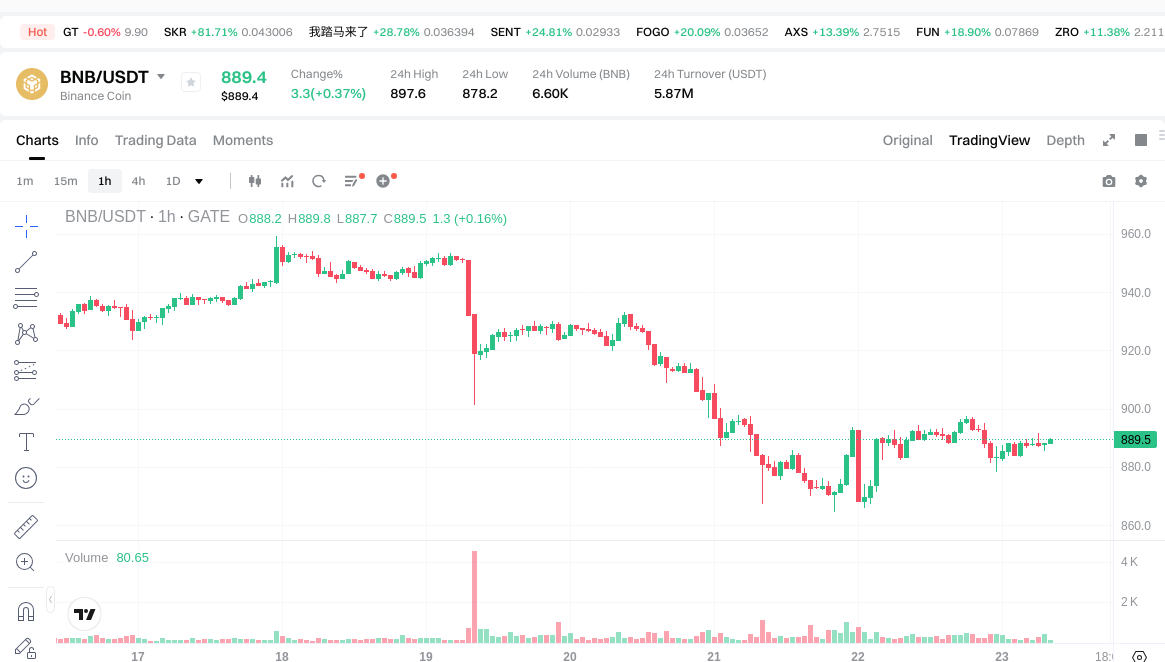
- Historical comparison: BNB demonstrated more stable long-term performance, with its all-time high of 1369.99 USDT recorded on October 13, 2025, while maintaining a price above 878 USDT as of January 2026. In contrast, REZ has declined approximately 98.4% from its historical peak.
Current Market Status (January 23, 2026)
- REZ current price: 0.004586 USDT
- BNB current price: 888.3 USDT
- 24-hour trading volume: REZ recorded 68,697.07 USDT versus BNB's 5,870,940.66 USDT
- Market sentiment index (Fear & Greed Index): 20 (Extreme Fear)
Check real-time prices:
II. Core Factors Affecting the Investment Value of REZ vs BNB
Supply Mechanism Comparison (Tokenomics)
Due to the absence of specific tokenomics data in the provided materials, a direct comparison of supply mechanisms between REZ and BNB cannot be established at this time.
Institutional Adoption and Market Application
Without available data on institutional holdings, enterprise adoption patterns, or specific national policy frameworks regarding these assets, a comprehensive analysis of their comparative market applications cannot be provided.
Technical Development and Ecosystem Building
The provided materials do not contain information about technical upgrades, development roadmaps, or ecosystem implementations for either REZ or BNB. Therefore, a comparative assessment of their technical trajectories and ecosystem maturity levels cannot be conducted.
Macroeconomic Factors and Market Cycles
In the absence of historical performance data, correlation metrics with macroeconomic indicators, or documented responses to monetary policy shifts, an analysis of how these assets perform under different economic conditions cannot be substantiated.
III. 2026-2031 Price Forecast: REZ vs BNB
Short-term Forecast (2026)
- REZ: Conservative $0.00302148 - $0.004578 | Optimistic $0.004578 - $0.00645498
- BNB: Conservative $817.236 - $888.3 | Optimistic $888.3 - $1065.96
Medium-term Forecast (2028-2029)
- REZ may enter a growth phase, with estimated price range of $0.004510833873 - $0.009792776509425
- BNB may enter an expansion phase, with estimated price range of $691.80804 - $1719.83478744
- Key drivers: institutional capital inflows, ETF developments, ecosystem expansion
Long-term Forecast (2030-2031)
- REZ: Baseline scenario $0.004687838384604 - $0.009759227182494 | Optimistic scenario $0.008523342517462 - $0.012491810793593
- BNB: Baseline scenario $846.3671802432 - $1685.1775106628 | Optimistic scenario $1511.36996472 - $1887.398811942336
View detailed price predictions for REZ and BNB
Disclaimer
REZ:
| Year |
Predicted High Price |
Predicted Average Price |
Predicted Low Price |
Price Change |
| 2026 |
0.00645498 |
0.004578 |
0.00302148 |
0 |
| 2027 |
0.0066749529 |
0.00551649 |
0.0035305536 |
20 |
| 2028 |
0.008412095601 |
0.00609572145 |
0.004510833873 |
32 |
| 2029 |
0.009792776509425 |
0.0072539085255 |
0.006165822246675 |
58 |
| 2030 |
0.010995111847526 |
0.008523342517462 |
0.004687838384604 |
85 |
| 2031 |
0.012491810793593 |
0.009759227182494 |
0.008197750833295 |
112 |
BNB:
| Year |
Predicted High Price |
Predicted Average Price |
Predicted Low Price |
Price Change |
| 2026 |
1065.96 |
888.3 |
817.236 |
0 |
| 2027 |
1328.8968 |
977.13 |
615.5919 |
10 |
| 2028 |
1452.796884 |
1153.0134 |
691.80804 |
29 |
| 2029 |
1719.83478744 |
1302.905142 |
794.77213662 |
46 |
| 2030 |
1858.9850566056 |
1511.36996472 |
846.3671802432 |
70 |
| 2031 |
1887.398811942336 |
1685.1775106628 |
893.144080651284 |
89 |
IV. Investment Strategy Comparison: REZ vs BNB
Long-term vs Short-term Investment Strategies
- REZ: May appeal to investors with higher risk tolerance seeking exposure to liquid restaking innovations and EigenLayer ecosystem developments, though current market conditions suggest considerable uncertainty
- BNB: May suit investors prioritizing established market presence, substantial trading volumes, and integration within a recognized exchange ecosystem
Risk Management and Asset Allocation
- Conservative investors: REZ 10-15% vs BNB 85-90%
- Aggressive investors: REZ 30-40% vs BNB 60-70%
- Hedging instruments: stablecoin allocation, options strategies, cross-asset diversification
V. Potential Risk Comparison
Market Risk
- REZ: Historical data indicates substantial price volatility, with approximately 98.4% decline from peak levels, coupled with relatively limited trading volume of 68,697.07 USDT as of January 23, 2026
- BNB: While demonstrating comparatively stable long-term performance, price fluctuations remain inherent to cryptocurrency markets, with current Fear & Greed Index at 20 indicating extreme fear sentiment
Technical Risk
- REZ: As a relatively recent market entrant (April 2024), longer-term technical stability and network resilience remain under observation
- BNB: Established infrastructure since July 2017 provides operational track record, though ongoing technical maintenance and ecosystem dependencies warrant monitoring
Regulatory Risk
- Global regulatory developments may impact both assets differently, with exchange-native tokens and liquid staking protocols potentially facing distinct compliance frameworks across jurisdictions
VI. Conclusion: Which Is the Better Buy?
📌 Investment Value Summary:
- REZ advantages: participation in liquid restaking sector, potential for higher yields compared to traditional staking mechanisms, early-stage positioning in EigenLayer ecosystem
- BNB advantages: established market position since 2017, substantial trading volume (5,870,940.66 USDT), relatively stable historical performance, integration within recognized exchange infrastructure
✅ Investment Recommendations:
- Novice investors: consider initiating positions with smaller allocations to established assets while maintaining substantial stablecoin reserves for risk management
- Experienced investors: may evaluate portfolio diversification across different risk profiles, balancing established assets with selective exposure to emerging protocols based on individual risk tolerance
- Institutional investors: conduct comprehensive due diligence on regulatory compliance, liquidity requirements, and operational infrastructure before determining allocation strategies
⚠️ Risk Disclosure: Cryptocurrency markets exhibit substantial volatility. This content does not constitute investment advice.
VII. FAQ
Q1: What is the current price difference between REZ and BNB, and why is it so significant?
As of January 23, 2026, REZ trades at $0.004586 while BNB trades at $888.3, reflecting a massive disparity that stems from their fundamentally different market positions and adoption levels. REZ, launched in April 2024 as a Liquid Restaking Token for the EigenLayer ecosystem, has experienced a dramatic 98.4% decline from its peak of $0.265, while BNB has maintained relatively stable performance since its 2017 launch as Binance's native utility token. The 24-hour trading volume further illustrates this gap: BNB's $5.87 million versus REZ's $68,697 demonstrates BNB's significantly deeper liquidity and broader market acceptance within the established Binance exchange infrastructure.
Q2: Which asset offers better risk-adjusted returns for 2026-2031?
Based on price forecasts, BNB presents a more conservative risk-return profile with projected 2031 prices ranging from $893 (low) to $1,887 (high), representing an 89% increase from current levels. REZ shows higher percentage growth potential—projected to reach $0.008198-$0.012492 by 2031 (112% increase)—but carries substantially greater volatility risk given its 98.4% historical decline and limited trading volume. For risk-conscious investors, BNB's established market presence and substantial liquidity suggest more predictable performance trajectories, while REZ may appeal to high-risk-tolerance portfolios seeking exposure to emerging liquid restaking innovations despite considerable uncertainty.
Q3: How should portfolio allocation differ between REZ and BNB based on investor profile?
Conservative investors should consider allocating 85-90% to BNB and only 10-15% to REZ, prioritizing the stability and liquidity of an established exchange token over speculative exposure to nascent restaking protocols. Aggressive investors might increase REZ allocation to 30-40% while maintaining 60-70% in BNB, accepting higher volatility for potential upside in the liquid staking sector. All investors should maintain substantial stablecoin reserves for risk management, particularly given the current Fear & Greed Index reading of 20 (Extreme Fear). Novice investors should begin with minimal allocations to either asset while developing market understanding, whereas experienced traders can implement cross-asset diversification strategies and hedging instruments like options to manage downside exposure.
Q4: What are the primary technological and ecosystem differences between REZ and BNB?
REZ functions specifically as a Liquid Restaking Token and Strategy Manager for EigenLayer, offering yields potentially higher than traditional ETH staking through its specialized restaking mechanism—a relatively new innovation in the DeFi landscape introduced in 2024. BNB serves as the native utility token for the Binance ecosystem, providing broader functionality including transaction fee discounts, participation in token sales, and integration across Binance's comprehensive exchange infrastructure established since 2017. While REZ targets a niche within liquid staking protocols, BNB benefits from integration within one of the world's largest cryptocurrency exchanges, offering substantially wider use cases and institutional adoption despite operating in different technical domains.
Q5: What regulatory risks distinguish REZ from BNB investments?
Both assets face regulatory uncertainty, but through different lenses: BNB, as an exchange-native token tied directly to Binance's operations, may encounter scrutiny related to centralized exchange regulations, securities classifications, and compliance requirements across multiple jurisdictions where Binance operates. REZ faces regulatory considerations specific to liquid staking protocols and DeFi applications, including potential classification questions around staking derivatives and the regulatory treatment of restaking mechanisms within the EigenLayer framework. Global regulatory developments could impact these assets asymmetrically—exchange tokens might face stricter operational requirements, while DeFi protocols could encounter challenges related to decentralization claims and securities law interpretations, making diversification across both categories potentially valuable for regulatory risk mitigation.
Q6: How does market sentiment currently affect REZ and BNB valuations?
The Fear & Greed Index at 20 (Extreme Fear) as of January 23, 2026, creates challenging conditions for both assets but impacts them differently due to their distinct market positions. BNB's substantial $5.87 million daily trading volume and established infrastructure may provide some resilience during fearful market periods, as traders continue utilizing Binance's exchange services regardless of broader sentiment. REZ's limited $68,697 trading volume makes it particularly vulnerable to sentiment-driven sell-offs, with extreme fear potentially exacerbating liquidity challenges and price volatility. Historical data shows REZ declined to all-time lows of $0.004148 in December 2025, suggesting newer assets with limited adoption face disproportionate pressure during negative sentiment cycles compared to established tokens like BNB that maintain operational utility independent of speculative trading.
Q7: What catalysts could drive price appreciation for REZ versus BNB through 2031?
REZ price appreciation would likely depend on successful EigenLayer ecosystem expansion, increased adoption of liquid restaking mechanisms, institutional capital inflows into DeFi staking products, and potential ETF developments recognizing restaking derivatives as distinct asset classes—all factors tied to emerging technology adoption curves with higher uncertainty. BNB's growth catalysts center on Binance exchange volume expansion, integration of new blockchain services within the Binance ecosystem, regulatory clarity enabling broader institutional participation, and macroeconomic conditions favoring cryptocurrency trading activity. The medium-term forecast (2028-2029) suggests both assets may enter growth phases: REZ potentially reaching $0.004511-$0.009793 and BNB $691.81-$1,719.83, driven by distinct sector-specific developments rather than correlated market movements, indicating portfolio diversification benefits despite significant risk differential.
Q8: Should investors consider REZ given its 98.4% decline from peak prices?
REZ's dramatic decline from $0.265 to $0.004586 represents substantial risk materialization that warrants careful consideration, though historical drawdowns alone don't definitively determine future potential. The severe correction may reflect initial overvaluation, limited product-market fit for liquid restaking solutions, or broader market conditions affecting nascent DeFi protocols disproportionately. Investors evaluating REZ should assess whether current valuations incorporate realistic growth prospects for the EigenLayer ecosystem, whether the liquid restaking value proposition addresses genuine market needs, and whether personal risk tolerance accommodates potential further downside given limited trading volume and operational track record. For most investors, REZ represents a highly speculative position suitable only for capital one can afford to lose entirely, contrasting sharply with BNB's more established risk profile despite cryptocurrency market volatility affecting both assets.
* The information is not intended to be and does not constitute financial advice or any other recommendation of any sort offered or endorsed by Gate.