The article "RUNI vs LTC: A Comparative Analysis of Two Emerging Cryptocurrencies" offers an in-depth comparison between Runes Terminal (RUNI) and Litecoin (LTC), focusing on investment value, historical price trends, and technical developments. It addresses the key question for investors: "Which is the better buy?" by examining essential factors like supply mechanisms, institutional adoption, and macroeconomic influences. The article provides a logical breakdown of price predictions up to 2030 and offers strategic investment advice. Ideal for investors seeking to understand the potential of RUNI and LTC, it also highlights risks and market dynamics.
Introduction: RUNI vs LTC Investment Comparison
In the cryptocurrency market, the comparison between Runes Terminal (RUNI) vs Litecoin (LTC) remains an unavoidable topic for investors. The two not only show significant differences in market cap ranking, application scenarios, and price performance, but also represent different positions in the crypto asset landscape.
Runes Terminal (RUNI): Launched recently, it has gained market recognition for its focus on providing tools and services to support blockchain projects.
Litecoin (LTC): Since its inception in 2011, it has been hailed as the "silver to Bitcoin's gold" and remains one of the most widely traded cryptocurrencies globally.
This article will provide a comprehensive analysis of the investment value comparison between RUNI and LTC, focusing on historical price trends, supply mechanisms, institutional adoption, technological ecosystems, and future predictions, attempting to answer the question investors care about most:
"Which is the better buy right now?"
I. Price History Comparison and Current Market Status
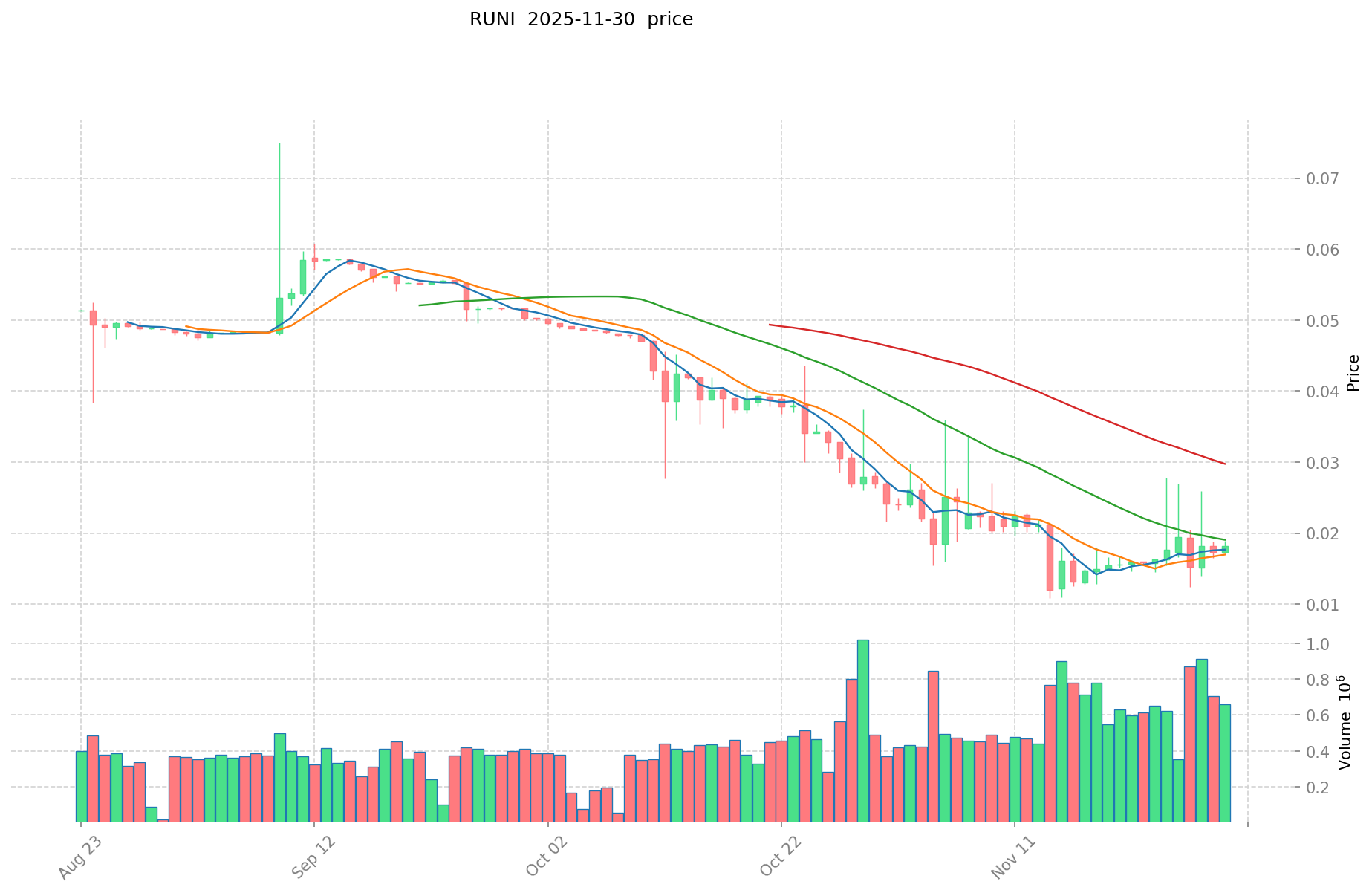
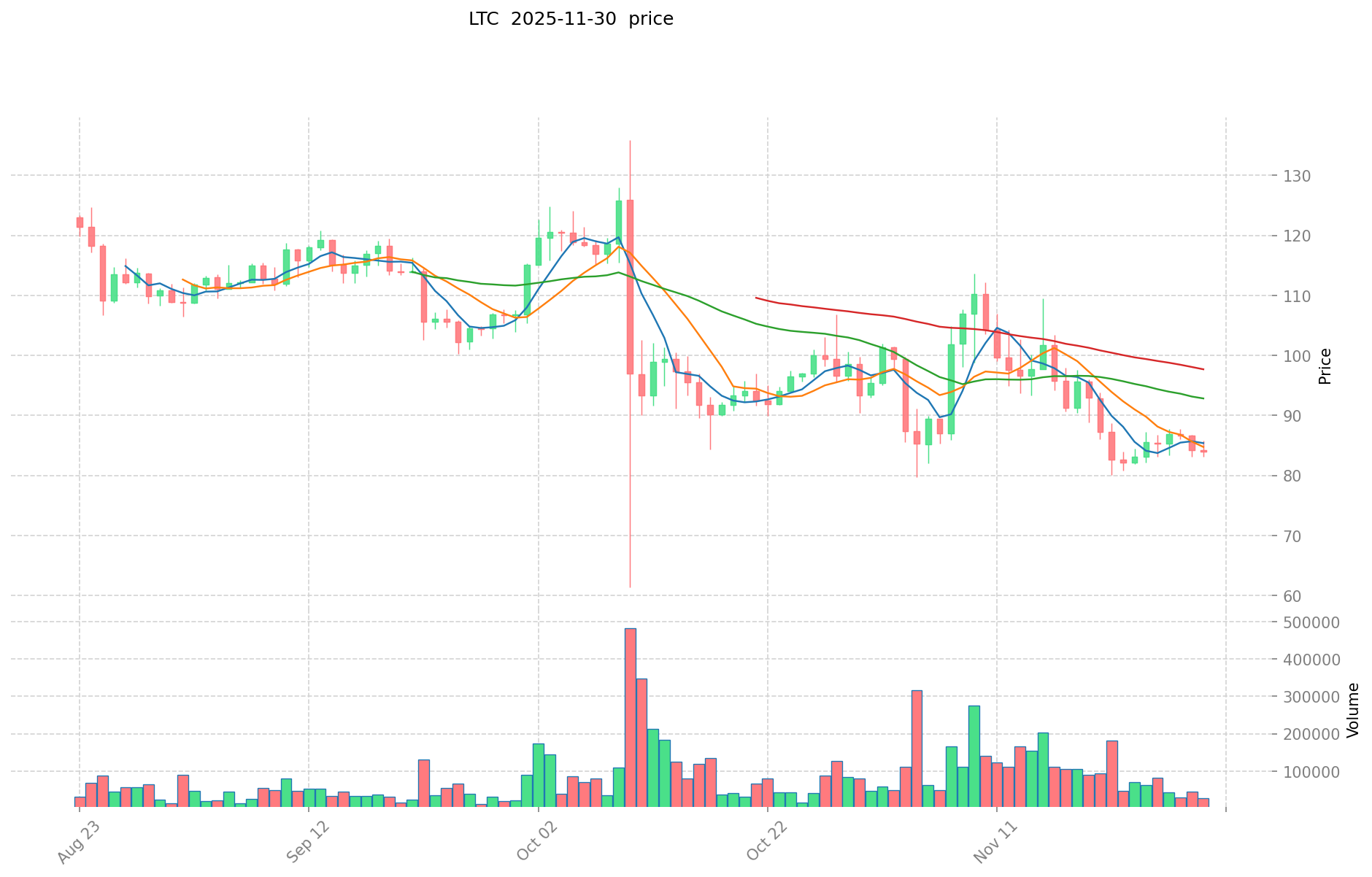
RUNI (Coin A) and LTC (Coin B) Historical Price Trends
- 2024: RUNI reached its all-time high of $2.836 on July 2, 2024.
- 2021: LTC hit its all-time high of $410.26 on May 10, 2021, during the crypto bull market.
- Comparative analysis: RUNI has experienced a significant drop from its all-time high of $2.836 to its current price of $0.017721, while LTC has also declined from its peak of $410.26 to $83.98.
Current Market Situation (2025-11-30)
- RUNI current price: $0.017721
- LTC current price: $83.98
- 24-hour trading volume: RUNI $12,110.53 vs LTC $2,768,149.24
- Market Sentiment Index (Fear & Greed Index): 28 (Fear)
Click to view real-time prices:
- View RUNI current price Market Price
- View LTC current price Market Price
II. Key Factors Affecting Investment Value of RUNI vs LTC
Supply Mechanism Comparison (Tokenomics)
- RUNI: Limited supply of 10 billion tokens, with 5 billion tokens circulating, creating artificial scarcity to potentially drive value
- LTC: Fixed maximum supply of 84 million coins with halving mechanism every 840,000 blocks (approximately every 4 years), creating deflationary pressure
- 📌 Historical pattern: Limited supply cryptocurrencies tend to experience price appreciation during bull markets due to supply constraints, with LTC's established halving cycles providing more predictable supply reduction events.
Institutional Adoption and Market Applications
- Institutional holdings: LTC has stronger institutional presence with established custody solutions and longer track record, while RUNI's institutional adoption remains limited
- Enterprise adoption: LTC has broader acceptance in payment processing and cross-border settlements through partnerships with payment processors, while RUNI lacks significant enterprise applications
- National policies: LTC benefits from regulatory clarity as one of the longest-established cryptocurrencies, while RUNI faces the regulatory uncertainty common to newer meme coins
Technical Development and Ecosystem Building
- RUNI technical development: Built on Solana blockchain, leveraging faster transaction speeds and lower costs, but development roadmap remains unclear
- LTC technical development: Implemented MimbleWimble Extension Block (MWEB) for enhanced privacy and scalability, with active ongoing development focused on security and efficiency improvements
- Ecosystem comparison: LTC has established integration with payment processors, ATMs, and wallets worldwide, while RUNI's ecosystem is primarily centered around trading and speculation rather than utility applications
Macroeconomic and Market Cycles
- Performance in inflationary environments: LTC has historically shown some correlation with gold during inflationary periods, potentially offering modest inflation hedge properties, while RUNI lacks sufficient history to evaluate
- Macroeconomic monetary policy: Both assets typically show sensitivity to Fed policy changes and risk-on/risk-off sentiment, with LTC demonstrating more established patterns
- Geopolitical factors: LTC's established infrastructure and wider global acceptance make it more practical for cross-border transactions in uncertain geopolitical environments
III. 2025-2030 Price Prediction: RUNI vs LTC
Short-term Prediction (2025)
- RUNI: Conservative $0.01506285 - $0.017721 | Optimistic $0.017721 - $0.02622708
- LTC: Conservative $53.7984 - $84.06 | Optimistic $84.06 - $104.2344
Mid-term Prediction (2027)
- RUNI may enter a growth phase, with an estimated price range of $0.01522800972 - $0.02722583556
- LTC may enter a bullish market, with an expected price range of $87.71694624 - $154.92863232
- Key drivers: Institutional capital inflow, ETF, ecosystem development
Long-term Prediction (2030)
- RUNI: Base scenario $0.031337271284319 - $0.038544843679712 | Optimistic scenario $0.038544843679712+
- LTC: Base scenario $190.19226868488 - $230.1326451087048 | Optimistic scenario $230.1326451087048+
View detailed price predictions for RUNI and LTC
Disclaimer: The above predictions are based on historical data and current market trends. Cryptocurrency markets are highly volatile and subject to change. This information should not be considered as financial advice. Always conduct your own research before making investment decisions.
RUNI:
| 年份 |
预测最高价 |
预测平均价格 |
预测最低价 |
涨跌幅 |
| 2025 |
0.02622708 |
0.017721 |
0.01506285 |
0 |
| 2026 |
0.024171444 |
0.02197404 |
0.0210950784 |
24 |
| 2027 |
0.02722583556 |
0.023072742 |
0.01522800972 |
30 |
| 2028 |
0.0337000469652 |
0.02514928878 |
0.023891824341 |
41 |
| 2029 |
0.033249874696038 |
0.0294246678726 |
0.02795343447897 |
66 |
| 2030 |
0.038544843679712 |
0.031337271284319 |
0.01974248090912 |
76 |
LTC:
| 年份 |
预测最高价 |
预测平均价格 |
预测最低价 |
涨跌幅 |
| 2025 |
104.2344 |
84.06 |
53.7984 |
0 |
| 2026 |
133.689024 |
94.1472 |
69.668928 |
12 |
| 2027 |
154.92863232 |
113.918112 |
87.71694624 |
35 |
| 2028 |
176.0946175296 |
134.42337216 |
81.9982570176 |
60 |
| 2029 |
225.12554252496 |
155.2589948448 |
136.627915463424 |
84 |
| 2030 |
230.1326451087048 |
190.19226868488 |
127.4288200188696 |
126 |
IV. Investment Strategy Comparison: RUNI vs LTC
Long-term vs Short-term Investment Strategies
- RUNI: Suitable for investors focused on emerging ecosystems and speculative growth
- LTC: Suitable for investors seeking established networks and potential inflation hedge properties
Risk Management and Asset Allocation
- Conservative investors: RUNI: 5% vs LTC: 15%
- Aggressive investors: RUNI: 15% vs LTC: 25%
- Hedging tools: Stablecoin allocation, options, cross-currency portfolios
V. Potential Risk Comparison
Market Risks
- RUNI: High volatility, limited trading history, susceptibility to market sentiment
- LTC: Correlation with broader crypto market, cyclical price movements
Technical Risks
- RUNI: Scalability concerns, network stability issues on Solana
- LTC: Mining centralization, potential security vulnerabilities
Regulatory Risks
- Global regulatory policies may impact both, with LTC potentially facing less scrutiny due to its established history
VI. Conclusion: Which Is the Better Buy?
📌 Investment Value Summary:
- RUNI advantages: Built on fast and low-cost Solana network, potential for rapid growth
- LTC advantages: Established history, wide acceptance, implemented privacy features (MWEB)
✅ Investment Advice:
- Novice investors: Consider a small allocation to LTC as part of a diversified crypto portfolio
- Experienced investors: Balanced approach with higher allocation to LTC, small speculative position in RUNI
- Institutional investors: Focus on LTC for its established market presence and regulatory clarity
⚠️ Risk Warning: Cryptocurrency markets are highly volatile. This article does not constitute investment advice.
None
VII. FAQ
Q1: What are the main differences between RUNI and LTC?
A: RUNI is a newer token built on the Solana blockchain, focusing on providing tools for blockchain projects. LTC, launched in 2011, is an established cryptocurrency often referred to as "silver to Bitcoin's gold". LTC has wider adoption and a longer track record, while RUNI offers potential for rapid growth but with higher risk.
Q2: Which coin has performed better in terms of price history?
A: LTC has a longer price history, reaching an all-time high of $410.26 in May 2021. RUNI's all-time high was $2.836 in July 2024. However, both have experienced significant drops from their peaks, with RUNI currently at $0.017721 and LTC at $83.98 as of November 30, 2025.
Q3: How do the supply mechanisms of RUNI and LTC differ?
A: RUNI has a limited supply of 10 billion tokens, with 5 billion currently circulating. LTC has a fixed maximum supply of 84 million coins and implements a halving mechanism every 840,000 blocks (approximately every 4 years), creating deflationary pressure.
Q4: Which coin has better institutional adoption?
A: LTC has stronger institutional presence with established custody solutions and a longer track record. It also has broader acceptance in payment processing and cross-border settlements. RUNI's institutional adoption remains limited.
Q5: What are the key technical developments for each coin?
A: RUNI leverages the Solana blockchain for faster transaction speeds and lower costs, but its development roadmap is unclear. LTC has implemented MimbleWimble Extension Block (MWEB) for enhanced privacy and scalability, with ongoing development focused on security and efficiency improvements.
Q6: How do the 2030 price predictions compare for RUNI and LTC?
A: For 2030, RUNI's base scenario predicts a range of $0.031337271284319 - $0.038544843679712, with potential for higher in an optimistic scenario. LTC's base scenario for 2030 is $190.19226868488 - $230.1326451087048, also with potential for higher in an optimistic scenario.
Q7: What are the main risks associated with investing in RUNI and LTC?
A: RUNI faces high volatility, limited trading history, and potential scalability issues on the Solana network. LTC risks include correlation with the broader crypto market, mining centralization, and potential security vulnerabilities. Both face regulatory risks, though LTC may face less scrutiny due to its established history.
* The information is not intended to be and does not constitute financial advice or any other recommendation of any sort offered or endorsed by Gate.














