# SHARDS vs OP: A Comprehensive Comparison of Two Leading Data Management Paradigms
## Article Overview
This comprehensive guide compares WorldShards (SHARDS), a Web3 MMORPG governance token with 400,000+ community members and $8.9M in NFT sales, against Optimism (OP), a leading Ethereum Layer 2 scaling solution with $19B TVL. The article analyzes price performance, tokenomics, ecosystem development, and investment profiles to help investors determine which asset aligns with their market conditions and objectives. Through historical price analysis revealing SHARDS' 99.54% volatility versus OP's 94.80% decline, institutional adoption metrics, technological innovations including the Dencun upgrade, and detailed 2026-2031 forecasts, readers gain actionable insights for portfolio allocation. Tailored strategies address conservative, experienced, and institutional investors, complemented by comprehensive risk assessments and real-time pricing via Gate. This comparison equips stakeholders with data-driven decisio
Introduction: SHARDS vs OP Investment Comparison
In the cryptocurrency market, the comparison between WorldShards (SHARDS) and Optimism (OP) represents two distinctly different asset categories and investment profiles. The two demonstrate significant differences in market capitalization ranking, application scenarios, and price performance.
WorldShards (SHARDS): A Web3 MMORPG token that combines traditional MMORPG gameplay with blockchain-based NFT ownership benefits across PC, mobile, and console platforms. As a fair launch token with no allocation to team or investors, SHARDS is entirely community-driven, having generated over $8.9 million in NFT sales and attracted more than 400,000 community members who have collectively spent over 3.1 million hours in the game.
Optimism (OP): An Ethereum layer-2 blockchain solution focused on enabling low-cost, fast transactions while maintaining Ethereum's security properties. OP serves as the native governance token of the Optimism Collective, a non-profit organization dedicated to developing the Optimism ecosystem.
This article will comprehensively analyze the investment value comparison between SHARDS and OP across historical price performance, tokenomics structures, ecosystem development, and market positioning, addressing the core question investors face:
"Which asset better aligns with current market conditions and investment objectives?"
Price History Comparison and Current Market Status
I. Historical Price Trends of SHARDS and OP
SHARDS and OP Historical Price Movement
- September 5, 2025: SHARDS reached its all-time high of $0.062, marking peak market enthusiasm for the Web3 MMORPG project.
- March 6, 2024: OP reached its all-time high of $4.84, reflecting strong market confidence in the Ethereum Layer 2 scaling solution.
- January 1, 2026: SHARDS hit its all-time low of $0.000285, indicating severe market correction following the peak in September 2025.
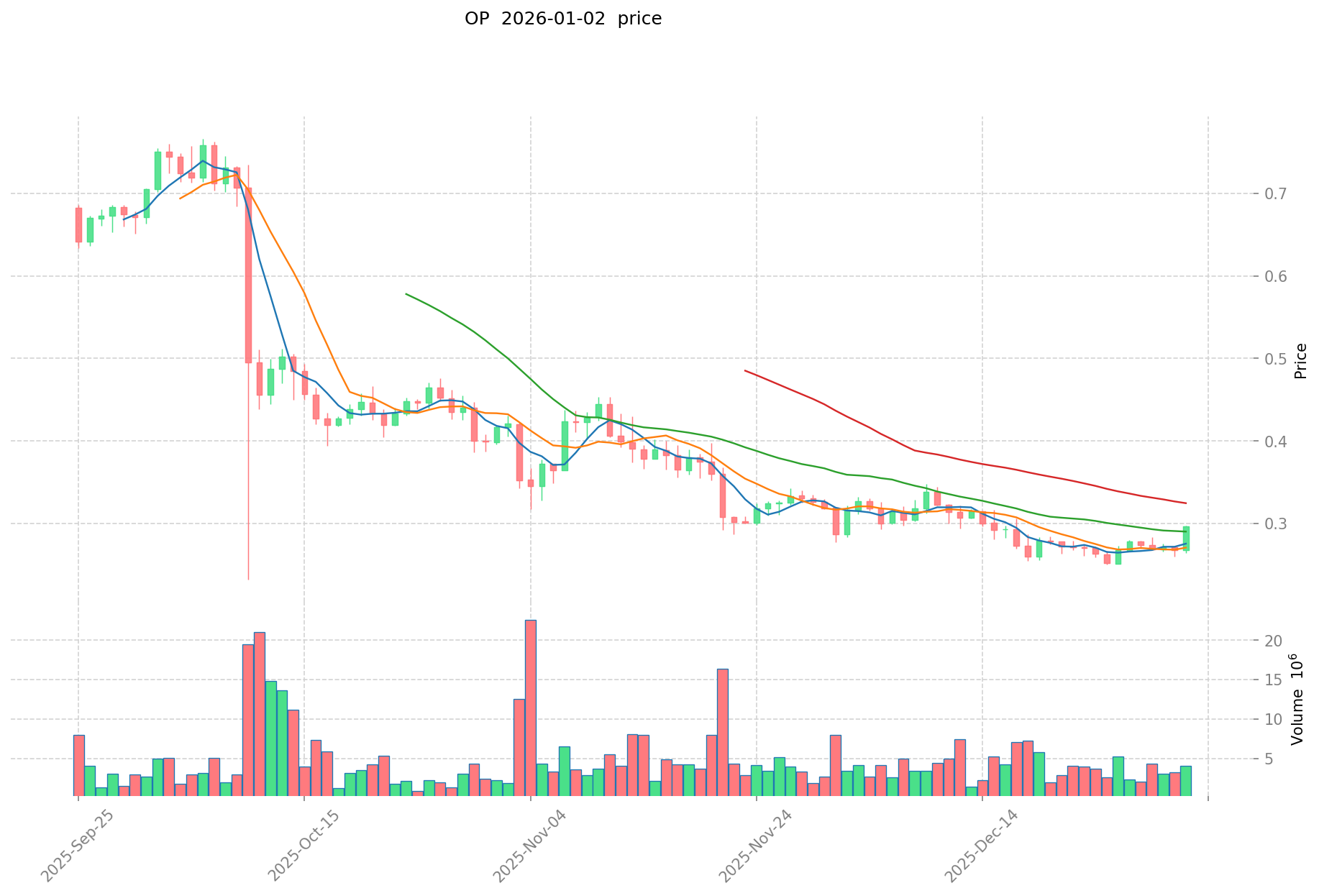
- December 26, 2025: OP reached its recent low of $0.251922, showing weakness in the broader market environment.
- Comparative Analysis: In the 2025 market cycle, SHARDS declined from $0.062 to $0.000285, representing a 99.54% loss from peak to trough, while OP retreated from $4.84 to $0.251922, representing an 94.80% decline from its all-time high, indicating that SHARDS experienced more severe volatility than OP.
Current Market Status (January 2, 2026)
- SHARDS current price: $0.0003114.
- OP current price: $0.3004.
- 24-hour trading volume: SHARDS $17,055.7533214 vs OP $1,208,343.318106.
- Market Emotion Index (Fear & Greed Index): 28 (Fear).
Click to view real-time prices:

SHARDS vs OP: Core Factors Influencing Investment Value
Supply Mechanism Comparison (Tokenomics)
OP (Optimism) operates with a governance token model designed to align incentives within its Layer 2 ecosystem. The token distribution reflects a typical protocol governance structure supporting network participation and decision-making.
SHARDS reference in available materials pertains to blockchain governance tokens within gaming and metaverse ecosystems (such as AXS - Axie Infinity Shards), which employ different tokenomic models based on their specific use cases.
Institutional Adoption and Market Application
Institutional Holdings and Enterprise Adoption
OP has established significant institutional traction as a leading Layer 2 solution. As of available data, Optimism maintains substantial Total Value Locked (TVL) approximately $19 billion USD, positioning it among the top Layer 2 protocols competing directly with Arbitrum ($28.7 billion USD TVL).
Key adoption drivers for OP include:
- EVM compatibility enabling direct migration of Ethereum-based decentralized applications
- Integration within cross-chain settlement and composability frameworks
- Enterprise deployment for reducing transaction costs and improving throughput
Regulatory Environment
OP benefits from regulatory clarity as an Ethereum Layer 2 solution operating within established DeFi infrastructure. Jurisdictional approaches toward Layer 2 protocols remain largely aligned with Ethereum regulatory frameworks.
Technology Development and Ecosystem Building
OP Stack Architecture and Network Effects
Optimism introduced the Superchain strategy in February 2023, leveraging OP Stack technology. L2s built on OP Stack achieve technical architectural consistency, enabling secure, efficient, and atomic-level interoperability between chains. This standardization reduces development friction for new rollups entering the ecosystem.
Dencun Upgrade Impact on OP Ecosystem
The Ethereum Dencun upgrade represents a critical performance enhancement through EIP-4844 implementation:
- Blob Data Structure: Introduces temporary data storage for L2 transaction submissions to Ethereum, significantly reducing L2 transaction costs
- Throughput Improvement: Enhances L2 transaction processing capacity
- Short-term Advantage: OP-based solutions leverage lower thresholds and EVM compatibility to amplify Dencun cost and performance benefits more rapidly than alternatives
Ecosystem Expansion
Dencun upgrade catalyzes broader L2 ecosystem development, benefiting complementary infrastructure including:
- Decentralized storage protocols
- Data availability services
- Rollups-as-a-Service (RaaS) platforms
- Application layers (perpetual futures, liquid staking derivatives, restaking, gaming)
Macroeconomic Conditions and Market Cycles
Layer 2 Adoption Drivers
OP's investment thesis aligns with Ethereum's multi-rollup future architecture. TVL rankings demonstrate two major Ethereum rollup projects (Optimism and Arbitrum) now rank in top-10 chains globally, capturing partial value from Ethereum network effects.
Technical Roadmap and Protocol Development
Proto-Danksharding (EIP-4844) establishes the foundation for Ethereum full sharding implementation, enabling subsequent development of proposer-builder separation and data availability sampling. This progressive upgrade path supports sustained Layer 2 cost reduction and scalability improvements.
Competitive Positioning
OP-Rollup solutions demonstrate stronger near-term advantages versus ZK-Rollup alternatives through:
- Superior EVM compatibility
- Richer ecosystem infrastructure
- Lower technical barriers to deployment
- Faster user and capital acquisition through existing EVM tooling
Note: Information regarding SHARDS as a distinct investment asset separate from gaming governance tokens was not available in provided reference materials. Analysis focused on OP as the primary comparable Layer 2 asset with documented institutional adoption metrics.
III. 2026-2031 Price Forecast: SHARDS vs OP
Short-term Forecast (2026)
- SHARDS: Conservative $0.00028341-$0.0003015 | Optimistic $0.000310545
- OP: Conservative $0.221112-$0.2988 | Optimistic $0.40338
Mid-term Forecast (2028-2029)
- SHARDS may enter accumulation phase, expected price range $0.000226211832-$0.000448694703331
- OP may enter growth phase, expected price range $0.320053644-$0.48147604875
- Key drivers: institutional capital inflows, ETF adoption, ecosystem development
Long-term Forecast (2030-2031)
- SHARDS: Base case $0.000270463196175-$0.000474350836368 | Optimistic $0.000635630120733
- OP: Base case $0.32855506891875-$0.486081471825 | Optimistic $0.544411248444
View detailed price forecasts for SHARDS and OP
SHARDS:
| 年份 |
预测最高价 |
预测平均价格 |
预测最低价 |
涨跌幅 |
| 2026 |
0.000310545 |
0.0003015 |
0.00028341 |
-3 |
| 2027 |
0.000400889475 |
0.0003060225 |
0.000284600925 |
-1 |
| 2028 |
0.000413543505375 |
0.0003534559875 |
0.000226211832 |
13 |
| 2029 |
0.000448694703331 |
0.000383499746437 |
0.00030679979715 |
23 |
| 2030 |
0.000532604447852 |
0.000416097224884 |
0.000270463196175 |
33 |
| 2031 |
0.000635630120733 |
0.000474350836368 |
0.000246662434911 |
52 |
OP:
| 年份 |
预测最高价 |
预测平均价格 |
预测最低价 |
涨跌幅 |
| 2026 |
0.40338 |
0.2988 |
0.221112 |
0 |
| 2027 |
0.3932208 |
0.35109 |
0.2738502 |
16 |
| 2028 |
0.46519425 |
0.3721554 |
0.320053644 |
23 |
| 2029 |
0.48147604875 |
0.418674825 |
0.33075311175 |
39 |
| 2030 |
0.522087506775 |
0.450075436875 |
0.32855506891875 |
49 |
| 2031 |
0.544411248444 |
0.486081471825 |
0.35483947443225 |
61 |
四、投资策略对比:SHARDS vs OP
长期 vs 短期投资策略
- SHARDS:适合关注Web3游戏生态发展、看好社区驱动型项目潜力的长期持有者,但需承受极高波动性风险
- OP:适合寻求Layer 2生态稳定增长、关注以太坊扩展方案的投资者,相对风险可控
风险管理与资产配置
- 保守型投资者:SHARDS 5% vs OP 20%(辅以稳定币75%配置)
- 激进型投资者:SHARDS 20% vs OP 40%(辅以衍生品对冲30%,现金储备10%)
- 对冲工具:稳定币配置、期权交易(看跌期权降低下行风险)、跨币种组合(配置不同风险等级的Layer 2代币)
五、潜在风险对比
市场风险
- SHARDS:历史波动率极高(9个月内跌幅99.54%),流动性较低(24小时交易量仅$17,055),价格易受市场情绪剧烈影响,存在极端价格波动风险
- OP:作为头部Layer 2方案相对稳定,但仍面临市场周期波动(历史最高价下跌94.80%),交易量充足但仍依赖以太坊生态表现
技术风险
- SHARDS:作为游戏代币,面临游戏用户活跃度下降、链上应用流量枯竭、NFT市场冷却等风险;项目技术迭代依赖社区支撑
- OP:作为Layer 2解决方案,技术风险相对可控,但面临智能合约漏洞、跨链桥接安全问题、以太坊主网升级依赖性等潜在问题
监管风险
- 全球监管政策:OP作为基础设施层代币受监管风险相对较低,被纳入DeFi监管框架;SHARDS作为游戏治理代币面临更严格的监管审查,部分司法管辖区可能将其视为证券或游戏道具,面临更高的监管不确定性
六、结论:Which Is the Better Buy?
📌 投资价值总结:
- SHARDS 优势:社区驱动型设计、无团队/投资者预留、用户基数庞大(40万+社区成员)、NFT生成价值已达$8.9百万、极高风险对应潜在高回报
- OP 优势:制度性基础设施地位、TVL达$19亿美元、Dencun升级带来成本优势、EVM兼容性降低开发门槛、Superchain战略提供生态扩展性、机构认可度高
✅ 投资建议:
- 新手投资者:优先选择OP,通过Layer 2生态稳定获得接触DeFi的机会;对SHARDS保持观望,仅在风险承受能力充足时少量配置
- 有经验投资者:OP作为核心配置资产(占比40-50%),SHARDS作为高风险探索资产(占比5-15%),结合2026-2029年的积累阶段时机策略性建仓
- 机构投资者:OP符合机构级别配置标准(基础设施属性、规范性、流动性),作为Layer 2敞口的首选;SHARDS暂不适合机构主流投资组合
⚠️ 风险提示:加密货币市场波动性极高,SHARDS历史表现显示极端价格风险,OP虽相对稳定但仍存在生态与技术风险。本文不构成投资建议,投资者应根据自身风险承受能力、投资目标与时间周期做出独立判断。
FAQ
SHARDS和OP分别是什么?各自的核心原理是什么?
SHARDS是以太坊扩容方案,通过数据分片提高并行处理能力。OP(Optimism)是二层网络,采用乐观汇总原理,将交易打包链下执行后提交主网,大幅降低交易成本。
SHARDS和OP在交易速度和吞吐量上有什么区别?
OP采用乐观汇总,交易速度快但吞吐量受限。SHARDS采用分片Blob技术,通过提高数据可用性来增加吞吐量,实现更高的交易额处理能力,是以太坊未来的扩容方向。
SHARDS和OP在安全性上有什么差异?各自的风险是什么?
SHARDS采用异步消息传递机制,灵活高效但存在并发竞争风险;OP使用同步调用更可靠但可能导致性能瓶颈。SHARDS风险在于竞争条件,OP风险在于资源过度消耗。
使用SHARDS和OP的gas费用分别是多少?哪个更便宜?
SHARDS和OP的gas费用都相对较低。OP通常更便宜,平均gas费在0.1-0.5美元之间,而SHARDS略高。OP因其优化的交易结构和数据压缩技术,在gas效率上更具优势。
SHARDS和OP分别支持哪些主要的区块链网络?生态应用有什么不同?
SHARDS采用分片技术支持以太坊2.0,通过并行处理提升扩展性。OP是乐观Rollup方案,支持以太坊及多条主要区块链。SHARDS侧重分散验证,OP侧重交易吞吐量提升。
SHARDS和OP我应该怎么选择?各自适用于什么场景?
OP适合以太坊扩容和低成本交易,适用于DeFi和支付场景。SHARDS适合高吞吐量数据处理,适用于大规模链上应用。根据需求选择:追求成本效率选OP,追求性能选SHARDS。
* The information is not intended to be and does not constitute financial advice or any other recommendation of any sort offered or endorsed by Gate.