# Article Overview: SNTR vs SNX: A Comprehensive Comparison of Two Leading Synthetic Assets Platforms
This comprehensive guide compares SNTR and SNX, two prominent synthetic asset tokens, analyzing their market performance, technology ecosystems, and investment potential. The article addresses critical questions for crypto investors evaluating these DeFi protocols on Gate: Which token offers better value? How do their price trajectories compare? The content examines historical price trends, tokenomics, institutional adoption, and risk factors across both platforms. Structured through market analysis, technical development assessment, price forecasts (2025-2030), and tailored investment strategies, this guide serves beginner to institutional investors seeking data-driven decisions on SNX's established DeFi infrastructure versus SNTR's emerging Solana-based opportunities.
---
**Key Sections:** Historical Price Comparison | Supply Mechanisms | Technology Ecosystems | Investment Risk Analysis | Price Forecasts
Introduction: SNTR vs SNX Investment Comparison
In the crypto market, comparisons between SNTR and SNX are an ongoing topic for investors. The two tokens differ significantly in market cap ranking, application scenarios, and price performance, representing different positioning within the crypto asset landscape.
Sentre (SNTR): Built on Solana, it functions as an open liquidity protocol featuring Sen OS—an open platform for DApps—and SenSwap, a liquidity accumulator based on Solana's AMM with a user-friendly interface and advanced technical features.
Synthetix (SNX): Designed for engineers to build decentralized and trustless networks, SNX supports a variety of synthetic assets, including fiat currencies pegged to the US dollar, precious metals, indices, and other cryptocurrencies.
This article will comprehensively analyze the investment value comparison between SNTR and SNX across historical price trends, supply mechanisms, market adoption, technical ecosystems and future outlook, while attempting to answer the most pressing question for investors:
"Which is the better buy right now?"
I. Historical Price Comparison and Market Status
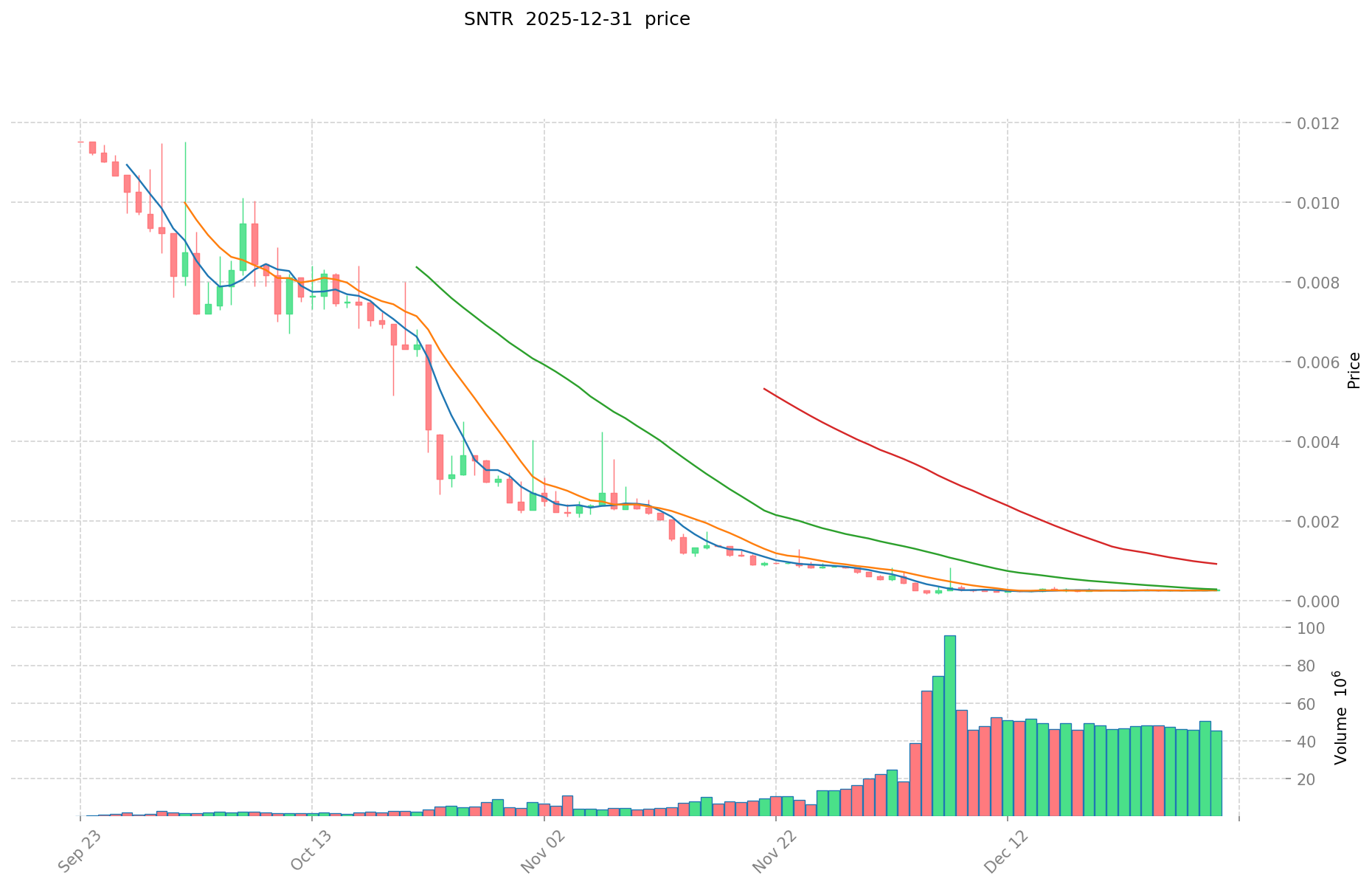
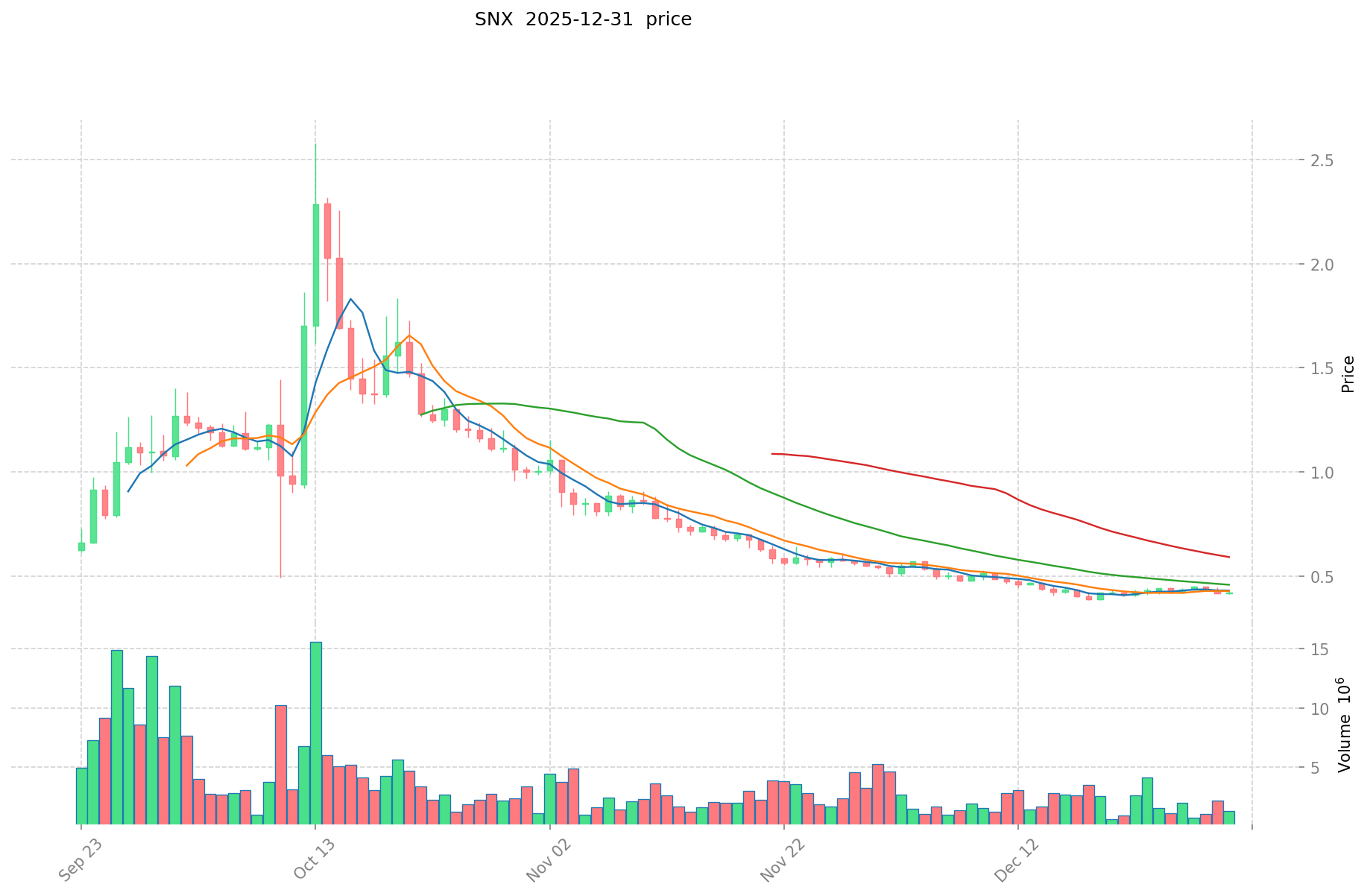
Sentre (SNTR) and Synthetix (SNX) Historical Price Trends
- 2022: Sentre reached an all-time high of $0.053225 on January 8, 2022, reflecting early market enthusiasm for the Solana-based liquidity protocol.
- 2021: Synthetix reached an all-time high of $28.53 on February 14, 2021, driven by the expansion of synthetic asset trading infrastructure on Ethereum.
- Comparative analysis: Over the market cycle from 2021 to 2025, Sentre has declined from $0.053225 to $0.0002794, representing a 99.48% decrease, while Synthetix has fallen from $28.53 to $0.4149, representing a 98.55% decrease.
Current Market Status (2025-12-31)
- Sentre (SNTR) current price: $0.0002794
- Synthetix (SNX) current price: $0.4149
- 24-hour trading volume: SNTR $12,306.14 vs SNX $569,628.32
- Market emotion index (Fear & Greed Index): 21 (Extreme Fear)
Click to view real-time prices:
II. Core Factors Affecting SNTR vs SNX Investment Value
Supply Mechanism Comparison (Tokenomics)
Based on the available reference materials, specific tokenomics details for SNTR and SNX are not provided. This section cannot be completed without comprehensive supply mechanism data.
Institutional Adoption and Market Application
Institutional Holdings
SNX demonstrates stronger institutional presence in the decentralized finance sector with higher liquidity compared to SNTR, reflecting greater institutional recognition in the DeFi market.
Enterprise Adoption
SNX plays a significant role in decentralized finance applications. However, specific comparative data on SNTR's applications in cross-border payments, settlements, or investment portfolios is not available in the reference materials.
National Policy
Specific regulatory attitudes from different countries toward SNTR and SNX are not documented in the provided reference materials.
Technology Development and Ecosystem Building
SNX Technology Development
SNX operates as a mainstream DeFi token with established market applications and blockchain infrastructure integration.
SNTR Technology Development
Specific technical upgrades and development roadmap information for SNTR is not available in the reference materials.
Ecosystem Comparison
SNX demonstrates active participation in DeFi services and has established infrastructure within the decentralized finance ecosystem. Comparative information regarding SNTR's DeFi, NFT, payment, and smart contract implementations is not provided in the available sources.
Macroeconomic and Market Cycles
Information regarding inflation environment performance, macroeconomic monetary policy impacts, and geopolitical factors affecting SNTR and SNX is not available in the provided reference materials.
III. 2025-2030 Price Forecast: SNTR vs SNX
Short-term Forecast (2025)
- SNTR: Conservative $0.000170-$0.0002794 | Optimistic $0.0002794-$0.000346456
- SNX: Conservative $0.22383-$0.4145 | Optimistic $0.4145-$0.48911
Mid-term Forecast (2026-2028)
- SNTR is expected to enter a consolidation phase with gradual appreciation, price range $0.00024-$0.000455
- SNX is expected to enter a moderate bull phase, price range $0.361-$0.601
- Key drivers: institutional capital inflows, ETF adoption, ecosystem development
Long-term Forecast (2029-2030)
- SNTR: Base case $0.287-$0.448 | Optimistic scenario $0.448-$0.544
- SNX: Base case $0.433-$0.630 | Optimistic scenario $0.605-$0.826
View detailed price forecasts for SNTR and SNX
SNTR:
| 年份 |
预测最高价 |
预测平均价格 |
预测最低价 |
涨跌幅 |
| 2025 |
0.000346456 |
0.0002794 |
0.000170434 |
0 |
| 2026 |
0.00046626272 |
0.000312928 |
0.00024095456 |
12 |
| 2027 |
0.0004947861072 |
0.00038959536 |
0.0002649248448 |
39 |
| 2028 |
0.000455456455608 |
0.0004421907336 |
0.000336064957536 |
58 |
| 2029 |
0.000466776538388 |
0.000448823594604 |
0.000287247100546 |
60 |
| 2030 |
0.00054478207913 |
0.000457800066496 |
0.000251790036572 |
63 |
SNX:
| 年份 |
预测最高价 |
预测平均价格 |
预测最低价 |
涨跌幅 |
| 2025 |
0.48911 |
0.4145 |
0.22383 |
0 |
| 2026 |
0.4879494 |
0.451805 |
0.361444 |
8 |
| 2027 |
0.549756324 |
0.4698772 |
0.408793164 |
13 |
| 2028 |
0.60158377916 |
0.509816762 |
0.34157723054 |
22 |
| 2029 |
0.7057393436366 |
0.55570027058 |
0.4334462110524 |
33 |
| 2030 |
0.826242947311873 |
0.6307198071083 |
0.605491014823968 |
52 |
IV. Investment Strategy Comparison: SNTR vs SNX
Long-term vs Short-term Investment Strategy
- SNTR: Suitable for investors seeking exposure to emerging Solana-based DeFi protocols with long-term appreciation potential through ecosystem development and institutional adoption
- SNX: Suitable for investors pursuing established DeFi infrastructure with relatively stable market positioning and moderate growth expectations in synthetic asset trading
Risk Management and Asset Allocation
- Conservative investors: SNTR 10% vs SNX 40% (with 50% stablecoins)
- Aggressive investors: SNTR 30% vs SNX 50% (with 20% stablecoins)
- Hedging tools: Stablecoin allocation, options strategies, cross-token portfolio diversification
V. Potential Risk Comparison
Market Risk
- SNTR: Extremely high volatility with 99.48% decline from all-time high; minimal trading volume ($12,306.14 daily) indicates severe liquidity constraints and substantial price slippage risk
- SNX: Significant volatility with 98.55% decline from peak; higher daily trading volume ($569,628.32) provides better liquidity but still faces market concentration risks
Technology Risk
- SNTR: Limited technical documentation available regarding protocol scalability and network security; dependence on Solana blockchain infrastructure introduces cascading failure risks
- SNX: Established DeFi infrastructure with proven smart contract implementations; potential vulnerabilities in synthetic asset pricing mechanisms and oracle dependency
Regulatory Risk
- Global regulatory policies remain uncertain for both tokens; increased enforcement against DeFi protocols and synthetic asset platforms may disproportionately impact SNX's decentralized finance applications; SNTR faces similar regulatory exposure as a Solana-based DeFi protocol
VI. Conclusion: Which Is the Better Buy?
📌 Investment Value Summary
- SNTR advantages: Early-stage Solana ecosystem participation, potential for high returns from protocol adoption, lower entry price for retail investors
- SNX advantages: Established market presence with institutional recognition, higher liquidity, more mature DeFi infrastructure, greater price stability relative to SNTR
✅ Investment Recommendations
- Beginner investors: Focus on SNX with smaller position sizing (5-10% of crypto allocation) to gain DeFi exposure with lower volatility relative to SNTR
- Experienced investors: Consider SNTR as high-risk speculation in early-stage protocols; allocate SNX for core DeFi positioning; implement stop-loss orders at 25-30% below entry price
- Institutional investors: SNX demonstrates stronger institutional integration potential; SNTR requires extensive due diligence on tokenomics, liquidity depth, and regulatory compliance before consideration
⚠️ Risk Disclaimer: Cryptocurrency markets exhibit extreme volatility and are subject to rapid, unpredictable price movements. This analysis does not constitute investment advice. Investors should conduct independent research and consult with qualified financial advisors before making investment decisions.
FAQ
SNTR和SNX分别是什么?它们各自的用途是什么?
SNX是Synthetix的原生代币,用于质押生成稳定币和合成资产。SNTR暂无明确定义,建议核实代币名称。SNX在生态中主要用于交易和质押激励。
SNTR和SNX在技术架构上有什么区别?
SNTR和SNX都属于Synthetix生态。SNX是治理代币,用于平台治理和质押激励;SNTR是合成资产代币,主要用于交易合成资产。SNX基于以太坊架构,SNTR则专注于合成资产的发行和流动性管理。
SNTR和SNX的市场表现和流动性对比如何?
SNX流动性较高但波动性大,市场表现不稳定。SNTR流动性相对较低但更稳定。SNX因价格波动导致资本利用率受限,总体而言SNX市场表现更为波动。
投资SNTR和SNX各自的风险是什么?
SNTR作为新兴协议代币,面临流动性风险和市场认可度不确定性。SNX作为衍生品协议,主要风险在于智能合约漏洞、价格波动剧烈和抵押清算风险。两者均受整体加密市场周期影响。
SNTR和SNX在生态应用中的差异有哪些?
SNTR用于Synthetix生态的铸币和治理,SNX则作为抵押资产的保证。SNX价值随抵押品变化波动,两者在生态中分别承担不同的功能角色。
从长期发展前景来看,SNTR和SNX哪个更值得关注?
SNX更值得关注。SNX生态更成熟,项目落地情况更好,市场认可度高。SNTR虽有潜力,但生态建设相对滞后,长期竞争力不如SNX突出。
* The information is not intended to be and does not constitute financial advice or any other recommendation of any sort offered or endorsed by Gate.