This article explores AQA, a Web3 ecosystem built on Solana, designed to integrate blockchain with real-world applications. Introduced in 2025, AQA offers decentralized finance and SocialFi innovations, connecting digital and tangible assets across sectors such as finance and real estate. The piece outlines AQA’s technological framework, market dynamics, ecosystem applications, and community engagement while addressing challenges like market volatility. Suitable for those interested in blockchain technology, the article provides insights into AQA's strategic developments, making it an important read for participants in the digital economy.
AQA's Position and Significance
In 2025, AQA (AQA) was introduced as a Web3 ecosystem designed to integrate blockchain technology with real-world applications. As a decentralized platform built on Solana, AQA plays a crucial role in facilitating secure transactions, digital ownership, and innovative financial solutions across various sectors such as finance, entertainment, real estate, and education.
As of 2025, AQA has positioned itself as a pioneering initiative bridging decentralized finance, SocialFi engagement, and industry-specific blockchain solutions with tangible real-world assets. The project aims to redefine digital economies and foster global adoption of Web3 technologies.
Origin and Development History
Birth Background
AQA was created in 2025 to address the need for seamless integration between blockchain technology and real-world applications. It emerged during the growing trend of Web3 adoption, aiming to create a comprehensive digital economy that connects decentralized finance with tangible assets.
The launch of AQA brought new possibilities for users seeking to participate in a scalable, transparent, and user-driven economic system.
Important Milestones
- 2025: Mainnet launch, introducing the AQA Digital Citizenship ID, SocialFi, and token-based incentive mechanisms.
- 2025: Introduction of the "AQA Digital City" initiative, connecting DeFi, SocialFi, and industry-specific blockchain solutions with real-world assets.
AQA continues to optimize its technology, security, and real-world applications with the support of its community and development team.
How Does AQA Work?
Decentralized Control
AQA operates on a decentralized network of computers (nodes) built on the Solana blockchain, eliminating the need for control by banks or governments. These nodes collaborate to validate transactions, ensuring system transparency and attack resistance, thus empowering users with greater autonomy and enhancing network resilience.
Blockchain Core
AQA's blockchain is a public, immutable digital ledger that records every transaction. Transactions are grouped into blocks and linked through cryptographic hashes, forming a secure chain. Anyone can view the records, establishing trust without intermediaries. As AQA is built on Solana, it benefits from high throughput and low transaction costs.
Ensuring Fairness
AQA utilizes Solana's Proof-of-Stake (PoS) consensus mechanism to validate transactions and prevent fraudulent activities such as double-spending. Validators maintain network security through staking and running nodes, receiving AQA tokens as rewards. This approach offers innovations such as higher energy efficiency and increased transactions per second compared to traditional Proof-of-Work systems.
Secure Transactions
AQA employs public-private key encryption to protect transactions:
- Private keys (like secret passwords) are used to sign transactions
- Public keys (like account numbers) are used to verify ownership
This mechanism ensures fund security while maintaining transaction privacy. Additional security features may be implemented as the project evolves.
Circulation Overview
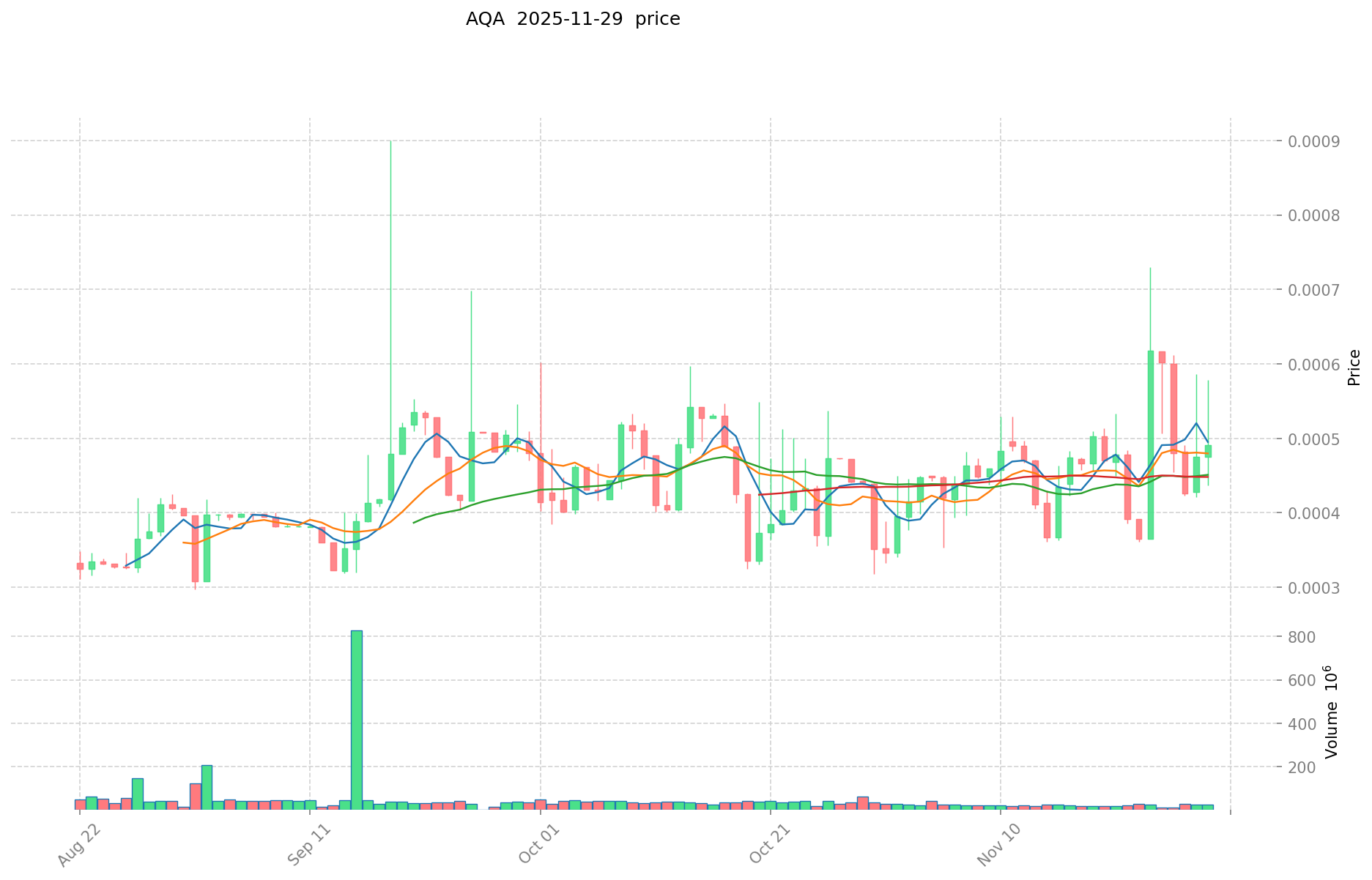
As of November 29, 2025, AQA's circulating supply is 240,000,000 tokens, with a total supply of 10,000,000,000.
Price Fluctuations
AQA reached its all-time high of $0.005158 on April 16, 2025.
Its lowest price was $0.000086, occurring on June 26, 2025.
These fluctuations reflect market sentiment, adoption trends, and external factors.
Click to view the current market price of AQA
On-Chain Metrics
- Daily Trading Volume: $12,735.68 (indicating network activity)
- Number of Holders: 1,085 (reflecting user participation)
AQA Ecosystem Applications and Partnerships
Core Use Cases
AQA's ecosystem supports multiple applications:
- DeFi: AQA Digital City facilitates decentralized finance solutions.
- SocialFi: AQA promotes social engagement and user-driven economic participation.
- Real Estate: AQA connects blockchain solutions with tangible real-world assets in the property sector.
Strategic Collaborations
AQA has built its platform on Solana, leveraging the blockchain's scalability and efficiency.
These partnerships provide a solid foundation for AQA's ecosystem expansion.
Controversies and Challenges
AQA faces the following challenges:
- Market Volatility: Significant price fluctuations, with a 89.048% decrease over the past year.
- Adoption Hurdles: As a relatively new project, AQA may face challenges in attracting users and partners.
- Competitive Pressure: Competition from established Web3 ecosystems and other blockchain platforms.
These issues have sparked discussions within the community and market, driving AQA's continuous innovation.
Fan Enthusiasm
AQA's community shows signs of growth, with 1,085 holders as of the latest data.
On X platform, related posts and hashtags (such as #AQA) occasionally gain traction.
Recent price increases (25.1% in 7 days) have ignited community enthusiasm.
Sentiment on X presents a mixed picture:
- Supporters praise AQA's Web3 integration and real-world applications.
- Critics may focus on the project's market cap and price volatility.
Recent trends show a generally positive sentiment due to recent price gains.
Hot Topics
X users discuss AQA's potential in bridging blockchain technology with real-world applications, particularly in finance, entertainment, real estate, and education sectors.
- Official Website: Visit AQA's official website for features, use cases, and latest updates.
- Whitepaper: AQA Whitepaper details its technical architecture, goals, and vision.
- X Updates: On X platform, AQA uses @AQA314, providing updates on technical developments, community activities, and partnership news.
AQA Future Roadmap
- Ecosystem Goals: Support the integration of decentralized finance, SocialFi, and industry-specific blockchain solutions.
- Long-term Vision: Become a leading platform in redefining digital economies and fostering global adoption of Web3 technologies.
How to Participate in AQA?
- Purchase Channels: Buy AQA on Gate.com
- Storage Solutions: Use a Solana-compatible wallet for secure storage
- Participate in Governance: Stay tuned for potential DAO or community governance initiatives
- Build the Ecosystem: Explore opportunities to develop DApps or contribute to the AQA Digital City initiative
Summary
AQA is redefining digital currency through blockchain technology, offering integration of Web3 technologies with real-world applications. Its focus on digital citizenship, SocialFi, and token-based incentives sets it apart in the cryptocurrency space. Despite facing challenges such as market volatility and adoption hurdles, AQA's innovative spirit and clear vision for bridging digital and real-world economies position it as an interesting project in the decentralized technology future. Whether you're a newcomer or an experienced player, AQA is worth watching and participating in as it develops its ecosystem.
FAQ
What does AQA mean?
AQA stands for Aquarius, a cryptocurrency token in the Web3 ecosystem. It aims to provide decentralized solutions for data management and sharing.
Is an AQA the same as a GCSE?
No, AQA and GCSE are not the same. AQA is an exam board that offers GCSEs, while GCSE is a qualification. AQA is one of several boards that provide GCSE exams in the UK.
What qualification is AQA?
AQA is not a qualification. It's likely a cryptocurrency or blockchain project, but specific details are not available in the given context.
What's the difference between AQA and Edexcel?
AQA and Edexcel are both UK exam boards. AQA offers a wider range of subjects, while Edexcel is known for its international focus and math exams.
* The information is not intended to be and does not constitute financial advice or any other recommendation of any sort offered or endorsed by Gate.















