Explore BlockCDN's transformative role in the CDN industry through blockchain technology, offering decentralized services and bandwidth monetization. Launched in 2017 on Ethereum, BlockCDN redefines content delivery by addressing traditional CDN inefficiencies, providing lower-cost, faster solutions suitable for website owners and bandwidth providers. The article delves into its technical architecture, market performance, strategic partnerships, and ongoing challenges, emphasizing community engagement and adoption strategies. With key insights into on-chain metrics and ecosystem applications, learn how BlockCDN is shaping the future of decentralized internet infrastructure.
BlockCDN's Positioning and Significance
In 2017, BlockCDN (BCDN) was launched as a distributed CDN system based on Ethereum smart contracts. It aims to solve the problem of underutilized internet bandwidth and high costs of traditional CDN services.
As a decentralized content delivery network platform, BlockCDN plays a key role in the field of web acceleration and content distribution. It allows global network participants to share their idle internet devices as CDN nodes.
As of 2025, BlockCDN has become an innovative project in the CDN industry, with an active community of bandwidth providers and website owners seeking distributed CDN services. This article will analyze its technical architecture, market performance, and future potential.
Origin and Development History
Background
BlockCDN was created in 2017 to address the inefficiencies and high costs in traditional CDN services. It emerged during the blockchain technology boom, aiming to leverage idle internet bandwidth and devices to create a distributed CDN network.
BlockCDN's launch brought new possibilities for website owners seeking faster and more cost-effective content delivery solutions, as well as for individuals looking to monetize their unused internet resources.
Key Milestones
- 2017: Main network launch, implementing a distributed CDN system based on Ethereum smart contracts.
- 2018: Price reached an all-time high of $0.283911 on January 7.
- 2022: Price hit an all-time low of $0.00008231 on May 13.
- 2025: Continued development and optimization of the BlockCDN ecosystem.
With support from its community and development team, BlockCDN continues to improve its technology, security, and real-world applications in the content delivery network space.
How Does BlockCDN Work?
Decentralized Control
BlockCDN operates on a decentralized network of computers (nodes) spread across the globe, eliminating the need for centralized control by traditional CDN providers. These nodes collaborate to provide CDN services, ensuring system transparency and attack resistance, while giving users more autonomy and improving network resilience.
Blockchain Core
BlockCDN's blockchain is a public, immutable digital ledger that records transactions and CDN service provisions. Transactions are grouped into blocks and linked through cryptographic hashes, forming a secure chain. Anyone can view the records, establishing trust without intermediaries.
Ensuring Fairness
BlockCDN utilizes Ethereum's consensus mechanism to validate transactions and prevent fraudulent activities. Participants maintain network security by sharing their idle internet devices and bandwidth, receiving BCDN tokens as rewards. Its innovation includes leveraging underutilized resources to provide CDN services at lower costs.
Secure Transactions
BlockCDN uses public-private key encryption to secure transactions:
- Private keys (like secret passwords) are used to sign transactions
- Public keys (like account numbers) are used to verify ownership
This mechanism ensures fund security and maintains pseudonymous transactions. Smart contracts based on Ethereum are used for automated and transparent settlements between CDN service providers and users.
Circulation Overview
As of November 29, 2025, BCDN's circulating supply is 346,445,342.60801333 tokens, with a total supply of 1,000,000,000.
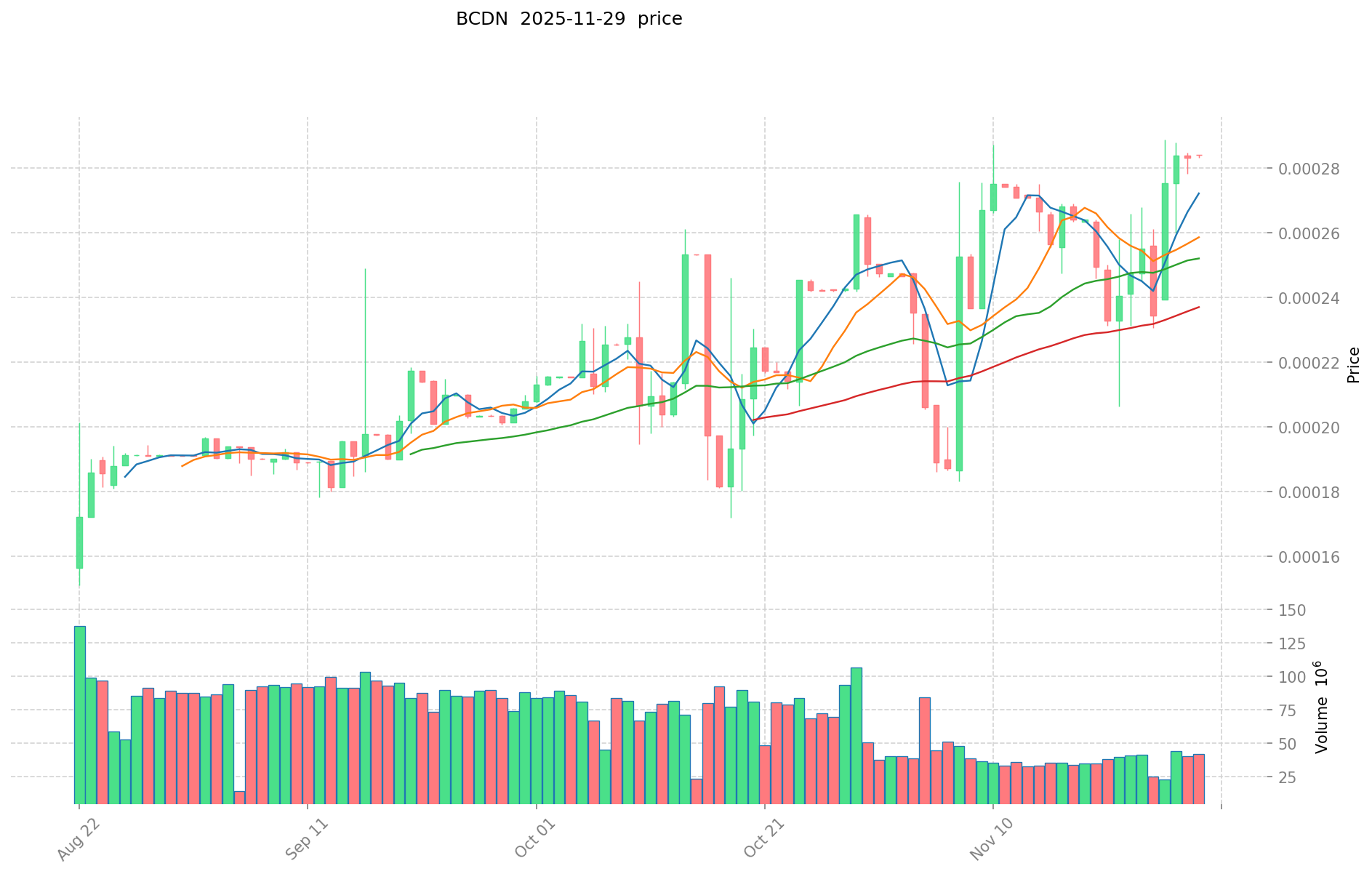
Price Fluctuations
BCDN reached its all-time high of $0.283911 on January 7, 2018.
Its lowest price was $0.00008231, occurring on May 13, 2022.
These fluctuations reflect market sentiment, adoption trends, and external factors.
Click to view the current BCDN market price
On-Chain Metrics
- Daily Transaction Volume: $11,901.8268021 (indicates network activity)
- Active Addresses: 33,470 (reflects user engagement)
BlockCDN (BCDN) Ecosystem Applications and Partnerships
Core Use Cases
BlockCDN's ecosystem supports various applications:
- CDN Services: Distributed content delivery network, providing faster and more efficient content distribution.
- Bandwidth Sharing: Allows users to share idle internet devices, creating a decentralized CDN infrastructure.
Strategic Partnerships
BlockCDN has established partnerships with Ethereum, enhancing its technical capabilities and market influence.
These partnerships provide a solid foundation for BlockCDN's ecosystem expansion.
Controversies and Challenges
BlockCDN faces the following challenges:
- Technical Issues: Scaling the network of distributed nodes
- Regulatory Risks: Potential regulations on decentralized network services
- Competitive Pressure: Competition from established CDN providers and other blockchain-based solutions
These issues have sparked discussions within the community and market, driving continuous innovation for BlockCDN.
Fan Enthusiasm
BlockCDN's community shows some activity, with 33,470 holders as of November 29, 2025.
On X platform, posts and hashtags related to BlockCDN occasionally gain traction.
Price fluctuations and updates to the CDN network tend to ignite community interest.
Sentiment on X presents a mix of opinions:
- Supporters praise BlockCDN's decentralized CDN approach and potential for bandwidth monetization.
- Critics focus on adoption challenges and competition from established CDN providers.
Recent trends show cautious optimism as the project continues to develop.
Hot Topics
X users discuss BlockCDN's potential impact on content delivery, decentralized internet infrastructure, and the feasibility of widespread adoption.
- Official Website: Visit BlockCDN's official website for features, use cases, and latest updates.
- Whitepaper: BlockCDN's whitepaper details its technical architecture, goals, and vision.
- X Updates: On X platform, BlockCDN uses @BlockCDN, as of November 29, 2025, providing updates on technical developments, community activities, and partnership news.
BlockCDN Future Roadmap
- Ecosystem Goals: Expand the network of distributed CDN nodes and increase adoption among content providers
- Long-term Vision: Become a leading decentralized content delivery infrastructure
How to Participate in BlockCDN?
- Purchase Channels: Buy BCDN on Gate.com
- Storage Solutions: Use Web3 wallets that support ERC-20 tokens for secure storage
- Participate in the Network: Share idle bandwidth and devices to contribute to the CDN network
- Ecosystem Building: Visit BlockCDN's GitHub repository to contribute code or develop applications
Summary
BlockCDN is redefining content delivery through blockchain technology, offering decentralized CDN services and bandwidth monetization.
Its concept of distributed content delivery and active development make it a unique project in the cryptocurrency space.
While facing challenges in adoption and competition, BlockCDN's innovative approach to CDN services positions it as an interesting player in the future of decentralized internet infrastructure.
Whether you're new to the space or an experienced user, BlockCDN is a project worth watching and potentially participating in.
FAQ
What is the main purpose of a CDN?
The main purpose of a CDN is to deliver content quickly and efficiently to users by distributing it across multiple servers worldwide, reducing latency and improving website performance.
What is fbcdn?
FBCDN is not a cryptocurrency. It stands for Facebook Content Delivery Network, used by Facebook to distribute content efficiently across its platforms.
* The information is not intended to be and does not constitute financial advice or any other recommendation of any sort offered or endorsed by Gate.














