The article explores Blade Games, a pioneering on-chain game and AI agent ecosystem leveraging the zkVM stack. Launched in 2024, it merges blockchain gaming with AI, allowing users to create dynamic on-chain economies. As of 2025, Blade has over 850,000 users and significant ecosystem revenue, making it a key player in GameFi and AI sectors. The article covers its technological architecture, market performance, and ecosystem applications while addressing challenges and key partnerships. Blade's integration of AI in gaming presents new opportunities for gamers and developers alike. Readers can learn how to participate in Blade Games through Gate.
Blade Games' Position and Significance
In 2024, Blade Games (BLADE) was launched as an on-chain game + AI agent ecosystem built around the zkVM stack. It aims to address the challenges of creating engaging blockchain games with AI integration.
As a pioneering platform combining blockchain gaming and AI agents, Blade Games plays a crucial role in the GameFi and AI sectors. It allows users to play, train, and create their own on-chain economies within games powered by AI agents.
As of 2025, Blade Games has become one of the largest on-chain game ecosystems on both Arbitrum and Mantle, boasting over 850,000 registered users and 5 eco-games. The project reportedly generates monthly ecosystem revenue exceeding $300,000 (in ETH value) and has over 200,000 active on-chain addresses.
This article will delve into its technological architecture, market performance, and future potential.
Origin and Development History
Birth Background
Blade Games was created in 2024 to solve the challenge of integrating AI agents into blockchain gaming, enhancing user engagement and creating dynamic on-chain economies.
It emerged during a period of growing interest in blockchain gaming and AI applications, aiming to revolutionize the gaming industry by providing players with AI-powered, on-chain gaming experiences.
Blade Games' launch opened up new possibilities for both gamers and AI enthusiasts in the blockchain space.
Important Milestones
- 2024: Mainnet launch, achieving integration of AI agents in blockchain games.
- 2024: Secured $2.4 million in seed funding led by PTC Crypto and IOSG ventures, with participation from Animoca Ventures, ForesightX, and Mantle Eco Fund.
- 2024: Ecosystem expansion to include 5 eco-games and over 850,000 registered users.
- 2024: Token Generation Event (TGE) on December 23, with initial listing on Gate.com.
With support from key partners including Arbitrum, Mantle, 0G Labs, and Delphinus Lab, Blade Games continues to enhance its technology, security, and real-world applications in the blockchain gaming sector.
How Does Blade Games Work?
Decentralized Control
Blade Games operates on a decentralized network of computers (nodes) spread across the globe, free from control by any single entity. These nodes collaborate to validate transactions, ensuring system transparency and resistance to attacks, thus empowering users with greater autonomy and enhancing network resilience.
Blockchain Core
Blade Games' blockchain serves as a public, immutable digital ledger recording all transactions. Transactions are grouped into blocks and linked through cryptographic hashes, forming a secure chain. Anyone can view the records, establishing trust without intermediaries. The platform leverages the Arbitrum and Mantle networks, enhancing performance through layer-2 scaling solutions.
Ensuring Fairness
Blade Games likely adopts a Proof-of-Stake (PoS) consensus mechanism to validate transactions and prevent fraudulent activities like double-spending. Validators maintain network security by staking BLADE tokens and running nodes, receiving rewards for their participation. This approach offers improvements in energy efficiency and transaction throughput compared to traditional Proof-of-Work systems.
Secure Transactions
Blade Games uses public-private key cryptography to secure transactions:
- Private keys (like secret passwords) are used to sign transactions
- Public keys (similar to account numbers) are used to verify ownership
This mechanism ensures fund security while maintaining pseudonymous transactions. Additional security features may include smart contract audits and multi-signature wallets to enhance the overall security of the ecosystem.
Circulation Overview
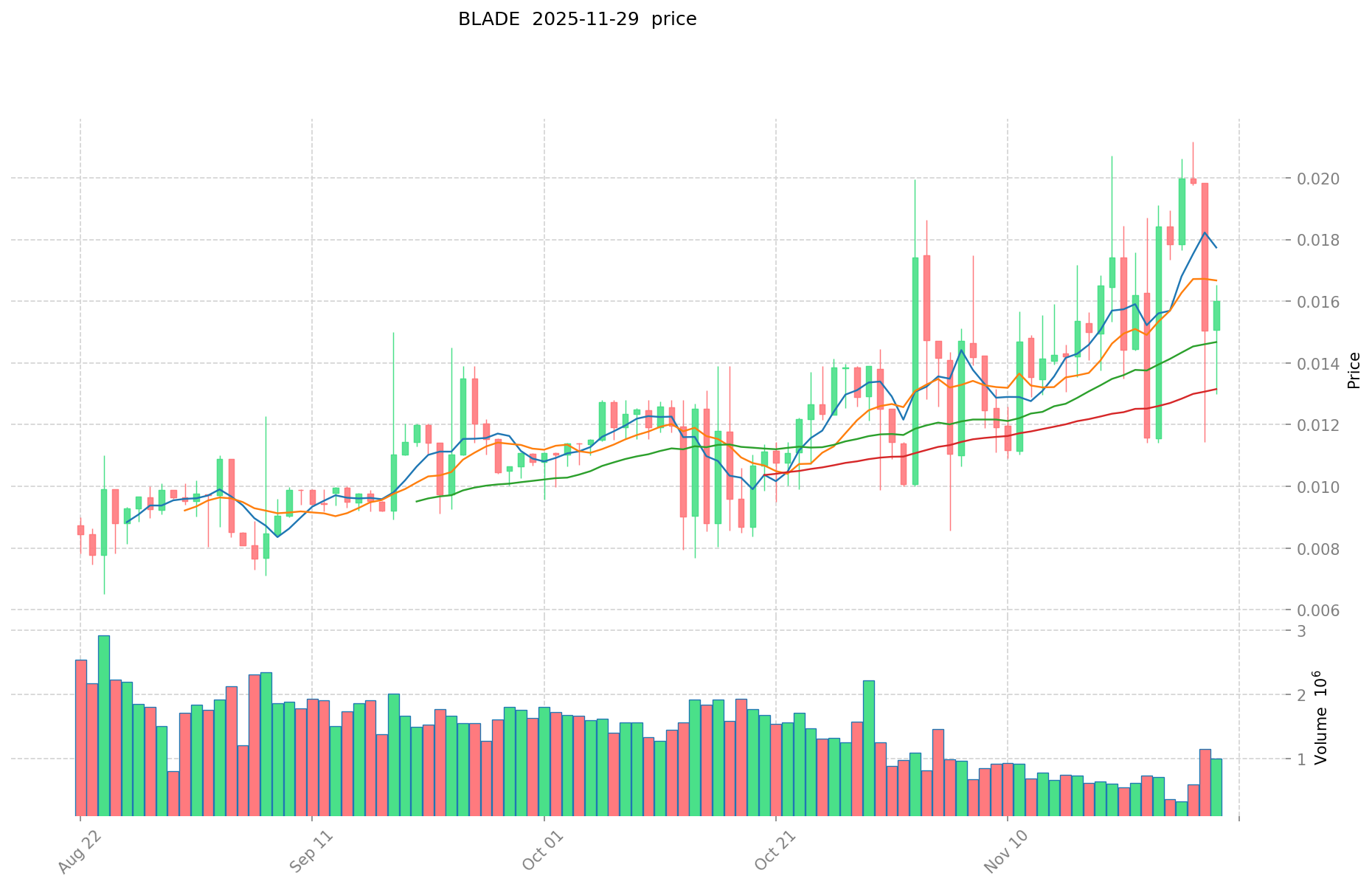
As of November 30, 2025, BLADE's circulating supply is 5,047,803 tokens, with a total supply of 100,000,000.
Price Fluctuations
BLADE reached its all-time high of $7.77 on December 23, 2024, driven by the initial token generation event (TGE) and listing on exchanges.
Its lowest price was $0.005737, occurring on July 26, 2025, likely due to market conditions or project-specific factors.
These fluctuations reflect market sentiment, adoption trends, and external factors.
Click to view the current market price of BLADE
On-Chain Metrics
- Active Addresses: Over 200,000 (reflecting user engagement)
Blade Games (BLADE) Ecosystem Applications and Partnerships
Core Use Cases
Blade Games' ecosystem supports multiple applications:
- On-chain Gaming: Five eco games, providing blockchain-based gaming experiences.
- AI Agents: Building AI agents operating in games, enabling user-driven on-chain economies.
Strategic Partnerships
Blade Games has established partnerships with Arbitrum, Mantle, 0G Labs, and Delphinus Lab, enhancing its technological capabilities and market influence.
These partnerships provide a solid foundation for Blade Games' ecosystem expansion.
Controversies and Challenges
Blade Games faces the following challenges:
- Market Competition: Competing with other blockchain gaming platforms and AI-driven ecosystems.
- Regulatory Uncertainty: Potential regulatory challenges in the evolving crypto gaming space.
- User Adoption: Attracting and retaining users in a highly competitive gaming market.
These issues have sparked discussions within the community and market, driving continuous innovation for Blade Games.
Fan Enthusiasm
Blade Games' community is vibrant, boasting over 850,000 registered users and 200,000 active on-chain addresses.
On X (formerly Twitter), related posts and hashtags (such as #BladeGames) frequently trend, with significant engagement.
The recent $2.4 million seed round funding has ignited community enthusiasm.
Sentiment on X shows diverse opinions:
- Supporters praise Blade Games for its innovative AI-driven gaming ecosystem and on-chain economy.
- Critics may focus on challenges in the blockchain gaming sector or concerns about AI integration.
Recent trends indicate generally positive sentiment due to the successful funding round and ecosystem growth.
Hot Topics
X users actively discuss Blade Games' AI integration, on-chain gaming experiences, and potential for user-created economies,
showcasing its transformative potential and the challenges of mainstream adoption in the blockchain gaming space.
- Official Website: Visit Blade Games official website for features, use cases, and latest updates.
- Whitepaper: Blade Games whitepaper details its technical architecture, goals, and vision.
- X Updates: On X, Blade Games uses @BladeGamesHQ, actively posting about technical updates, community events, and partnership news.
Blade Games Future Roadmap
- Ecosystem Growth: Expand the number of eco games and increase user base.
- AI Agent Development: Enhance AI agents for more sophisticated in-game interactions.
- Long-term Vision: Become a leading platform for on-chain gaming and AI-driven economies.
How to Participate in Blade Games?
- Purchase Options: Buy BLADE on Gate.com.
- Storage Solutions: Use secure wallets compatible with Arbitrum network.
- Engage in Governance: Participate in community decisions through the project's governance mechanisms.
- Build the Ecosystem: Visit the developer documentation to contribute to the Blade Games ecosystem.
Summary
Blade Games is redefining blockchain gaming by integrating AI agents and on-chain economies, offering innovative gaming experiences and user-driven economic opportunities.
Its active community, substantial funding, and strong market performance set it apart in the crypto gaming sector.
Despite facing challenges in market competition and user adoption, Blade Games' innovative spirit and clear roadmap position it as a significant player in the future of decentralized gaming technology.
Whether you're a newcomer or an experienced player, Blade Games is worth watching and participating in.
FAQ
What kind of vampire is Blade?
Blade is a dhampir, a half-vampire, half-human hybrid. He possesses vampire strengths without most weaknesses.
Is Blade a human or a vampire?
Blade is a fictional character, a half-human, half-vampire hybrid known as a 'Daywalker' in Marvel comics and films.
What is a Blade?
Blade is a decentralized exchange (DEX) protocol designed for efficient cross-chain trading and liquidity provision in the Web3 ecosystem.
What species is Blade?
Blade is not a species. It's a cryptocurrency project or token in the Web3 space. No specific animal or creature is associated with Blade.
* The information is not intended to be and does not constitute financial advice or any other recommendation of any sort offered or endorsed by Gate.















