The article delves into the ESG framework, exploring its origins, development, market performance, and ecosystem applications. ESG focuses on blockchain technology to drive sustainability in environmental, social, and governance practices. It covers challenges like market volatility and adoption while highlighting opportunities in renewable energy NFTs and carbon reduction. Targeting investors and sustainability advocates, the piece underscores ESG's role in decentralized finance. Key topics include the decentralized network, strategic partnerships, and community dynamics, offering a comprehensive guide to ESG’s impact and future roadmap.
ESG's Positioning and Significance
In 2022, ESG Financial launched ESG (ESG), aiming to address the challenges in the voluntary carbon reduction domain. As a pioneer in developing applications for voluntary carbon reduction, ESG plays a crucial role in the renewable energy and carbon offset sectors.
As of 2025, ESG has become an important player in the ESG (Environmental, Social, and Governance) crypto space, with a focus on securing emission rights for carbon reduction produced by individuals through an objective reward system.
Origins and Development History
Birth Background
ESG was created by ESG Financial in 2022, with the goal of extending operations from a Renewable Energy NFT Platform to the Voluntary Carbon Reduction domain. It was born in the context of increasing global awareness of environmental issues and the need for sustainable finance solutions. ESG aims to secure emission rights for carbon reduction produced by individuals through an objective reward system, bringing new possibilities to the renewable energy industry and individual carbon offsetters.
Important Milestones
- 2022: Launch of the ESG token, introducing a new paradigm in DeFi products related to the real economy of the renewable energy industry.
- 2023: Expansion into the Voluntary Carbon Reduction domain, as outlined in Whitepaper 2.0.
With the support of ESG Financial, ESG continues to optimize its technology, security, and real-world applications in the renewable energy and carbon offset sectors.
How Does ESG Work?
No Central Control
ESG operates on a decentralized network of computers (nodes) spread across the globe, free from the control of banks or governments. These nodes collaborate to verify transactions, ensuring system transparency and attack resistance, granting users greater autonomy and enhancing network resilience.
Blockchain Core
ESG's blockchain is a public, immutable digital ledger that records every transaction. Transactions are grouped into blocks and linked through cryptographic hashes to form a secure chain. Anyone can view the records, establishing trust without intermediaries.
Ensuring Fairness
ESG likely uses a consensus mechanism to validate transactions and prevent fraudulent activities such as double-spending. Participants maintain network security through activities like staking or running nodes, and are rewarded with ESG tokens.
Secure Transactions
ESG uses public-private key encryption technology to protect transactions:
- Private keys (like secret passwords) are used to sign transactions
- Public keys (like account numbers) are used to verify ownership
This mechanism ensures fund security, while transactions remain pseudonymous.
Circulation Overview
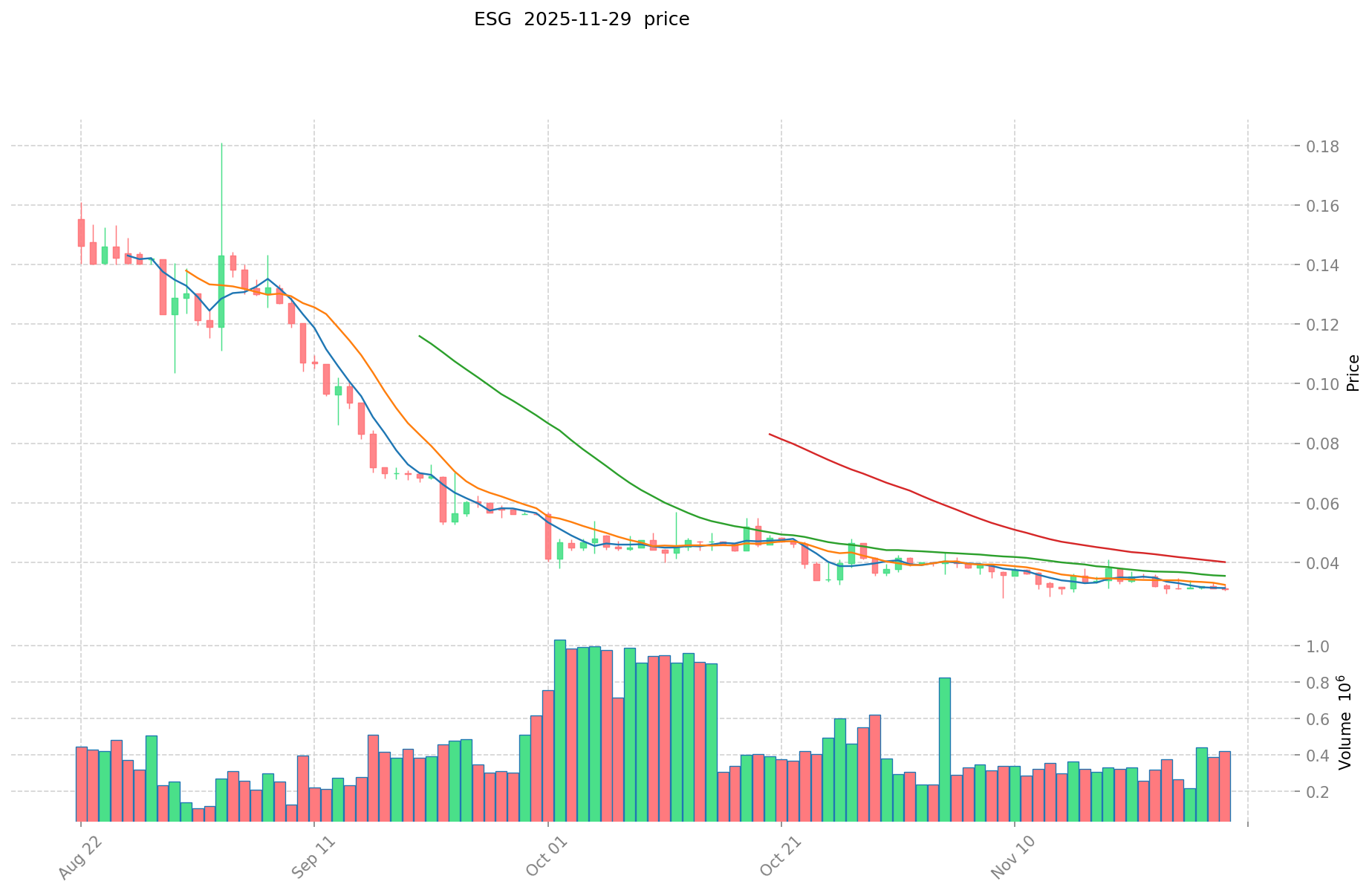
As of November 29, 2025, ESG's circulating supply is 2,850,000 coins, with a total supply of 49,000,000.
Price Fluctuations
ESG reached its all-time high of $3.83 on November 21, 2022.
Its lowest price was $0.02868964, recorded on November 13, 2025.
These fluctuations reflect market sentiment, adoption trends, and external factors.
Click to view the current market price of ESG
On-Chain Metrics
- Daily Transaction Volume: $11,987.77985 (indicating network activity)
- Active Addresses: 6,510 (reflecting user engagement)
ESG Ecosystem Applications and Partnerships
Core Use Cases
ESG's ecosystem supports multiple applications:
- Renewable Energy NFTs: ESG Finance provides a platform for tokenizing renewable energy assets.
- Voluntary Carbon Reduction: ESG Finance aims to develop applications for individual carbon reduction rewards.
Strategic Partnerships
ESG has extended its operations to the voluntary carbon reduction domain, positioning itself as a leader in this emerging sector.
Controversies and Challenges
ESG faces the following challenges:
- Market Volatility: The token has experienced significant price fluctuations, with a 89.34% decrease over the past year.
- Adoption Hurdles: As a relatively new project, ESG may face challenges in gaining widespread adoption and recognition.
These issues have sparked discussions within the community and market, driving ongoing innovation for ESG.
Fan Enthusiasm
ESG's community shows potential for growth, with 6,510 holders as of the latest data.
On X platform, related posts and hashtags like #ESG may gain traction as the project develops.
X sentiment may be mixed:
- Supporters likely praise ESG's focus on environmental and social governance in the blockchain space.
- Critics might point to the token's significant price decline over the past year.
Recent trends suggest cautious sentiment due to market performance.
Hot Topics
X users may discuss ESG's potential in the voluntary carbon reduction market and its renewable energy NFT platform.
- Official Website: Visit ESG Financial's official website for features, use cases, and latest updates.
- X Updates: On X platform, ESG Financial uses @ESG_Financial, sharing updates on their renewable energy and carbon reduction initiatives.
ESG Future Roadmap
- Ecosystem Goal: Become the leading developer of voluntary carbon reduction-oriented applications
- Long-term Vision: Secure emission rights for carbon reduction produced by individuals through an objective reward system
How to Participate in ESG?
- Purchase Channels: Buy ESG on Gate.com
- Storage Solutions: Use compatible Ethereum wallets for secure storage
- Ecosystem Engagement: Explore opportunities in renewable energy NFTs and voluntary carbon reduction initiatives
Summary
ESG is redefining the intersection of blockchain technology and environmental, social, and governance principles, offering solutions in renewable energy NFTs and voluntary carbon reduction. Its focus on sustainability and individual carbon reduction rewards sets it apart in the cryptocurrency space. Despite facing challenges such as market volatility and adoption hurdles, ESG's innovative approach to combining blockchain with ESG principles positions it uniquely in the decentralized technology landscape. Whether you're new to crypto or an experienced player, ESG's environmentally-conscious initiatives make it a project worth watching and participating in.
FAQ
What is ESG in simple words?
ESG stands for Environmental, Social, and Governance. It's a framework used to assess a company's sustainability and ethical impact.
Who is behind ESG?
ESG is not backed by a specific individual or organization. It's a concept and framework developed by the investment community to evaluate companies' environmental, social, and governance practices.
What are the 4 pillars of ESG?
The 4 pillars of ESG are: Environmental, Social, Governance, and Economic. These pillars form the foundation for sustainable and responsible business practices.
Why is ESG controversial?
ESG is controversial due to its subjective criteria, potential for greenwashing, and debates over its impact on financial performance and market efficiency.
* The information is not intended to be and does not constitute financial advice or any other recommendation of any sort offered or endorsed by Gate.














