The article explores how FEAR, a pioneering mixed NFT token and blockchain game brand, reshapes horror gaming by integrating NFTs and decentralized technology. It covers FEAR's creation, significant milestones, and technical operations, providing insights into market fluctuations and ecosystem applications. Challenges like market volatility and competition are examined, alongside community dynamics and social media sentiment. The roadmap highlights FEAR's growth ambitions in NFTs and horror-themed gaming. Ideal for gamers, NFT collectors, and investors, the piece explains participation options via Gate, enhancing understanding of FEAR's unique niche and value in blockchain gaming.
FEAR's Positioning and Significance
In 2021, the creators of the famous Whack It series launched FEAR (FEAR), aiming to address the lack of integration between NFTs and blockchain gaming in the horror genre.
As the first mixed NFT token and blockchain game horror brand, FEAR plays a crucial role in the gaming and NFT sectors, bridging the gap between traditional gaming experiences and blockchain technology.
As of 2025, FEAR has become a unique asset in the blockchain gaming industry, offering exclusive benefits to holders and users within its horror game ecosystem. With a dedicated user base and an active development community, FEAR continues to push the boundaries of blockchain gaming and NFT utility.
Origin and Development History
Birth Background
FEAR was created in 2021 by the team behind the Whack It series, with the goal of revolutionizing the horror gaming experience through blockchain technology and NFTs.
It emerged during the NFT and blockchain gaming boom, aiming to provide unique gaming experiences and financial incentives through token ownership.
FEAR's launch brought new possibilities for horror game enthusiasts and NFT collectors alike.
Important Milestones
- 2021: Launch of the FEAR token and initial gaming platform.
- 2025: Significant price drop, with the token reaching its all-time low of $0.00267373.
With support from its community and development team, FEAR continues to optimize its technology, security, and real-world applications within the horror gaming niche.
How Does FEAR Work?
Decentralized Control
FEAR operates on a decentralized network of computers (nodes) worldwide, free from control by a single entity.
These nodes collaborate to validate transactions, ensuring system transparency and attack resistance, granting users greater autonomy and enhancing network resilience.
Blockchain Core
FEAR's blockchain is a public, immutable digital ledger that records every transaction.
Transactions are grouped into blocks and linked through cryptographic hashes, forming a secure chain.
Anyone can view the records, establishing trust without intermediaries.
Ensuring Fairness
FEAR likely uses a Proof-of-Stake (PoS) consensus mechanism to validate transactions and prevent fraudulent activities like double-spending.
Participants (validators) maintain network security by staking FEAR tokens and receive rewards for their participation.
Secure Transactions
FEAR uses public-private key encryption to protect transactions:
- Private keys (like secret passwords) are used to sign transactions
- Public keys (like account numbers) are used to verify ownership
This mechanism ensures fund security, while transactions remain pseudonymous.
Additional features include NFT functionality and integration with horror gaming experiences.
Circulation Overview
As of November 30, 2025, FEAR has a circulating supply of 17,715,412 tokens, with a total supply of 41,739,201.62033058.
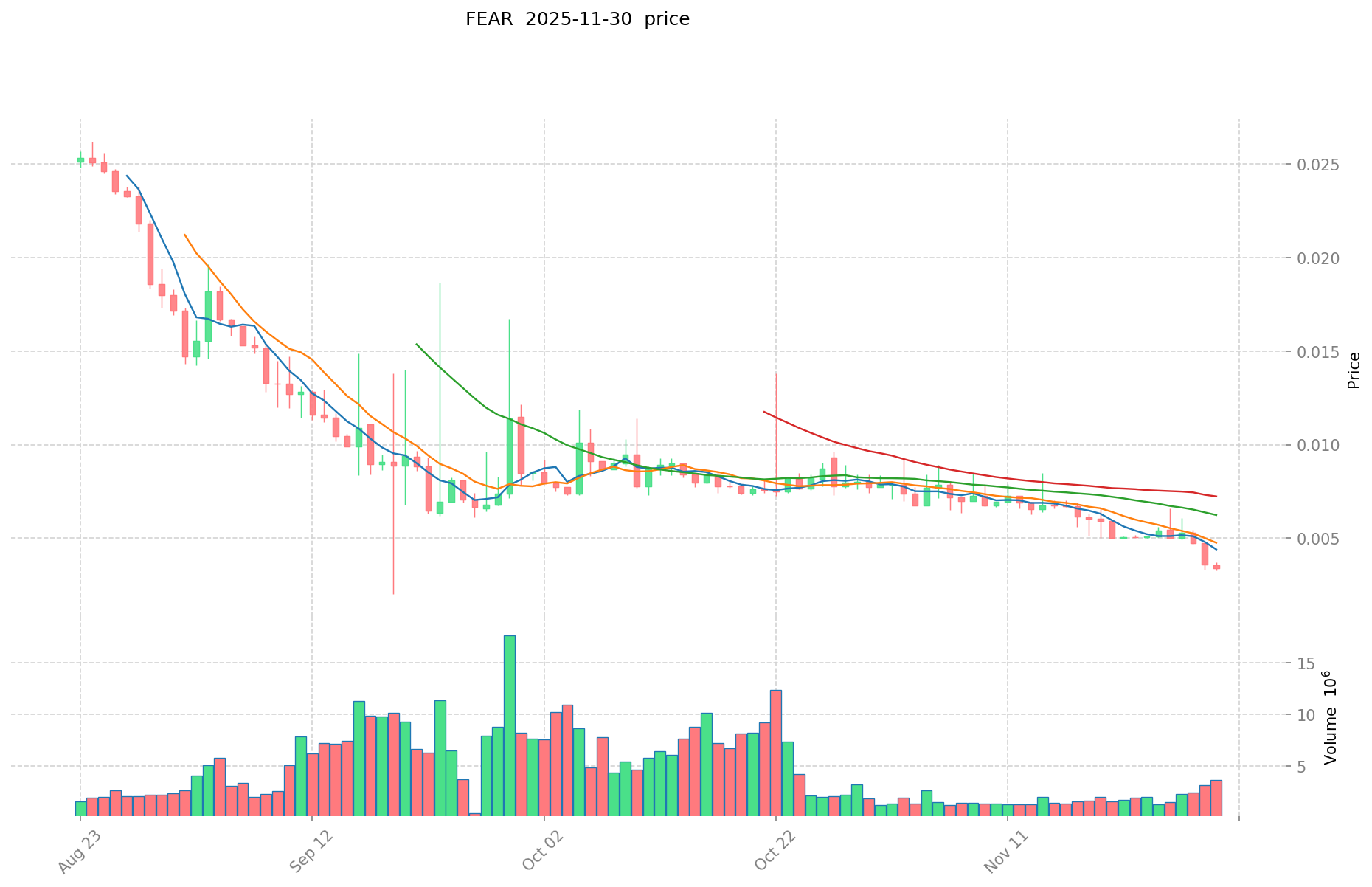
Price Fluctuations
FEAR reached its all-time high of $3.88 on November 30, 2021, likely driven by the overall crypto market bullish trend at that time.
Its lowest price was $0.00267373, occurring on November 30, 2025, possibly due to broader market downturns or specific project-related factors.
These fluctuations reflect market sentiment, adoption trends, and external factors.
Click to view the current market price of FEAR
On-Chain Metrics
Due to limited data availability, specific on-chain metrics such as daily transaction volume, active addresses, and staking rate are not provided. These metrics would typically indicate network activity, user engagement, and community commitment to network security.
FEAR Ecosystem Applications and Partnerships
Core Use Cases
FEAR's ecosystem supports multiple applications:
- GameFi: FEAR token is used in horror-themed blockchain games, allowing players to earn rewards.
- NFTs: FEAR is integrated with NFT sales and transactions, providing exclusive benefits to holders.
Strategic Partnerships
FEAR has established partnerships with Gather Network to enhance its reward system and gaming experience.
These partnerships provide a solid foundation for FEAR's ecosystem expansion.
Controversies and Challenges
FEAR faces the following challenges:
- Market Volatility: Significant price fluctuations, with a 96.28% decrease over the past year.
- Competition: Pressure from other gaming and NFT-focused cryptocurrencies.
These issues have sparked discussions within the community and market, driving FEAR's continuous innovation.
Fan Enthusiasm
FEAR's community shows moderate activity, with 1,661 holders as of November 30, 2025.
On X platform, posts and hashtags related to FEAR occasionally gain traction.
Price movements and game updates tend to ignite community interest.
Sentiment on X appears mixed:
- Supporters praise FEAR's unique horror gaming niche and NFT integration.
- Critics express concerns about the significant price decline and market performance.
Recent trends show generally bearish sentiment due to price depreciation.
Hot Topics
X users discuss FEAR's gaming features, NFT sales, and token utility,
highlighting both its niche appeal and the challenges it faces in the broader crypto market.
- Official Website: Visit FEAR's official website for features, use cases, and latest updates.
- X Updates: On X platform, FEAR uses @fearnfts, actively posting about game developments, NFT releases, and community events.
FEAR Future Roadmap
- Ongoing: Continue developing horror-themed blockchain games and expanding NFT offerings.
- Ecosystem Goals: Increase user base in the horror gaming niche and expand NFT collections.
- Long-term Vision: Establish FEAR as a leading token in the horror gaming and NFT space.
How to Participate in FEAR?
- Purchase Channels: Buy FEAR on Gate.com
- Storage Solutions: Use Web3 wallets compatible with ERC-20 tokens for secure storage
- Participate in Games: Engage with FEAR-powered games to earn rewards
- NFT Involvement: Participate in FEAR NFT sales and trading
Summary
FEAR redefines the intersection of cryptocurrencies, horror gaming, and NFTs, offering unique gaming experiences and NFT utilities.
Its niche focus and integration with horror-themed blockchain games set it apart in the cryptocurrency landscape.
Despite facing market volatility and competition, FEAR's innovative approach to gaming and NFTs gives it a distinct position in the decentralized technology future.
Whether you're a horror gaming enthusiast or an NFT collector, FEAR presents an intriguing opportunity to explore.
FAQ
What is the true meaning of fear?
Fear is a primal emotion that triggers a survival response, alerting us to potential dangers and preparing our bodies for action.
What is the root cause of fear?
The root cause of fear is often uncertainty and perceived threats to our safety, well-being, or goals. It's a primal emotion that evolved as a survival mechanism.
What is fear in the Bible?
In the Bible, fear often refers to reverence and awe for God, rather than terror. It's a respectful attitude towards God's power and authority, encouraging obedience and righteous living.
What are the 4 types of fear?
The 4 types of fear are: 1) Fear of the unknown, 2) Fear of failure, 3) Fear of rejection, and 4) Fear of change. These are common psychological responses that can impact decision-making and behavior.
* The information is not intended to be and does not constitute financial advice or any other recommendation of any sort offered or endorsed by Gate.













