In this article, we delve into a comparative analysis of ZAP and XLM, highlighting their investment potential and market performance. Addressing key factors such as price history, supply mechanisms, and institutional adoption, we aim to guide investors in determining the more promising opportunity. Suitable for both new and experienced investors, the article provides strategic insights into investment tactics tailored to risk tolerance. Keywords such as "ZAP vs XLM investment" and "cross-chain interoperability" are optimized for quick scanning, ensuring concise readability.
Introduction: ZAP vs XLM Investment Comparison
In the cryptocurrency market, the comparison between ZAP and XLM has always been an unavoidable topic for investors. The two not only show significant differences in market cap ranking, application scenarios, and price performance, but also represent different positioning in the crypto asset space.
ZAP (ZAP): Since its launch, it has gained market recognition for its unique approach to connecting capital and community.
Stellar (XLM): Since 2014, it has been hailed as a decentralized gateway for transmitting digital and fiat currencies, becoming one of the cryptocurrencies with high global transaction volume and market capitalization.
This article will provide a comprehensive analysis of the investment value comparison between ZAP and XLM, focusing on historical price trends, supply mechanisms, institutional adoption, technological ecosystems, and future predictions, attempting to answer the question most concerning to investors:
"Which is the better buy right now?"
I. Price History Comparison and Current Market Status
ZAP and XLM Historical Price Trends
- 2024: ZAP reached its all-time high of $0.8375 on October 9, 2024.
- 2025: ZAP hit its all-time low of $0.00075 on November 25, 2025.
- 2018: XLM reached its all-time high of $0.875563 on January 3, 2018.
- 2015: XLM hit its all-time low of $0.00047612 on March 5, 2015.
- Comparative Analysis: In the current market cycle, ZAP has experienced a significant drop from its all-time high to its all-time low within a year, while XLM has shown more long-term stability with its all-time high and low spread over several years.
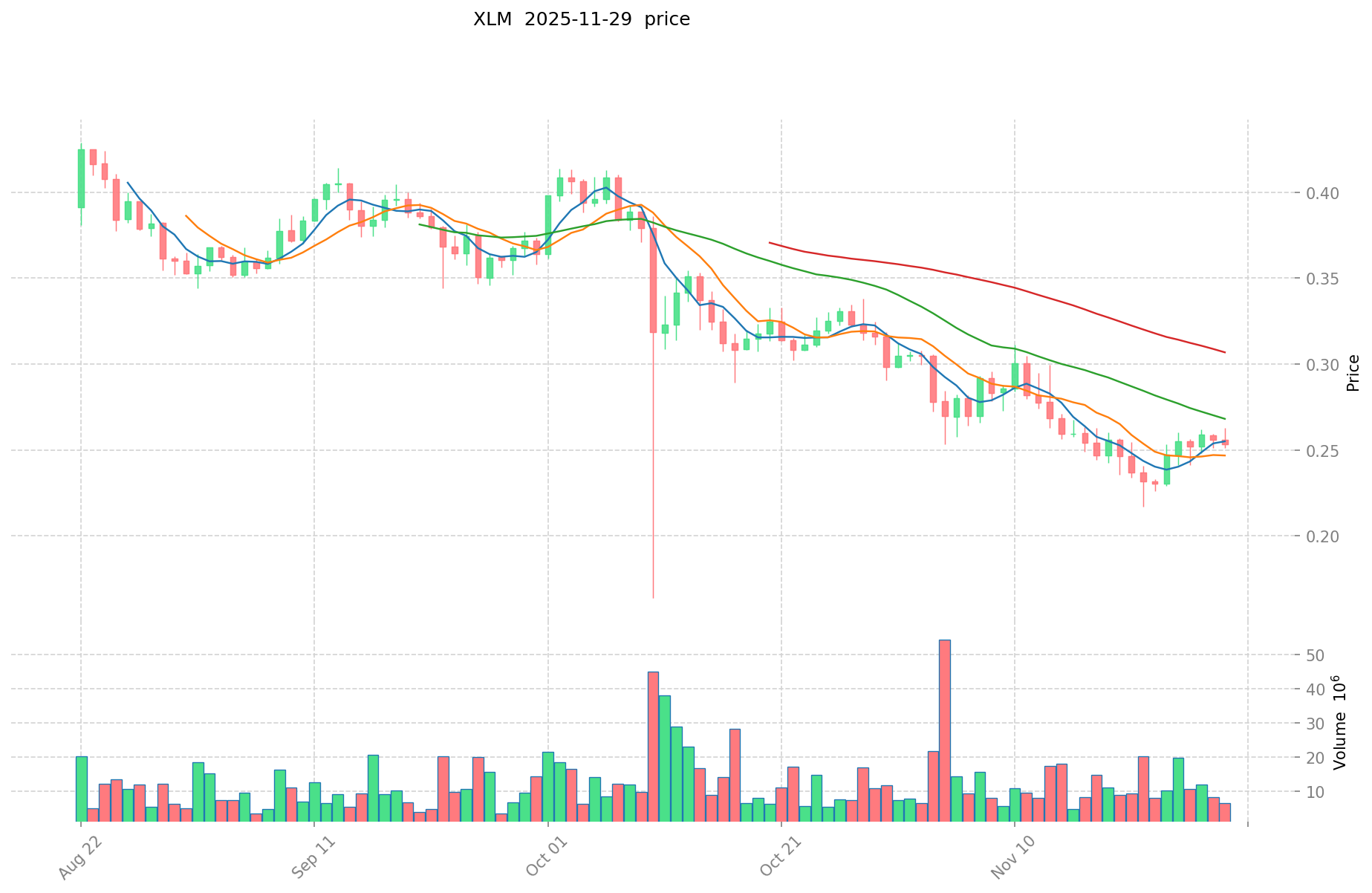
Current Market Situation (2025-11-29)
- ZAP current price: $0.001365
- XLM current price: $0.25321
- 24-hour trading volume: ZAP $13,733.08 vs XLM $1,142,990.19
- Market Sentiment Index (Fear & Greed Index): 28 (Fear)
Click to view real-time prices:
- View ZAP current price Market Price
- View XLM current price Market Price

II. Core Factors Affecting Investment Value of ZAP vs XLM
Supply Mechanisms Comparison (Tokenomics)
- ZAP: Fixed total supply of 520,000,000 ZAP tokens
- XLM: Inflationary model with 50 billion initial supply, later changed to deflationary (50% of tokens were burned in 2019)
- 📌 Historical Pattern: Fixed supply assets like ZAP tend to experience higher volatility during market cycles, while XLM's controlled supply may offer more stability after its significant burn event.
Institutional Adoption and Market Applications
- Institutional Holdings: XLM has gained more institutional adoption through Stellar Development Foundation's partnerships with financial institutions
- Enterprise Adoption: XLM has stronger adoption in cross-border payments and settlements through partnerships with IBM and various financial institutions, while ZAP focuses on oracle services
- Regulatory Attitudes: XLM generally benefits from more favorable regulatory standing as Stellar has actively worked with regulators, while ZAP faces the general regulatory uncertainty common to oracle tokens
Technical Development and Ecosystem Building
- ZAP Technical Upgrades: Focus on bonding curve mechanisms for data providers and consumers
- XLM Technical Development: Implementation of Protocol 19 upgrade, enhancing smart contract capabilities and network efficiency
- Ecosystem Comparison: XLM has broader ecosystem spanning payments, asset tokenization, and DeFi applications, while ZAP remains more focused on its oracle service niche
Macroeconomic Factors and Market Cycles
- Inflation Performance: XLM's larger market cap and broader adoption may provide more stability during inflationary periods
- Monetary Policy Effects: Both tokens face similar impacts from interest rate changes and dollar strength, though XLM's payment network use case may provide some insulation
- Geopolitical Factors: XLM's cross-border payment infrastructure gives it potential advantages during periods of increased demand for alternative international settlement options
III. 2025-2030 Price Prediction: ZAP vs XLM
Short-term Prediction (2025)
- ZAP: Conservative $0.00075075 - $0.001365 | Optimistic $0.001365 - $0.00173355
- XLM: Conservative $0.208075 - $0.25375 | Optimistic $0.25375 - $0.3628625
Mid-term Prediction (2027)
- ZAP may enter a growth phase, with an estimated price range of $0.00167135787 - $0.00246210783
- XLM may enter a growth phase, with an estimated price range of $0.221240565 - $0.452100285
- Key drivers: Institutional capital inflow, ETF, ecosystem development
Long-term Prediction (2030)
- ZAP: Base scenario $0.002189555975214 - $0.002919407966952 | Optimistic scenario $0.002919407966952 - $0.003240542843317
- XLM: Base scenario $0.47212176094902 - $0.5131758271185 | Optimistic scenario $0.5131758271185 - $0.549098135016795
View detailed price predictions for ZAP and XLM
Disclaimer
ZAP:
| 年份 |
预测最高价 |
预测平均价格 |
预测最低价 |
涨跌幅 |
| 2025 |
0.00173355 |
0.001365 |
0.00075075 |
0 |
| 2026 |
0.002045043 |
0.001549275 |
0.000991536 |
13 |
| 2027 |
0.00246210783 |
0.001797159 |
0.00167135787 |
31 |
| 2028 |
0.0025981527663 |
0.002129633415 |
0.001277780049 |
56 |
| 2029 |
0.003474922843255 |
0.00236389309065 |
0.001512891578016 |
73 |
| 2030 |
0.003240542843317 |
0.002919407966952 |
0.002189555975214 |
113 |
XLM:
| 年份 |
预测最高价 |
预测平均价格 |
预测最低价 |
涨跌幅 |
| 2025 |
0.3628625 |
0.25375 |
0.208075 |
0 |
| 2026 |
0.33297075 |
0.30830625 |
0.2435619375 |
21 |
| 2027 |
0.452100285 |
0.3206385 |
0.221240565 |
26 |
| 2028 |
0.5100075981 |
0.3863693925 |
0.235685329425 |
52 |
| 2029 |
0.578163158937 |
0.4481884953 |
0.277876867086 |
76 |
| 2030 |
0.549098135016795 |
0.5131758271185 |
0.47212176094902 |
102 |
IV. Investment Strategy Comparison: ZAP vs XLM
Long-term vs Short-term Investment Strategy
- ZAP: Suitable for investors focusing on oracle services and potential for high volatility
- XLM: Suitable for investors seeking stability and cross-border payment solutions
Risk Management and Asset Allocation
- Conservative investors: ZAP: 10% vs XLM: 90%
- Aggressive investors: ZAP: 30% vs XLM: 70%
- Hedging tools: Stablecoin allocation, options, cross-currency portfolio
V. Potential Risk Comparison
Market Risk
- ZAP: Higher volatility, lower liquidity
- XLM: Susceptible to competition in the payment sector
Technical Risk
- ZAP: Scalability, network stability
- XLM: Network upgrades, smart contract vulnerabilities
Regulatory Risk
- Global regulatory policies may have different impacts on both, with XLM potentially facing less scrutiny due to its focus on traditional financial use cases
VI. Conclusion: Which Is the Better Buy?
📌 Investment Value Summary:
- ZAP advantages: Niche oracle service, potential for high returns in bull markets
- XLM advantages: Established ecosystem, institutional adoption, cross-border payment solutions
✅ Investment Advice:
- New investors: Consider a higher allocation to XLM for its stability and established use cases
- Experienced investors: Balanced approach with both ZAP and XLM, adjusting based on risk tolerance
- Institutional investors: Focus on XLM for its regulatory clarity and partnerships with financial institutions
⚠️ Risk Warning: The cryptocurrency market is highly volatile. This article does not constitute investment advice.
None
VII. FAQ
Q1: What are the key differences between ZAP and XLM?
A: ZAP focuses on oracle services with a fixed supply, while XLM specializes in cross-border payments with a deflationary model. XLM has broader institutional adoption and a more established ecosystem.
Q2: Which token has shown better price stability historically?
A: XLM has demonstrated more long-term price stability, with its all-time high and low spread over several years. ZAP, in contrast, experienced significant volatility within a single year.
Q3: How do the supply mechanisms of ZAP and XLM differ?
A: ZAP has a fixed total supply of 520,000,000 tokens, while XLM initially had an inflationary model but switched to deflationary after burning 50% of its tokens in 2019.
Q4: Which token has greater institutional adoption?
A: XLM has gained more institutional adoption through Stellar Development Foundation's partnerships with financial institutions and its collaboration with IBM for cross-border payments and settlements.
Q5: What are the primary use cases for each token?
A: ZAP primarily serves as an oracle token for data providers and consumers, while XLM is used for cross-border payments, asset tokenization, and various DeFi applications.
Q6: How do the long-term price predictions for ZAP and XLM compare?
A: By 2030, ZAP's base scenario predicts a range of $0.002189555975214 - $0.002919407966952, while XLM's base scenario predicts $0.47212176094902 - $0.5131758271185, suggesting potentially higher growth for XLM.
Q7: What investment strategies are recommended for ZAP and XLM?
A: For conservative investors, a 10% ZAP to 90% XLM allocation is suggested. Aggressive investors might consider a 30% ZAP to 70% XLM split. New investors may want to focus more on XLM for its stability and established use cases.
* The information is not intended to be and does not constitute financial advice or any other recommendation of any sort offered or endorsed by Gate.













