This article dives into the investment comparison between ZetaChain (ZETA) and Near (NEAR), two promising blockchain platforms for decentralized applications. It covers historical price trends, supply mechanisms, institutional adoption, technological ecosystems, and current market situations. Investors will find detailed analyses helping them answer the pivotal question: "Which is the better buy right now?" Designed for both conservative and aggressive investors, it evaluates risk management and asset allocation strategies. For real-time price updates, check ZETA and NEAR prices on Gate. The content is ideal for quick scanning, optimizing SEO keyword density and readability.
Introduction: ZETA vs NEAR Investment Comparison
In the cryptocurrency market, the comparison between ZETA and NEAR has always been a topic that investors can't ignore. The two not only have significant differences in market cap ranking, application scenarios, and price performance, but also represent different positioning in the crypto asset space.
ZetaChain (ZETA): Since its launch, it has gained market recognition for its omnichain and cross-chain capabilities.
Near (NEAR): Introduced in 2020, it has been hailed as a highly scalable protocol supporting fast DApp operations on mobile devices.
This article will comprehensively analyze the investment value comparison between ZETA and NEAR, focusing on historical price trends, supply mechanisms, institutional adoption, technological ecosystems, and future predictions, attempting to answer the question investors care about most:
"Which is the better buy right now?"
I. Price History Comparison and Current Market Status
ZetaChain (ZETA) and Near (NEAR) Historical Price Trends
- 2024: ZETA reached its all-time high of $2.87 on February 15, 2024.
- 2022: NEAR hit its all-time high of $20.44 on January 17, 2022.
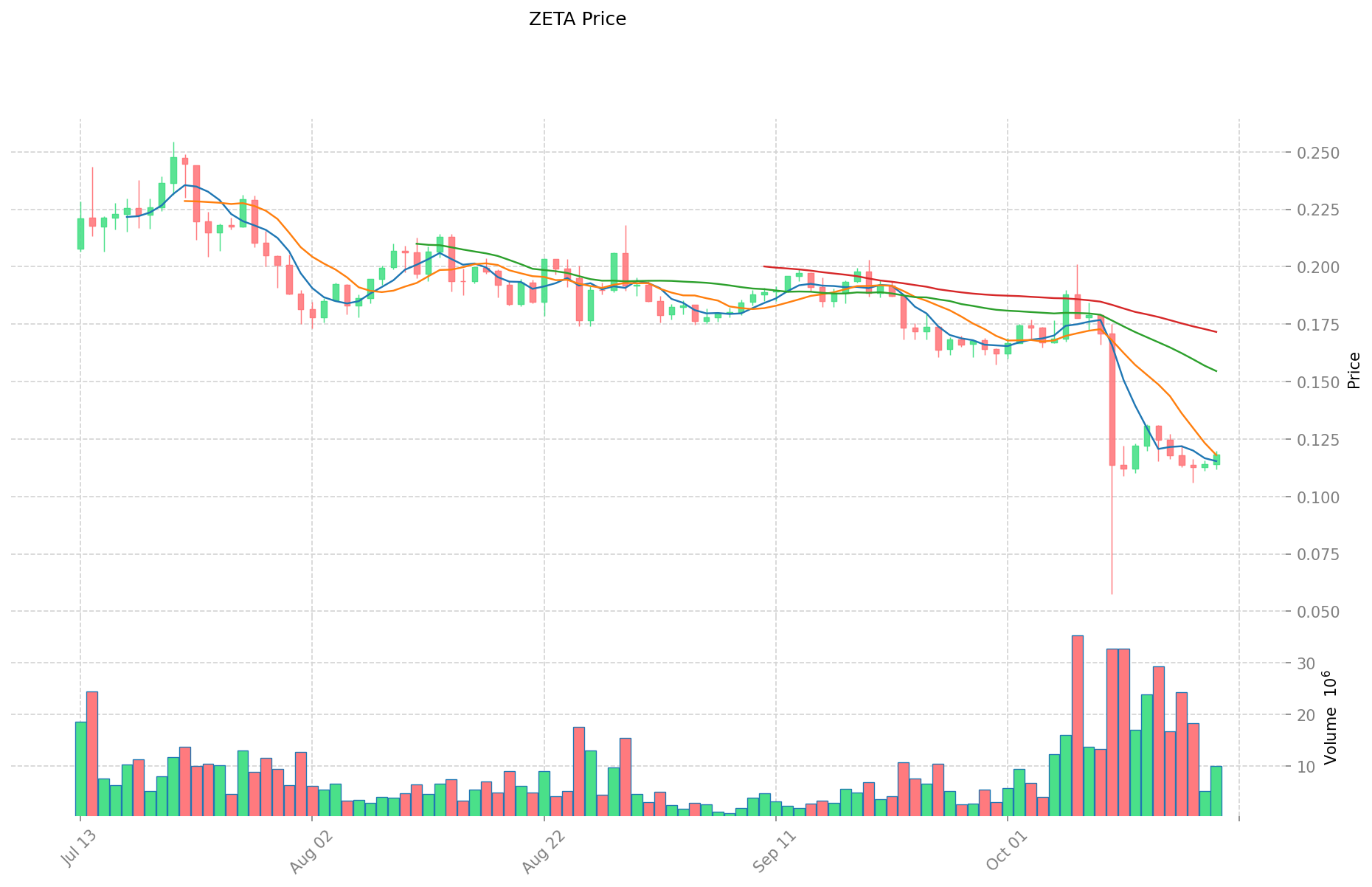
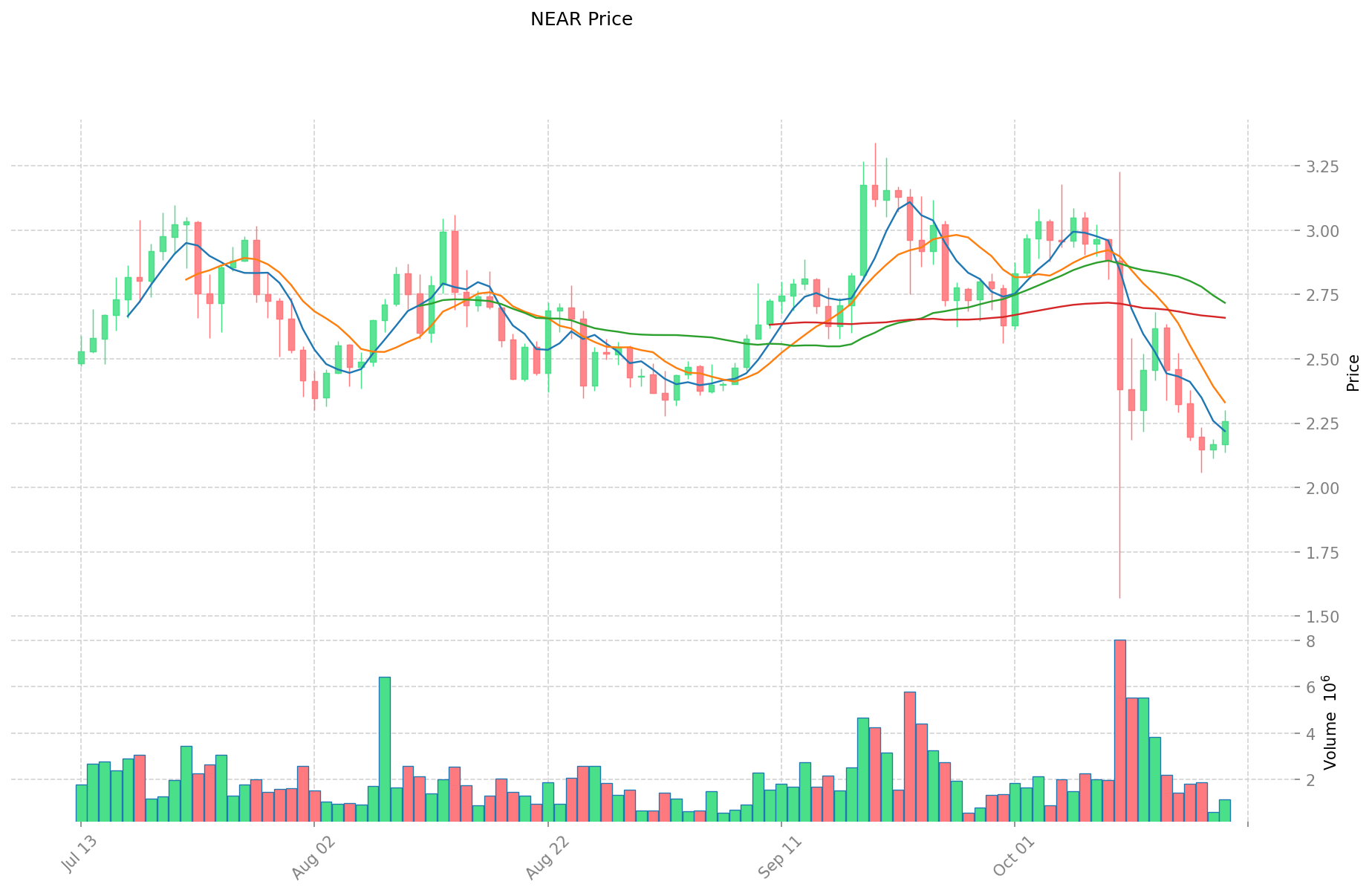
- Comparative Analysis: In the recent market cycle, ZETA dropped from its peak of $2.87 to a low of $0.05735, while NEAR declined from its high of $20.44 to its current price of $2.253.
Current Market Situation (2025-10-20)
- ZETA current price: $0.11797
- NEAR current price: $2.253
- 24-hour trading volume: ZETA $1,157,392.80 vs NEAR $2,490,946.12
- Market Sentiment Index (Fear & Greed Index): 29 (Fear)
Click to view real-time prices:
- Check ZETA current price Market Price
- Check NEAR current price Market Price
II. Core Factors Affecting the Investment Value of ZETA vs NEAR
Supply Mechanisms Comparison (Tokenomics)
-
ZETA: Fixed supply of 2.1 billion tokens with deflationary mechanisms - 70% of protocol fees are used for token burns
-
NEAR: Maximum supply of 1 billion tokens with an adaptive inflation model that ranges from 1% to 5% based on network usage and staking participation
-
📌 Historical Pattern: Deflationary models like ZETA's tend to create stronger price support during bear markets, while NEAR's inflation model helps sustain network security through validator incentives.
Institutional Adoption and Market Applications
- Institutional Holdings: NEAR has stronger institutional backing with investors including a16z, Coinbase Ventures, and Pantera Capital, while ZETA has gained traction with tier-2 investors
- Enterprise Adoption: NEAR has more established enterprise partnerships through the NEAR Foundation, while ZETA focuses primarily on retail user applications for its modular trading infrastructure
- Regulatory Stance: Both projects have pursued regulatory clarity, with NEAR maintaining stronger regulatory relationships across multiple jurisdictions
Technology Development and Ecosystem Building
- ZETA Technical Upgrades: Recent implementation of ZK rollups for scalability and the Hyperscalable Modular Chain architecture providing improved throughput for DeFi applications
- NEAR Technical Development: Progressive sharding implementation through Nightshade and the introduction of Fast Finality Layer for transaction processing speed improvements
- Ecosystem Comparison: NEAR has a more diverse ecosystem spanning DeFi, NFTs, and enterprise solutions, while ZETA has focused exclusively on building specialized financial infrastructure with higher performance for trading applications
Macroeconomic Factors and Market Cycles
- Performance in Inflationary Environments: ZETA's deflationary model theoretically provides better inflation protection, though neither has been tested in a prolonged high-inflation environment
- Monetary Policy Impact: Both tokens show high correlation with tech stocks and risk assets during interest rate changes
- Geopolitical Factors: NEAR's stronger presence in emerging markets may provide diversification advantages during regional economic disruptions
III. 2025-2030 Price Prediction: ZETA vs NEAR
Short-term Prediction (2025)
- ZETA: Conservative $0.0684-$0.1180 | Optimistic $0.1180-$0.1722
- NEAR: Conservative $1.3056-$2.2510 | Optimistic $2.2510-$2.5661
Mid-term Prediction (2027)
- ZETA may enter a growth phase, with projected prices of $0.1386-$0.2222
- NEAR may enter a consolidation phase, with projected prices of $2.0116-$3.6042
- Key drivers: Institutional inflows, ETFs, ecosystem development
Long-term Prediction (2030)
- ZETA: Base scenario $0.2356-$0.2772 | Optimistic scenario $0.2772-$0.2993
- NEAR: Base scenario $1.8911-$3.6367 | Optimistic scenario $3.6367-$5.3459
View detailed price predictions for ZETA and NEAR
Disclaimer: This analysis is for informational purposes only and should not be considered as financial advice. Cryptocurrency markets are highly volatile and unpredictable. Always conduct your own research before making investment decisions.
ZETA:
| 年份 |
预测最高价 |
预测平均价格 |
预测最低价 |
涨跌幅 |
| 2025 |
0.1722362 |
0.11797 |
0.0684226 |
0 |
| 2026 |
0.210399495 |
0.1451031 |
0.084159798 |
23 |
| 2027 |
0.222189121875 |
0.1777512975 |
0.13864601205 |
50 |
| 2028 |
0.261960974690625 |
0.1999702096875 |
0.137979444684375 |
69 |
| 2029 |
0.323351829064687 |
0.230965592189062 |
0.200940065204484 |
95 |
| 2030 |
0.299331407477025 |
0.277158710626875 |
0.235584904032843 |
135 |
NEAR:
| 年份 |
预测最高价 |
预测平均价格 |
预测最低价 |
涨跌幅 |
| 2025 |
2.56614 |
2.251 |
1.30558 |
0 |
| 2026 |
3.1793124 |
2.40857 |
1.5414848 |
6 |
| 2027 |
3.604184148 |
2.7939412 |
2.011637664 |
24 |
| 2028 |
3.29503455422 |
3.199062674 |
3.0391095403 |
41 |
| 2029 |
4.0263402814964 |
3.24704861411 |
2.7275208358524 |
44 |
| 2030 |
5.345940838270704 |
3.6366944478032 |
1.891081112857664 |
61 |
IV. Investment Strategy Comparison: ZETA vs NEAR
Long-term vs Short-term Investment Strategies
- ZETA: Suitable for investors focused on cross-chain infrastructure and DeFi potential
- NEAR: Suitable for investors seeking ecosystem diversity and established institutional backing
Risk Management and Asset Allocation
- Conservative investors: ZETA: 30% vs NEAR: 70%
- Aggressive investors: ZETA: 60% vs NEAR: 40%
- Hedging tools: Stablecoin allocation, options, cross-currency portfolios
V. Potential Risk Comparison
Market Risks
- ZETA: Higher volatility due to smaller market cap and newer project status
- NEAR: Potential market saturation in the Layer 1 space
Technical Risks
- ZETA: Scalability challenges, network stability during high-volume periods
- NEAR: Sharding implementation complexities, potential security vulnerabilities
Regulatory Risks
- Global regulatory policies may have differing impacts on both tokens, with NEAR potentially facing more scrutiny due to its wider adoption
VI. Conclusion: Which Is the Better Buy?
📌 Investment Value Summary:
- ZETA advantages: Deflationary model, focus on omnichain and cross-chain capabilities
- NEAR advantages: Established ecosystem, strong institutional backing, scalability improvements
✅ Investment Advice:
- Novice investors: Consider a larger allocation to NEAR for its established track record
- Experienced investors: Balanced approach with exposure to both, leaning towards ZETA for higher growth potential
- Institutional investors: NEAR may be more suitable due to its regulatory clarity and wider adoption
⚠️ Risk Warning: The cryptocurrency market is highly volatile. This article does not constitute investment advice.
None
VII. FAQ
Q1: What are the main differences between ZETA and NEAR?
A: The main differences are: ZETA has a fixed supply with deflationary mechanisms, focuses on omnichain and cross-chain capabilities, and has a smaller market cap. NEAR has an adaptive inflation model, a more diverse ecosystem, stronger institutional backing, and is positioned as a highly scalable Layer 1 protocol.
Q2: Which token has performed better historically?
A: NEAR reached its all-time high of $20.44 in January 2022, while ZETA's all-time high was $2.87 in February 2024. However, ZETA is a newer token and has shown strong growth potential in its shorter history.
Q3: How do their supply mechanisms differ?
A: ZETA has a fixed supply of 2.1 billion tokens with deflationary mechanisms, where 70% of protocol fees are used for token burns. NEAR has a maximum supply of 1 billion tokens with an adaptive inflation model ranging from 1% to 5% based on network usage and staking participation.
Q4: Which token is considered more suitable for long-term investment?
A: Both tokens have long-term potential, but NEAR may be considered more suitable for conservative long-term investors due to its established ecosystem and stronger institutional backing. ZETA could be attractive for those seeking higher growth potential in cross-chain infrastructure.
Q5: What are the main risks associated with investing in ZETA and NEAR?
A: For ZETA, main risks include higher volatility due to smaller market cap, scalability challenges, and network stability issues. For NEAR, risks include potential market saturation in the Layer 1 space, sharding implementation complexities, and potential security vulnerabilities.
Q6: How do institutional adoptions compare between ZETA and NEAR?
A: NEAR has stronger institutional backing with investors including a16z, Coinbase Ventures, and Pantera Capital. ZETA has gained traction with tier-2 investors but has less established institutional support compared to NEAR.
Q7: What are the price predictions for ZETA and NEAR by 2030?
A: By 2030, ZETA's base scenario prediction is $0.2356-$0.2772, with an optimistic scenario of $0.2772-$0.2993. For NEAR, the base scenario prediction is $1.8911-$3.6367, with an optimistic scenario of $3.6367-$5.3459. However, these predictions are speculative and should not be considered as financial advice.
* The information is not intended to be and does not constitute financial advice or any other recommendation of any sort offered or endorsed by Gate.












