What Was This Chain Split Incident?
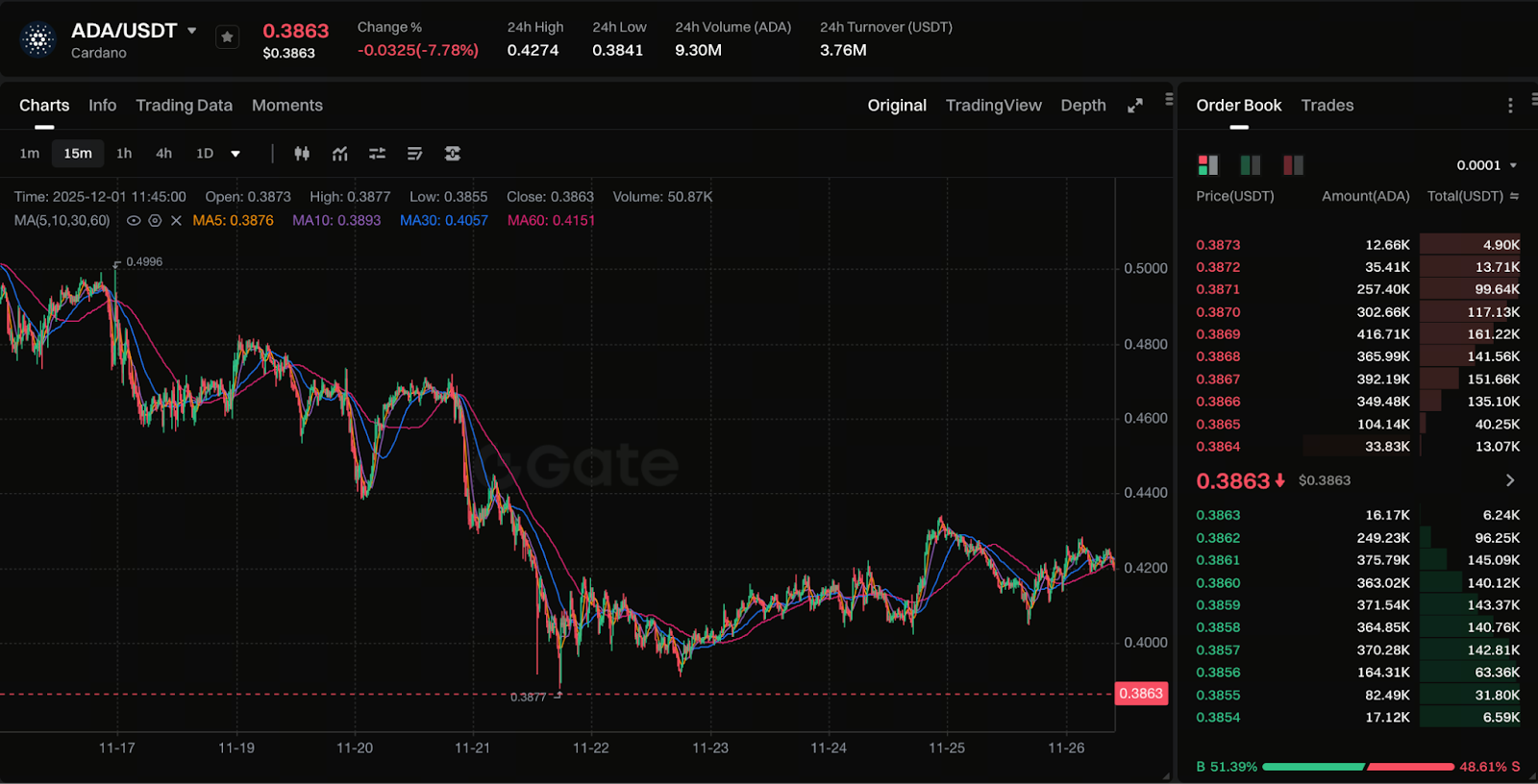
Image source: https://www.gate.com/trade/ADA_USDT
On November 21, the Cardano network suffered its most severe chain split since its 2017 launch. A “delegation transaction” with a malformed format was accepted by some nodes but rejected by others running older versions. This split the network into two conflicting ledgers.
During the incident, some nodes continued to add blocks to the forked chain (which included the faulty transaction), while others maintained the canonical chain (which excluded the abnormal transaction). As a result, two parallel chains emerged, causing disruptions in transaction confirmations, block explorers, and DeFi protocols.
How Did the “AI-Generated Transaction” Spark the Incident?
Reports indicate that the malformed transaction wasn’t manually entered. Instead, a developer used an AI tool to generate a script, which was then executed on the mainnet. The goal was to replicate a previous testnet anomaly, but running it on the mainnet triggered the vulnerability. Some developers described this as a “careless experiment,” while Cardano co-founder Charles Hoskinson publicly labeled it a “premeditated attack.”
Afterward, the user known as “Homer J” admitted responsibility on social media, stating the intent was to challenge and test the network, but the consequences were clearly underestimated.
ADA Price Movements and Market Response
News of the chain split triggered market volatility. ADA plunged about 16% at one point, reaching a low near $0.41.
Meanwhile, major exchanges including Coinbase, Upbit, and Kraken suspended ADA deposits and withdrawals to prevent double-spending or data inconsistencies during the split.
This event also raised doubts among investors about Cardano’s security and stability. Market confidence was undermined.
Community and Developer Response: Patches, Node Upgrades, and Restoring Consensus
The Cardano ecosystem responded swiftly to the split. The development team released node software updates to versions 10.5.2 and 10.5.3 within hours and coordinated stake pool operators to upgrade their nodes. By November 22, the network was reunited and normal operations resumed through the Ouroboros consensus protocol.
Officials also stressed that despite the seriousness of the incident, all wallet funds remained safe and asset safety was confirmed.
Long-Term Impact on Cardano’s Confidence and Risk
This split exposed several issues and long-term risks:
- Bugs in node software had gone undetected for years, suggesting that core codebase review and testing may be insufficient.
- A single AI-generated transaction destabilized the entire chain, highlighting new risks associated with integrating AI into blockchain systems.
- Even with a swift recovery, the incident could have lasting effects on community trust, institutional adoption, and exchange confidence.
On the positive side, Cardano’s rapid response and patch deployment demonstrated strong emergency capabilities and team coordination. Enhanced code audits and improved security mechanisms may help the team manage these risks in the future.