Regulatory Advancements Reshape Markets: Capital Preferences Shift Before Prices
When stablecoin regulation comes up, many immediately ask, “Will this hurt the market?”
Yet, both history and today’s market structure show that regulation most often reshuffles capital preferences first—prices follow afterward.
This is because regulation fundamentally accomplishes two things:
- It defines which assets large-scale capital can hold for the long term;
- It establishes repeatable, reliable pathways for capital to move from fiat to on-chain.
Once these pathways are standardized, capital doesn’t flow evenly into every asset. Instead, it prioritizes assets with more predictable risk-return profiles. In short, regulation doesn’t simply add or subtract liquidity—it redefines the investable asset pool.
Four Core Drivers of On-Chain Liquidity Redistribution
With stablecoin regulation in place, liquidity migration typically follows four main principles:
- Compliance Accessibility: Assets that institutions, brokers, custodians, and auditors can easily access naturally attract lower-barrier capital.
- Return Certainty: Capital prefers assets with clear, verifiable sources of return over those driven by speculation or sentiment alone.
- Liquidation & Risk Control: In volatile markets, assets with transparent liquidation mechanisms and robust collateral rules are more likely to attract long-term capital.
- Liquidity Depth: Institutional investors fear illiquidity. Depth and effective slippage management become critical competitive advantages.
Combined, these drivers shift the market from broad-based liquidity to a more tiered structure.
Five Asset Classes Poised to Capture Incremental Liquidity
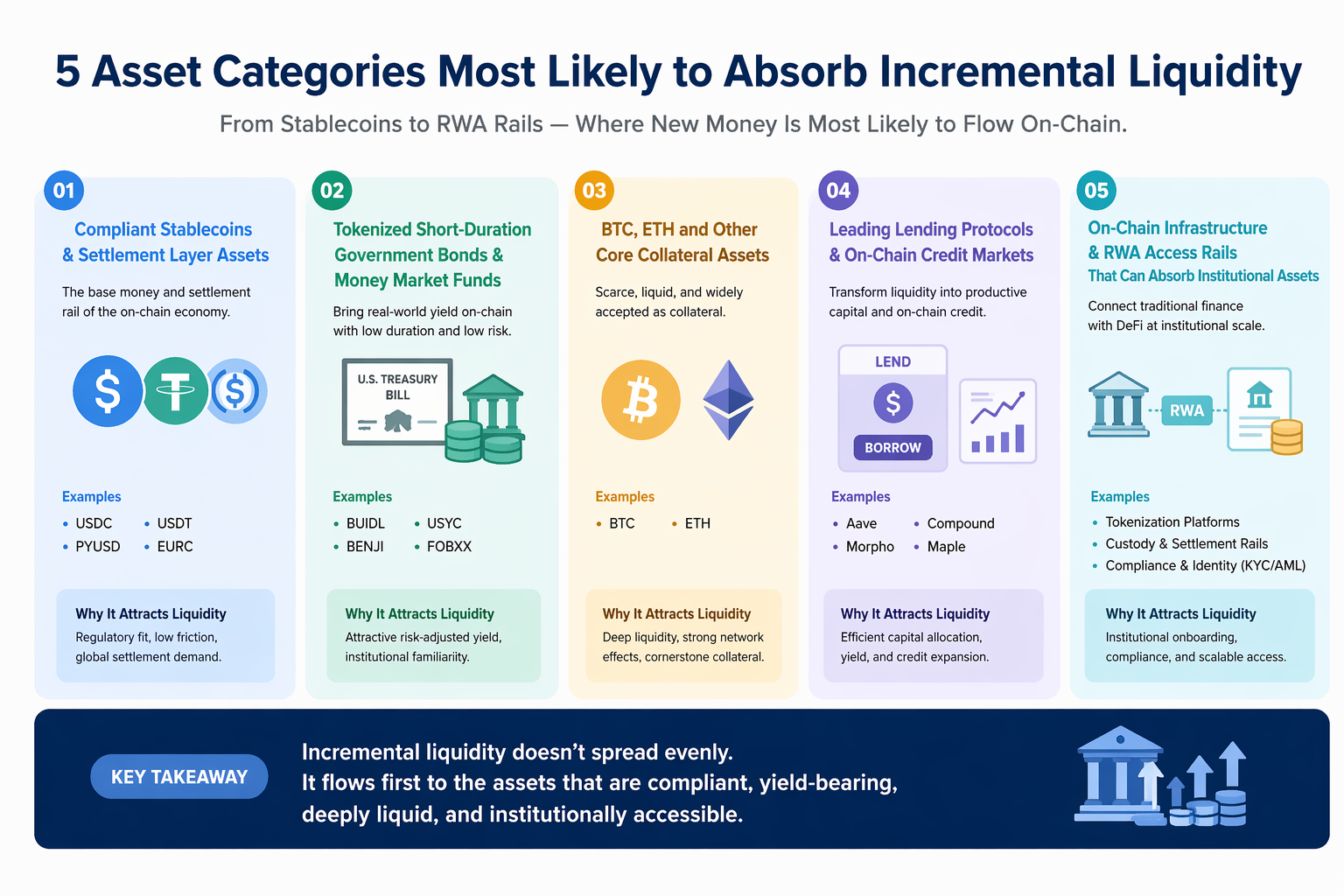
1. Compliant Stablecoins and Settlement Layer Assets
The biggest initial winners from regulatory progress are stablecoins and their settlement networks. Stablecoins serve as the “cash layer” for on-chain capital—every risk asset trade passes through them.
Going forward, stablecoin ecosystems are likely to concentrate around these features:
- Frequent, transparent reserve disclosures
- Stable fiat on/off-ramps
- Broad support from exchanges and on-chain protocols
- Verifiable cross-chain and settlement efficiency
Conclusion: The clearer the stablecoin regulatory framework, the more concentrated the “cash layer” becomes, boosting capital efficiency and reinforcing leading players.
2. Tokenized Short-Term Treasuries and Money Market Assets
As regulations boost stablecoin credibility, the next question becomes: “Can idle stablecoins earn low-risk returns?”
On-chain “yield-bearing cash equivalents” will attract significant conservative capital.
Key selling points for these assets:
- Returns closely linked to traditional interest rate systems;
- Volatility much lower than high-beta crypto assets;
- Serve as defensive core holdings within portfolios.
Practically, these assets form a two-tier structure with stablecoins:
Trading capital stays in stablecoins, while allocation capital flows to yield-bearing cash.
3. Core Collateral Assets: BTC, ETH, and Select Staked Tokens
Regulation doesn’t just favor the “cash layer”—it also elevates core collateral assets. When institutions enter on-chain credit markets, they first accept collateral that is liquid, reliably valued, and risk-managed.
Future incremental capital in risk assets is likely to concentrate in:
- BTC: Distinct macro attributes and liquidity advantages
- ETH: Central to on-chain finance and infrastructure
- High-quality staked derivatives: Provided they’re transparent, auditable, and have robust liquidation mechanisms
This marks a shift from “token narrative competition” to “collateral quality competition.”
4. Leading Lending Protocols and On-Chain Credit Markets
With compliant stablecoins and core collateral in place, lending protocols become the primary beneficiaries.
However, liquidity will concentrate in a select few protocols that meet these criteria:
- Public, dynamically managed collateral parameters
- Liquidation systems proven in extreme volatility
- Multiple redundancies in oracles and risk modules
- Institutional access and compliance-ready interfaces
The race in credit markets will be less about the highest APY and more about who can ensure capital exits even under stress.
5. On-Chain Infrastructure and RWA Channels for Institutional Assets
Beyond individual assets, capital will flow toward “asset issuance and trading infrastructure”:
- Compliant custody and coordination layers
- Institutional-grade risk control and settlement middleware
- RWA issuance, valuation, and distribution networks
Essentially, regulation shifts DeFi’s competitive landscape from a protocol race to an infrastructure race.
Which Assets Get Sidelined: High Volatility No Longer Equals High Premium
Liquidity redistribution also means some assets will be systematically discounted.
At greatest risk in this new era:
- Long-tail assets driven purely by sentiment, lacking cash flow
- Small-cap tokens with thin liquidity and shallow order books
- Protocol tokens with opaque governance and disclosures
- Hot sectors reliant on high leverage for short-term gains
The old “pump first, explain later” playbook will struggle as regulation tightens and institutions enter.
Markets will increasingly reward verifiable assets and penalize the unverifiable.
Three Liquidity Scenarios
Balanced Expansion (Base Case)
Features: Regulation advances steadily; stablecoins and yield-bearing cash expand together; BTC/ETH steadily absorb new capital.
Result: Lower volatility, greater structural differentiation, and continued dominance of leading assets.
Risk-On Rotation (Aggressive Case)
Features: Core asset rallies drive return expectations; capital moves from the cash layer into high-beta assets.
Result: Short-term “alt-season” rallies, but sustainability depends on new stablecoin inflows and market depth.
Regulatory Shock or Liquidity Contraction (Defensive Case)
Features: Policy uncertainty or weaker macro liquidity drives capital back to stablecoins and tokenized treasuries.
Result: High-volatility assets come under pressure, credit spreads widen, defensive assets outperform.
Practical Framework: Six Key Metrics to Track Capital Flows
To determine where liquidity is moving, track these six indicators weekly:
- Total stablecoin market cap and net growth: Is the cash layer expanding?
- Exchange stablecoin reserves: Is capital entering for trading or staying OTC?
- Tokenized treasury/money market fund size: Is defensive capital increasing?
- BTC.D and ETH/BTC strength: How is risk capital rotating among core assets?
- TVL and lending utilization in top protocols: Is credit demand really growing?
- Funding rate + OI + spot net flow: Are rallies spot-driven or leverage-driven?
A practical rule of thumb:
- Cash layer expansion + credit layer growth + core asset strength = healthy uptrend
- No cash growth + leverage spikes first = fragile rebound
- Cash layer rotation into defensive assets = risk appetite cooling
Conclusion: Regulation Isn’t the Enemy of Liquidity—It’s a Filter
Stablecoin regulation won’t make on-chain liquidity “disappear”—it will upgrade it. Liquidity will shift from indiscriminate flows to targeted, threshold-based concentrations; from speculative chasing to verifiable allocation.
In the future, the assets most likely to capture incremental capital won’t be the loudest—they’ll be those that:
- Have clear compliance pathways;
- Offer transparent sources of return;
- Maintain deep, robust liquidity.







