In privacy-focused blockchain architectures, a single token typically cannot effectively serve both value transfer and ecosystem governance roles. As a result, BEAM separates its PoW token from its DAO governance token, establishing distinct layers for payments, incentives, and decision-making. This structure is commonly adopted by networks that need to balance robust security with flexible governance.
This challenge generally spans three dimensions: issuance mechanisms, incentive distribution, and governance structure. These components together define how value is created and distributed within the BEAM network.
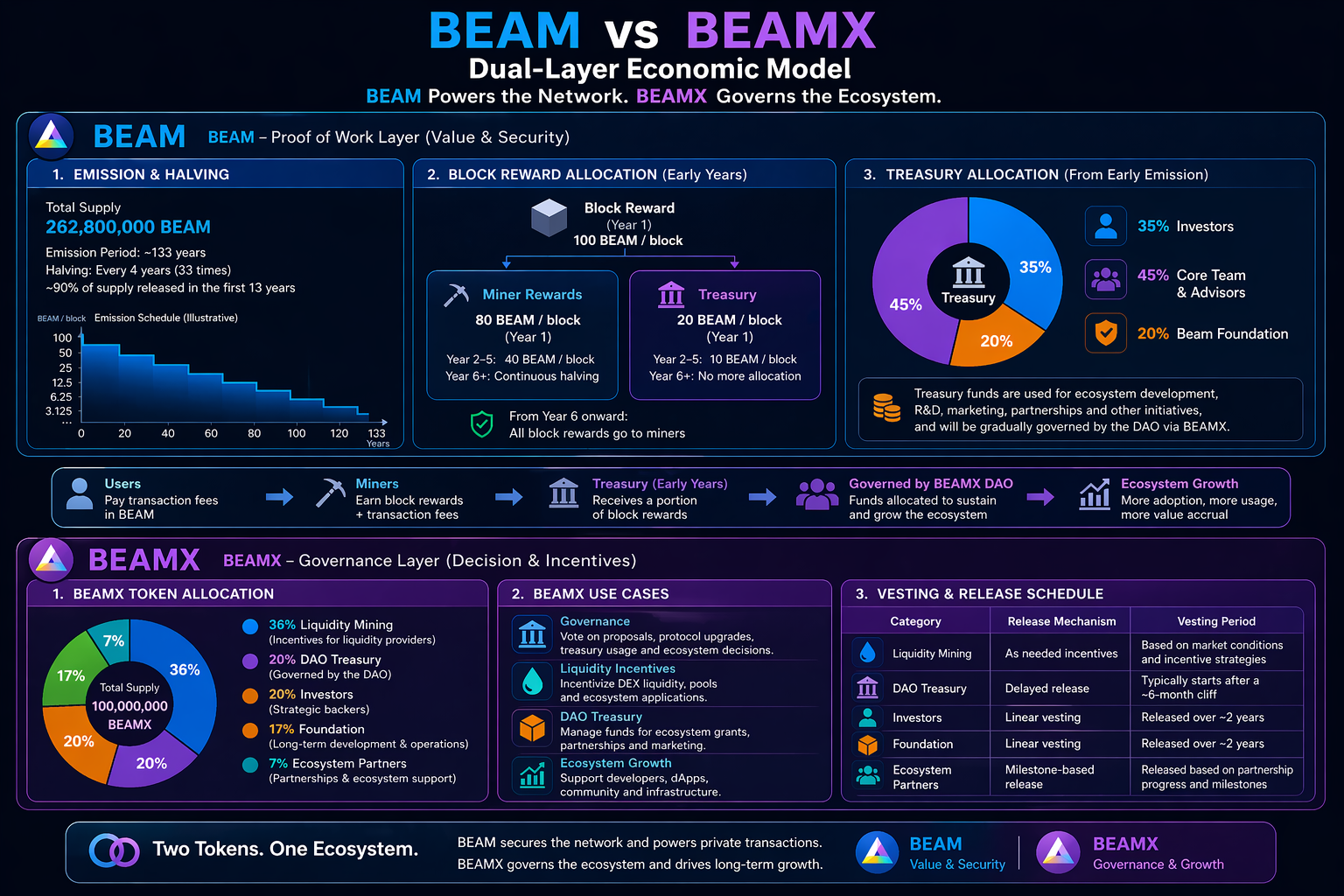
What Functions Does the BEAM Token Serve in the Economic System
BEAM, as the native token of the main chain, is fundamentally designed to support both payments and security incentives.
Mechanically, every transaction consumes BEAM as a transaction fee. Combined with block rewards, these fees constitute the primary source of miner revenue, incentivizing computational power to secure and maintain the network. Transaction fees not only compensate for computational resources but also help manage network load.
Structurally, BEAM operates across both user and network layers. Users utilize BEAM for private payments, nodes receive BEAM as rewards, and the network leverages BEAM to maintain security. This single-value asset connects multiple layers, creating a closed economic loop.
This design is significant because it links private transactions directly to network security, ensuring the operation of the network is driven by real usage rather than external input.
How Do BEAM’s Issuance Mechanism and Halving Policy Impact Supply
Understanding the supply structure is key to grasping the economic model.
BEAM is issued continuously via block rewards, with scheduled halvings that gradually reduce new supply. Issuance is accelerated in the early phases to incentivize miners, while later stages create token scarcity by reducing new issuance.
From a structural standpoint, BEAM’s total supply is capped at approximately 262.8 million tokens, with an issuance period of about 133 years. The majority of tokens are released in the early years, following a “front-loaded” distribution path that enables the network to rapidly establish its security foundation.
| Dimension |
BEAM Design |
| Total Supply |
262,800,000 BEAM |
| Issuance Period |
~133 years |
| Halving Interval |
Every 4 years |
| Release Pace |
Front-loaded distribution |
This mechanism is designed to adjust the supply-demand balance over time, providing varying incentive strengths throughout the network’s lifecycle.
How Are Miner Incentives and Block Rewards Distributed in BEAM
The way incentives are distributed directly affects network participation.
Miners earn rewards for producing blocks, with these rewards comprising both newly minted BEAM and transaction fees. In the network’s early stages, a portion of block rewards is also allocated to the Treasury to help grow the ecosystem.
The proportion of block rewards allocated to miners and the Treasury shifts over time. As the network matures, Treasury allocations are gradually reduced and miner rewards increase, eventually making the network fully reliant on miners and transaction fees.
| Phase |
Miner Reward |
Treasury |
| Year 1 |
80 BEAM |
20 BEAM |
| Years 2–5 |
40 BEAM |
10 BEAM |
| Later Phases |
Continual halving |
Gradual phase-out |
This structure demonstrates that BEAM supports early ecosystem development through additional allocations, then transitions to a model focused solely on security incentives.
How Are Treasury Funds Allocated and Utilized Within the Ecosystem
The Treasury bridges issuance and governance.
A portion of block rewards is directed to the Treasury to support development, marketing, and ecosystem partnerships. Control of these funds is not fully centralized and transitions progressively toward decentralized governance.
Initially, the project team and related stakeholders allocate Treasury funds. Over time, governance mechanisms enable more distributed decision-making.
| Recipient |
Share |
| Investors |
35% |
| Core Team & Advisors |
45% |
| Foundation |
20% |
This approach ensures resource support in the network’s early stages while setting the stage for a transition to decentralized governance.
How Does BEAMX Operate Within the Governance System
Governance is implemented through BEAMX.
BEAMX is a governance token used for proposal voting, fund allocation, and steering the ecosystem’s direction. Unlike the main chain token, BEAMX does not participate in payments or mining, focusing solely on the decision-making layer.
BEAMX shifts network control from a single entity to token holders, promoting decentralized resource allocation. The DAO framework empowers diverse participants to shape the ecosystem’s evolution.
This design expands the economic system from “value creation” to “value allocation,” establishing a comprehensive closed loop.
How Are BEAMX’s Distribution and Vesting Mechanisms Structured
BEAMX distribution directly shapes governance power.
With a total supply of 100 million tokens, BEAMX is allocated to various participant categories. Tokens are vested in phases to mitigate volatility from concentrated releases.
Liquidity mining commands the largest share to stimulate ecosystem activity, while allocations to the DAO Treasury and investors support long-term growth and funding.
| Category |
Share |
| Liquidity Mining |
36% |
| DAO Treasury |
20% |
| Investors |
20% |
| Foundation |
17% |
| Ecosystem Partners |
7% |
This structure balances governance and incentive mechanisms, fostering both short-term engagement and long-term stability.
How Does the Dual-Layer Economic Model Achieve Synergy
BEAM and BEAMX form a multi-layered architecture that separates value generation from governance authority.
BEAM generates value and sustains network operations, while BEAMX determines how that value is allocated. Transactions incur fees, miners receive rewards, a portion of funds is directed to the Treasury, and governance mechanisms then redistribute these resources.
This model separates payments from governance, allowing economic activity and decision-making to occur independently, yet remain interconnected.
Such a framework ensures the network maintains operational stability while supporting dynamic adjustment capabilities.
Where Are the Limitations of the BEAM Economic Model
All economic systems have constraints.
While the dual-token structure enhances flexibility, it also raises the barrier for user understanding and participation, as users must grasp both payment and governance logic.
The model relies heavily on ecosystem activity; if transaction demand is low, the balance between fees and incentives may be disrupted. Additionally, privacy features reduce on-chain transparency, complicating external analysis and regulatory compliance.
These limitations indicate that BEAM’s design is best suited for environments demanding high privacy and structural efficiency, rather than universal blockchain applications.
Summary
By separating core chain and governance tokens, BEAM modularizes value creation, network security, and resource allocation, enabling privacy blockchains to maintain robust security while achieving flexible governance.
FAQ
What is the relationship between BEAM and BEAMX?
BEAM is for payments and incentives; BEAMX is for governance and fund allocation. Together, they form a dual-layer economic system.
What are the characteristics of BEAM’s issuance mechanism?
It features long-term issuance with periodic halvings, gradually reducing supply and fostering scarcity.
Why is BEAMX a standalone token?
It enables governance functions so network decisions are not tied to the main chain token.
What role does the Treasury play in the economic model?
The Treasury supports BEAM ecosystem growth and allocates funds through governance processes.
Is the BEAM economic model complex?
Compared to single-token systems, BEAM is more complex—but this enables a clear separation between payments and governance.







