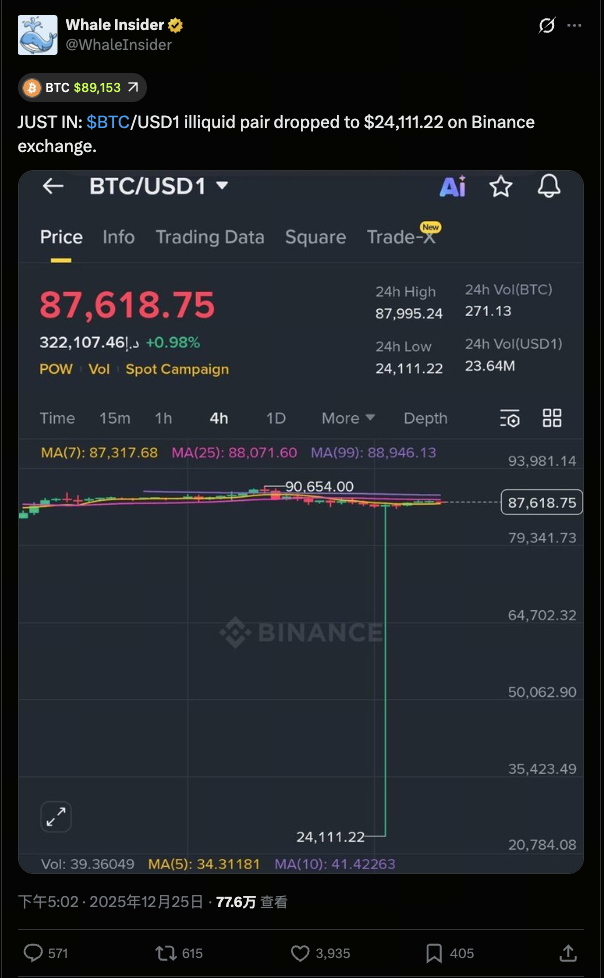
Image source: https://x.com/WhaleInsider/status/2004115622297301461
Recently, Bitcoin (BTC) saw extreme price swings on the Binance BTC/USD1 trading pair—plunging briefly to $24,111 before rebounding rapidly to nearly $87,000. This dramatic movement sparked widespread market attention and discussion, with many investors mistakenly assuming a total market crash for Bitcoin. In reality, the anomaly stemmed from the specific trading pair’s market structure and liquidity, not a collapse in Bitcoin’s overall market value.
Overview: Why Did Bitcoin Drop to $24,111?
On December 25, 2025, Binance data showed BTC on the BTC/USD1 pair briefly traded at around $24,111 before surging back to approximately $87,000 within seconds. While this “price spike” appeared severe, similar moves did not occur on other major BTC pairs such as BTC/USDT or BTC/USDC. As such, it does not signal a genuine collapse in Bitcoin’s overall market price.
What Is the Binance USD1 Trading Pair and What Are Stablecoin Characteristics?
BTC/USD1 is a Binance trading pair based on the USD1 stablecoin. USD1 is a relatively new stablecoin backed by World Liberty Financial. Compared to established stablecoins like USDT or USDC, USD1 has lower market depth and less trading activity. Its smaller market size means its peg mechanism and order book depth are far weaker than those of mainstream stablecoins, making the pair more prone to extreme price volatility.
Risk Factors: “Flash Crash” Dynamics from Thin Liquidity
This price anomaly is widely attributed to a “flash crash” caused by thin liquidity. In pairs with sparse liquidity, large orders can quickly consume all available counterparties, causing prices to move sharply and suddenly. With a thin BTC/USD1 order book, a single large sell order can rapidly drive prices lower, followed by swift arbitrage trades and new buy orders that push prices back up.
Extreme volatility like this is more likely during periods of low liquidity, such as holidays or quiet trading hours. Trading bots and cross-exchange arbitrage mechanisms also act quickly to close price gaps, typically making the rebound faster than the drop.
Market Response: Comparing Major Trading Pairs and Price Trends
Notably, while the BTC/USD1 pair experienced a flash crash, prices for Bitcoin on major pairs like BTC/USDT and BTC/USDC remained nearly stable, fluctuating around $87,000. This demonstrates that the broader crypto asset market did not suffer a true systemic crash; instead, the phenomenon was localized.
When tracking prices, investors should pay close attention to the source of trading pair data. In analyzing price trends and making trading decisions, avoid drawing conclusions based solely on a single trading pair’s quote.
Expert Perspective: Is This a Market Warning?
Most industry professionals see this event as a reminder of market microstructure and trading mechanisms, not a macro-level crash signal. Analysts point out that “flash crashes” like this are classic signs of liquidity mismatches and shallow order books, especially during periods of low trading volume such as holidays.
Similar incidents may recur on trading pairs with low liquidity, particularly when stablecoin projects are still being promoted and market participation remains limited.
How Should Investors Understand and Respond to Such Price Swings?
For most crypto asset investors, the key is to:
- Understand liquidity differences between trading pairs;
- Reference mainstream price indices when analyzing price trends;
- Watch for structural risks behind extreme volatility;
- Avoid placing large orders on pairs with thin liquidity.
These strategies help reduce slippage and risk exposure caused by shallow order books.
Conclusion: Structural Insights Behind Bitcoin’s Market Volatility
In summary, the flash crash to $24,111 on Binance’s BTC/USD1 pair was not a collapse of the Bitcoin market as a whole, but a brief price spike caused by localized structural mismatches. Investors should take this event as a lesson in the importance of trading depth and market microstructure, and avoid making emotional or erroneous trading decisions based on misinterpreted price data.







