Bitcoin in 2026 Shows a 2022 “Bear Market Rally” Pattern: Up 21% but Fails to Break Key Resistance

Last Updated 2026-03-25 18:11:13
Reading Time: 1m
Although Bitcoin (BTC) has climbed 21% since November 2025, market research indicates this trend is more akin to the "bear market rally" pattern observed in 2022. This article analyzes critical technical indicators and potential future price risks.

Current Bitcoin Market Review
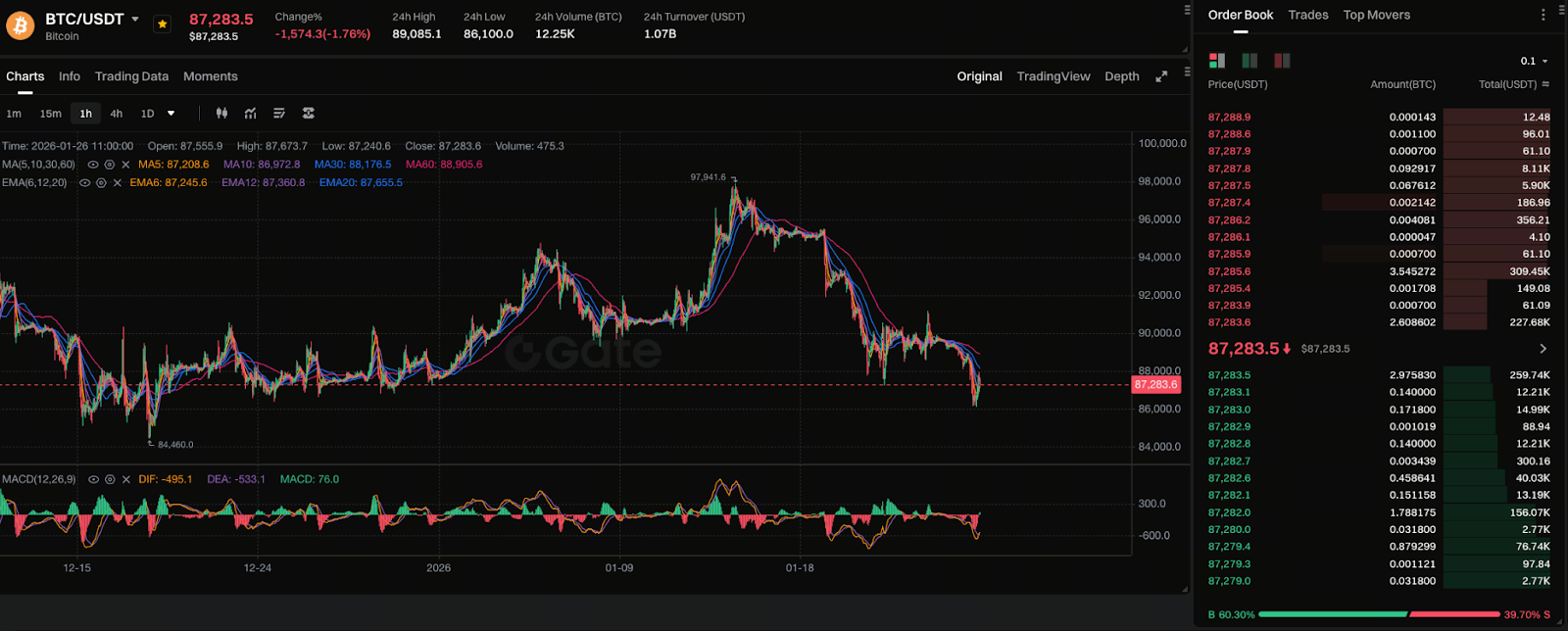

Chart: https://www.gate.com/trade/BTC_USDT

At the start of 2026, Bitcoin rebounded from its November 2025 low of around $80,500 to nearly $97,900, marking a gain of roughly 21%. While many investors see this as a sign of recovery, a closer look indicates this rally may be repeating historical patterns.

This upward move is notable, but the price still hasn’t reclaimed the long-term 365-day moving average (MA), with resistance currently near $101,000. Bitcoin has failed to hold above this level, showing bulls have yet to fully take control.

2022 vs. 2026 Trend Comparison

On-chain analytics platform CryptoQuant highlights that this Bitcoin movement closely mirrors the rebound seen during the 2022 bear market: back then, the price dropped below the 365-day MA, bottomed out, and rebounded, but selling pressure near the long-term trend line prevented a sustained bull run.

In 2022, BTC bounced nearly 47% from the bear market low, but ultimately fell after hitting resistance at the annual moving average. Now, the recent 19–21% rally faces similar resistance. If Bitcoin faces another rejection, the bear market may continue rather than end.

Why Technical Indicators Matter

The 365-day moving average (MA) serves as a critical threshold in long-term technical analysis, marking the direction of the market trend. If the price can reclaim and hold above this MA, it’s usually seen as a strong signal of a trend reversal. If the price remains below, the market is typically still in a downward channel.

Currently, Bitcoin’s rally has failed to break through this key technical level. Short-term performance remains fragile, with resistance overhead and the market in an uncertain phase. If the price drops below recent lows, it could trigger further selling pressure.

Exchange Inflows and Market Sentiment Analysis

Another important indicator is the amount of BTC flowing into exchanges. Recent data shows Bitcoin inflows to exchanges are rising, which often signals that investors are preparing to sell rather than hold. Increased inflows may point to higher selling pressure, not new capital entering the market.

Even though price indexes have climbed, investor sentiment remains cautious. Historically, bear markets have seen short-lived rebounds, and excessive optimism can leave investors vulnerable to being misled by these technical rebounds.

Investor Risks and Potential Future Trends

Overall, despite Bitcoin’s recent strong rebound, it’s not enough to confirm a long-term trend reversal. If BTC fails to break out and hold above the $101,000 level, a pullback or continued bear market may follow. Conversely, a clear breakout above this resistance could fuel higher price expectations.

For investors, it’s critical to determine whether this rally truly signals a bull market foundation. Technical indicators, trading volume, and capital flows are all key references for assessing future trends.

Conclusion:

Despite BTC’s more than 21% gain, market analysis indicates this is more likely a technical rebound within a bear market than confirmation of a bull market. The price has yet to break through key trend lines and long-term moving average resistance, so risks persist. Tracking these technical and capital flow indicators can help clarify future market direction.

Author: Max
Disclaimer
* The information is not intended to be and does not constitute financial advice or any other recommendation of any sort offered or endorsed by Gate.
* This article may not be reproduced, transmitted or copied without referencing Gate. Contravention is an infringement of Copyright Act and may be subject to legal action.

Related Articles

What is Fartcoin? All You Need to Know About FARTCOIN
Intermediate

What is Fartcoin? All You Need to Know About FARTCOIN

Fartcoin (FARTCOIN) is a representative meme coin within the Solana ecosystem based on an AI-driven narrative. Its core concept originated from an experiment aimed at exploring the "boundaries between AI Agents and humor." More than just a digital asset with social attributes, the project deeply couples absurd humor culture with on-chain financial logic by integrating autonomous AI interaction models.
2026-04-04 22:01:19
Gold Price Forecast for the Next Five Years: 2026–2030 Trend Outlook and Investment Implications, Could It Reach $6,000?
Beginner

Gold Price Forecast for the Next Five Years: 2026–2030 Trend Outlook and Investment Implications, Could It Reach $6,000?

Analyze current gold price trends alongside authoritative five-year forecasts, integrating an evaluation of market risks and opportunities. This gives investors insight into the potential trajectory of gold prices and the main drivers expected to shape the market over the next five years.
2026-03-25 18:13:30
Aster vs Hyperliquid: Which Perp DEX Will Prevail?
Beginner

Aster vs Hyperliquid: Which Perp DEX Will Prevail?

Aster and Hyperliquid are the two representative protocols of the "purpose-built L1 path" within the current decentralized perpetual exchange (Perp DEX) sector. As a pioneer in the field, Hyperliquid has built a deep liquidity moat through its highly mature order book architecture and strong community consensus. Conversely, Aster, as a rising challenger, seeks to leapfrog the competition in high-performance trading through more aggressive multi-chain aggregation logic, private transaction modules, and an underlying execution environment optimized for 2026 market demands.
2026-03-24 11:58:33
AI-Native Settlement Layers: How United Stables Is Building the Next Financial Rail
Beginner

AI-Native Settlement Layers: How United Stables Is Building the Next Financial Rail

Stablecoins were originally designed as dollar substitutes within exchanges, primarily used for asset pricing and trade settlement. As on-chain financial ecosystems have matured, their role has expanded beyond simple payments to include collateral assets, cross-chain liquidity mediums, and unified settlement units. In particular, as AI systems and automated agents begin to participate directly in economic activity, demand has risen sharply for programmable value units capable of instant settlement. This shift is pushing stablecoins toward the role of foundational financial infrastructure.
2026-03-25 03:16:17
Aerodrome Tokenomics: How ve(3,3) Powers Base's Most Profitable DEX
Beginner

Aerodrome Tokenomics: How ve(3,3) Powers Base's Most Profitable DEX

AERO is the native token of Aerodrome Finance, a core decentralized exchange and liquidity protocol in the Base ecosystem. It is primarily used for liquidity incentives and ecosystem operations. veAERO is a governance NFT that users receive by locking AERO, representing both voting power and the right to share protocol revenue. Through a dual track structure of AERO as a utility token and veAERO as a governance credential, Aerodrome separates liquidity usage value from long term governance power, allowing participants to act as liquidity providers, governance decision makers, and revenue sharers within the same system.
2026-03-25 06:40:31
Hybrid Collateral Stablecoins: Inside United Stables' Stability and Yield Architecture
Beginner

Hybrid Collateral Stablecoins: Inside United Stables' Stability and Yield Architecture

In the early stages of the crypto market, traditional stablecoins mainly relied on single-reserve or single-collateral models. Their primary focus was price stability and payment convenience, which allowed them to become foundational tools for on-chain trading and capital flows. As the market has entered a more mature financial phase, however, this structure has begun to reveal limitations, including high concentration risk and the difficulty of balancing liquidity with yield. These constraints have driven the evolution toward multi-layer collateral and portfolio-based designs, such as the dual-layer hybrid collateral architecture proposed by United Stables, which seeks to redefine the underlying logic of stable assets.
2026-03-25 03:17:39





