Image: https://www.gate.com/trade/BTC_USDT
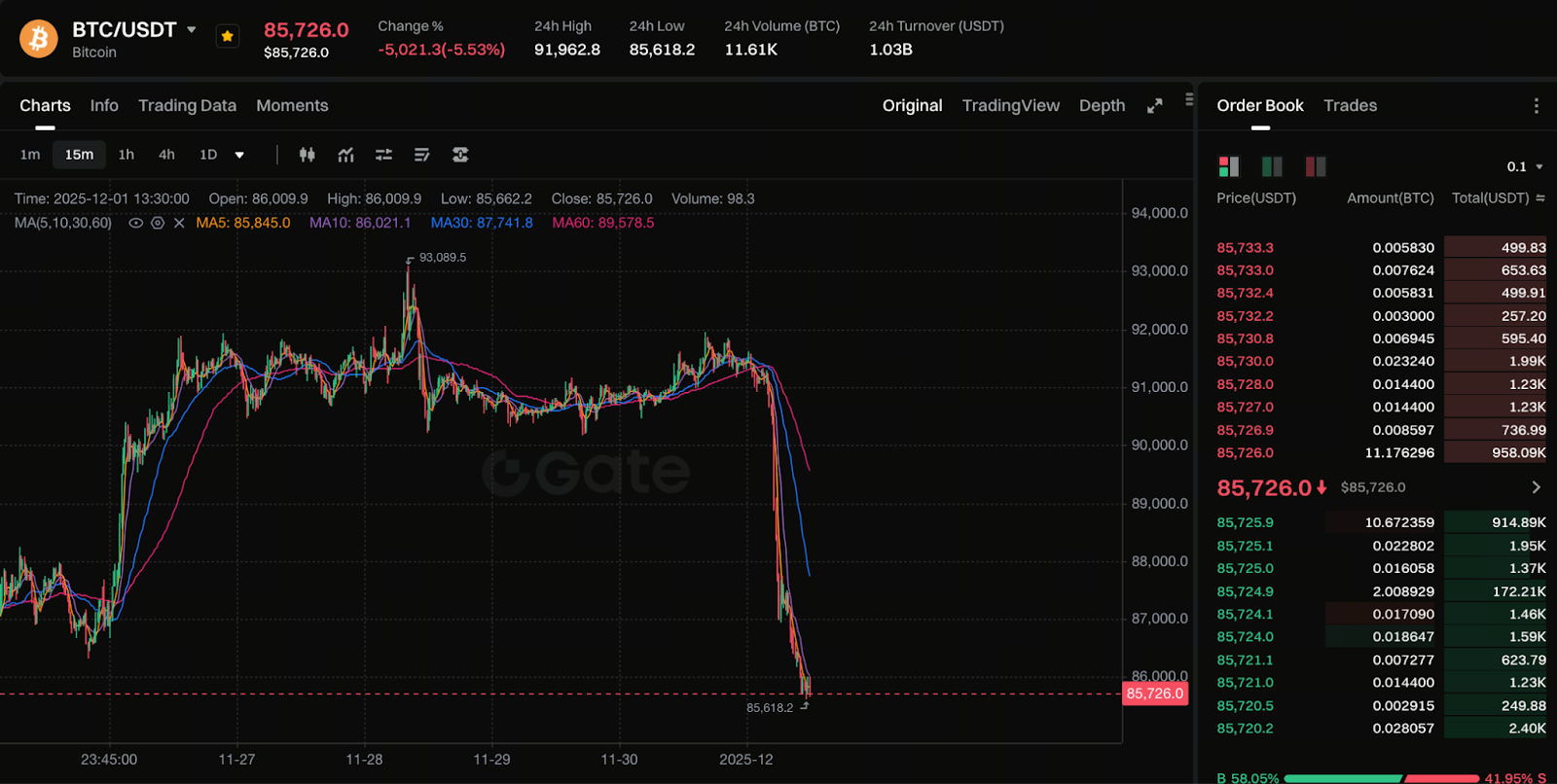
As of December 1, 2025, after a sharp pullback from its annual high, BTC briefly dipped below $90,000, triggering market concerns. However, as market conditions shifted, BTC rebounded above $90,000, sparking renewed debate about its upside potential. As the benchmark for the digital asset market, Bitcoin’s price swings reflect not only technical factors but also macroeconomic trends, capital flows, and overall market sentiment.
BTC Current Price and Market Context
Throughout 2025, BTC saw several periods of pronounced volatility. The decline from its early-year peak was driven in part by increased global economic uncertainty and a rise in risk aversion among investors. As the year drew to a close, growing expectations of a Federal Reserve rate cut began to restore risk appetite, enabling BTC to recover above $90,000. At the same time, overall liquidity and trading volume improved, establishing new short-term support levels for BTC.
Key Drivers of the Rebound
Macroeconomic and Interest Rate Expectations
The market broadly anticipates a Federal Reserve rate cut in December, which would inject liquidity and lower financing costs—further fueling risk asset rallies. Bitcoin, as a high-risk, high-return asset, tends to outperform in an accommodative monetary policy environment.
Market Sentiment Recovery
The steep correction earlier in the year shook investor confidence, prompting some retail and institutional investors to sell in panic. As BTC stabilized near $90,000, sentiment improved, and buyers returned, providing price support.
Institutional and Capital Inflows
The renewed presence of institutional investors and capital inflows into Bitcoin-related investment products have given BTC steady upward momentum. This has deepened market liquidity and helped dampen volatility, making the rebound more sustainable.
Resistance and Market Risks
Despite the current rebound, BTC faces significant challenges.
Clear Price Resistance: The $92,000–$95,000 range is a key zone where many market participants are likely to set sell orders, creating strong selling pressure. Only a breakout above this resistance band could open the door to a move toward $100,000.
Limited Liquidity and Market Activity: While recent capital inflows have helped, overall market activity remains below previous peaks. Limited liquidity could cause price consolidation and choppy trading within key ranges, slowing upward momentum.
Macroeconomic and Regulatory Risks: Shifts in Federal Reserve policy, global economic uncertainty, and regulatory changes all pose downside risks for Bitcoin. For example, if rate cuts fall short of expectations, investors may reallocate away from risk assets, limiting BTC’s upside.
Potential Future Trends and Key Levels
If BTC holds above $90,000 and attracts sufficient buying interest in the $92,000–$95,000 range, a push toward $100,000 remains possible. Key levels for investors to watch include:
- Support Zone: $90,000
- Short-term Resistance: $92,000–$95,000
- Potential Upside Target: $100,000
If liquidity, capital flows, and macro policy align, BTC could reach its year-end target. Conversely, significant negative events or a slowdown in capital inflows could see BTC retrace to the $85,000–$88,000 range and consolidate there.
Conclusion
BTC’s recovery above $90,000 has reignited market optimism, but the outlook remains uncertain. Investors should closely monitor macro policy, capital flows, and market sentiment to gauge the likelihood of a move toward $100,000. Sound investment strategies and robust risk management will be essential for navigating future volatility.